What's the difference?
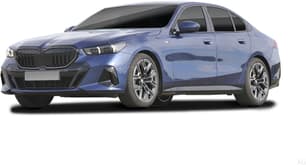
More than half a century of 5 Series pedigree has led BMW to this, the first electric version of its venerable sedan, the i5.
It's true that electric cars come with benefits that suit the realm of luxury (or at least executive) motoring like their effortless acceleration and near-silent operation, so this new G60 5 Series has the potential to be the best yet in its ‘i5’ form.
But there are rivals, well-liked ones at that, which BMW must contend with to snatch the spot at the top of the large premium sedan ladder technically held currently by the Porsche Taycan in terms of sales - though Mercedes’ E-Class would lead if its electric cousin EQE’s sales were combined.
So, with names like that to go up against, BMW better have brought its A-game.
If you want something large, fast and comfortable, no one does it better than the Germans, and the latest entrant to the market is Audi’s all-new S7 Sportback.
Using the uber-stylish second-generation A7 as a basis, the new S7 Sportback scores cutting-edge technology and premium appointments befitting a large luxury sedan, but it’s often what’s under the bonnet that will draw buyers in.
This new S7 replaces the old version’s 4.0-litre twin-turbo V8 for a 2.9-litre twin-turbo petrol V6 but, don’t fear, as having fewer cylinders has not dulled its performance or appeal.
As a whole though, does the new Audi S7 Sportback deliver a winning blow?
There’s no getting around the i5 being a rather expensive offering. More than $150,000 to get into an electric sedan that’s not much faster than a hot hatch is a big ask, but there’s plenty to enjoy about the 5 Series.
Things like its heated leather seats shouldn’t be the reason you’re willing to spend so much on a sedan when a $50,000 hybrid SUV will score you the same, instead it’s the fact the 5 Series is a delight to drive and hasn’t lost the feeling of prestige the badge has earned over the last half a century.
In terms of value - if speed isn’t your focus and you’re less of a gadget-type-operator when looking at cars like this - the 520i has the style and comfort you’d need and at $100K less than the M60.
And in terms of large electric sedans, the i5 eDrive40 is cheaper than a Porsche Taycan (by a little) or an Audi e-Tron (by a lot). The Genesis G80 Electrified is the closest cheaper rival, by about $10K, or the less powerful Mercedes EQE is similarly priced at $154,900.
Essentially, if you’re looking at a 5 Series, it might be worth considering if you really need it to be electric, but if so, there aren’t many alternatives in its category for the price.
Note: CarsGuide attended this event as a guest of the manufacturer, with meals provided.
Audi’s S7 Sportback wraps style, comfort and sportiness in an appealing package that is sure to please onlookers and occupants alike.
The great engine/transmission aside, the S7 Sportback also has cutting-edge technology at a more affordable pricetag, though less-than-comfortable rear-seat space lets it down a little.
We wish the car we sampled didn’t have the all-wheel steering, as we much preferred the more neutral feel of the S6 sedan we also drove but, overall, the S7 Sportback puts forward a strong case for its existence.
If you’ve watched other members of the BMW family go into a new generation within the last few years - the 3, 4 and 7 Series particularly, you won’t be too surprised by what you see here. Especially with the latter, having seen the petrol variants look roughly the same as the electric ones.
BMW specifically made the petrol 520i and the i5 variants look similar for egalitarian purposes - to not disenfranchise 520i buyers who are still spending a fair chunk of cash but might not be ready to go EV.
That means all three variants score a mix of new and old. The kidney grille remains and isn’t as large as on the M3 or 4 Series, while the bonnet line following it and the ‘character line’ down the car’s side also remain. And yes, the Hoffmeister kink where the C-pillar meets the passenger window’s lower corner is still there.
On that C-pillar though is a ‘5’ stamped into the bodywork, new to this generation, while the front grille as mentioned has a glowing light surround - the brand’s ‘Iconic Glow’ already seen on the 7 Series.
Overall, thanks to being slightly larger in every dimension, the new 5 is starting to look bigger than a 7 Series from a little while ago. And that’s because it is - its body is overall longer than an E65 7 Series from the mid-2000s.
It’s 5060mm long 1900mm wide, 1515mm tall (97mm longer, 32mm wider, and 36mm taller). Its wheelbase is 20mm longer too at 2995mm.
Audi’s second-generation A7 has always been a bit of a looker, but Audi has taken it up another notch in the S7 Sportback.
Differentiating the S7 Sportback is a more aggressive bodykit, complete with larger air intakes up front, blacked out exterior trim, quad-exhaust tips (denoting that it’s an Audi Sport model) and large 21-inch wheels
The S7 doesn’t go too overboard with the aggressive appointments however (that’s what the top-spec RS7 Sportback, due here later this year, is for), but balances its sportiness with a stately aesthetic.
We think the S7 Sportback is stunning, especially the white exterior colour that gives it an almost Stormtrooper-like look, but even our test car, finished in Daytona Grey, while much more subtle, is still easy on the eyes.
We especially like the strong shoulder line, chiselled doors and sloping roofline of the Sportback body style that combine in profile to make the S7 look like a sprinter on the starting blocks ready to pounce.
Inside, the S7 Sportback scores all of Audi’s latest interior technology, including a 12.3-inch Virtual Cockpit instrumentation and dual-screen centre console layout.
The triple screen set-up definitely helps the S7 Sportback feel very cutting-edge from the driver’s seat, especially when you start to play around with the multimedia system that sports haptic feedback when you press the screen.
Everything is laid out in a clear, concise and easy-to-use manner, while the surfaces of the dashboard are covered in soft-touch, premium materials.
If we’re being honest, we'd probably skip the red-leather interior of our test car in favour of something a little more subdued, but to each their own.
We like the integrated air-vents that blend well into the dash, while the sea of black is broken up with some aluminium detailing and different finishes.
A longer wheelbase means more space inside, where the 5 Series also still looks fairly familiar to those who have spent any significant time in a recent model BMW.
BMW has historically been pretty bang-on with ergonomics, and the new-gen 5 does a good job of sticking to that. Comfortable sports seats and quality feel for the materials on touch points mean the 5 Series feels nice to be in, and relatively restrained interior design for a somewhat luxurious car means it looks nice too.
It’s let down only by a couple of things - its multimedia screen and Operating System 8.5 is a little less simple to use now, and requires more touching the screen than previous iDrive systems, rendering the scroll wheel less useful.
The BMW Interaction Bar too is a little tricky to see controls on, as well as lacking physical feedback for using controls. Vent flow controls are digital sliders on the Bar, while vent direction is controlled by an unusual ‘joystick’ style control nearby.
The rear seat is plenty spacious, as you’d expect from a large sedan, with climate controls and ports for charging devices in the rear.
Measuring 4969mm long, 1908mm wide, 1417mm tall and with a 2928mm wheeblase, the S7 Sportback falls well and truly into the large car class.
Up front, the driver and passenger have plenty of room, while the seats and steering wheel are almost infinitely adjustable to find the perfect position.
As you can imagine though, the sloping roofline does eat into the rear-seat headroom a little.
The outboard seats offer plenty of leg- and shoulder-room, but the slanted roof prevents my six-foot-tall frame from sitting up straight comfortably.
Don’t get me wrong, the space is perfectly useable for children or even some smaller adults, but don’t expect to get any basketball players in those seats.
As for the middle seat, only children will find it comfortable due to the protruding transmission tunnel and higher-set seat.
The S7 Sportback’s boot offers at least 535 litres of space and expands to 1380L with the 40:20:40 split-fold rear seats stowed.
Being a liftback (or Sportback in Audi parlance) means the boot is much more practical than a standard sedan, and with such a large aperture, bigger items such as suitcases or golf clubs won’t be annoying to load and unload.
Bag hooks, storage tie-down points and carbo netting also feature to ensure your goods don’t roll around when the S7 Sportback is in motion.
Storage around the cabin though, could be a little better as the wireless smartphone charger takes up a fair chunk of room in the shallow central storage bin under the front armrest.
The usual storage tray found ahead of the shifter is also absent, due to the dual-screen centre console layout, but two generous cupholders and sizeable door pockets are still available up front.
Second-row passengers get access to a fold-down armrest with shallow storage tray and cupholders, as well as door pockets that can accommodate large bottles.
There are three members of the new 5 Series family from launch, with a base 520i starting things off from $114,900 before on-road costs.
It’s the only petrol-powered (with mild-hybrid, we’ll come back to this) variant in the trio, but it does have a fairly extensive list of features as standard. In terms of tech and comfort, most of what comes with the 520i is available further up the range too, with the major differences being drivetrain related.
In the 520i, the interior upholstery is synthetic ‘Veganza’ leather with Alcantara, though optional Merino leather is a $4000 BMW Individual option. The front seats are heated as standard, however, and electrically adjustable with memory settings and lumbar support.
A 12.3-inch instrument display paired with a 14.9-inch multimedia display are standard across the range, running BMW’s Operating System 8.5, while a head-up display, ambient lighting, wireless phone charging tray and BMW’s ‘new’ Interaction Bar are included too - a crystalline-style strip across the dash with touch-sensitive ‘buttons’ like the climate controls.
A panoramic glass roof - unable to be opened - is standard too, while the 520i’s sound system is a Harman Kardon set-up with 12 speakers.
Exterior features are quite similar to the more expensive i5 variants, with Adaptive LED headlights, automatic boot opening, an M design kit with front and rear aprons, side sills, and BMW’s Iconic Glow kidney grille surround.
Optional in the 520i is an ‘Enhancement Package’ which adds a choice of aerodynamic 21- or 20-inch wheels, metallic paint, and a 655-watt 17-speaker Bowers & Wilkins surround sound system for $5400. One test car on the launch we attended was painted in a BMW Individual colour - Tanzanite Blue - which upped the price to $7800.
Moving up the range to the mid-tier i5 eDrive40, which starts from $155,900, adds Merino leather interior, metallic paint, Bowers & Wilkins surround sound and aerodynamic 20-inch wheels standard, but it also includes adaptive suspension and some other EV-related features.
BMW’s ‘Adaptive Suspension Professional’ comes with Integral Active Steering (rear-wheel steering) and is a step up over the M Sport suspension from the 520i, while its aero wheels function as a way to keep the electric car’s range being affected by resistance.
The eDrive40 also comes with an acoustic protection system to make ‘electric car noises’ to warn pedestrians, as well as BMW’s ‘Iconic Sounds’ for the occupants - basically a system that uses orchestral sounds composed by Hans Zimmer that are affected by acceleration intensity, speed, and drive mode.
It also comes with the standard kit for an electric car, a Mode 2 and Mode 3 charger, cable, and a five-year Chargefox subscription.
The top-spec i5 M60 xDrive ups the cost to $215,900 and the features list again slightly (as well as being far more powerful).
Its suspension is even more advanced, adding the brand’s Adaptive M Suspension Professional with active anti-roll, plus 21-inch aero wheels as a no-cost option. The M60 also gains an M rear boot lip spoiler.
Inside, BMW’s ‘Crafted Clarity Glass’ controls in the centre console are standard, as is ventilation for the front seats and a four-zone automatic air conditioning system.
Priced at $159,900 before on-road costs, the new S7 Sportback is about $20,000 cheaper than before.
While the $20,000 saving is nice, we’d argue that maybe the $180,000 pricetag for an S7 was a bit high to begin with.
Aside from the new engine (more on that below), the S7 Sportback comes standard with a laundry list of equipment, including keyless entry, push-button start, 21-inch wheels (available in three designs), adaptive air suspension, privacy glass for the rear, electric tailgate with gesture control, soft-close doors, panoramic sunroof and Matrix LED headlights.
As expected of an Audi, the interior is kitted out with leather and soft-touch materials throughout, but it's equipment such as the illuminated seat belt buckles and loose wheel-nut detection that really elevate it above its peers.
The multimedia system is displayed on a 10.1-inch touchscreen and features satellite navigation with real-time traffic alerts, wireless Apple CarPlay support, Android Auto connectivity, Wi-Fi hot-spotting, wireless smartphone charging and digital radio, while the four-zone climate controls are nestled in the lower 8.6-inch screen.
While we prefer physical buttons to a purely touchscreen set-up, Audi’s implementation is fantastic thanks to the haptic feedback from the screens, which mimic a button press.
We also like that there is a dedicated volume-control knob, meaning you aren’t fumbling around with the touchscreen while driving to turn down the music.
The S7 Sportback also features Audi’s signature 12.3-inch Virtual Cockpit panel, which is still the best application of a digital instrumentation.
We’ve gone into detail about why we love it so much in the past, but a quick recap is that it's super-easy to use, can be customised to show whatever you want to see, and is clear in its layout.
Despite the long list of equipment, there are still a few items left on the options list.
Some, such as ceramic brakes and a Dynamic Package, are aimed to improve performance around the bends, so it’s nice that the extras aimed at a particular type of customer are not bundled into the asking price for everyone.
Likewise, there are also comfort- and style-orientated choices such as carbon interior, DVD player (in 2020?), heated rear seats and a premium sound system, but with the latter costing $11,700, the S7 Sportback’s price can quickly balloon.
Eight exterior colours are also available, each a no-cost choice.
Despite BMW calling it ‘electrified’, the base 520i is only a mild hybrid so most wouldn’t realise unless they were told.
Its turbocharged 2.0-litre four cylinder puts out a modest 153kW and 330Nm, with power and torque sent to the rear wheels via an eight-speed automatic transmission.
BMW claims it’ll knock over the 0-100km/h sprint in 7.5 seconds, a few seconds too slow to blow anyone’s socks off.
The mid-spec eDrive40 has a little more kick to it, its rear-mounted electric motor capable of 250kW/430Nm and able to cut that time to 6.0 seconds.
It’s fitted with an 84kWh battery to draw its power from, the same as the 442kW/820Nm M60 with its all-wheel drive dual-motor setup.
The M-tuned i5 can hit 100km/h in a claimed 3.8 seconds. Bye bye socks, perhaps.
Powering the new S7 Sportback is a 2.9-litre twin-turbocharged petrol V6, punching out 331kW/600Nm, which is paired to an eight-speed automatic transmission that sends drive to the road via Audi’s quattro all-wheel-drive system.
The result is a zero-to-100km/h acceleration time of 4.6 seconds.
Keen-eyed Audi fans might note that those are the exact same engine and outputs as the RS5 Sportback, RS5 Coupe and RS4 Avant, and they’d be right, however, Audi has added the 48-volt mild-hybrid and an electric powered compressor (EPC) to reduce turbo lag in the S7 Sportback.
It’s a similar system first employed in the SQ7 large SUV, and basically means that the EPC is spooling up the turbo at low engine speeds for better off-the-line performance.
The mild-hybrid technology no doubt helps shift the S7 Sportback’s 2040kg weight with peak power now available earlier on in the rev range (from 5700rpm), while maximum torque is available from 1900rpm.
Compared to the older car, the new S7 Sportback matches its predecessor in power, but ups torque by 50Nm despite losing the old car’s 4.0-litre twin-turbo V8 engine.
BMW claims the petrol 520i sips 6.7 litres per 100km from its 60-litre fuel tank, though we were unable to independently test any of the claimed figures on the launch day.
The base car has a theoretical range of 896km if it was possible to achieve the claimed fuel consumption figure for the duration of the whole tank - but it isn’t and realistically you could knock about 20-30 per cent off that, depending on how enthusiastically you drive.
In the i5 variants, the same 84kWh battery provides slightly different ranges due to the eDrive40 using 16.56kWh per 100km, and the M60 using 18kWh.
The eDrive40 has a claimed 550km maximum range, while the M60 has a 506km figure thanks to its extra motor and weight.
Official fuel economy figures for the S7 Sportback are 8.5 litres per 100km, but in our brief time with the car we managed 13.6L/100km, mainly due to the inner-city and country B-road driving.
The 48-volt mild-hybrid system works to reduce fuel usage, by as much as 0.4L/100km according to Audi, and allows the car to coast with the engine off between speeds of 55km/h and 160km/h for up to 40 seconds.
The start/stop system also aids in reducing fuel usage.
For some cars, the list of features is what really separates the variants, but that’s not the case for the 5 Series. As is a bit of a BMW tradition, the drivetrains dictate the different trim levels and prices, and there are three fairly distinct flavours of 5 Series.
Starting at ground level, the 520i might at first seem like a bit of boring vanilla. Except it’s actually quite smooth and light vanilla.
There’s not a lot to write about when it comes to its drivetrain, but the lightness of its engine and petrol tank combo when compared to EV batteries and motors is refreshing, and makes for a quite dynamic rear-drive sedan.
Its 153kW and 330Nm is delivered smoothly enough with the mild hybrid assistance doing a little in helping responsiveness, but without intervening in the gearshifts it doesn’t feel particularly keen.
It lacks the ride comfort of the i5’s adaptive suspension, but it’s able to be driven in a spirited manner that belies its size and even, to some extent its 1725kg kerb weight. Chocolate sprinkles on the vanilla, if you like.
It’s not fast, but it feels nimble compared to its electric siblings and can carry a fair bit more speed through corners, after which there’s room to notice its rear-drive characteristics.
It’s especially noticeable after getting out of the 2130kg eDrive40, though the extra power from its 250kW/430Nm motor makes for some more spirited acceleration and a little more excitement when exiting a corner, especially if you’re aiming to double-check if it really is rear-wheel drive. There’s a little more than choc-topped vanilla going on here.
The steering is, like in the 520i, direct and responsive, though in most cases is probably best set to ‘comfort’ rather than ‘sport’ in its settings.
The eDrive40 is rather comfortable and capable when barrelling through twisty backroads, and doesn’t feel out of hand for a five-metre-long sedan. It holds its weight well, and telegraphs when you might be approaching the limit quite sensibly.
When considering that, then, it’s impressive how brutally capable the 2305kg M60 is.
Here, we’re looking at a double-choc fudge with extra choc, and maybe some cookie dough in there for good measure. There’s a lot to like, but boy is it heavy.
It’s 580kg (or exactly half a Peugeot 208 GTi) heavier than the 520i, but it feels quick on its feet and its anti-roll seems to do a lot in terms of dynamics, the limiting factor really seems to be its tyres (which can and will squeal quite quickly to let you know when approaching said limit).
While you’ll need to take caution with how much speed you approach a corner with, you’re not going to lack acceleration on the other side, its all-wheel drive being less ‘fun’ but more efficient at getting you away from the bend than in the rear-drive eDrive40.
That adaptive suspension does also translate to a comfortable ride on relatively rough roads - only particularly bad bumps will reveal how much weight and pressure is being placed on each corner of the big sedan.
Audi’s formula for a go-fast vehicle has always been simple – quattro all-wheel-drive for grip, potent engine for speed – and the new S7 Sportback remains true to that formula.
We are big fans of the 2.9-lite twin-turbo V6 engine, which is matched wonderfully with a smooth-shifting eight-speed automatic transmission.
The S7 Sportback always seems to have plenty to give no matter where you are in the rev range, and the transmission isn’t bogged down with slow gear changes up or down.
Though it’s hard to tell how much the EPC helps in getting the S7 up to speed, if you have you window down and accelerate hard from a standstill, you can hear the electronics whirring away.
The standard air suspension also does a wonderful job at absorbing road imperfections in comfort, while it can be switched over to dynamic for a more sporting characteristic.
Grip is plentiful thanks to 255/35 tyres and the quattro all-wheel-drive system but, as with other Audis, the S7 Sportback tends towards understeer when pushed hard around a corner.
Being such a long and wide model, you definitely feel the S7 Sportback’s size on the road, especially when navigating through quick direction changes, but this is where the $7700 Dynamic Package comes into play.
It adds a sports differential, variable ratio steering and all-wheel steering, all aimed at sharpening the S7 up in the bends.
Our test car was fitted with the option pack, but it left us a little cold.
The all-wheel steering especially, made the S7 Sportback’s handling feel too artificial for our tastes, and we were never able to gauge where the rear end wanted to go in a corner.
If we were buying one, we’d leave the Dynamic Package option box unticked.
Bringing the S7 Sportback to a stop are big 400/350mm brake rotors front/rear, with six-piston callipers in the front.
Ceramic brakes with grey-painted callipers can be optioned for $18,000, but the standard stoppers do a fine job scrubbing speed in the S7 Sportback.
ANCAP hasn’t crash tested the new 5 Series. The last generation was a five-star car and it would be unusual to see that change with additional safety features - even with stricter testing.
The 5 Series comes with BMW Driving Assistant Professional as standard, with active cruise, lane assist and departure warning, front and rear cross traffic alert, collision prevention and intervention systems - in fact BMW says it has about 40 safety systems including an augmented reality dash display.
Its list of airbags includes front and side airbags for driver and passenger including one between the two occupants, as well as curtain airbags front and rear.
Audi’s S7 Sportback was awarded a maximum five-star safety rating by ANCAP based on crash-testing done by Euro NCAP in 2018.
The S7 scored 93 and 85 per cent in the adult- and child-occupant protection tests, while the vulnerable road user and safety assist categories yielded an 81 and 78 per cent score respectively.
Standard safety equipment includes tyre pressure monitoring, autonomous emergency braking, driver attention alert, adaptive cruise control, lane-keep assist, blind-spot monitoring, surround-view monitor, front and rear parking sensors, rear cross-traffic alert and a head-up display.
The AEB system is operational from 10-85km/h according to ANCAP’s documentation, and comes with pedestrian and cyclist detection.
Noticeably absent from the safety list is traffic-sign recognition, though the satellite navigation will give the speed-limit readout based on GPS data.
The S7 Sportback is also fitted with an exit warning system to warn passengers of any incoming cyclists or cars to prevent opening a door into strife.
BMW has a fairly industry-standard five-year/unlimited kilometre warranty on its new cars, while its electric car batteries are covered by an eight year/160,000km warranty.
For servicing, BMW offers numerous discounted packs and deals based on your preferences and desire to pay upfront.
For the 5 Series, a five-year/80,000km basic service package is $2400, though the i5 will have different needs and lower servicing costs not yet listed by the brand.
Like all new Audi models, the S7 Sportback comes with a three-year/unlimited kilometre warranty with three years roadside assist.
Audi’s warranty still lags behind Mercedes-Benz and Genesis, two premium marques that offer a five-year/unlimited kilometre warranty on their models.
Scheduled service intervals are every 15,000km/12 months, whichever comes first.
A three- or five-year service plan is available for the S7 Sportback, priced at $2350 and $4110 respectively.