What's the difference?
Back in the day, the 3 Series sedan was often the entry to the brand for first time BMW owners, and for good reason. They offered practical interior space without compromising on engine performance.
And they simply looked good, no boring nanny design elements. Then the 1 Series came along and price points bumped up, so how does the ‘entry’ BMW 320i M Sport live up to its long-standing reputation?
With an updated dashboard that brings the interior and tech up to market and a sharper exterior design, it more than holds its own at the table of luxury sedans, despite hard competition from the likes of the Audi A4, Mercedes-Benz C200 and Jaguar XE.
However, if the Merc is a placid and well-behaved mare… the BMW is the barely-broken-in bronco and it takes a certain kind of ‘rider’ to enjoy what the 320i has to offer.
I’ve been discovering just that this week with my family of three. What did we find out? Read below!
Balancing luxury car comfort, hot hatch agility and supercar speed is no easy task, yet that is what made the six previous generations of BMW's M5 so iconic.
In seventh-generation ‘G90’ guise, the M5 has another skeleton in the cupboard: the toughest emissions regulations that Europe, and now Australia, have ever seen.
A twin-turbo V8 was untenable and going battery electric was not an option. Plug-in hybrid was the only answer. For the new M5, BMW combined a revised 4.4-litre ‘S68’ bent eight with a punchy electric motor for 535kW and 1000Nm.
Problem is, the G90 is widely acknowledged as one of the greatest BMW M cars of all time, especially in CS trim. And thanks to a circa-600kg weight hike to nearly 2500kg, the new M5's 0-100km/h claim is actually slower than the old 'F90' M5.
Doesn’t exactly sound like a big leap forward, does it?
A drive through the Central West of NSW and around the iconic Mount Panorama racing circuit gave us answers to two questions. Does the M5 work on Australia roads, and does BMW M's latest super-sedan represent progress?
I thoroughly enjoyed my time in the BMW 320i M Sport. It’s fun to drive and I felt connected to what the car was doing on the road. The harder ride may not appeal to some but I didn’t mind it. The cosy back seat and boot mean it will probably suit a smaller family best and one which doesn’t have to worry about carrying a lot of gear around regularly, but it suited my needs just fine.
I reckon this is a car for those drivers who don’t want to compromise on performance but still have a kid or two. If you’re after the cushioned comfort of a Merc, this won’t appeal but I didn't want to give this one back and happily give it a firm 8/10.
My son liked the sports car looks and enjoyed the amenities in his row. He gives it a 10/10.
Let’s get one thing out of the way: the new M5 is a very good car. Considering the emissions limitations and size increase of its base model, it is an impressive bit of engineering.
What’s trickier is deciding whether the new car is really better to drive. Less edgy but supremely comfortable and quiet; BMW leaned into the daily usability of the plug-in hybrid M5 rather than amping the petrol-electric system for maximum thrills. And do you know what? That’s fine with me.
The new M5 still performs on road and track and does an incredible job of hiding its weight (most of the time). Perhaps the G90 is a little more Audi RS6 than F90 in its demeanour but some would argue that’s no bad thing.
The concept of the BMW M5 is not static, it evolves with the times, and the G90 is no exception. Expect future Competition and CS variants to unlock some extra lunacy.
Note: CarsGuide attended this event as a guest of the manufacturer, with meals provided.
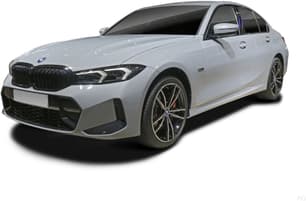
Sharper than its predecessor, the new 320i has LED everything with the rear lights being longer and curving around to the sides of the car.
The classic 'kidney' grille is darkened and more pronounced, with the black panelling extending to the rear to create an unapologetically sporty presence. A presence that’s accentuated by the twin exhausts.
The batcave interior with its black headliner, black seats… black everything, looks smart and stylish.
You do have a fair bit of harder touchpoints throughout but the customisable ambient lighting helps to soften the overall effect.
With its 2068mm width, 4709mm length and 1435mm height, the sedan makes its presence known without feeling cumbersome to manoeuvre. Urban dwellers need not fear their local car park!
The M5’s raw size is what you notice first. The G90 M5 is a whopping 113mm longer, 67mm wider and 37mm taller than the car it replaces, with the wheelbase stretched 24mm.
It is also the most pumped M5 yet, compared to a 520i it is 70mm chubbier at its flared wheel arches. The ‘M5’ insignia on the C-pillar means you’ll know this is the fast one.
Presence is not in question, then, but beauty? Not the right word. The G90 makes its predecessors — especially the original ‘E28’ — look demure.
The cabin layout builds on the concept debuted by the iX electric SUV, with twin integrated screens and focus on technology and minimal buttons. Materials are mostly high quality and feel fitting for the M5’s asking price.
For such a sleek looking sedan, it’s generous up front with plenty of head and legroom.
You can adjust the seat to sit quite low and both front seats have extendable under-thigh supports, which should excite taller drivers.
My 189cm (6’2”) brother has the 328i and is very comfortable but taller front passengers will encroach on back seat passenger comfort.
The front seats are quite firm on the backside, they also lack adjustable lumbar support, so expect to stretch the kinks out on a longer trip.
The amenities and tech feel well thought out and easy enough to use. The 12.3-inch touchscreen multimedia system looks great and has the best-looking graphics I’ve sampled.
The BMW system is intuitive to use once you get used to it. If you’re not interested in using the touchscreen, you can also utilise the rotary-wheel for menu selections.
There’s also Bluetooth connectivity, wireless Apple CarPlay and Android Auto plus built-in satellite navigation.
The 12.3-inch digital instrument panel is customisable and the information displayed simply but you won’t really look at it because of the head-up display.
Front occupants enjoy a wireless charging pad for their smart phone, a USB-A and USB-C port plus a 12-volt socket. Rear passengers get a couple of USB-C ports, too.
The storage is good for this size sedan but overall passenger room takes priority, but the glove box and middle console will suffice for everyday use.
While it may not excite others, I love the big bottle holders in the doors. They’re large enough for my big 1.5L bottle and angled for easy access. These are found in the rear doors as well.
Back seat passengers enjoy climate control, directional air vents, two cupholders, netted map pockets and reading lights.
My six-year old was happy with the amenities and lower ground clearance because he felt comfortable and had his independence.
The boot offers a good capacity of 480L and the aperture isn’t too narrow, so you can comfortably access items if they roll to the back.
I had plenty of room for my little family’s needs but if you’re a larger family, you may need to get strategic with gear storage.
Being a base model, you do miss out on a powered tailgate, which is a shame but not too much of an issue given this is a sedan and the lid isn’t heavy.
There’s also no spare tyre or even a puncture repair kit but you have run-flats, so you should be able to limp to a service centre if need be.
BMW has persevered with its twin-screen, minimal-button approach for its 'Operating System 8.5' in the M5.
The 14.9-inch central touchscreen is bright, responsive and high resolution but the software remains a little strange. The main interface is classy but when looking for settings to adjust you’re presented with a Windows 95-esque panel of small square touch targets. It’s not intuitive.
Wirelessly mirroring Apple CarPlay or Android Auto works a treat, at least. Digital climate controls keep temp adjustment persistently on screen and a shortcut to fan speed. The nipple-like vent direction adjustment grows on you, as do the digital vent sliders.
The 12.3-inch digital driver’s display still doesn’t have the freedom of customisation and clarity of Audi’s interface.
The M5 has two cupholders, a deep central storage cubby, door bins that swallow two 600mL plastic bottles and twin wireless charging pad that resolutely grips smartphones even under the sort of tummy-churning G-Forces this M5 can manage.
Setting the M5 apart from the regular sedan is a unique centre console bunching 'M Drive' modes, 'M Hybrid' modes and other shortcut functions together next to the gear toggle and M-engraved crystal 'iDrive' controller.
Comfortable front seats are power adjustable with in/out, up/down lumbar support and have two memory positions.
The 5096mm long M5’s back seat is very spacious. Headroom is good for those beyond 182cm (six-foot), the bench is extremely supportive, while leg and toe room are adequate.
A fold-down centre armrest has two cupholders and there are USB-C charge ports in the back of each bucket seat for a total of four.
You can buy an accessory mount that holds tablets or smartphones for rear seat passenger entertainment, too.
When you look in the boot, BMW offering a Touring version of the latest M5 makes even more sense. The load aperture is big but the usable space is narrow; the sides intrude on load space.
The 466-litre space will make fitting suitcases for an airport run tricky and, even with the 40/60 split-fold rear bench, you will struggle to fit a bike in the back. There’s no spare tyre, either.
There are seven variants for the BMW 3 Series sedan and our model is the base model for the petrol variants.
There is a plug-in hybrid version, the 330e, if you’re after a more fuel-efficient option but it will up the price by about $20K.
As it stands the 320i M Sport is $78,900, before on-road costs. Our model has been finished in 'M Brooklyn Grey', which adds $1539 to the price.
That puts it at a similar price point as its rivals. You get a well-specified package with the M Sport but it doesn’t have the same sense of cushioned comfort as the Merc does, but more on that later.
Still, the sporty and streamlined interior is headlined by BMW’s dual 12.3-inch screens that sit propped on the dash like a futuristic cockpit.
The mix of synthetic leather and cloth seats are electric and have adjustable side bolsters for when you want to go hard in a turn.
The interior also boasts a sunroof and wireless Apple CarPlay and wired Android Auto. There are some other highlights like the 18-inch alloy wheels, leather steering wheel and the crystal-clear head-up display, to name a few.
The last M5 was well equipped but the new car is wanting for nothing. Australian cars have just about every option for $259,900, before on-road costs.
Australian M5s wear staggered 20-inch front and 21-inch rear alloy wheels paired with standard metallic paint, 'M Carbon Exterior' package (including carbon roof and rear lip spoiler), adaptive LED headlights and BMW’s 'Iconic Glow' illuminated kidney grille surrounds.
Keyless entry, a heated steering wheel, heated and ventilated front seats, interior camera, powerful 18-speaker Bowers & Wilkins sound system, M seatbelts, four-zone climate control and a power tailgate are the cabin highlights.
Optional extras are thin on the ground; you can choose from (eight) no-cost paint colours and all manner of 'Individual' shades (from $4100), four interior trims including classy 'Dark Oak' wood and four leather colours. There’s classic black ‘Merino’ leather, or you can have it dyed with a mix of 'Silverstone', red or 'Kyalami Orange'.
Aside from that, the only major option is carbon ceramic brakes at a staggering $18,500, and an M5 Touring wagon costs $263,900.
Though the M5 is more expensive than Audi’s closest rival, the RS6, the gulf isn’t huge considering you get a lot more punch in the BMW. Mercedes-AMG does not have an E-Class answer, yet.
Good value, then? Well, an equally potent Porsche Panamera is twice the price. So yes, in a sense.
The 320i M Sport has the ‘baby’ engine in the 3 Series line-up but the 2.0-litre, four-cylinder turbo-petrol powertrain still delivers on power with a maximum output of 135kW/300Nm.
This is a rear-wheel drive and has an eight-speed auto-transmission which delivers very smooth gear changes.
Despite having the smaller engine, it can still go from 0-100km/h in just 7.4 seconds.
Unlike the Mercedes-AMG C63, BMW has kept the M5’s eight-cylinder heart and this has proven to be a good decision.
The 4.4-litre twin-turbo petrol engine has been optimised with “a cross-bank exhaust manifold and optimised oil separation”, says BMW.
The V8 spins to 7200rpm though it isn't a screamer, outputting a full-bodied 430kW (5600-6500rpm) and 750Nm (1800-5400rpm).
Augmented with a transmission-mounted 145kW electric motor that can produce up to 450Nm, thanks to pre-gearing, maximum combined outputs are 535kW and 1000Nm.
Weight blunts punch, though, so despite nearly 100kW and 250Nm more, the new M5 is a tenth slower to 100km/h than its predecessor (claimed), at 3.5 seconds for the sprint.
You can thank a 220kW/tonne power-to-weight ratio, worse than the old car's 233kW/tonne figure. The new G90 claws some time back with brute force, hitting 200km/h in just 10.9 seconds and goes on to a limited top speed of 305km/h.
You can choose from five powertrain settings, starting with 'Electric' and 'Hybrid' for everyday use, while 'eControl' lets you store battery power for urban use.
'Dynamic' provides the best balance, says BMW, while 'Dynamic Plus' is like a qualifying mode. Think maximum combined punch for up to 10 minutes, at which point you’ll have drained the battery.
Driving in pure electric mode, the take-off can be a little jerky but the quietude and decent power make it pleasant. Power sources are combined expertly in Hybrid and giving it some stick in Dynamic is more than enough to make your passengers feel queasy.
In a world with rising fuel prices, the efficiency of this decently powered sedan should excite you.
The official combined fuel cycle is 6.5L/100km. Real world testing saw my figure at 7.4L/100km after a mix of open-road and urban driving this week.
I thought that was great for how hard I drove it and for the power, you won’t be wincing when you put your foot down. I would expect it to be higher in an urban setting.
The 320i has a 59L fuel tank and based on the official combined cycle figure, you should get just over 900km of driving range, which is great, especially if you do 'roadies' like me!
Electric-only range is rated up to 69km in WLTP testing, but the 18.6kWh battery is more likely to give you around 60km in real-world driving. It can be topped up in about two hours using an 11kW AC charger, or overnight on a three-pin socket.
BMW includes both Mode 3 (public) and Mode 2 (home) charging cables with the M5.
The M5 uses 3.2L/100km of 98 RON premium unleaded in ADR testing, corresponding to just 72g/km of CO2, so it should sail through the first rounds of Australian emissions regulations.
Indulging in what the V8 has to offer sees that consumption spike, though. An enthusiastic road drive saw the M5 gulp 12.4L/100km, according to the trip computer.
There's a lot that I like about how this performs but a highlight is how eagerly the car responds when you accelerate.
However, it’s not unbridled power. There’s no bucking at the front or shuddering through the steering wheel. It’s controlled but still very fun.
The lower centre of gravity and coupe-like height of this does mean it handles corners well and the bolstered seats hold you firmly into place, meaning you can be free to drive this a little harder than you might normally. Which I did and can confirm it handles itself well.
This has the M Sport suspension, which means it’s stiff, but you feel very connected to the road.
You do get a lot of talk-back from bumps in the road but unless you hit a big pothole, you never feel rattled by them.
But it is a harder ride than other luxury models, which doesn’t bother me as I like the handling, but if you want limo-like comfort, look elsewhere.
The cabin is very nice to spend a lot of time in and relatively quiet, even at higher speeds.
The 11.4m turning circle and sleek dimensions makes it very handy to park, even in tight car parks. The nose is long but the front and rear parking sensors take out any ‘will I make it’ moments and the super clear reversing camera is great.
The three M5 elements start with daily usability. We trundled out of Bathurst in electric mode, with the adaptive dampers (and other myriad settings) in Comfort.
The M5 has steel springs, double wishbone front suspension and a five-link rear axle, all of which has been heavily reworked by the boffins at M. Naturally, the ride is firm, though in Comfort the body moves through its motions smoothly.
The M5 is an effortless tourer, its eight-speed automatic shmoozing through ratios as it climbs and descends steep gradients. Wind and tyre noise insulation is good on coarse chip tarmac, though a bit more burble from the V8 would be appreciated.
The M5 has nine adjustable parameters to wake it up: 'Drivetrain', 'Energy Recovery', 'Drivelogic' (gear shift aggression), 'Chassis', 'Steering', 'Brake', 'M xDrive', stability control settings and 'M Sound'. Favourite settings can be stored to the wheel-mounted M1 and M2 buttons.
With the dampers still in Comfort the M5 remains fantastically capable with power delivery from the xDrive mighty rewarding on corner exit. Sport dampers sharpen the experience up further, amplifying the M5’s surprising agility. Thank the rear-wheel steer for this big sedan’s switchback performance.
Step beyond the limit of grip, brake too late, or get on the power too early, though, and the M5’s mass reveals itself rapidly. It doesn’t help that the accurate steering is devoid of feel. The brake-by-wire pedal is too numb and light, as well, making it tricky to judge grip levels on the road.
Feel is less of an issue on a dry Mount Panorama circuit, where the M5 turns out to be a total pussycat. The all-wheel drive, consistent dynamics, strong brakes and well-tuned stability control make for an approachable but seriously fast sedan.
The responsive transmission will hold gears to redline and is eager on the downshift in its most aggressive setting while tactile shift paddles make commanding ratio changes yourself that bit more engaging.
Prodigious punch out of corners is matched by the impressive consistency of the carbon ceramic brakes. The M5 pulled up for The Chase every time with minimal fuss, even from above 250km/h.
Similar credit goes to the 285mm front and 295mm rear Hankook S1 Evo tyres which remained consistent and predictable all day despite reaching temperatures over 130 degrees, according to the tyre pressure monitor.
The safety list includes a suite of features and the following come as standard: adaptive cruise control, auto emergency braking (operational from 5.0-210km/h), blind-spot monitoring, speed sign recognition, forward collision warning, SOS emergency call button, daytime running lights and rear cross-traffic alert.
I like the intelligent seatbelt reminder and that the bonnet is considered 'active', meaning it will lift up and away from the engine if the sensors detect that a pedestrian has been hit.
However, I have to call out the lane departure and keeping aids. It’s a hit or miss system and I tested it extensively this week once I noticed it.
You can customise the sensitivity levels and even on the highest sensitivity, it works too sporadically for my liking. BMW should improve this system for future instalments.
The 3 Series has been awarded a maximum five-star ANCAP safety rating but it was done a while ago in 2019. It only has seven airbags and is missing the newer front centre airbag.
There are ISOFIX child seat mounts on the outboard seats and three top tether anchor points but the back seat is a bit too narrow to comfortably fit three child seats side by side.
You'll be able to fit a 0-4 rearward facing child seat but may struggle if you're a tall family.
The regular BMW 5 Series range scored a maximum five stars in 2023 ANCAP safety testing but this does not apply to the M5.
The M5 features nine airbags and a host of active safety systems, including auto emergency braking (AEB), blind-spot monitoring, rear cross-traffic alert, lane-keep assist, auto parking and speed limit assist.
Lane-keep can easily be turned off via two taps but the other systems require more menu navigation, though are mostly unintrusive. A 'Track' mode disables lane-keep, AEB and other systems along with switching the central display off.
The 320i comes with a five-year/unlimited km warranty, which is standard for this class.
You can choose between a three- or five-year capped-priced servicing plan. The five-year plan costs just $2150, or $430 a year, which is competitive for this class.
Like other BMWs, servicing intervals are condition-based, with the car letting you know when it needs to be serviced.
In Australia, BMW has moved to match other manufacturers in offering a five-year/unlimited kilometre warranty on all its cars.
Servicing is recommended on a condition basis, with the M5’s multimedia system prompting a visit to the mechanics. BMW offers pre-paid service packs for five years/80,000km at a price of $5059 for the basic offer and $8152 for 'Inclusive Plus', which covers brake pad and rotor replacements.
It is expensive next to a regular 5 Series but when you consider the purchase price and performance level, the M5’s service pricing is not astronomical.