Four 2 Series variants were offered for the launch drive program, a 230i Coupe (which BMW nominates as the most popular model in the range), M240i Coupe, M2, and M2 Pure.
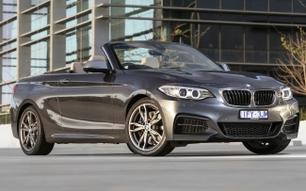
Claimed 0-100km/h acceleration of 5.6sec for the 230i M Sport Coupe is quick, with the convertible stopping the clocks three tenths later.
Peak torque of 350Nm is plenty, and with that number available from 1450-4800rpm the mid-spec 2 Series is an entertaining drive.
It's M Sport (strut front, five-link rear) suspension keeps the body well buttoned down in quick going, while the beefier M brakes provide strong and progressive stopping power.
Even a firm squeeze of the throttle can't side-step some hesitation as the turbo spools up before right foot pressure translates into forward momentum, but despite the sporty tune, ride quality is good (even riding on notoriously harsh 18-inch run-flat rubber), while response and road feel from the variable-ratio steering are excellent.
The eight-speed auto is beautifully slick, with manual changes, via wheel-mounted paddles, sharp and positive.
Add the grippy leather sports wheel, snug sports front seats, and racy cloth/Alcantara trim (leather in the convertible), and you have a comfortable, nicely balanced and fun-to-drive package.
Accelerating from 0-100km/h in 4.6sec (convertible 4.7sec), the M240i effortlessly achieves 'genuinely rapid' status. Yes, it's fast, but never furious, in the sense that even under the pressure of enthusiastic peddling it remains civilised and composed.
Maximum torque of 500Nm is not to be sneezed at, and when you realise that mountainous maximum is actually a flat-top plateau stretching from only 1520rpm up to 4500rpm, satisfying urge is never far away. And the flexible 3.0-litre turbo-six is an aural treat as it howls its way towards a 7000rpm rev ceiling.
The standard 'Adaptive M Suspension' offers settings from 'Comfort' through to 'Sport+', but even in the most forgiving mode the car remains taut and communicative.
The 18-inch rims, shod with Michelin Pilot Super Sport rubber (225/40 front / 245/35 rear) don't upset the ride as much as you'd expect, although coarse-chip surfaces send rumble through to the cabin.
In terms of ergonomics and general function, the new iDrive6 system is simple and intuitive to use, the current BMW dash and console layout is a model of efficiency, but the two-stage (depress small button on stubby lever, then shift) process to select drive or reverse can be a frustratingly hit-and-miss affair if you need to get going quickly.
Then, the M2 is all business, with a properly focused feel, and the ability to accelerate from 0-100km/h in a claimed 4.5sec for the six-speed manual, and just 4.3sec for the seven-speed dual-clutch. Try not to smile as that g-force shoves you back in your seat. You won't succeed.
Although peak power arrives at a relatively high 6500rpm, maximum torque of 465Nm (500Nm for limited periods on overboost) is ready for action across a broad spread from 1400-5650rpm, so the M2 has adrenalin flowing through its veins at all times.
An electronically controlled 'Active M Differential' manages torque distribution across the rear axle to optimise power down, with the ability to send anywhere from zero to 100 percent of drive to either back wheel.
The 'M Servotronic' steering, switchable through comfort and sport modes, is feelsome and linear in its response, the mega 'M Compound Brake' package (borrowed from big-brother M4) is professional grade, and while the seven-speed dual-clutch may shift faster, snicking up and down the manual's six ratios is a rare pleasure.
Rolling on 19-inch, ultra-high-performance Michelin semi-slick rubber (255/35 front / 275/35 rear) the M2 is never going to waft like a limousine, but if you're signing on for this kind of performance and dynamic ability, some ride harshness over less than perfect surfaces goes with the territory.








.png)


