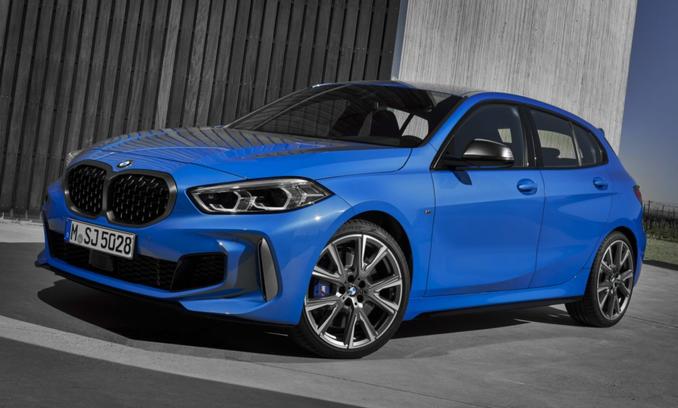
The 2025 BMW 1 Series range of configurations is currently priced from $57,900.
You can read the full review here.
This is what Chris Thompson liked most about this particular version of the BMW 1 Series: Feature-packed front row, Price remains competitive, Capable and fun to drive
The 2025 BMW 1 Series carries a braked towing capacity of up to 1300 Kg, but check to ensure this applies to the configuration you're considering.
The BMW 1 Series 2025 prices range from $46,310 for the basic trim level Hatchback M Sport to $89,870 for the top of the range Hatchback Xdrive.
The fuse box in this car is fiendishly located behind the glove box. To access it, you first need to unclip the strut that controls the glove box lid’s action, unclip the two sides of the glove box where it pivots (there’s a plastic tab on each side) pull the glove box inner down and then you should be able to see the fuses laid out deep inside the dashboard. Next to the access panel, there should be a folded chart showing which fuse does what. There are some excellent online tutorials on how to do this.
If this chart is missing (and it’s possible as it’s a loose-leaf sheet of paper) there are lots of online guides to show you what fuse protects what circuit.
To remove or replace the fuses themselves, I’d recommend a specific set of long-nosed pliers designed for this job as there’s very poor access to the actual fuses and getting at them by hand is going to be a pain.
Show more
The 330e is a plug-in hybrid (PHEV), so it has a petrol engine and a smaller battery pack than a full EV (which runs exclusively on battery power). That means the BMW’s battery should be less expensive to replace if it ever needed to be.
At the moment, the world is waiting to find out how long EV batteries last, but it’s looking like between 10 and 20 years is going to be the magic number. A lithium-ion battery like this one will last longer if it’s never over-charged and is cycled regularly rather than left sitting for long periods.
Show more
The BMW XM is BMW's flagship SUV, and a standalone M model. It also carries a plug-in hybrid V8 powertrain.
Show more
The BMW 1 Series comes in eight colours, the only non-cost colour is 'Alpine White'.
Metallic paints are $1700 each, and include 'Black Sapphire', 'M Portimao Blue', 'Skyscraper Grey', and 'Thundernight Metallic' (purple).
BMW Individual colour options include 'Storm Bay Metallic' ($3500), 'Frozen Pure Grey Metallic' ($5000) and 'Frozen Portimao Blue' ($5000).
The BMW 1 Series has a relatively sporty interior, with M Sport coloured stitching on the dash and the same coloured illumination in aluminium panelling.
The front of the cabin is simply laid out in terms of ergonomics, but the rear lacks features and is a slight squeeze for adults hoping to spend more than a short trip in there.
The 118 comes with a 1.5-litre three-cylinder turbo petrol engine that drives the front wheels via a seven-speed dual-clutch transmission. It makes 115kW of power and 230Nm of torque.
The M135 has a 2.0-litre four-cylinder engine, also turbocharged, but driving all four wheels via a similar seven-speed DCT. It makes 233kW and 400Nm.
The BMW 1 Series has 380 litres of boot space with all seats up, or 1200L with the rear 60/40 split seats both folded down.
The 1 Series has a large 10.25-inch multimedia touchscreen and 10.7-inch driver display in a curved unit as standard, as well as wireless phone charging and a head-up display.
The BMW 1 Series has a standard five-seat layout, with the front seats electrically adjustable, heated and finished in synthetic leather.
The rear seats are a 40/60 split fold, also in synthetic leather trim.
BMW says the 118 should hit 100km/h in 8.5 seconds, while the M135 xDrive has a claimed sprint time of 4.9 seconds.
Both 1 Series variants have a 49-litre fuel tank, but different fuel consumption rates and reccomended fuel RON ratings.
The 118 consumes 6.4 litres of recommended 95 RON fuel for every 100km covered according to BMW, and should have a theoretical range of 765km.
The M135 xDrive drinks more, at 7.8L/100km, and has a recommended fuel quality of 98 RON. Theoretical range should be 628km, though as usual, achieving this would usually only be possible in lab conditions.