What's the difference?
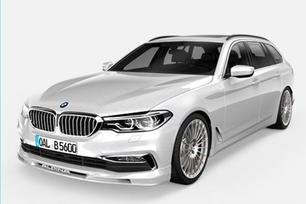
The BMW Alpina B5 Bi-Turbo is not actually a BMW. Not according to the German Federal Motor Transport Authority, at least.
Nope, the modifications applied by tuning house Alpina to the 5 Series are deemed so significant that if you open the bonnet and look inside the engine bay, you'll see that the BMW VIN has been struck through twice and an Alpina vehicle number stamped underneath it.
The B5 is not the first model to be recognised in this way, either; the German government has recognised Alpina as a seperate car manufacturer since 1983.
The B5 has other ‘B' siblings, too. There's the B3 S Bi-Turbo, which is based on the BMW 3 Series, the B4 S Bi-Turbo (the BMW 4 Series) and the B7 Bi-Turbo (I don't need to tell you what this is based on, right?) which I've reviewed, too.
So just what has Alpina done to this unsuspecting BMW 5 Series? Is it really worth the extra money? How does the B5 compare to an M5? Could it actually be superior? And did they really take the speed limiter off to let it warp-speed to beyond 300km/h?
Segment-bender, model-mash-up, mold breaker, franken-ute: there are many odd ways to describe the new electric Deepal E07 large 'SUV'.
I prefer to think of it as the mullet haircut of cars — business up front but a party at the back — but Deepal has settled on Multitruck to describe its new SUV-ute mash-up.
There isn’t anything like this vehicle on sale in Australia right now. The most similar vehicle on the global stage would be the Tesla Cybertruck, but the E07 is smaller and much less gaudy.
We got to have our first taste of the new adventure ready machine on Australian roads, and this is what you need to know.
The Alpina B5 is a special car – more special than most people will ever give you credit for if you own one. Those that do know what an Alpina is will let you know; people will cross dangerously busy streets to talk to you about your car. Insanely fast, almost incomprehensibly comfortable and effortlessly powerful to drive.
The Deepal E07 is a breath of fresh air. It’s exciting to see a vehicle zig when others zag.
It’s not just a conversation-starter, it is well priced, stacked with gear and has some potent performance. Not to mention that rear end has some real-world practicality, even if it isn’t quite a ute.
That is bolstered by a long warranty and a capped-price servicing program to take the risk out of trying a new brand.
It isn’t the sharpest driving machine out there, the safety tech is still annoying and having all the controls in the multimedia screen is infuriating.
Also, there are question marks on if buyers really want or need that fraken-ute rear end.
Time will tell if this car is fad like the mullet haircut or a real-world game changer.
Note: CarsGuide attended this event as a guest of the manufacturer, with meals provided.
Interesting is the right word for it, because while it might be questionable that Alpina's changes to the exterior are aesthetic pleasing, they are definitely intriguing to those who aren't familiar with the brand.
First, there are those 20-spoke wheels. Alpinas have worn this style of wheel forever and they've become the most famous outward sign that this is not just another BMW. So don't under any circumstances take them off and replace them with anything else. You'd be run out of town by the Alpina mafia.
Yes, they're more painful to clean than a cheese grater (trust me, I know. And if you look closely at these images you can see the dirty bits I've missed), but if you really don't like them then perhaps it's a sign this car isn't for you.
Then there's the boot-lid spoiler. It's square and 1980s'-looking, it also appears a bit like it's been bought online and installed by a teenager, but again, this is another Alpina tradition and it suits the car's character perfectly.
All right, those pinstripes; they're known as the Deco-Set and are a hat-tip to the Alpina racecars of the 1970s and '80s. Again, don't take these off, your Alpina will drop through the centre of the Earth in value. These are also part-and-parcel of owning one of these cars. I'm not a massive fan of them.
But I'm all about that front spoiler, with the floating Alpina lettering that you can option in silver, high-gloss black or gold.
Inside, there are fewer Alpina additions, but they're nonetheless unmissable. There's the Alpina-badged steering wheel, and a new virtual instrument cluster, embossed headrests and illuminated door sills.
There's also the little numbered plaque on the centre console which proves its authenticity, ours was number 49. Out of how many? I don't know. But I do know Alpina produces only about 1700 cars globally a year. Rolls Royce does about 4000. So, you can rest assured your B5 is exclusive.
At almost 5m long, 1.9m wide and 1.5m tall, the B5 is a large saloon, but having recently reviewed the Alpina B7 it feels small in comparison. How does it drive? We're getting there.
The E07 stands out from the crowd. It’s design will turn heads and you’ll have strangers coming over for a sticky beak at all times.
It’s a big beast at more than five metres long and close to two metres wide. That puts it in Toyota LandCruiser territory.
The biggest talking point is the rear. What looks like a liftback is actually a retractable roof that converts it to an open tray at the touch of a button.
You can have it open with the rear seats folded flat or the rear seats up and the glass divider still in place to keep the world at bay.
Outside of the rear end, it's a futuristic-looking car with squished LED headlights, flush door handles and a closed-off front end typical of modern electric cars from China.
Inside it borrowed cues from Tesla with its minimalist design with next to no buttons and only a big central screen.
The interior quality feels good, with premium materials covering all surfaces.
Practicality is not really a BMW strong point no matter which model you pick. See, BMW mostly makes the car equivalent of uber-stylish and skin-tight active wear which looks good and performs brilliantly, but sometimes you just want pockets and a bit of room for your… um… bits and pieces.
So while there are two cup holders up front and two in the back, the bottle holders in the doors aren't huge, the centre console bin is on the small side, there's a hidy-hole in front of the shifter, the glove box is just a box for little more than gloves and there's no other great cabin storage options.
Legroom in the rear is good but not great, too - I'm 191cm tall and have about 30mm between my knees and the seat back in my driving position. Middle-seat passengers will also have to straddle the drive shaft hump in the floor. Headroom is restricted in the back, too (you could blame the sunroof) with my hair just skimming the headlining (I do have big hair).
Under that power tailgate, the B5's boot capacity is 530 litres which is 15L more than its big sister, the B7. There are two plastic storage areas either side of the luggage space for wet things. While there is one USB outlet in the front there aren't any in the rear.
There are two sides to this story.
The convertible back makes it one of the only true dual-purpose vehicles, but let’s not oversell its capabilities.
It only has a payload of 300kg and only has a 1500kg braked towing capacity, so it's not tradie spec.
It is probably best suited for throwing a few surfboards in the back or mountain bikes and heading off to a remote spot where you can sleep in the car in relative comfort.
There is no rugged ladder frame underneath, but it can do a bit of light off-roading in all-wheel-drive guise.
Ground clearance of 223mm is good and it can wade up to depths of 600mm.
It has a vehicle-to-load function that allows you to power appliances, which boosts its potential as a campsite companion.
Inside it has spacious cabins with oodles of head, leg and shoulder room in both rows. That is thanks to its more than three-metre wheelbase — the distance between the front and rear axle that determines how spacious a cabin is.
There are rear air-con vents and USB charging ports for both rows, and the rear seats can tilt backwards for sleepy young-uns.
The boot capacity is 524L, or 1654L with the rear seats folded. A front boot under the bonnet is 131L.
One of my biggest gripes is that nearly every function of the car is controlled through the big multimedia screen.
There are shortcuts and app-like tiles that make it easier to navigate, but it’s still a hassle to dive into the menu to change side mirrors and other functions usually controlled via physical buttons.
Tesla set the precedent by moving all its functions into the screen and other tech-focused EVs have followed suit, but it smacks of cost savings rather than improving the user experience.
The BMW Alpina B5 lists for $210,000, making it only $10K more the BMW M5 which comes with almost identical features apart from the Alpina engineering to the engine and chassis.
Arriving standard is leather upholstery, four-zone climate control, nav, the Alpina embossed-headrests, a 10.25-inch display, digital radio, Alpina door sills, sunroof, proximity key, power front seats, 12-speaker Harman Kardon stereo, head-up display, Alpina virtual instrument cluster, heated front and rear seats, and the 20-inch Alpina wheels.
The test car I drove had been optioned with a limited-slip differential ($5923), steering-wheel heating ($449); soft-close function for doors ($1150); sunblinds ($1059); TV function ($2065) ambient air package ($575), and front-seat ventilation ($1454).
The E07 is available in two grades: a single-motor rear-wheel-drive version and a dual-motor all-wheel-drive variant.
Prices start at $64,900 plus on-road costs for the rear-wheel-drive variant and jump to $73,900 for the dual-motor version.
That’s a very reasonable price for a large electric vehicle, but as it has no real competitors it has the segment and price point to itself.
The only difference between the two variants is the addition of the second motor that brings some serious potent performance.
Both are fully loaded with a laundry list of standard gear.
The E07 rides on monster 21-inch alloy wheels, has LED lighting front and back, a hands-free power tailgate and auto folding side mirrors.
Inside there is a 15.4-inch multimedia screen that is incompatible with wireless Apple CarPlay and Android Auto, and there is a wireless device charger and USB-A and -C ports front and back.
A monster head-up display — which projects information on the windscreen in front of the driver — replaces the driver display, with no instruments in front of the driver.
This is joined by power-adjustable front seats that are wrapped in supple Nappa leather. The front seats are heated, ventilated and have a massage function.
This is topped off with 256-colour ambient lighting and an 18-speaker stereo.
There is self-levelling air suspension that has three height levels, with the tallest providing a healthy 223mmm of ground clearance.
There is some cool tech such as camping mode and a relax mode. The latter fully reclines the front seats, closes the panoramic roof blind and plays some sleep-inducing sounds such as rain noise. Camping mode is similar and allows for you to sleep in the car overnight.
The Alpina B5 uses the same 4.4-litre V8 engine found in the BMW M5 (and also the B7). But, and it's a big but, the M5 makes 441kW and 750Nm, while the B5 outdoes it with 447kW and 800Nm. Admittedly, the B5's torque arrives at the 3000rpm mark, while the M5's is all there from 1800rpm.
How does the B5 beat it? Alpina installed its specially developed twin turbochargers and intercoolers, a high-performance cooling system, a reconfigured air intake set up and a different exhaust system.
The B5, though, is a tenth of a second slower to 100km/h compared to the M5 with a time of 3.5 seconds, but it will blast on to a top speed of 330km/h while the M5 is limited to 250km/h in regular form and 305km/h with the optional M Driver's package.
Both uses the same ZF eight-speed automatic transmission with identical gear ratios, and both are all-wheel drive.
Both versions can be called potent, but the all-wheel-drive is express.
The rear-wheel-drive version uses a single electric motor to make 242kW and 365Nm, and the all-wheel-drive variant adds a second motor to make a combined 440kW and 645Nm.
That extra grunt drops the E07’s 0-100km/h time from 6.7 seconds to about four seconds.
The Alpina B5 needs petrol. By that, I mean it needs quite a lot of it if you want to enjoy it properly. What type of mileage does it get? Officially, it should use 11.1L/100km after a combination of urban and open roads, where as the M5 is set to 10.5L/100km.
That makes sense, the B5 produces more power and torque, and it's 85kg heavier than the M5 at 2015kg.
Our test car's trip computer was reporting 13.2L/100km after flying low over country roads and slow city piloting. The more time spent in the urban warfare that is the daily peak hour commute, the more that figure crept and hovered around the 15L/100km mark.
Both variants use a circa-90kWh Nickel-Manganese-Cobalt (NMC) battery, which is a big unit by EV standards.
It delivers a WLTP-verified driving range of 550km in the RWD version and 510km in the AWD.
The E07’s charging speed is also at the top end of the spectrum.
It has a max DC charge rate of 240kW, which Deepal said can replenish the battery from 30 to 80 per cent in 15 minutes.
AC charging is capped at 7kW, which is below other EVs that can max out at 11kW.
Our test was too limited to conduct a proper real-world test.
Ok, stay with me here. For this next bit you'll need a fresh egg, a lounge chair, and it might be a good idea to have some plastic bags and carpet cleaner on hand.
First, in front of the lounge chair flatten out the plastic bag and place the egg on it. Next, sit down on the chair and very carefully rest the ball of your foot on the egg with as little pressure as humanly possible.
This is exactly how little force you need to apply to the go-pedal of the B5 to accelerate from a standstill to 60km/h in about five seconds.
If anything sums up the driving experience of the B5, it's that sense of effortlessness.
Stomp on that accelerator, and you'll be shot to 100km/h in 3.5 seconds, without a hint of broken traction thanks to the all-wheel-drive system.
The ride should have been terrible on 20-inch wheels shod in low-profile rubber (Pirelli P Zero 255/35 front, and 295/30 rear), but the Alpina-tuned air suspension is close to miraculous in the way it cushioned and censored the potholes out of Sydney's worst roads. Yes, it can be a touch floaty, particularly in the Comfort Plus setting, but this is benchmark-setting stuff for a comfortable ride.
Don't expect this beast to roar. Unlike the M5, the B5 gets its work done without deafening everybody around it. Sure, the B5's V8 sounds amazing when you push it, but it's not brash, not loud and not lairy. Buy an M5 or Mercedes-AMG E63s if you want to be heard half a block before you get home, but you won't get that with the B5 and its exhaust system.
The B5 also handles well, but I have to say the engagement factor is low. I piloted it effortlessly through the twists and turns of my country test circuit and roads which normally have me grinning like a maniac behind the wheel had me feeling a bit disconnected in the B5. That air suspension, the numb steering and pedal actions make it difficult to ‘feel' the road.
It's highways where the B5 is a king, but even at 110km/h there's the sense that this car is still fast asleep and won't get out of bed for anything less than 150km/h - making it perfect for Germany's autobahns, but maybe not for here in Australia.
The E07 is a big beast, weighing in at 2440kg for the AWD, and the RWD is about 100kg lighter.
Even that fancy air suspension can't hide that bulk. On smooth city streets and well-maintained motorways, the E07 is very pleasant and comfortable. But on pockmarked and undulating country roads travelling at the sign-posted 80km/h or 100km/h, it rocks and rolls considerably.
The monster 21-inch wheels are likely part of the problem, too.
After looking at my phone in the passenger seat for 20 seconds I started to get car sick… I wasn’t the only person who had that feedback.
Switching to sports mode sharpened it up a little, but the comfort mode was far too soft.
There is a custom mode where drivers can find a happy medium.
The E07 did recover much better over small imperfections, though.
The steering was well-weighted and direct, and the brake and accelerator pedal had a good feel to them with sharp responses that inspire confidence.
We spent most of our time in the all-wheel-drive variant.
It’s fast and brutally quick off the mark, but it doesn't suplex you back into your seat like some electric cars do. Instead the power delivery was more linear, with excellent traction control and no wheel slip.
Deepal has gone the extra mile and added quality Michelin EV tyres that improve grip through corners and reduce noise into the cabin.
The E07 was remarkably quiet inside, even by EV standards, with noise and tyre roar kept to a minimum.
The Alpina B5 is based on the BMW 5 Series which had a five-star ANCAP rating awarded to it in 2017.
Along with the comprehensive suite of airbags, traction and stability control, there's an impressive array of advanced safety equipment. Coming standard is AEB (front and rear), evasive steering, front and rear cross-traffic warning, blind-spot alert and lane-keep assist. The Alpina B5 also comes with BMW's emergency call function.
For child seats you'll find two ISOFIX mounts and three top tether points across the rear row.
safety
If you're unfortunate enough to get a flat tyre, there's a puncture repair kit in the boot which works provided the hole isn't giant, as I've experience in the past with these systems.
Deepal has packed the E07 with safety gear and driver aids.
It has eight airbags, ISOFIX anchor points for the two rear window seats, and a top-tether anchor for all three back seats.
There are front and rear parking sensors, a 360-degree camera and a transparent chassis view that allows you to see underneath the vehicle.
Deepal has ticked all the driver aid boxes with autonomous emergency braking with cyclist and pedestrian detection, lane departure warning and lane-keep assist, rear cross traffic alert with auto braking function, blind-spot detection, speed sign recognition and over speed alert, door open warning, rear passenger alert, safe distance alert and adaptive cruise control.
It’s nice to have all that tech, but it is over-sensitive and you end up just turning it off, which defeats the purpose of having them in the first place.
The E07 hasn’t been crash tested yet, so there's no ANCAP safety rating to report at this stage.
The Alpina B5 is covered by BMW's three-year/unlimited kilometre warranty. Servicing is recommended every 12 months or 15,000km.
Deepal covers the E07 with a strong but not market-leading seven-year/160,000km warranty, and the battery is guaranteed for eight years/240,000km.
It also has a tempting seven-year/140,000km capped-price servicing program that requires visits every 12 months or 20,000km, with the former on the shorter side for an EV. The RWD costs $2954.59 over the full term, compared to the AWD's $3143.90. Both outlays are competitive.