What's the difference?
In any other super car, it would seem deeply strange, wrong even, to loll (and LOL) in the back seats while a colleague blasts you around a race track at insane speeds, and not just because cars with V12 engines making 575kW and 1000Nm don’t normally have more than two seats.
The Bentley Flying Spur Speed is, of course, no ordinary car, it is a super sedan, a luxe limousine crossed with a rocket ship, and if Sir wants to get to the rooftop helipad in a spectacular hurry, then these are the back seats to be sitting in.
We flew to Japan, and the spectacular setting of the Magarigawa Club, a members-only race track carved out of the rolling hills outside Tokyo at a rumoured cost of $US2 billion, to try the back seats, and the driver’s seat, of the new and very impressive Flying Spur Speed.
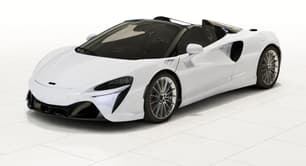
Obviously the headline item of the new McLaren Artura Spider is the ability to drop the top and feel the wind in your hair, or, should you live in Melbourne, at least the damp mist on your face.
But this new plug-in powerhouse has plenty more to offer than just its folding hardtop.
The coupe and convertible are more powerful, there’s a new and louder exhaust, faster gear shifts, a richer rev range, better suspension and better braking.
Oh, and there's a new feature designed to unlock your inner hooligan, but we’ll come back to that one in just a moment...
But at its core, the Artura Spider is a plug-in hybrid monster that goes someway to previewing the future of the supercar species.
Does electrification enhance the excitement? We strapped in to find out.
The Bentley Flying Spur Speed is a whole lot of car, for a whole lot of money. Sure, I’d rather have a Ferrari or a Porsche with similar power (and the Panamera shares the same V8 and hybrid set up), but then if you’re in the market for a Bentley like this you already have a garage full of other options. And I can see why you’d add one of these to your collection. Because you can.
Note: CarsGuide attended this event as a guest of the manufacturer, with travel, accommodation and meals provided.
McLaren’s most liveable offering proves hybrid heroes have a place in the supercar stable of tomorrow. Angry and affable in near-equal measure, it is utterly docile during the week and completely bonkers on the weekend.
Note: CarsGuide attended this event as a guest of the manufacturer, with travel, accommodation and meals provided.
Bentley seems to have spent the design budget on the Continental GT Speed, which was launched at the same time and gets the same new engine under its slightly sexier bonnet. The big move there has been going from Bentley’s traditional four headlight face to a smoother more modern one with just two lights, or eyes.
The Flying Spur, by comparison, sticks with the more traditional look, and four eyes, but that doesn’t necessarily mean it looks nerdier. Indeed, it’s still an impressive and handsome beast and does a mighty fine job of making this much metal and mass look bold and desirable.
Truly, vehicles this large tend to look lumpen and making one look as good this Flying Spur Speed does is an impressive feat. Look at the photos and be impressed.
The interior fit out and fittings are stunning, with Bentley boldly claiming it makes the best car cabins in the world. It’s not an outrageous claim, either.
As is pretty par for the course with McLarens, the Artura's design is more about aerodynamics than aesthetics, with everything you see outside designed to either help you slip through the air, or stick to the road.
There is, however, one important new part of the design, and that is the roof, which opens in 11 seconds and at speeds of up to 50km/h, meaning you should never be caught in sudden rain.
Elsewhere, you’ll find it is all angles and alloys outside, while inside, it is a pretty driver-focused experience. I particularly love the steering wheel, which is totally free of buttons – a refreshing change which means it has one job and one job only.
Then there’s the central screen, which looks a bit like it’s just been plonked in the cabin, but works seamlessly. One note, though. It's positioned a little too low, meaning you have to take your eyes right off the road to look at it when driving.
I’m not going to pretend that I had my laptop out taking notes while we were hitting 200km/h down the back straight at Magarigawa, but at more sane speeds there’s no doubt the rear seats of this car would be a very relaxing, plush, cosseting and pleasant smelling place to sit and work.
That’s at least partly what the Flying Spur Speed is for, a limousine for those who don’t like, or perhaps can’t quite afford, a Rolls-Royce, but still want great British solidity, class and that sense of obscene wealth, probably inherited.
The bonus of the Flying Spur is that it’s also a lovely place to be should you choose either of the front seats, with hugely comfortable seats that are more like couches, endless adjustability and many soothing massage settings for your heated and ventilated pews.
The spinning central 12.3-inch display remains the highlight, offering you a modern touch screen, which can disappear to reveal either three classic analogue dials or a plan piece of dashboard, if you prefer a “digital detox”.
Practical? Not really, but then, what were you expecting? There are two seats, some 124 litres of luggage space in its under-bonnet boot, phone connections and… well, that’s about it.
One design element I do love, which counts as a practicality perk, is the glass finish applied to the rear buttresses, which don’t just look cool, but help you see out the back when peering over your shoulder.
Is “value” even a word that people use when they can afford to shop for a Bentley that costs $581,900, and will not be their only car? At very least, it’s a term that means something different to the people who breathe that kind of rarefied air.
The kind who have memberships to the exclusive Magarigawa Club where the Flying Spur Speed was launched. When just being a member costs a rumoured $1 million a year (and there’s a waiting list to get in), then half that much for a car probably isn’t so much.
The Flying Spur Speed comes with everything you would expect from a Bentley, incredible levels of comfort, a modern hybrid system that allows you to pretend you’re an eco-warrior while driving through the zero-emission zones of big cities like London and plenty of space and shiny things to look at.
The stereo is a Naim for Bentley audio system "arguably the finest in-car hi-fi available in any production car", while you also score a panoramic sunroof and mood lighting and even lovely deep-pile mats in the footwells. Ahh.
Sure, you could buy Ferraris and Lamborghinis for that kind of money, but they don’t have comfortable back seats like this Bentley, for those days when you really need to get to the chopper (parked on your personal helipad) in a hurry.
Prepare to enter the rarefied air of the supercar world. The McLaren Artura Spider lists at $525,010, or about $50K more than the hardtop Artura, which has also been updated for 2025 and lists at $477,310.
Either way you’re staring down the barrel of around half a million to climb into the new Artura. But kudos to McLaren for offering the new model’s power upgrades, courtesy of a relatively straightforward software update, to owners of the current-gen Artura at no charge.
Anyway, for that spend you get a whole heap of power and performance, of course, but there’s also some new safety stuff and a new launch control designed to unleash your inner hooligan.
It’s called the 'Spinning Wheel Pull-Away' feature, which is essentially a burnout mode allowing you to light up the rear tyres, and even flick through the gears as they’re spinning, attracting the attention of passers-by and the local police in equal measure.
Add to that a redesigned exhaust that delivers a louder and more natural soundtrack, and it begins to become clear the Artura wants to leave any suggestion that it is somehow a mild supercar in its rear-view mirror.
Elsewhere, you’re riding on staggered alloys which are 19 inches up front and 20 inches at the rear, wrapped in Pirelli P-Zero rubber.
And then there’s the roof, which is a lightweight carbon-fibre and composite design operated by eight individual e-motors.
Also new in the cabin is a wireless charge pocket, while a digital dash is joined by a slightly off-looking but effective low-mounted central screen. Standard is a five-speaker McLaren-branded stereo, and rear glass screen is automatic and heated.
If you’re going to put the word “Speed” in the title of your car, you really can’t mess about when it comes to the powerplant, and Bentley also has a proud history of making hugely powerful V12 engines to live up to. That’s a history that has now ended, with the announcement that the new 4.0-litre twin-turbo V8 in this Flying Spur Speed will be the one and only in all Bentleys, henceforth, including the Continental and the Bentayga SUV.
Bentley’s W12 engine is, sadly, no more, which might well make some older Flying Spurs quite collectable.
The V8 will come in different flavours, of course, and it’s also a hybrid, as is the modern way. Bentley calls the 140kW electric motor attached to the engine an “e-machine”.
Using that machine, the Speed can whisk you around in silent, EV-only mode for up to 81km. With such a stupendous sounding V8 on offer, it’s hard to see why you’d bother, but it’s an option, and the hybrid system is cleverly set up so that the harder you drive, the quicker the battery recharges, so effectively you’d almost never have to actually plug this PHEV in.
With the engine and e-machine combined, you’re looking at a staggering 575kW and 1000Nm, enough to propel all 2646kg of this Flying Spur Speed to 100km/h in just 3.5 seconds.
It might not sound quite as orchestrally moving as the big, sassy W12, but it’s still a hell of a replacement, as it is, in fact, “the most powerful Bentley engine ever”. That will do nicely.
The magic of the Artura’s powertrain isn’t the twin-turbocharged V6, but its dinner-plate-sized e-motor, which adds 70kW and 225Nm to the total outputs.
In EV mode, which lasts around 33km, that’s all the power you get. But when both power sources are in use, the e-motor essentially plugs any turbo lag or power holes, delivering smooth, constant and massively ample power.
How much power? Try 515kW and 720Nm — up some 15kW on the existing Artura — unlocking a sprint to 100km/h in 3.0 seconds, a run to 200km/h in 8.4 seconds and from a standstill to 300km/h in 21.6 seconds.
That power is fed through an eight-speed automatic and channelled to the rear tyres, with the help of an 'E-Diff', while pre-configured 'Electric', 'Comfort', 'Sport' and 'Track' modes arrive as standard, too.
There are also a heap of suspension and software enhancements, longer-laster braking, stiffer engine mounts to tighten the entire vehicle, faster damping, significantly quicker gearshifts and a broader rev range.
So, if you were very careful to use your 81km of EV-only range, as often as possible, and you drove very slowly and treated the accelerator pedal with great care, you might, possibly, achieve the Flying Spur Speed’s claimed fuel-economy of 10.7 litres per 100km.
That’s the great thing about hybrids like this, they are theoretical fuel misers of the highest order. But if you aren’t careful and you care more about enjoying that twin-turbo V8 engine you’ve paid so much money for, you’re never, ever going to get it under 15L/100km, and you’ll quite likely exceed 20L/100km, as we did, with ease, by driving it around a track all day.
Theoretically, again, this Bentley will emit just 33 grams of CO2 per kilometre.
You can plug the Artura in, of course, and taking the 7.4kWh battery from zero to 80 per cent charged will take around 2.5 hours. McLaren reckons you can expect fuel use of around 4.8L/100km when both powertrains are in operation.
Be warned, though, there’s enough magic used to fill Hogwarts when it comes to calculating that number, and you can expect that figure to likely double if driving sedately, and skyrocket if you get on Tinder terms with the accelerator.
Any car with a whopping 575kW and 1000Nm is going to be interesting, even invigorating to drive, but you’d have to say the smaller and lighter it is, the more excitement, and even fear, you’re going to be faced with.
In the case of the Bentley Flying Spur Speed, you’re talking about an enormous, and enormously luxurious and comfortable, sedan that’s designed to carry more than two people, and weighs a hefty 2646kg.
It’s a limousine powered by a rocket, as I said earlier, but looking at the size, and pondering the weight of it, you really don’t expect too much in the way of thrills. Effortless performance, sure, titanic overtaking thrust, perhaps, but then you read the fine print and note that this Flying Spur Speed can hit 100km/h in 3.5 seconds.
That’s seriously fast in anything, but in a car this big, and filled with as much luxury as a mid-sized super yacht, it feels other worldly.
Hammering the big Speed around a tight, intense race track feels strange at first and then strangely comfortable. Even sitting in the back wasn’t so much frightening as amusing, as the big Bentley simply slopes through any challenge you throw at it.
Sure, I’d like it to be louder, and you do miss the sound of the old 12-cylinder engine (and Bentley fans in particularly might find its absence upsetting), but the V8 is still throaty enough to please your ears, and it’s important to consider that it’s actually more powerful than the old W12, which is no mean feat.
Compared to the shorter, sharper Continental GT Speed we drove on the same day, the Flying Spur does have a bit more body roll, a bit more pitch and dive under braking from 200km/h, or when accelerating ballistically out of slow corners, but it’s still stupendously impressive for what it is.
And that is a luxury limousine that can turn itself into a race track weapon if you, and your three passengers, want it to.
I know it sounds strange, given how knife-sharp and angular the McLaren Artura Spider looks, but perhaps this plug-in powerhouse's biggest party trick is not how it operates at its 8500rpm redline, but how it behaves at low speeds in town or cruising on the freeway.
This is a properly comfortable supercar, happily tootling around in near-silence in in EV mode, or just cruising around, the improved damping smoothing out the road below and the exhaust note barely noticeable.
Honestly, there was a moment on this test drive when I found myself in EV mode with the roof down while travelling at around 70km/h, and I could hear birds chirping as I passed them, such was the calm ambience of the cabin.
Supercars aren't designed as daily drivers, but the McLaren Artura Spider is so effortlessly easy to live with you could use it as your weekday runabout, before unleashing it on the weekends.
Open the taps a little more, though, and suddenly that nature changes, unlocking a darker and more dynamic side to the McLaren's personality, courtesy of the 3.0-litre twin-turbo V6, putting the entire 515kW and 720Nm at your disposal.
I don't think I've driven a car in which the distance between its twin personalities is so vast. Plant your right foot and the acceleration (0-100km/h in just 3.0 seconds) is properly violent, while the gearing has been set up in a way that it is near impossible to hit the redline on a public road – at least without obliterating the speed limit.
The steering is a predictable highlight – super direct, and near-telepathic in the way it responds to your inputs. The eight-speed auto goes about its work with seamless efficiency, too.
The biggest highlight, though, is the Artura's agility. McLaren is famed for taking an approach to removing weight from its vehicles that is so ruthless it's a miracle they don't make prospective owners step on a scale before handing over the keys. And while its true convertibles are heavier than their hardtop counterparts, you can't tell in the Artura Spider.
Instead, the brand has worked to remove weight and tighten the drive experience, mostly through new and stiffer engine mounts and that single piece carbon-fibre tub, which is why there is no additional body stiffening required in the convertible over the coupe.
As a result, the Spider feels light, lithe and super reactive, devouring corners with no jiggling or roll and no different (in that sense) to the hardtop version we drove last year.
One of the other big changes the brand made this time around is to retune the exhaust, making it louder and more natural-sounding, and you can take advantage of that in the Spider, with the rich bass filling the cabin as though your own personal orchestra is being conducted by your right foot.
So, if you're in the camp that says electrification has no place in the world of supercars, you're wrong. Electrification doesn't hamper excitement here, it enhances it.
The Flying Spur Speed comes with 10 airbags and it has not been crash tested. Bentley also has its own 'Safeguard' suite of technologies including auto emergency braking, 'Swerve Assist' and 'Turn Assist'.
Other tech includes 'Predictive Adaptive Cruise Assist with Lane Guidance', lane departure warning, emergency assist, remote park assist and 3D surround-view monitor.
There's new stuff in the world of safety, too. For one, there’s lane monitoring, which McLaren — ever keen to maintain the purity of its drive experience — is quick to point out you can switch off, and when you do, that it stays off until you switch it back on again.
That said, blind-spot monitoring and rear cross-traffic alert are optional, and you’re more chance of a Powerball win than seeing a Artura Spider crash-tested by ANCAP for an independent safety rating.
The Bentley Continental GT Speed comes with a five-year, all-inclusive servicing plan as standard.
That sounds good, but stunningly, Bentley still only offers a three-year manufacturer warranty, albeit one with no mileage limitations. That's way below industry standard these days.
The battery that forms part of the hybrid system is, however, warrantied for eight years, or 160,000km.
The Artura arrives with a five-year, unlimited-kilometre warranty as standard, while the battery is covered for six years or 75,000km. Five years of roadside assistance is thrown in, as are your first three years of services.