What's the difference?
In any other super car, it would seem deeply strange, wrong even, to loll (and LOL) in the back seats while a colleague blasts you around a race track at insane speeds, and not just because cars with V12 engines making 575kW and 1000Nm don’t normally have more than two seats.
The Bentley Flying Spur Speed is, of course, no ordinary car, it is a super sedan, a luxe limousine crossed with a rocket ship, and if Sir wants to get to the rooftop helipad in a spectacular hurry, then these are the back seats to be sitting in.
We flew to Japan, and the spectacular setting of the Magarigawa Club, a members-only race track carved out of the rolling hills outside Tokyo at a rumoured cost of $US2 billion, to try the back seats, and the driver’s seat, of the new and very impressive Flying Spur Speed.
Driving a whopping great SUV down the straight on a race track at more than 200km/h sounds like fun, but it actually feels a bit wrong, like entering a baby elephant in a dog show.
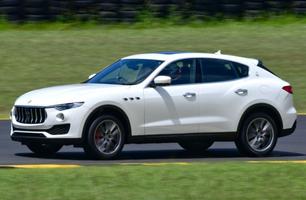
These are strange times, of course, and the Maserati Trofeo Levante is a suitably strange vehicle - stylish, classy, expensively appointed family hauler that also has the heart and soul of a race car.
Indeed, while performance SUVs are an increasingly commonplace vehicle, the Levante - which was actually getting along in the tooth as a model before this significant upgrade - has higher performance credibility than most.
That's because it has a big Ferrari V8 driving all four of its wheels and delivering a properly supercar-like 433kW and 730Nm.
It's not what you might call a typical Maserati buyer's car, but then only those who know what the Trofeo badge stands for - shouty insanity, basically - will be interested in this end of town. It is a lot of car, but is it worth the large load of money on the sticker ($330,000)?
The Bentley Flying Spur Speed is a whole lot of car, for a whole lot of money. Sure, I’d rather have a Ferrari or a Porsche with similar power (and the Panamera shares the same V8 and hybrid set up), but then if you’re in the market for a Bentley like this you already have a garage full of other options. And I can see why you’d add one of these to your collection. Because you can.
Note: CarsGuide attended this event as a guest of the manufacturer, with travel, accommodation and meals provided.
Maseratis are built for a fairly specific niche buyer; someone with a lot of money, someone slightly older and certainly someone who likes the finer things in life and appreciates Italian style, quality and heritage.
They are not, typically, the kind of buyers who want to tear around race tracks like fiends in big, shouty SUVs. But apparently there is a niche within the niche of Maserati fans who do, and they are willing to invest big dollars in vehicles wearing the Trofeo badge, like this Levante.
It might seem a slightly strange creation, a track-mad SUV with a screaming Ferrari engine, but surprisingly, it really does work.
Bentley seems to have spent the design budget on the Continental GT Speed, which was launched at the same time and gets the same new engine under its slightly sexier bonnet. The big move there has been going from Bentley’s traditional four headlight face to a smoother more modern one with just two lights, or eyes.
The Flying Spur, by comparison, sticks with the more traditional look, and four eyes, but that doesn’t necessarily mean it looks nerdier. Indeed, it’s still an impressive and handsome beast and does a mighty fine job of making this much metal and mass look bold and desirable.
Truly, vehicles this large tend to look lumpen and making one look as good this Flying Spur Speed does is an impressive feat. Look at the photos and be impressed.
The interior fit out and fittings are stunning, with Bentley boldly claiming it makes the best car cabins in the world. It’s not an outrageous claim, either.
While the other two Maseratis to get the Trofeo treatment - the Ghibli and Quattroporte sedans - are undeniably lovely, the Levante is not quite as pretty.
Admittedly, for an SUV, it looks very good, and the Trofeo touches - that big, nostrilled bonnet, the red gills on the sides, the carbon, the badges - really do lift its game to another level.
Overall, though, the Levante has just never felt beautiful enough to me to be a Maserati. These guys really do style well, as you'd expect from a premium Italian brand, but making an SUV sexy is beyond even them.
I'll grant you, it does look good from front on, but at the rear they just seem to have run out of ideas.
Credit is due for feeling properly special inside, however.
I’m not going to pretend that I had my laptop out taking notes while we were hitting 200km/h down the back straight at Magarigawa, but at more sane speeds there’s no doubt the rear seats of this car would be a very relaxing, plush, cosseting and pleasant smelling place to sit and work.
That’s at least partly what the Flying Spur Speed is for, a limousine for those who don’t like, or perhaps can’t quite afford, a Rolls-Royce, but still want great British solidity, class and that sense of obscene wealth, probably inherited.
The bonus of the Flying Spur is that it’s also a lovely place to be should you choose either of the front seats, with hugely comfortable seats that are more like couches, endless adjustability and many soothing massage settings for your heated and ventilated pews.
The spinning central 12.3-inch display remains the highlight, offering you a modern touch screen, which can disappear to reveal either three classic analogue dials or a plan piece of dashboard, if you prefer a “digital detox”.
If you've got to move five people in a genuine hurry, the Levante is a pleasant way to go about it.
There's plenty of head and shoulder room, the seats, while firm in the front, are pleasant to the touch and supportive and there's a 580-litre boot with an electric tailgate and split-folding seats.
The boot feels properly spacious, too, with a 12-volt power outlet and four tie-down points. You won't, however, find a spare wheel out there, so serious off-roading is out (although it probably was already if you look at those expensive wheels).
There are huge door pockets with room for bottles and two big cup holders in the front. The centre-console bin looks lovely, it's all carbon fibre, but is quite small.
There are also three USB points, one in the front and two in the rear, and Apple CarPlay and Android Auto connectivity.
Is “value” even a word that people use when they can afford to shop for a Bentley that costs $581,900, and will not be their only car? At very least, it’s a term that means something different to the people who breathe that kind of rarefied air.
The kind who have memberships to the exclusive Magarigawa Club where the Flying Spur Speed was launched. When just being a member costs a rumoured $1 million a year (and there’s a waiting list to get in), then half that much for a car probably isn’t so much.
The Flying Spur Speed comes with everything you would expect from a Bentley, incredible levels of comfort, a modern hybrid system that allows you to pretend you’re an eco-warrior while driving through the zero-emission zones of big cities like London and plenty of space and shiny things to look at.
The stereo is a Naim for Bentley audio system "arguably the finest in-car hi-fi available in any production car", while you also score a panoramic sunroof and mood lighting and even lovely deep-pile mats in the footwells. Ahh.
Sure, you could buy Ferraris and Lamborghinis for that kind of money, but they don’t have comfortable back seats like this Bentley, for those days when you really need to get to the chopper (parked on your personal helipad) in a hurry.
I'm sorry, but $330,000 for an SUV, of any kind? Personally I can't see the value, but then personally, as we'll discuss below in the Design section, I can't see the attraction.
This is one of the most expensive SUVs money can buy, well above things like Range Rover Sport SVR ($239,187) or even Porsche Cayenne Turbo Coupe ($254,000), although a pricier Ferrari one is surely on the way.
You'd want a lot for that, and the way it drives and sounds, thanks to that Ferrari engine, accounts for quite a few dollars.
There's also an undeniably high-quality feel to everything you touch on the car, inside and out, and a vast quantity of carbon fibre everywhere as well.
Other highlights include the 21-inch machine polished wheels, an 8.4-inch touchscreen with Navigation and DAB radio, full matrix LED headlights, and incredible Pieno Fiore natural leather, “the best the world has ever seen”, as Maserati says.
The lovely if firm front seats are heated and ventilated, sporty and 12-way adjustable, with Trofeo logos stitched into the headrests. The rooflining is lovely Alcantara, the steering wheel is sporty and features carbon-fibre shift paddles, ad the stereo system is Harman Kardon Premium and has 14 speakers.
And even the rear seats are heated. It feels expensive, and it should. But still, $330K?
If you’re going to put the word “Speed” in the title of your car, you really can’t mess about when it comes to the powerplant, and Bentley also has a proud history of making hugely powerful V12 engines to live up to. That’s a history that has now ended, with the announcement that the new 4.0-litre twin-turbo V8 in this Flying Spur Speed will be the one and only in all Bentleys, henceforth, including the Continental and the Bentayga SUV.
Bentley’s W12 engine is, sadly, no more, which might well make some older Flying Spurs quite collectable.
The V8 will come in different flavours, of course, and it’s also a hybrid, as is the modern way. Bentley calls the 140kW electric motor attached to the engine an “e-machine”.
Using that machine, the Speed can whisk you around in silent, EV-only mode for up to 81km. With such a stupendous sounding V8 on offer, it’s hard to see why you’d bother, but it’s an option, and the hybrid system is cleverly set up so that the harder you drive, the quicker the battery recharges, so effectively you’d almost never have to actually plug this PHEV in.
With the engine and e-machine combined, you’re looking at a staggering 575kW and 1000Nm, enough to propel all 2646kg of this Flying Spur Speed to 100km/h in just 3.5 seconds.
It might not sound quite as orchestrally moving as the big, sassy W12, but it’s still a hell of a replacement, as it is, in fact, “the most powerful Bentley engine ever”. That will do nicely.
This will be the last time Maserati gets a proper Ferrari engine like this a 3.8-litre twin-turbo V8 shouty monster, which is good for 433kW and 730Nm.
The future, as is the case everywhere, is going to be more electric and less noisy. For now, anyone who can should enjoy this V8 masterpiece, which drives all four wheels through Maserati's Q4 on-demand all-wheel drive system via a limited-slip rear differential and uses an eight-speed automatic transmission.
Its claimed 0 to 100km/h time is 3.9 seconds, which puts it in what used to be super-car territory, and is still very quick indeed, while top speed is an unimaginable 304km/h.
So, if you were very careful to use your 81km of EV-only range, as often as possible, and you drove very slowly and treated the accelerator pedal with great care, you might, possibly, achieve the Flying Spur Speed’s claimed fuel-economy of 10.7 litres per 100km.
That’s the great thing about hybrids like this, they are theoretical fuel misers of the highest order. But if you aren’t careful and you care more about enjoying that twin-turbo V8 engine you’ve paid so much money for, you’re never, ever going to get it under 15L/100km, and you’ll quite likely exceed 20L/100km, as we did, with ease, by driving it around a track all day.
Theoretically, again, this Bentley will emit just 33 grams of CO2 per kilometre.
The official claimed fuel economy for the Maserati Levante Trofeo is 13.5 litres per 100km, but good luck with that.
A more realistic number would probably sit somewhere above 17 litres per 100km, and we would have easily exceeded 20 litres while driving it like lunatics around a track.
But you just paid $330K for an SUV, what do you care about fuel economy?
Any car with a whopping 575kW and 1000Nm is going to be interesting, even invigorating to drive, but you’d have to say the smaller and lighter it is, the more excitement, and even fear, you’re going to be faced with.
In the case of the Bentley Flying Spur Speed, you’re talking about an enormous, and enormously luxurious and comfortable, sedan that’s designed to carry more than two people, and weighs a hefty 2646kg.
It’s a limousine powered by a rocket, as I said earlier, but looking at the size, and pondering the weight of it, you really don’t expect too much in the way of thrills. Effortless performance, sure, titanic overtaking thrust, perhaps, but then you read the fine print and note that this Flying Spur Speed can hit 100km/h in 3.5 seconds.
That’s seriously fast in anything, but in a car this big, and filled with as much luxury as a mid-sized super yacht, it feels other worldly.
Hammering the big Speed around a tight, intense race track feels strange at first and then strangely comfortable. Even sitting in the back wasn’t so much frightening as amusing, as the big Bentley simply slopes through any challenge you throw at it.
Sure, I’d like it to be louder, and you do miss the sound of the old 12-cylinder engine (and Bentley fans in particularly might find its absence upsetting), but the V8 is still throaty enough to please your ears, and it’s important to consider that it’s actually more powerful than the old W12, which is no mean feat.
Compared to the shorter, sharper Continental GT Speed we drove on the same day, the Flying Spur does have a bit more body roll, a bit more pitch and dive under braking from 200km/h, or when accelerating ballistically out of slow corners, but it’s still stupendously impressive for what it is.
And that is a luxury limousine that can turn itself into a race track weapon if you, and your three passengers, want it to.
We got to drive all three Trofeo-fettled Maseratis on track at Sydney Motorsport Park, and before that on the road, where the Levante felt very pleasant, and pleasantly expensive at all times.
As you might expect, a vehicle with 433kW is difficult to fully appreciate on public roads, although there was the occasional and exciting change to give it a quick, loud blat between gears.
It only takes hearing that engine note, and feeling that torque surge, a few times to see why someone might fall in love with this car, or at least this engine.
Out on the track, the rear-driven Ghibli and Quattroporte, which share the Levante's engine, were surely the more fun and frenetic things to drive, but there were those who chose the Levante as their best of the three, even for circuit driving.
There's no doubt that its on-demand all-wheel-drive system, which is biased towards the rear but asks the front wheels for help when required, made it feel the most planted, and the safest, through fast and slow bends.
There's a definite sense that its engine is being asked to work the hardest, though, to push all that bulk through the air (although its brakes never seemed to fade, which is impressive with more than two tonnes of SUV to stop).
While the big, deafening V8 is willing and keen to rev all the way to 7000rpm (where it bangs on the redline waiting for your upshift, if you're driving in manual mode - I do like that), it started to make large sucking sounds towards the top of each gear, as if it was desperately trying to get more oxygen in.
It genuinely sounded different to the other two Trofeo cars, which is odd, but perhaps they just weren't as near their limits. That bulk also slowed it slightly in terms of top speed down the straight, but it still exceeded 220km/h with ease.
What should be said is that I was genuinely shocked at how good the Levante Trofeo was around a track. So much so I asked to have a second go, just to make sure I wasn't going mad.
Sure, it makes no sense to me personally, and I don't know why anyone needs an SUV that's good on a track, but if you do, I can recommend the Levante for sure.
That hugely enjoyable engine is just too much fun, although it's even better in a sedan like the Ghibli...
The Flying Spur Speed comes with 10 airbags and it has not been crash tested. Bentley also has its own 'Safeguard' suite of technologies including auto emergency braking, 'Swerve Assist' and 'Turn Assist'.
Other tech includes 'Predictive Adaptive Cruise Assist with Lane Guidance', lane departure warning, emergency assist, remote park assist and 3D surround-view monitor.
Maserati's safety offering on the Levante includes six airbags, a reversing camera and 360-degree overhead camera, parking sensors front and rear, adaptive cruise control and Blind Spot Detection, Forward Collision Warning Plus, Pedestrian Detection, Lane Keep Assist, Active Driver Assist and Traffic Sign Recognition.
There is no ANCAP rating for the Levante as it's not been crash tested here.
The Bentley Continental GT Speed comes with a five-year, all-inclusive servicing plan as standard.
That sounds good, but stunningly, Bentley still only offers a three-year manufacturer warranty, albeit one with no mileage limitations. That's way below industry standard these days.
The battery that forms part of the hybrid system is, however, warrantied for eight years, or 160,000km.
Maserati offers a three-year, unlimited kilometre warranty, but you can choose to buy 12-month or two-year warranty extensions, and even a sixth or seventh-year drive-train warranty extension.
When much, much cheaper Japanese and Korean cars are offering seven and even 10-year warranties, this is so far off the pace that such a fast vehicle should be embarrassed. And if you're buying something Italian, a better, longer warranty would seem like a must. I'd be negotiating at sale for them to throw the longer warranty offer in.
Maserati says servicing for the Ghibli has a "ball park costing of $2700.00 for the first three years of ownership" with a service schedule of every 20,000km or 12 months (whichever occurs first)
Also, "please note that the above is indicative only of the manufacturers basic routine service maintenance schedule and does not include any consumable items such as tyres, brakes etc or additional dealership charges such as environmental levies etc."