What's the difference?
Audi would probably prefer you not to realise this, but the five distinct versions of S4 and S5 on the market all pertain to a single performance and equipment formula spread across five different bodystyles.
Yes five, and this has been the case for more than a decade, with the S4 sedan and Avant wagon, A5 two-door Coupe, convertible Cabriolet and five door liftback Sportback all representing vastly different shapes for you to choose from, with the same underpinnings. This simply echoes the A4 and A5 ranges they’re based on of course, and BMW clearly thought it was a good idea too, given the 3 and 4 Series ranges were split into individual lines at the start of last generation.
Mercedes-Benz offers a similar array, minus the liftback, but is happy to wrap the whole lot under the C-Class label.
So, given that the A4 and A5 range scored a mid-life update a few months ago, it’s only logical that the changes flow on to the performance S4 and S5s, with the top-tier RS4 Avant following suit.
We’ve covered the latter in October, and now it’s the turn for the former, and CarsGuide was among the first to drive the updated S4 and S5 ranges at their Australian media launch last week.
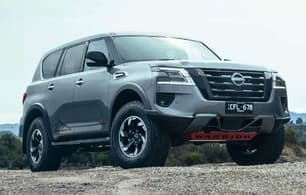
The entire 2025 Nissan Patrol range – including the Ti-based, Premcar-boosted Warrior – has undergone a cabin update.
Changes include a new bigger touchscreen multimedia system, wireless charging and an off-road monitor.
The same V8 engine remains across the range so there are no changes to power and torque.
So, do these cabin tech updates make any kind of significant difference to the Warrior package?
The S4 and S5 range continues to represent a great formula for performance you can live with every day. They're arguably the sweetest balance Audi produces, actually. All come fantastically equipped, with cabins that feel truly special, and we’re lucky they can be had in a choice of five bodystyles.
The Nissan Patrol Warrior is a very capable 4WD, it’s a refined, comfortable all-rounder with plenty of potential as a touring vehicle.
PremCar’s work here – as on the Navara – has made a good 4WD even better.
All of that conversion work, engineering upgrades and fitment of accessories is the kind of sensible work an experienced 4WDer would apply via the aftermarket. The bonus here is that it’s all factory-backed and covered by a 10-year/300,000km warranty, albeit with conditions.
If you can cope with the fuel bills, this big V8 4WD remains a refreshingly old-school style of off-roader – relying more on sheer grunt than touchy tech – and the latest round of cabin updates has added more appeal to what is already a very appealing vehicle.
The S4 sedan and Avant have scored the bulk of design updates, with all new and recontoured side panels including the sedan’s C-pillar matching what was applied to the A4 earlier this year.
This is paired with new front and rear facias and lighting for a subtle but extensive rework of the fifth-generation S4’s conservative look.
The S5 Sportback, Coupe and Cabriolet get S5-specific new lighting and facias, but no sheetmetal changes. As before, the Coupe and Cabriolet ride on a 60mm shorter wheelbase than the Sportback, sedan and Avant.
The S5s also get Matrix LED headlights as standard which do a neat animated sequence when you unlock the car.
Other visual hallmarks include new S4-specific 19-inch wheels, with S5 stepping up to its own unique 20-inch wheel. The six-piston front brake calipers are appropriately painted red, and there’s S-specific adaptive dampers under there too. All variants aside from the Cabriolet get a lip spoiler on the rear.
On the inside, there’s a new centre console and bigger 10.1-inch multimedia screen, while the Audi Virtual Cockpit driver instrument display now offers a hockey stick-style rev counter in additional to traditional dial layouts.
The Nissan Patrol Warrior is 5269mm long (with a 3075mm wheelbase), 2079mm wide, 1990mm high and it has a listed kerb weight of 2858kg. It’s 94mm longer and 84mm wider than the Ti.
Though this latest round of range updates have been mostly limited to the multimedia system, that’s a-okay because this Warrior has more than enough heavy-shouldered presence on- and off-road and not simply because it’s a chunky behemoth.
While other large 4WDs, such as the Toyota LandCruiser 300 Series, have bowed to contemporary-taste pressure and become a bit softer around the edges, the Warrior retains some of the blocky stature of 4WDs past.
Inside, the interior has benefitted from the new bigger multimedia system which sits atop the dash and dominates real estate up front. The interior feels slightly fresher than in previous iterations, but still comfortably familiar.
The biggest practicality change among the five S4 and S5 variants is their upgrade to the latest version of Audi’s MMI multimedia system, which steps up to a 10.1-inch touchscreen and drops the scroll wheel from the centre console.
It also boasts ten times the computing power of the version it replaces and uses this and an on-board sim card to access Google Earth maps for navigation and Audi Connect Plus that offers driver information such as fuel prices and parking information as well as point of interest search and weather information, plus the ability to make emergency calls and seek roadside assistance.
There’s also a wireless phone charger, but using Apple CarPlay will still require a cord as per Android Auto.
I only drove the S4 Avant and S5 Sportback at their media launch, which are clearly the most practical of the five, but from our experience with the previous versions, each looks after its occupants well in terms of space and storage. Back seat accommodation is clearly not a priority in the Coupe and Cabriolet, but there’s three other variants if that’s what you’re looking for.
The Cabriolet can open its automatic folding soft top within 15 seconds, at speeds of up to 50 km/h.
The Warrior cabin is essentially a Ti interior – as such, it’s roomy and plush, with expanses of soft-touch surfaces. Due to plenty of ‘Warrior’ touches and the most recent updates as noted earlier, the cabin feels made-over yet instantly recognisable.
The centre console is no longer the confusion of buttons, dials and knobs it previously was and there are plenty of storage spaces for driver and front passenger – glove box, cupholders, bottle holders in the doors etc – as well as some concealed spaces (with pop-up lids) for keys, phone and other everyday carry gear.
Second-row passengers get comfortable seats, as well as two USB charge points, and temperature and fan controls in the back of the centre console. Those in this row also have access to the back of the centre console.
There are cupholders in the fold-down armrest, map pockets in the seat backs and bottle holders in the doors.
Second-row seats have a top tether point and an ISOFIX point on both outer seats.
Third-row seats are flat and hard compared to the other positions and, in terms of space, are better suited to children or adults for brief stints.
All three rows get air con – there are roof-mounted vents – and there are handy storage spaces in the third row, but no cupholders.
The third row has one top tether child seat anchorage point.
The rear cargo area has load tie-down points and a 12V socket, as well as tyre-changing tools under the floor. The new full-sized spare tyre is underslung at the rear.
With the third-row seats in use, boot space is listed as 467L. With the third row stowed away, there’s a claimed 1413L of cargo space. With the second and third rows stowed there’s a claimed 2623L.
As I mentioned above, the S4 and S5 line-up are in many ways the same, but also different, and these differences result in a price span of $20,500 between the S4 sedan and the S5 Cabriolet.
The former is now $400 cheaper with a list price of $99,500, with the also-$400 cheaper S4 Avant not far beyond at $102,000.
The S5 Sportback and Coupe are now $600 more expensive at an equal list price of $106,500, while the swish folding soft top of the S5 Cabriolet pushes it up to $120,000 (+$1060).
Equipment levels are consistent across all five variants aside from the S5s getting Matrix LED headlights as standard and one inch larger 20-inch wheels.
Key details include Nappa leather trim with front sport seats with seat heaters and massage function, a Bang & Olufsen sound system which spreads 755W across a total of 19 speakers, brushed aluminium inlays, head-up display, coloured ambient lighting, tinted windows and metallic paint.
Over the past 12 months, the S5 Sportback has proven to be the most popular of the five variants by far, accounting for 53 per cent of sales, with the S4 Avant next in line at 20 per cent, the S4 sedan making up 10 per cent, and the S5 Coupe and Cabriolet combining to make up the remaining 17 per cent.
The Nissan Patrol Warrior is a eight-seat 4WD wagon with a price-tag of $105,660, before on-road costs.
Standard features include a 12.3-inch touchscreen multimedia system (with wireless Apple CarPlay and Android Auto and sat nav), as well as a new 7.0-inch driver dash display, wireless charging and an off-road monitor.
Other features onboard include front and rear parking sensors, a 360-degree camera view and a tyre-pressure monitoring system.
The more than $15,000 worth of carried-over Premcar conversion work, upgrades and fitment of accessories include a re-engineered version of Nissan’s 'Hydraulic Body Motion Control' (HBMC) system, a 50mm total suspension lift with new springs front and rear increasing vehicle height to 1990mm (+50mm over the Ti), and increased ground clearance to 323mm (+50mm) and wheel track to 1735mm front and rear (+40mm).
Warrior-specific suspension modifications include not only the Warrior-tuned HBMC (front and rear) but front Warrior red springs, rear Warrior multi-rate red springs and Warrior rear bump-stop.
Exterior changes carried over into this Warrior iteration include a red Warrior-branded bash plate, front Warrior-embossed bumper valance, a black grille, Patrol Warrior decals, black side mirror caps, plus an upgraded exhaust system with bi-modal valve and a unique exhaust tip.
There's also a black flare kit (with grained finish), Warrior towbar (towbar cross member, tongue, harness only, all modified to fit the new, bigger full-size spare), two rear recovery points, Warrior rear bumper valance (with grained finish) and a black chrome tailgate Warrior badge.
The Warrior wheel and tyre package is the Yokohama Geolandar 15 All Terrain tyres (295/70R18) on 18 x 9 J cast-aluminium Patrol Warrior black machined-face alloy wheels.
The Patrol Warrior has a specially modified space for a full-size alloy spare wheel.
Inside, carried-over Warrior-specific touches include an Alcantara Warrior embossed garnish, clear-coated gloss black centre console and centre multimedia fascia as well as leather-accented and Alcantara door trim.
Exterior paint choices include 'Gun Metallic', 'Moonstone White', 'Brilliant Silver' and 'Black Obsidian'.
What you get in a Warrior for the price compares favourably, especially when cross-shopped with something like a GMC Yukon Denali, another eight-seat 4WD wagon with a V8 – as its price-tag is $174,990, excluding on-road costs.
Audi has taken an ‘if it ain’t broke’ approach with the mechanicals, with all S4 and S5 models unchanged with this update. So the centrepiece continues to be the single-turbocharged 3.0-litre V6 that produces 260kW and 500Nm, with the latter available from a broad 1370-4500rpm.
The rest of the drivetrain is also unchanged, with the venerable but excellent ZF eight-speed torque converter auto paired with the Quattro all-wheel drive system that can send up to 85 per cent of drive to the rear wheels.
The Warrior has a 5.6-litre V8 petrol engine producing 298kW and 560Nm, matched to a seven-speed automatic transmission.
This solid combination lacks a dynamic edge, but the Warrior produces such a supremely relaxed and assured delivery of power and torque – it feels almost lazy – that you forgive it for not being the zippiest thing around.
The Patrol has full-time four-wheel drive with high- and low-range and a rear diff-lock.
Official combined fuel figures range from 8.6L1/00km for the S4 sedan to 8.8L/100km for the Avant, Coupe and Sportback, while the heavier Cabriolet steps up to 9.1L/100km.
All are pretty good considering their performance potential and the size of these cars, plus the fact that they only require 95 RON Premium Unleaded fuel.
All have a 58-litre fuel tank, which should enable a range of at least 637km between fills based on the Cabriolet’s figure.
The Nissan Patrol Warrior has an official combined cycle (urban/extra-urban) fuel consumption figure of 14.4L/100km.
I recorded 21.4L/100km on this test. I did a lot of high- and low-range 4WDing – but the Patrol was never working hard.
The Patrol has a 140L fuel tank capacity, so going by our on-test fuel-consumption figure you could reasonably expect a full-tank driving range of about 654km.
The S4 and S5 range were already an excellent balance between everyday comfort and a genuine sporting edge, and nothing has changed with this update.
I spent time behind the wheel of the S4 Avant and S5 Sportback at their media launch, and both managed to deliver the proper Audi luxury experience over some pretty rough rural roads, while always feeling a bit more sporting than a regular A4 or A5. That’s with the Drive Select left in the default mode, but you can shift that sporting personality up a few notches (while scaling back the comfort), by selecting Dynamic mode.
My preferred means of adjusting their personality is by simply tugging the transmission selector back to activate S mode, which livens up the engine and transmission without stiffening up the suspension.
Across the five S4 and S5 bodystyles, there is some variance in performance potential, with the S4 sedan and S5 Coupe topping the performance chart with 0-100km/h boasts of 4.7s, with the S5 Sportback trailing them by 0.1s, the S4 Avant by a further 0.1s and the Cabriolet managing a still-fast 5.1s claim.
Another area I consider the S4 and S5s to get just right is their exhaust note. It is adaptive, but there’s nothing synthetic about it, and the generally muted and distinctly V6 burble is always there to remind you that you’re aboard a proper performance model, but not in such a way that it will annoy you, or your neighbours. Polite performance, if you will.
This latest update is cabin-centric so it’s brought no powertrain changes or any improvements to 4WD mechanicals or driver-assist tech. And that’s fine because the Warrior is pretty darned impressive, as is.
On-road and on dirt tracks, it’s all smooth sailing. The Patrol Warrior is tighter and more composed than its standard stablemates, and that's mostly due to its upgraded suspension and HBMC system.
HBMC acts as a sway bar and sway bar disconnect equivalent and combines with the Aussie-tuned suspension to rein everything in when you're on bitumen and loosen everything when you're on dirt or off-road.
The Patrol as standard is a nice wagon to drive, but the Premcar work undertaken to create the Warrior – all the conversions and upgrades – have made it that much better.
On the open road you have the opportunity to appreciate just how comfortable and refined the Patrol Warrior is.
And as for 4WDing, well, the Warrior is a Patrol at heart so it has reliable four-wheel drive mechanicals, plenty of torque over a broad rev range and a rear diff lock.
There's more ground clearance in the Warrior over the Ti at 323mm (+50mm ), so approach (40 degrees) and departure angles (23.3 degrees) are an improvement over the standard Patrol.
The Warrior’s tyres – Yokohama Geolandar 15 All Terrain tyres (295/70R18) – are bigger and offer more grip, so they provide plenty of traction on terrain where a standard Patrol may struggle.
Premcar has modified the towbar position to accommodate the new bigger full-size spare wheel and tyre.
Another good thing is the fact the Patrol Warrior has two recovery points at the rear.
The HBMC system, which performs so seamlessly on-road, provides more articulation off-road, as well as a bit more wheel travel through difficult terrain.
And, as I’ve noted before on other tests, one of the impressive points about Premcar’s work here – the conversions, the modifications, the engineering upgrades and the fitment of accessories – is that it’s all the kind of common-sense upgrades an experienced 4WDer would apply to their Patrol.
But, even in something this impressive, the news is not all good.
The Warrior is a big vehicle and at 2858kg you have to drive it with that in mind, all the time. It fills the trail and with its wider wheel track, you have to be focused on wheel placement, even more so than usual.
The bi-modal exhaust is awesome, but those exhaust caps (underneath the Warrior's right-hand side step) are too vulnerable to damage.
They compromise the vehicle's ramp-over angle, so you have to drive with careful consideration, especially if the Warrior rocks even slightly to the right-hand side going up or down a steep rocky hill, because there’s a risk of grinding those exhaust tips against rock steps, dirt or a tree stump.
The Patrol is a towing platform of note and towing capacities remain as 750kg (unbraked) and 3500kg (braked).
The Warrior's GVM (gross vehicle mass) at 3620kg is 120kg more than the Ti Patrol’s.
All S4 and S5 variants boast an impressive array of safety features, but there’s some interesting points when it comes to ANCAP ratings. Only four cylinder A4 models (therefore not S4) were given a maximum five star rating when tested according to less stringent 2015 standards, but all A5 variants (therefore S5) aside from the Cabriolet carry a five star rating based on the tests applied to the A4. So officially, the S4 is not rated, but the S5 Coupe and Sportback are, but based on the A4 rating that doesn’t apply to the S4. As with most convertibles, the Cabriolet is simply not rated.
The airbag count totals eight in the sedan, Avant and Sportback, with dual front airbags, plus side and curtain airbags covering front and rear.
The Coupe drops the rear side airbags, while the Cabriolet also drops curtain airbags, meaning there’s no airbags for rear seat occupants. The roof is made of folding fabric, there has to be some safety compromise.
Other safety features include front AEB that works up to 85km/h, adaptive cruise control with traffic jam assist, active lane guidance and collision avoidance assist that can automatically swerve, a 360 degree camera system, rear cross-traffic alerts, exit warning that can prevent you opening a door into an oncoming car or cyclist, and pre sense rear that can detect an impending collision from behind and prepare the seatbelts and windows for maximum protection.
The Nissan Patrol range does not have an ANCAP safety rating because it has not been tested.
That said, as standard it has dual front airbags, front-side and curtain airbags that cover all three rows, as well as two ISOFIX points and two top tether points in the second row.
Driver-assist tech includes AEB, rear cross-traffic alert, lane-departure warning/intervention, blind-spot warning/intervention and adaptive cruise control.
Audi continues to offer a three year, unlimited kilometre warranty, which is in line with BMW but lags behind the five years offered by Mercedes-Benz these days. This also contrasts with the five year norm among mainstream brands, which is punctuated by the seven year warranties of Kia and SsangYong.
Service intervals are a convenient 12 months/15,000km though, and the same five year ‘Audi Genuine Care Service Plan’ offers capped price servicing for the same $2950 total over five years applies to all S4 and S5 variants. This is only marginally more than the plans offered for regular petrol A4 and A5 variants, so you’re not being stung for the thoroughbred versions.
All new Patrols have a 10-year/300,000km warranty when the vehicle is serviced with Nissan and the Premcar work is covered for the same amount of time – with the same conditions applied.
Five years of roadside assistance also applies – with the same conditions.
Servicing is scheduled at 12 month/10,000km intervals, and capped price service rates apply for five years. That means each of the first five services will cost you $499.