What's the difference?
Spoilt. That's what we are. If you're in the market for a hot hatch, you can have your pick of German-built and French ones from as little as $27,000. There isn't a dud among them now that the VW Polo GTI has had a bit of an update and you can pick and choose your style. Audi's S1 is aiming to be king of the kids with its stiffly-priced S1.
Set the finances aside and consider for a moment what's on offer. As it turns out, a lot.
The Audi Q8 has had a mid-life upgrade and it brings a few minor tweaks to the design, technology and equipment.
Plug-in hybrids tend to rank a little lower on my excitement scale when it comes to available powertrains because I usually find the constant charging inconvenient.
However, the electric driving range of the 60 TSFIe quattro S Line grade has been bolstered by 27km, increasing it to 74km overall.
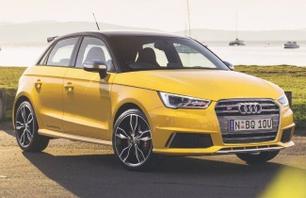
Cars this small shouldn't be this fast and useable at the same time, but the Audi S1 is. It isn't without its problems - the ride is harder even than the Fiesta ST which might weary some prospective buyers.
It's also a bit difficult to justify the price - in its basic form it's missing a few creature comforts that you'd expect in a $50,000 car - reversing camera, high-res screen, that sort of thing.
However, in the hot hatch world, those things don't matter. It has the bragging rights, the tech and the outright blinding speed to take on the bonkers Focus ST and equally zany Megane RS. And even the Audi S3.
The updated Audi Q8 60 TFSIe quattro S line still looks good inside and out. It fits a family comfortably without feeling too big and there’s enough here to satisfy those who like the luxury features.
It's price tag will hurt it but the improved power outputs and driving range is a big plus and makes the plug-in hybrid powertrain make more sense.
The A1 is so small it starts to strain Audi's design language. When you cram on the S-style bumpers and raccoon-eyed trim on the hatchback, it's starts to look a bit busy.
It isn't quite a shrink-wrapped A3 - Ingolstadt's designers know better than that - but it's full of Audi design cues, such as the strong, light-catching character lines, distinctive LED daytime running lights and fondness for big wheels.
Inside is along the themes of the A3, with what are becoming Audi's trademark; round eyeball air-con vents, the manual fold-down screen familiar to Q3 owners (but smaller) and a good clear dash. The handbrake jars slightly as it feels cheap to hold and wobbles a bit.
The S Sport seats are big and comfortable, and the top half of the backs are capped in plastic, which was colour-coded on our car. The rear passengers will certainly get an eyeful of whatever terrifying hue you've chosen, so choose wisely.
Despite the five doors, the back seats are occasionals, like the Mini the A1 is gunning for, and the boot is very small, but okay for shopping for couples or singles.
When it comes to style, the Q8 60 TFSIe quattro S line has it in spades. Featuring a design that looks athletic with its long lines and wide stance, you'll always be proud to hop into it.
Red calipers now come standard and they look awesome on the optioned 22-inch alloys. The update sees a redesigned front with new grille and reshaped matrix LED headlights and a 2D badge design.
While SUV coupes aren’t usually my jam, the Q8 manages to tick the 'sexy' box.
The interior is honestly the same and only die-hard fans will notice the new menu screens on the multimedia system. The cabin is a fine example of what a luxury SUV should look like because its polished, well-built and sumptuous but it has the classic Audi edge, so there is still a sporty vibe going on.
The panoramic sunroof adds some airiness to the otherwise dark cabin and the Valcona leather upholstery is liberally splashed about, so most of what you touch feels premium and soft.
Starting at $49,900, Audi S1 is by far the priciest of the small-hatch based hotties, at least until Mini's madcap JCW arrives. This price is just almost double that of VW stablemate's forthcoming 2015 Polo GTI.
Standard on the manual-and-five-door-only S1 is a ten speaker stereo, climate control, ambient lighting, remote central locking, cruise control, satnav, headlight washers, auto headlights with xenon low beams, partial leather seats, leather-bound steering wheel, auto wipers and rear parking sensors.
Our Misano Red ($990 option) came with two extra packs. The Quattro Exterior Package ($3990) adds bi-xenon headlights with red trim, red brake calipers, spoiler, quattro logos on rear doors (ahem!) and five-spoke 18-inch alloys that are part matt black, part polished.
The Quattro Interior Package ($2490) adds S Sport front seats with Nappa leather and red backrest capping with quattro logo (ugh), more nappa around the cabin with contrast stitching, flat bottom steering wheel and red rings on the air vents.
There's an S Performance Package that brings the best of these two packs together for $4990, saving about $1500 and the embarrassment of the quattro logos.
Our test car also had aluminium air vents ($220), black contrasting boot lid ($300) and black roof ($720).
The A1 is so small it starts to strain Audi's design language
The grand total is a sobering $58,610. There's a couple more options that'll easily pop you over $60,000.
Audi's MMI is dash-mounted in the A1 as there's no room on the narrow centre console. As ever, it works well and doesn't take much getting used to. The satnav is a bit grainy on the smaller screen but is otherwise a competent unit.
Sound is from a ten-speaker stereo and you can stream across Bluetooth or plug in a memory card. The sound was good but the system did take a while to find the phone whenever we came back to the car.
There are three Q8 grades before you hop into the flagship SQ8 performance model, and the variant on test for this review sits second from the top.
The mid-life refresh sees pricing increased across the entire range and adds over $1700 to the (already steep) $154,284 MSRP price tag.
Compared to its plug-in hybrid rivals, the BMW X5 xDrive50e and Volvo XC90 Recharge Ultra T8, the 60 TFSIe quattro S line slides in as the most expensive.
Our test vehicle has also been fitted with a few extra items like 22-inch alloys, metallic paint and a luxury seat package, which adds ventilation function to the front seats and heated rear outboard seats. It does tack on $9900 to the overall price tag, though.
The 10.1-inch multimedia system remains and while it sits on the smaller end compared to some of its rivals now, it does get an updated layout and apps for 2025.
Other standard equipment includes a panoramic sunroof, matrix LED headlights, heated side mirrors with memory, keyless entry and start, a powered tailgate, heated front seats, electric lumbar support, three-zone climate control, electrically adjustable steering wheel, electric auto cargo cover, and a tyre repair kit.
The technology is the standout with a 17-speaker Bang & Olufsen sound system, wireless Apple CarPlay and Android Auto, digital radio, as well as built-in satellite navigation, a 12.3-inch digital instrument cluster and colour head-up display.
You also get an Audi Connect plus app which allows remote access for security and assistance services including car finder with remote signal, remote lock and unlock, emergency call, and online roadside assistance.
Does the PHEV Q8 offer good value? Value is relative, the features list is fairly robust but it’s hard to ignore that this PHEV sits $10K above its internal combustion siblings.
This is where the action is. The S1's tiny body packs a 2.0-litre turbocharged four-cylinder producing 170kW and 370Nm of torque. The S1 will streak to 100km/h in 5.9 seconds thank to the traction aid of quattro all-wheel drive.
All Audi S1s come with a six-speed manual
Despite a pretty solid hammering during its week with us, including more time than we'd have liked in Sydney traffic, the stop-start function helped deliver a pretty reasonable 10.2L/100km, however that's a long way over claimed 7.1L/100km.
All Audi S1s come with a six-speed manual, so dual-clutch haters can save the whining. The only downside from not having a self-shifter is the ECU can't deliver the boy racer farts, parps and crackles of the other S cars.
The Q8 60 TFSI e is AWD and has a 3.0-litre V6 turbo-petrol plug-in hybrid powertrain for a combined power output of 360kW and 700Nm of torque.
The power output has increased by 20kW with the mid-life refresh and that shaves 0.4 seconds off the 0-100km/h sprint time bringing it down to just 5.0 seconds. So it’s a quick and powerful SUV.
The powertrain is paired with an eight-speed automatic transmission which is mostly smooth and the switch between petrol and electric is fairly seamless.
As far as plug-in hybrids go, everything seems to work well here.
If you're buying the S1 as a comfortable urban runabout with a cool badge, you're half right. While the seating for front passengers is certainly supportive, the hard suspension tune will ensure you're well aware of road surface imperfections.
The S1 is a rocket
Thankfully, what it missed out on in the ride department it makes up for in every other way - the S1 is a rocket. The 2.0-litre turbo jammed under the bonnet has almost no lag and is paired with a slick six-speed manual that is terrific fun to manhandle through the gears.
The way the S1 picks up speed when it's on boost is addictive and licence-endangering. A flattened accelerator in second or third will obliterate just about anything this side of $100,000 and you'll be having more fun in this than big brother S3 because the chassis is more adjustable and there's a bit more life.
You can hear the turbo sing to accompany the bassy exhaust growl. Hit the massive brakes hard and the car remains stable even over rutted roads. Turning the wheel brings almost-instant turn-in, mashing the throttle again a fun little wriggle. It's superb.
It's tremendous fun point-to-point on a twisty road
You'll have to be a bit patient with the throttle to get the wriggle, though - give it too much too early and it will want to push wide, the quattro system shuffling power around to try and quell understeer while the electronic diff fiddles with the braking system to do the same thing. It gets there in the end, but you're better off meting out the power with your right foot for maximum rewards.
It's tremendous fun point-to-point on a twisty road - despite being a bit heavy for its size (1415kg), it's as chuckable as the next best thing, the Fiesta ST.
The Q8's athletic looks are matched by its on-road handling. The power has a hefty kick that’s effortlessly delivered once you’re up to speed. It did have a few confused moments when I had to accelerate quickly from a full stop - the lower gears didn’t immediately engage and I got a proper bunny hop but it was short lived and for the most part the powertrain delivers the goods.
The adaptive air suspension makes for a comfortable ride despite the massive wheels and you can comfortably cruise around town or the highway without much jostling.
Cabin noise is minimal around town but you get a low hum of road noise at higher speeds. Overall, it's still a refined cabin space to spend a lot of time in.
I do miss hearing some of the engine thrums though because even when the battery is depleted, you don’t get a lot of engine feedback. It certainly adds to the refinement but it loses some of the fun.
The higher driving position feels comfortable and visibility is quite good. Steering is responsive and feels sporty with lane changes but its 13.3m turning circle lets it down in car parks.
The 360-degree view camera system is clear and this has multiple parking sensors. In theory parking should be easy but again, until you get used to that bigger turning circle it can feel clumsy in smaller spaces.
Six airbags, stability and traction control, ABS, brake assist and distribution all add up to a five star ANCAP rating.
The PHEV Q8 variant is unrated with ANCAP as it’s not covered by it’s siblings' five-star rating from 2019, but it does have a lot of standard safety features like eight airbags, including side chest airbags for the front and rear passengers. Surprisingly, it misses out on a front centre airbag though.
A standout feature is the safe exit assist which will delay your door from opening if it detects a car or cyclist. Always a handy thing when you have a kid like mine who can carelessly throw open their door.
There is also a ‘pre-sense’ feature where the car detects that you’re approaching traffic at lights or a roundabout and it will automatically start slowing down for you, which I quite liked.
Other standard features include adaptive cruise control with stop and go, lane keeping aid, lane departure warning, blind-spot monitoring, forward collision warning, rear cross-traffic alert, driver attention monitoring (sound and visual alerts), 360-degree view camera system, front and rear parking sensors, tyre pressure loss indicator, intelligent seatbelt reminders, first aid kit, hi-vis vests and a collapsible warning triangle.
The autonomous emergency braking (AEB) has car, cyclist and pedestrian detection and is operational up to 85km/h (up to 250km/h for cars).
There are two ISOFIX child seat mounts and three top tether anchor points. The rear seat is wide enough to accommodate three child seats side by side.
The safety systems feel well-calibrated and are not intrusive for daily driving. In a world when cars seem to chime an alert for everything, this is a welcomed plus.