What's the difference?
Audi's A5 Coupe and Sportback have always been good looking cars. Yes, yes, beauty is in the eye of the beholder and all that, but seriously, just look at one and tell me it's not handsome.
Happily, the just-updated RS5 doesn't just build on the looks of its more sedate sibling, but on the performance, too, adding near-supercar speed to those supermodel looks.
Sounds like a pretty good match, right? Let's find out, shall we?
If you think it’s a Mercedes-Benz A-Class you want or maybe an Audi A3 Sportback or even a Volkswagen Golf, then stop and read this first before making a purchase.
The BMW 1 Series alternative isn’t just another prestige little car, because there are some fundamental differences between this 1 and those others, and they could cause you to totally rethink your decision.
If you’re already keen on getting a 1 Series then you need to read this, too, not only to help you find the right one, but also to alert you to what might be a couple of uncomfortable truths.
Good looking, good to drive, and good to simply sit in, the Audi RS5 range ticks plenty of premium boxes. Whether you can live with the practicality pitfalls of the Coupe is up to you, but if you can't, might I suggest taking a wander over to our RS4 Avant review?
I’m the first to say the 1 Series is kind of the ugly duckling of the BMW family, but those looks grow on you, especially when you consider that this is exactly what a BMW hatch should look like. That this is one of the only rear-wheel-drive hatches left on the planet makes it even more special – and of course engaging to pilot. The downside is the price and the lack of value from a features perspective, plus safety could be bolstered with more technology. Still, anybody who likes to drive will commend you on your choice of a BMW.
I defy anyone to describe the RS5, and especially the Coupe, as anything but stunning. Seriously, the near perfect proportions and swept-back styling make it look fast even when it's parked.
Up front, there's a new-look black-mesh grille that's been given a 3D effect, like it juts out over the road in front it, while the thing headlights have been carved back into the body work like they're been windswept under hard acceleration.
The 20-inch darkened alloys fill the arches, too, with a sharp body crease that runs from the front headlight all the way back to the bulging shoulder lines above the rear tyres accentuating the curves.
Inside, the RS5 is a sea of black Nappa leather and sporty touches, and we particularly like the chunky, flat-bottomed steering wheel, which both looks - and feels - great.
The 1 Series looks exactly how a BMW hatchback should. I know that sounds silly but what I mean is BMW could easily have designed something that was proportioned more like other hatches; that popular sort of bubble on wheels.
Instead, what you have is a hatch that retains BMW’s traditional attributes – there’s the long nose, the cabin set back, the high sides and the wheels placed almost at the very corners.
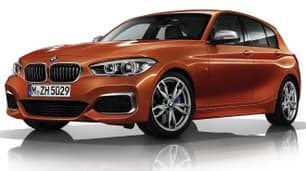
Seriously, look at the image of the orange 1 Series side on, now hold your out your hand and use it to cover just the windows – see, it looks just like a BMW 2 Series convertible. Does it look good? To me it does, right up until you get to the hatchback, and then it looks a bit awkward. But I do admire BMW’s designers for creating something unique looking.
That orange 120i ('Sunset Orange' is the official colour) is the most recent 1 Series I’ve tested. Those wheels aren’t standard, they’re 18-inch M ones and they are part of the optional 'M Sport Package', which also includes the body kit, complete with side skirts and the lower grille in gloss black.
The 1 Series is as affordable as BMWs get, but it’s still a real BMW. The cabin, for example, looks much like every BMW, only smaller.
There’s the large, slab-like dash with the display sitting atop, below are the air vents and below that is the radio and then the climate-control dials. It’s a stack that’s kept its familiar order and shape on nearly all BMWs for what seems like forever.
The centre console has a similar layout as the one in a 3 Series or 5 Series or any Series, with the shifter and rotating media controller. Even the doors have the same design as those cars higher up in the BMW family, with the big moulded pockets and large pull handles.
The cabin isn’t as ‘blingy’ as the new Mercedes-Benz A-Class, but it’s not as plain as the Audi A3.
That steering wheel is part of the M-Package too, but the leather upholstery is a separate option.
The signs that this isn’t a more expensive BMW are the manual handbrake, the compact instrument cluster with analogue dials, the small dash-top display and the fact that there’s a lot less real estate to be covered by trim pieces and material, which doesn’t have the same high-quality feel as those fancier models.
The cabin isn’t as ‘blingy’ as the new Mercedes-Benz A-Class, but it’s not as plain as the cockpit of an Audi A3 – it’s somewhere in between; refined and well designed.
At 4.3m end to end, the 1 Series is 16mm shorter that the A3 Sportback and 20mm narrower, at just over 1.7m across.
We only tested the Coupe, and I can tell you that the practicality perks on offer largely depend on where you're sitting.
Up front, you're spoiled for room in the two-door Coupe, with the two spacious seats separated by a sizeable centre console that's also home to two cupholders and a variety of cubbies, with extra bottle storage in each of the front doors.
The back seat, though, is a little, or a lot, tighter, with come acrobatics required to even climb into it, given the Coupe only has two doors. The Sportback offers two more doors, which will surely make the process a little easier.
The Coupe measures 4723mm in length, 1866mm in width and 1372mm in height, and will deliver a decent 410 litres in luggage space in the boot. The Sportback measures in at 4783mm, 1866mm and 1399mm, and boosts your luggage space to 465 litres.
Either vehicle has your tech needs sorted, with an abundance of USB and power outlets serving both front and backseat riders.
The 1 Series’ boot has a cargo capacity of 360 litres, which is more than the boot space of the Audi A3 Sportback (340 litres) but less than the new Mercedes-Benz A-Class’s 370 litres of luggage room.
What does that mean in real-world terms? It’s not a lot of space, and you might struggle to get a pram in, so check that beforehand if you have small ones. That said, there was enough room for two carry-on sized bags, a computer bag and a scooter when my wife and I went on a weekend away with our four year old.
Space in the second row is also limited. Headroom isn’t too bad, but at 191cm tall I can’t sit behind my driving position without my knees digging into the seatback. I can just fit back there in the A3 and I have even more room for my knees in the A-Class.
Room up front is good with plenty of shoulder, head and elbow room for somebody my size.
Storage could be better: you’ll only find cup holders up front (two of them), the centre-console storage bin is small and so are the door pockets in the rear, but all is not lost because the door bottle holders in the front are massive, the glove box is a decent size and there are nets on the backs of the front seats.
It’s good to see directional air vents in the second row and a 12V power outlet, but there aren’t any USB ports back there – if you want to plug in a device there’s only one and it’s up front, along with another 12-volt outlet.
The rear doors appear large from the outside but the aperture to get in and out isn’t huge – again look at the images to see what I’m on about.
It's available as a Coupe or a Sportback, but either way, the RS5 commands a $150,900 asking price. And that's not chump change, but Audi's performance model does come with a lot of bang for those bucks.
We'll get to the engine and safety stuff in a moment, but in terms of fruit, you'll find 20-inch alloys outside, as well sportier RS body styling, sport brakes, Matrix LED headlights, keyless entry and push-button start and heated mirrors, a sunroof and privacy glass. Inside, there's Nappa leather seats (heated in the front), illuminated door sills, stainless steel pedals and ambient interior lighting.
The tech stuff is handled by a new 10.1-inch central touchscreen that gets both Apple CarPlay and Android Auto, as well as Audi's Virtual Cockpit, which replaces the dials in the driver's binnacle with a digital screen. There's also wireless phone charging, and a killer 19-speaker Bang and Olufsen sound system.
So, it’s a little BMW, does that mean the price is little? Nope. It’s like asking if a little Rolex is cheap. it might be cheap for a Rolex, but not for a watch in general, and it's the same for the 1 Series.
The 1 Series range starts at $39,990 for the petrol 118i, while its 118d diesel twin is $44,990. Both come with the standard Sport Line package, which adds 16-inch light alloy wheels and LED headlights, while in the cabin it brings cloth upholstery, sports seats and a leather sports steering wheel, high-gloss black trim and BMW scuff plates. Other standard features include a 6.5-inch display, with sat nav, reversing camera, six-speaker stereo, a digital radio and air-conditioning.
The 125i is only a tempting $3000 above the 120i at $49,990 and comes standard with the M Sport Package
For another $7000 you can get into the 120i grade, which lists for $46,990 and comes standard with the Urban Line package, which fits 17-inch alloy wheels in the double-spoke style, adds front and rear bumpers with matt finish air intakes, plus dual chrome tail pipes, while the cockpit gets leather upholstery, and gloss-black and pearl-effect trim.
Along with the Urban Line gear, the 120i has all of the 118i’s standard features and adds more of its own, including front and rear parking sensors, LED fog lights, dual-zone climate control, the interior lights package, plus smart phone connectivity with voice control.
The 125i is only a tempting $3000 above the 120i at $49,990 and it comes standard with the M Sport Package, which is what our most recent test car was fitted with (see the images of the orange 120i). The M Sport pack adds 18-inch light-alloy wheels and the tough body kit, the M Sport steering wheel and aluminium trim to the interior.
Apart from the M Sport package, also standard is an 8.8-inch screen with a DVD player and, somewhat disappointingly, cloth and Alcantara seats. Sure, they look nice, but how did the 120i get real leather and the 125i didn’t?
Still the 125i comes with more impressive performance hardware than the grades below, such as sports suspension, variable steering, M Sport brakes (inner vented rear discs) and blue calipers.
At the top of the 1 Series range is the M140i and while it’s getting into pricey territory at $59,990 (don’t forget that’s not including the on-road costs), you are getting what I’m predicting will be a sought after car in years to come. And possibly even a collector's item.
The M140i isn’t a fully fledged M car – it’s a diet version from the M Performance section of BMW, which gives cars a bit of a taste of the hardcore world of beasties like the M2 and M3, without costing as much or being quite as brutal to drive.
I’ll talk about the high-performance parts more in the sections on driving and engines, but briefly, you might like to know the M140 gets adaptive suspension and a six-cylinder turbo petrol engine – yes in a tiny hatch. Powerful.
The price is bang-on compared to rivals such as the new Mercedes-Benz A-Class and Audi A3
The M140i also has the standard features of the 125i and adds its own, such as the 18-inch alloy wheels, black chrome tail pipe, adaptive LED headlights, leather upholstery, keyless entry, power front seats and a Harmon/Kardon 12-speaker stereo.
So, is the 1 Series good value? The price is bang-on compared to rivals such as the new Mercedes-Benz A-Class and Audi A3 (click those to see my reviews of them, too), but the 1 Series gets less in standard features compared to the Benz (such as Apple CarPlay) and about the same level of equipment as the A3.
If you’re a fan of black and white, you might be relieved to know these are the only two colours you won’t have to pay for. The rest, including Sunset Orange (see the images), Seaside Blue, Melbourne Red, Glacial Silver and Mineral Grey cost $1190.
Its a terrific engine, this - a twin-turbo 2.9-litre six-cylinder TFSI that will deliver 331kW at 5700rpm and 600Nm at 1900rpm, sending it thundering to all four wheels (because quattro) via an eight-speed tiptronic automatic.
That's enough, says Audi, to deliver a 0-100km/h sprint time of 3.9 seconds in the Coupe and the Sportback. Which is very, very quick.
As you step up through the grades the engines become more powerful. The entry-grade 118i has a 1.5-litre three-cylinder turbo-petrol making 100kW of power and 220Nm of torque, while its diesel twin has a 2.0-litre turbo-four making 110kW and much more torque at 320Nm.
The 120i has a 2.0-litre turbo-petrol four-cylinder and an output of 135kW and 270Nm. Then above that is the 125i, which is getting into performance territory with its 2.0-litre turbo four petrol making 165kW and 310Nm.
But all hail the M140i and its beautiful 3.0-litre six-cylinder turbo-petrol, with 250kW and 500Nm that it wants to share with you.
All cars are rear-wheel drive and all have an eight – hang on, that’s important: all cars are rear-wheel drive. Do you know how many other hatchbacks are rear-wheel drive? Try next to none – not the A-Class, not the A3, not the Golf. Rear-wheel drive is favoured for performance cars because it offers better balance and better acceleration thanks to the weight shift to the rear of the car. BMW has long claimed that RWD is one of the keys to its "sheer driving pleasure".
Now let me finish the sentence... all have an eight-speed automatic, and it’s a beauty – a little slow, but smoother for driving than a dual clutch, and way more fun than a CVT.
But wait, because there’s a manual gearbox, too. It’s a no-cost option and you can get it on any variant apart from the 125i.
The RS5 Coupe will sip a claimed 9.4L/100km on the combined cycle, and emit a claimed 208g/km of Co2. It's fitted with a 58-litre fuel tank.
The RS5 Coupe will the same 9.4L/100km, but emit 209g/km of Co2.
BMW says its most efficient petrol engine in the 1 Series range is the three-cylinder in the 118i, which uses just 5.2L/100km after a combination of urban and open roads.
The diesel unit in the 118d will use 4.2L/100km. Let that sink in for a moment – petrol engines are becoming so fuel efficient that they’re rivalling diesels, which have long been lauded for their frugality.
So don't just buy the diesel just because it’s more efficient, because you may never recoup the extra money you paid over the 118i.
Thirstier but still super-efficient is the 2.0-litre in the 120i. BMW’s claim is 5.9L/100km. During my week with the 120i I put 413km on the clock and used 15.57 litres doing so (measured at the pump), which comes to 7.7L/100km. The car’s computer said 7.8L/100km.
That’s great fuel economy, even if it is higher than the claimed figures. The 125i’s official fuel consumption is also 5.9L/100km.
It’s not surprising that the M140i, with its 3.0-litre six-cylinder turbo-petrol engine, is the least fuel efficient but its official figure of 7.1L/100km is still low.
With our time behind the wheel limited to the RS5 Coupe, we can only really report on how the two-door feels on the road, but given the prodigious power on offer, it's unlikely the addition of two doors is going to make the Sportback any slower.
In short, the RS5 is thunderously fast, collecting speed with utter nonchalance thanks to this thick and endless-feeling supply of power unleashed whenever you plant your right foot.
It makes even the most ham-fisted attempts at cornering feel fast as lightning, with the power flow able to make up for every slow entry and exit by simply piling on pace between bends.
But that's what you expect from an RS model, right? So perhaps more impressive is the RS5's ability to transform back into a relatively sedate urban cruiser when the red mist subsides. The suspension is firm, especially over rough road surfaces, and you do need to be a little careful with the accelerator to avoid that lurching feeling at every green light, but driven calmly, it doubles as a everyday car quite nicely.
Like in the RS4, we did find the gearbox felt a little quick to change at pace, shifting up or down at strange moments on the way into or out of corners, but you can reclaim control via the paddle shifters.
If I could run into a showroom and take whichever 1 Series I wanted it’d be the M140i – and not just because it would give me the best chance of outrunning the police after they discovered the break-in, but because the thing is so much fun to drive.
It’s also the most expensive, of course, but it’s worth it for that screaming straight six and for its agility.
You’ll have fun, though, in every grade of the line-up – they’re all engaging to pilot with great driving positions, good pedal feel and that eight-speed auto is smooth in traffic yet will shift hard when you have your race face on.
You might find the 118i, with its three-cylinder, a little under powered, especially with five people and their bags on board. If you’re keen on this grade, then consider the diesel, which will give you more torque. Our 120i test car proved to have enough oomph for overtaking and moving quickly when needed.
The 125i is less tame, with its throatier exhaust note, firmer ride and better handling thanks to the M suspension.
If you plan on choosing the M Sport Package for, say, the 120i keep in mind that you’ll lose the comfortable ride these cars have on their standard tyres.
Our 120i had the pack and while the body kit looks tough, the 18-inch alloy wheels shod in low-profile rubber (225/40 R18 Bridgestone Potenza 5001s front and 245/35 R18 at the rear) meant the ride was overly jarring on bad roads.
Given that Sydney was my test bed for the 120i and its roads are shocking, the ride was less than comfy. The M-sport suspension will only make the ride less comfortable, but in return you’ll have a 120i with better handling.
Run-flat tyres are common on BMWs and you may have heard of a few issues surrounding noise and a harsher ride. While that can be true, it's the price you pay for having a tyre you won’t immediately have to change if you get a puncture. Only the 120i and the M140i don’t have run-flats as standard.
The safety story begins with six (Coupe) or eight (Sportback), and the usual suite of braking and traction aids, but then climbs into the tech-savvy stuff from there.
You get a 360-degree camera, adaptive cruise with stop and go, active lane assist, front and rear parking sensors, AEB with pedestrian detection, rear cross-traffic alert, an exit warning system, blind-spot monitoring and turn assist, which monitors oncoming traffic when making a turn.
It's a lot of gear, and it all contributes to Audi's five-star ANCAP safety rating, awarded in 2017 to the A5 range.
The BMW 1 Series has the maximum five-star ANCAP rating, but this was awarded in 2011 and a lot has changed since then – particularly expected levels of safety.
BMW has updated the advanced technology to keep up with AEB (city) with pedestrian detection and lane-departure warning standard on all grades. It would be good to see more safety tech in the form of blind-spot warning, rear cross traffic alert and lane-keeping assistance.
For child seats you’ll find two ISOFIX mounts and three top tether points across the rear row.
A spare tyre is not something you will find – all apart from the 120i and the M140i have run flats, while those two have puncture-repair kits.
Audi vehicles are covered by a three-year, unlimited-kilometre warranty, which is feeling more than a little underdone when compared to some competitors.
Services are due every 12 months or 15,000kms, and Audi allows you to pre-pay your service costs for the first five years, at a cost of $3,050.
The 1 Series is covered by BMW’s three-year/unlimited kilometre warranty. Servicing is condition-based – the car will let you know when it needs a check-up.
BMW offers two service packages, which cover the car for five years/80,000km: the Basic is $1340 and the Plus costs $3550.