What's the difference?
It's the end of the line for that Audi A4 as we know it. In saying goodbye to the ‘B9’ generation A4 that launched in 2015, we welcome the Audi RS4 Competition Plus.
It is the most hardcore example of the breed yet, sitting lower to the floor with hard-edged gear changes, lightweight wheels and snuggly bucket seats. You can also get it in swoopy RS5 Sportback guise.
Audi is only bringing 75 units of each down under as a swan song for the B9 generation RS4 and RS5 before the even-numbered model moves into its all-electric future.
As we’ll go on to discover, these two special models see the A4 and A5 bow out in style.
I'm calling it - the Volkswagen Passat is the forgotten hero of station wagons.
It's surprisingly large while retaining the creature comforts and understated styling of old-world glamour.
Then enters the R-Line. A badge that diehard Volkswagen enthusiasts know is synonymous with sporty performance and handling.
However, it can be overlooked for its more affordable rivals, the Mazda6 and Skoda Octavia wagons.
But does affordability take it out of the running for the family market? Or is this the answer for the drivers who don't want to compromise on performance but still have a kid (or three) to throw in the back?
I've been hauling my little family of three around town this week to see what the big blue wagon could do.
What a way to send off this generation of Audi RS4 and RS5. The extra focus courtesy of those trick coil overs and drama from the exhaust plus the sharper gear changes deliver the best Audi has done with these RS products.
There are some compromises, with the suspension favouring outright control over low-speed comfort. It’s also true that the current BMW’s M3 and M4 are more impressive, but when the products are nearly seven years fresher than Audi’s, what do you expect?
Plus, those looking for a more restrained and polite fast executive sedan (or wagon) will gel with the Audi’s sophistication. There aren’t many of these Competition Plus RS4 and RS5s coming to Australia and they are impressive visually and from behind the wheel. It’s a fitting way to send off the current generations.
Note: CarsGuide attended this event as a guest of the manufacturer, with accommodation and meals provided.
I so enjoyed driving the Volkswagen Passat 206TSI R-Line. It's a roomy wagon that should fit a lot of different types of families. It still has sporty performance that will entice even the most reluctant family car buyer, so don't be turned off by its large proportions! I really like the comfort, convenience and handling of this one, so it gets an easy 8.0/10 from me.
My kid thought the blue colour was cool and loved having so many things to play with in the back seat. His only complaint was about the heavier doors but he still managed. He gives it an 8.0/10, too.
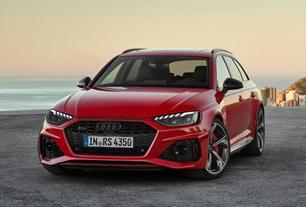
The RS4 Avant’s 'Progressive Red' metallic helps the black milled 20-inch alloy wheels pop. Its stance is hugely purposeful with wheels tucked right up in the blistered arches courtesy of the lowered ride height — it's how the Avant would have looked in a design sketch.
The visual bulk of the long-roofed RS4 gives it the sort of proportions motoring journalists love to wax lyrical about, even if plenty of buyers still prefer coupes or lifted SUVs.
The RS5's more flowing, elegant lines match well with the Navarra Blue paint work, silver-accented wheels and conventional leather-appointed seats within.
Both cars have effectively identical front cabins reflecting Audi’s classy and sleek design language. The integration of technology is pretty good and the RS4’s additional red styling pack really makes it feel sporty within.
The Passat is a large car and stands at 4708mm long, 1832mm wide and 1504mm high. The boxier rear and long nose make these proportions feel even larger.
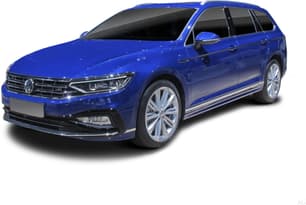
The 2023 model doesn't see much change, if any, to the previous iteration. The exterior features the classic VW sharp pleat that runs the length of the body, slim-line LED lights and pronounce grille with lots of chrome accents found throughout.
It looks shiny, new and stylish, but not garish. You'd be proud to be seen in this.
The interior is also classically VW – sharp, a little pared back and hosting easy to see buttons and dials. The adjustable ambient lighting elevates the cabin space, as does the black headliner (R-Line exclusive).
An interesting feature is the directional air vents, the slatted design is carried the entire length of the dash which accentuates the width of the car. It all looks seamless and well thought out.
The RS4's cabin is excellent, with a good mix of physical buttons and responsive touchscreens for control. There’s enough storage space for this kind of vehicle, with good door bins and well-sized cupholders in the centre as well as USB-C and -A charge points.
Audi’s multimedia system is friendly though the large touch targets and dark background aren’t as crisp as those fitted to the latest rivals. The screen isn't as big, either, measuring 10.1 inches for the multimedia item. The RS4 supports wireless Apple CarPlay and Android Auto.
That said, Audi’s 12.3-inch digital driver’s display with bright and poppy mapping software and generous customisation remains right at the head of the pack.
There is a panel of switches below the touchscreen for climate control, physical selection of the five-or-so drive modes and a collection of helpful buttons on the perfectly-shaped and sized leather-appointed steering wheel.
It lacks F1 or DTM wow-factor compared to the C63 and M3 with their easy-access driver mode buttons and toggles on the steering wheel but the RS4's restrained looks will resonate with those that prefer a bit more elegance inside.
Neither the RS4 nor RS5's back seats are designed for those over about 175cm. The RS4’s roof is a little higher so it is good enough for most adults but the RS5’s sloping profile compromises things. It has two individual buckets compared to the RS4’s three-wide bench.
Rear seat passengers get air vents, an individual climate zone, bottle holders in the doors, USB charge points and ISOFIX attachments for the outboard seats, with matching top tethers in the seat backs.
The Audi RS4’s boot is a generous 505L with under floor storage and a netted area on the driver’s side. Folding the 40/20/40 split-fold bench increases space to 1495L. That said, the RS5’s 465L is still very good, though it is not quite as practical in the real world.
Being fitted with roof rails makes for sleek integration of roof racks for the RS4 to slip roof pods, bike racks or whatever else you might choose to take on a trip away.
A very practical family wagon with all passengers enjoying ample head and legroom.
The amenities in both rows are very good. The seats are fairly comfortable but the lumbar support isn't awesome. The massage function on the driver's side is a nice novelty but not strong enough to be called a massage. Think of it as gently stretching.
For storage, you get a decently sized middle console, dedicated phone tray, cooled glove box, drink bottle holders in each door and two cupholders.
There are plenty of charging options available for the front with two USB-C ports and a 12-volt socket. Bonus having the wireless Apple CarPlay (and Android Auto), as it's one less cable you have to worry about.
In general, I like how easy the tech is to use. The 9.2-inch touchscreen multimedia system looks great and is responsive.
It's easy to get all the connections going and you can pull the built-in satellite navigation directions through to the 10.25-inch digital instrument panel. I did miss having a head-up display this week but the info on the instrument panel is displayed clearly.
The back seat gets a couple of cupholders in the fold-down armrest and drink bottle holders in each door. It also has directional air vents with climate control, reading lights and one USB-C port for charging. However, I would have liked to have seen another charging port, to limit sibling squabbles.
There are ISOFIX child seat mounts on the outboard seats plus three top tether anchor points.
The backseat is wide enough to fit three child seats side by side if needed, and there's plenty of room for front passengers when a 0-4 rearward facing child seat is installed.
The windows are wide and offer good visibility but I really like the 142mm ground clearance. It was super easy for my six-year old to climb in and out.
The only thing he mentioned he didn't like was how heavy the doors were to operate. I don't mind this because they feel solid but they do swing wide, so be wary of letting any wild kids just hop out themselves in a crowded car park. You may get (or inflict) some dings.
The boot is a great size at 650L, with all seats in use, but if you pop down the backseats, that jumps up to 1780L.
The back seat also split-folds 40/20/40, which opens up your storage options. I enjoyed using the powered tailgate with kick function, it's handy on the grocery run.
You'd expect the RS5 to be more popular given how uncool wagons are these days but Audi's whole thing is wagons — or Avants, for the initiated — so it makes sense that the RS4 Avant outsells the RS5 Sportback about two-to-one.
For the RS4 Avant’s basic asking price of $165,015, before on-road costs, you get luxury features such as LED headlights, an RS design package, Nappa leather upholstery, power-adjust seats, a Bang & Olufsen 19-speaker sound system and metallic paint on top of the significant changes to the RS4’s chassis and zingy 331kW V6.
The RS5 is a little dearer, reflecting the addition of Matrix LED headlights that aren’t available on the wagon.
But we have the 'Competition Plus Pack', which is a $13,990 indulgence that swaps adaptive dampers for Audi’s 'RS Sport Suspension' coil over package with manual rebound and compression adjustment and height adjustment.
The cars sit 10mm lower than a normal RS4 but you can go to a dealer to move the ride height up or down from there.
That’s not it, though. You also get a louder exhaust system with matte black pipes, fixed-ratio steering system, a retuned eight-speed automatic with more aggressive shifts, different rear differential programming, black exterior badging, 2.0kg lighter 20-inch Audi Sport wheels (in silver or black), special LED entrance lights and your speed limiter raised to 290km/h.
The 'Navarra Blue' RS5 pictured is a ‘basic’ Competition Plus. You can go further, as done with the RS4 Avant with its manual-adjust bucket seats ($1300), 'Interior Design Pack' in red ($3400), matte carbon exterior pack ($6300) and carbon trim, bringing its total cost to $191,405, before on-road costs.
That makes the RS4 and RS5 the most affordable in their competitor set, below a BMW M3 Competition xDrive Touring ($183,500) and Mercedes-AMG C63 S E Performance hybrid, which is $187,900, before on-road costs.
The 206 TSI R-Line is top of a (small) two-model line-up. Our example has been finished in 'Lapiz Blue', a colour exclusive to the R-Line. Otherwise, expect a sea of monochromatic colour options.
We say top model but it's not necessarily a massive jump up in specifications from the 162 TSI Elegance, you're paying for the engine performance on this one.
This R-Line will cost you $67,790, before on-road costs. That's a $4K price hike from the 2022 model with no discernible upgrades.
And that price tag still puts it well above its closest rivals, with the Octavia RS 180 TSI being $53,090 and the Mazda6 Atenza at $52,140 (all before on-road costs).
However, you won't be disappointed with the features list with Nappa leather-appointed seat trim, R-Line stitched detailing on the floor mats and seats, electric and heated front seats, massage function on the driver's seat, a panoramic sunroof as well as wireless Apple CarPlay and Android Auto all coming as standard.
The R-Line also enjoys 19-inch alloy wheels, a full-sized spare, heat insulating tinted glass, 65 per cent light reducing rear privacy glass and 30-way adjustable ambient lighting in the cabin.
Audi’s 2.9-litre twin-turbo petrol V6 has seen plenty of use across performance products from Audi and Porsche, including the Macan S and Audi S6.
In the RS4 and RS5 Competition Plus, it develops the same 331kW (at 5700-6700rpm) and 600Nm (at 1900-5000rpm) as the regular car. This makes it an extremely flexible engine that delivers predictable punch anywhere in the power band.
That said, it lacks the explosive character of BMW’s twin-turbo inline six — the figures are only 15kW and 50Nm higher on paper yet the M3’s response is that much more ferocious.
Audi’s RS division has tried to capture a bit more emotion, retuning the eight-speed torque converter automatic transmission for crisper shifts. This also benefits the RS4’s 0-100km/h sprint time, which falls two tenths to 3.9 seconds in Competition Plus guise.
The V6 breathes a little easier, too, with a different exhaust. Audi says the extra sound is down to 8.0kg less sound deadening in the car.
There’s more resonance at idle that does feel tiring sitting in traffic idling but the trade-off is a brawny mid-range baritone that develops into a shrill bark approaching the redline.
The R-Line has a 2.0-litre, four-cylinder turbo-petrol powertrain with a maximum output of 206kW/350Nm.
That puts its engine specs 44kW up on the Elegance model and you feel that difference when you put your foot down.
The six-speed auto transmission provides surprisingly smooth shifting in most settings. The grunty engine combined with the all-wheel drive creates a sporty and purposeful driving experience.
The Audi RS4 wagon is rated to use 9.5L/100km in ADR combined cycle (urban/extra-urban) consumption testing while the slipperier RS5 returns 9.4L/100km in the same test.
We weren’t able to run accurate or particularly relevant fuel figures on the event but the trip computers showed around 12L/100km in both RS4 and RS5.
While these numbers are high compared to your average passenger car, the Audi is more efficient than BMW's rivals, and gets remarkably close to the hybrid C63 in the real world.
The fuel tank is quite small for this kind of vehicle at 58 litres. That limits the RS4’s theoretical driving range to 611km.
Unsurprisingly, the Audi RS4 and RS5 require 98 RON premium unleaded petrol.
That powerful engine does cost you a little bit with efficiency. The official combined fuel figure is 8.1L/100km and real-world testing saw my figure at 8.6L.
Not too bad for the type of driving I did this week, which was a combo of open-road and urban. I wasn't scared of putting my foot down but I would expect to see a double-digit figure in an urban setting.
This has a 66L fuel tank and based on the official combined figure, you should be able to get around 815km driving range, which is great.
The time allocated to driving the RS4 Avant Competition Plus was fairly limited and we were sadly unable to sample how the highly adjustable coil over suspension performed where it makes most sense — on the racetrack.
Still, winding country roads between Sydney and the Southern Highlands served up some challenges, demonstrating how the Competition Plus pack changes the character of the RS4 and RS5.
The only real negative is comfort, specifically over those horrible plastic speed bumps that litter shopping centre car parks. With adaptive dampers, carmakers can set programs for these kinds of obstacles to soften and stiffen the clever shocks at just the right time. Not so the Competition Plus pack cars, which ride these bumps harshly.
That about does it, though, and everything thing else is a net benefit. The steering system addresses some criticism of the earlier RS4s. Further than a retune, the Competition Plus gets a new rack, that is non-progressive with a fixed ratio of 15:1 (instead of 13.3:1) and 2.4 turns lock-to-lock. The reactions to each input feel a hint more faithful.
When above 40km/h the coil overs come into their own. Even though the RS4 rides firmly it doesn’t constantly jiggle over small bumps. Over sharp-edged hits, the suspension rounds the hits off so, while you feel them, there’s a sense of control and sophistication.
Having speed limits to contend with means it is essentially impossible to find the limits of grip of the 275/30R20 Continental SportContact 6 tyres on the road and there isn’t much body roll, either.
The RS4 is still rewarding, though, getting up on its toes just enough through a series of bends to feel engaging. It gives an impression of being quite light and at 1820kg it is now considered featherweight next to rivals.
The RS4's Quattro all-wheel drive system favours the rear wheels when driving normally (60 per cent rear) and can send up to 85 per cent of the drive to the back axle.
The tweaked electronically-controlled rear limited-slip differential amplifies the throttle steer-ability of the RS4, giving you the confidence to squeeze the gas on exit.
It helps that the Competition Plus bucket seats are a little thinner and set closer to the floor giving you more feedback. This is the key differentiator between the RS4 and RS5 we drove — the buckets make the car feel alive.
Strong brakes are made up of 375mm front rotors clamped by six-piston calipers. Optional carbon ceramic brakes with larger 400mm front rotors help save 6.5kg and, if you plan to use the RS4 on track, are a smart buy along with a set of Pirelli P Zero Corsa semi slick tyres ($850).
Really, though, neither the RS4 nor RS5 are the perfect car for the track. They are plenty capable and fast on the road with just enough fun, reward and character thrown in to keep you coming back for more.
The performance of this is to be commended. Powerful but poised, there's a sense of performance in reserve when you put your foot down and while still fun, it's not unbridled power.
It inspires confidence, the lower centre of gravity and firm steering meaning you tackle corners with minimum roll. You can accelerate out of a corner a little earlier than you might normally in this.
The cabin is nice and quiet with some road noise at higher speeds but not enough to intrude on chatting.
Despite suspension that feels sporty, aka stiff, the ride comfort is very good, with back seat passengers also feeling the comfort. There's not a lot of jostling in this.
Let's talk parking. It is a large car but you don't feel those dimensions when you park it.
It's very forgiving to manoeuvre with the front and rear parking sensors, crisp 360-degree view camera and tight 11.7m turning circle!
And if you're not confident it has a self-parking feature.
The Audi A4 range was rated a maximum five stars in ANCAP safety testing in 2021, with the rating now considered expired. The stamp also only applied to four-cylinder models — so not the RS4 we drove.
It has lots of safety equipment, including eight airbags (dual frontal, side chest, front and rear side head curtains), autonomous emergency braking (AEB) functional up to 250km/h with pedestrian detection, front and rear cross-traffic alert, lane-keep assist, blind-spot monitoring, safe exist warning and tyre pressure monitoring.
Adaptive cruise control with lane-trace assist makes it an easy car to use on the motorway. The systems are well integrated and easy to switch on and off as you like.
This has a good list of safety features with the following being standard: LED daytime running lights, lane departure alert, lane keeping aid, blind-spot monitoring, rear cross-traffic alert, 360-degree view reversing camera with dynamic guidelines, front and rear parking sensors, driver fatigue alert, and adaptive cruise control (with stop/go function).
I like the Emergency Assist feature which will provide multiple visual and sound alerts if there's no steering wheel activity detected. If there's still no driver input, the car will slow down and ultimately come to a complete stop.
The Passat's maximum five-star ANCAP safety rating has just expired and at the time of writing was yet to be retested.
The 2023 Passat has nine airbags, including side airbags for the rear outboard seats, as well as curtain airbags covering both rows.
There are three top tethers across the rear row and ISOFIX child seat mounts on the outboard positions.
Audi covers the RS4 and RS5 with a five-year/unlimited kilometre warranty which is now the expected norm across the premium part of the market.
A five-year service plan can be pre-purchased, costing $3630 for both models with maintenance due annually or every 15,000km.
After the five-year warranty period, owners can choose to extend the service packaging and warranty for two extra years at a cost of $4260. This can be done twice, extending the warranty up to nine years.
The Passat comes with a market standard five-year/unlimited km warranty, and roadside assistance is included for one year (through Allianz Insurance) if you get your car serviced at a VW centre.
There is a three- or five-year capped price servicing plan that can be pre-purchased and will save you money compared to the pay-as-you go option. Servicing averages $620 though, which is expensive for the class.
Servicing intervals are reasonable at every 12 months or 16,500km – whichever occurs first.