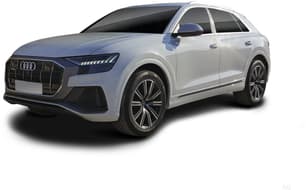
What's the difference?
The Audi Q8 is a big luxury SUV that is aimed at people who just don’t need a seven-seater, and are more focused on style than outright practicality.
It’s essentially a competitor to the likes of the BMW X6 and Mercedes-Benz GLE Coupe, though the design of the Q8 isn’t as exaggeratedly swoopy as those two. In fact, you might prefer to consider how it lines up against a Range Rover Sport.
Styling is one (very subjective) thing, but how does this new entrant into the luxury SUV class stack up in terms of the way it drives, its plushness and its value for money?
Let’s find out.
The Subaru Outback has a lot to answer for. Way back in 1994 the Japanese brand created the high-riding wagon scene - and while the idea never really took off with most mainstream makers, European luxury brands seemingly loved the idea of a rugged estate. It’s another niche to fill, after all.
This led to the Volvo V70 Cross Country in 1997, and Audi followed suit with the A6-based Allroad quattro back in 1999.
Other luxury brands have entered the fray since then, and obviously the market has proliferated with SUVs… but they’re not the same as a high-riding station wagon.
There has been evolution in the Audi Allroad line-up over time: in 2015 the company added the smaller A4 Allroad, while the original larger A6-based Allroad wagon continues to cop the rough-and-tumble treatment, as it has for decades now.
So, since the all-new Audi A6 Allroad has just arrived in Australia, we thought we’d see what it’s like. And perhaps more pertinently, maybe we’ll be able to answer the question that many of you probably have: Should you buy a high-riding wagon? Or is it smarter to just buy an SUV?
The Audi Q8 is a compelling and impressive new entrant into the luxury SUV fray, and it deserves to do well considering the pricing and specification on offer. I have no doubt that an even more enticing version of the Q8 - be it an SQ8 or RS Q8 - is on its way, and it’s bound to be even more impressive again.
I was thoroughly impressed by the Audi A6 Allroad 45 TDI quattro 2020 model. It is excellent on road, resolved and comfortable on unsealed surfaces, and very well packaged for family touring.
I’d personally have it in a heartbeat over a Q7 or any SUV, for that matter. I can understand why some buyers wouldn’t consider it, but if you’re someone who likes to think outside of the boxy SUV, then be sure to take a look at the Audi A6 Allroad.
It isn’t a coupe-style SUV, but it also kind of is. That’s what’s most interesting about the design of the Q8, which has muscular haunches, a huge grille with a polarising silver trim ‘mask’ around it (which thankfully can be had in gloss black, too), and a body that may look familiar to you if you like big luxury SUVs.
That’s because it’s got some stuff in common with the likes of the Porsche Cayenne and Bentley Bentayga, which share some underbody components. If you squint there’s a bit of family resemblance, but the Q8 is convincingly different enough to justify some attention in its own right.
There are standard-fit LED headlights and daytime running lights, plus massive 21-inch wheels that fill those copious arches. And if those aren’t big enough, there are optional 22-inch alloys, too.
The lines that run the length of the body aren’t over the top, and the beautifully named “blisters” that run over the tops of the wheel arches are pronounced, but not shouty. The tail-light garnish really accentuates the broadness of the Q8, and in an interesting styling highlight, the big Audi has pillar-less doors - hello Subarus from the 1990s!
It’s exceptional to look at from the outside, with a strong road presence that helps it stand out from the round-edged Q5 and Q7 models that sit below it. The dimensions definitely help out in that regard - the Q8 is 66mm shorter than Q7 at 4986mm long, and has the same wheelbase (2995mm). It is 2190mm wide (up 27mm on Q7), but sits 1705mm tall (38mm shorter).
The interior? Well, there’s quite a bit of pleasantness there, too. Check out the interior images for yourself.
If this isn’t the best looking genre of car, I must have been blindfolded since birth. You might think differently - be sure to let me know in the comments section below.
But for me, I just love the idea of a station wagon that is beefed up with SUV styling cues, and the Audi Allroad formula has been en pointe for generations now. This latest A6 Allroad doesn’t disappoint, either, with all the elements you’d expect.
Things like the bulging contrasting wheel-arch liners, the rugged underbody protection bash plates, and even the silver roof rails and silver metallic side sill protectors with ‘quattro’ emblazoned upon them - it just all works.
And being an Audi A6 wagon underneath the glittery bits, it’s a sizeable vehicle. The dimensions read like so: length - 4951mm; wheelbase - 2925mm; width - 1902mm; height - 1458mm, though that depends on the height of the air suspension.
The A6 Allroad sits about 45 millimetres higher than the standard A6 Avant wagon (not sold in Australia). And the ground clearance also varies depending on the air suspension height setting, but it is officially recorded at 139mm - which isn’t very high at all, but that’s for the regular driving setup. In its raised height, that jumps by 45mm to 184mm. Nowhere near an off-road Toyota, but still high enough to stop the belly from scraping.
And there are other hardware bits to help you out if the going gets tough - out of sight is Audi’s ‘quattro’ all-wheel drive system with a self-locking centre differential that the brand says provides “superior traction and its high level of safety and agile handling”. There is hill descent control, and the infotainment screen can display the location, elevation, compass and driving angles, too.
As for the design of the interior? It’s high-tech Audi opulence and comfort at its best. Check out the interior pictures to see what I mean.
If you’re considering the Q8 as an alternative to the Tardis-like Q7, you’ll be upset. It may pay to think of it as a slightly larger Q5 in terms of cabin space, because despite its imposing dimensions, the Q8 is cosier inside than you might think.
That isn’t to say it’s small or cramped. Not at all. And the raked roofline of the Q8 isn’t as big an imposition on passenger comfort and space as it is in its direct German competitors.
For someone my height - 182cm - there’s enough headroom in the rear seat to be comfortable with a similarly sized driver in front, and the legroom and foot room is well considered, too. The back seat slides fore and aft in a 60:40 ratio, up to 100mm, so if you have smaller back-seaters, you can allow for a bigger boot space.
Storage is well considered for all occupants, with bottle-sized door pockets all around, cupholders between the seats (in a flip-down armrest in the back), plus some extra loose item and covered storage up front -along with a wireless phone charger in the centre console.
And in terms of boot space and luggage capacity, the Q8 is better than many SUVs in the class; with the seats pushed all the way back there is 606 litres of space available, and should you need more space, the second-row slide function liberates 75L more (total: 681L). That expands to 1755L with the rear seats folded down (which can be done in a 40:20:40 ratio, making for easy stowage of skis or other long items).
Up front, there are comfortable seats with nice amenities, and the design of the dashboard is neat and tidy. Very minimalist.
As for the tech interface and media screens, there is some learning required to get the hang of how to use them. The top screen controls the media and navigation function, while the lower one manages climate and car controls. Both are touchscreens, but both have haptic feedback which makes it feel like you’re hitting a physical button rather than the screen.
The resolution of both screens is lovely, with superb 3D mapping and even a surround-view camera system that uses AI to give you a 3D view of the car and its surroundings.
But the menus aren’t as intuitive as they could be - things like the fact you have a lane keeping assistance button that sits separate to the rest of the safety controls, and that’s separate again to the button on the end of the indicator stalk that adapts the active cruise control/lane keeping system. There’s a voice control system if you think the screens will be too distracting to use while on the move.
One issue with fit and finish - the dash top didn’t align perfectly with the plastic below in all cars present on test, whether equipped with the standard plastic dash finish or the optional leather-trimmed version. It’s something that’s hard to un-see.
Technical. Practical. Glorious. Three words I’d use to describe the cabin of the Audi A6 Allroad.
The cockpit isn’t anything out of the ordinary for an Audi of the modern era, and as such it will feel familiar to you if you’ve been in or around any of its more recent stablemates. It also means that you’ll find yourself in a high-end, high-tech and highly pleasant interior. The materials used are beautiful and of a high standard. They look very nice and it is an extremely pleasant place to be. And you can hate on me if you want, but I’m sold on brown leather. Yummo!
It will take some time for you to get to grips with the dual-touchscreen layout of the cabin, but once you get the hang of it, it becomes second nature.
The media screen is very easy to use, the menus are simple to learn, and over my week there were absolutely no issues with Apple CarPlay - either when connected via USB, or when used wirelessly.
The second screen below controls a lot of the main functions of the air conditioning system, and while I’m not a huge fan of using a screen to touch through temperature and fan controls, this one has haptic feedback and is well positioned - it’s not as much of a glance away from the road as in, say, a Land Rover or Range Rover. There’s also a volume knob which is good, and quick buttons for Drive Select and demister for front and rear windscreens.
In terms of the practicalities, there are bottle holders in the doors, a pair of cup holders between the front seats, a covered centre console bin with Qi wireless phone charging (remember not to leave your phone in there!) and there are two USB ports in there, plus a SIM card slot and SD card slot as well.
The seat comfort is very good - there’s electric adjustment on both seats with lumbar adjustment, and the driver’s seat gets memory settings as well. The electric steering wheel adjust is a nice touch as well, and there’s a remote boot release trigger, too.
There are twin sunroofs, and the front one can tilt and slide while the rear one is fixed. It helps lighten things up a bit if you have the optional dark headlining, which I personally wouldn’t choose.
Rear seat space is excellent. Sitting behind my own 182cm driver’s seat position, I had easily enough legroom, headroom and shoulder room - in fact, the rear pew is so accommodating, it could easily fit three of me across - but foot space is a little tight due to the large transmission tunnel.
Those in the back are well catered for – there are 2x USB ports, a pair of large door pockets with bottle holders, twin mesh map pockets, a flip down armrest with storage and cupholders, and our car had quad zone climate control (as part of the optional Premium Plus package - standard is three-zone climate), plus there are centrally mounted directional air vents and in the door pillars at face height. Our tester also had those optional manual sunblinds, which would certainly help those in the back get some shut-eye on longer trips.
The centre section of the rear seat can be split folded down on its own as well – so you have 40:20:40 rear seat folding, which is great for skis or snowboards. Plus there are two ISOFIX child seat attachments and three top-tether points available for baby seats. And one of the most excellent additions to any car ever – illuminated seat belt buckle receivers. It just makes it that much easier to see at night.
If you need to fold down those rear seats, there are boot-mounted triggers. That’ll help expand the luggage capacity from the standard 565 litres (VDA) to an expansive 1680L (VDA). The cargo hold easily fit the three CarsGuide suitcases (124L, 95L and 36L) with room to spare.
There is no Audi Allroad seven seater, though. And that’s potentially where something like a Q7 makes more sense, depending on your intent.
There will be two versions of the Q8 to begin with, the 55 TFSI you see here, and the 50 TDI which will arrive later in 2019.
Both come quite well equipped, and for a vehicle that is Audi’s flagship SUV, the Q8 is convincingly well priced in both petrol and diesel guises, with identical list pricing (RRP) of $128,900 before on-road costs for both the 50 TDI and 55 TFSI.
The Q8 55 TFSI undercuts the closest BMW X6 (50i - $153,619) and Mercedes-Benz GLE Coupe (AMG 43 - $145,830) by $24,719 and $16,930 respectively. That’s good news in anyone’s book.
As for the diesel version, there’s a more affordable X6 (xDrive30d - $119,900) and GLE Coupe (350d - $126,330), and it’s a fair statement that you can get a Range Rover Sport petrol or diesel for less, and the base Porsche Cayenne petrol is more affordable, too. But it’s the standard equipment levels that impress with the big Audi SUV.
Included as standard are 21-inch alloy wheels, the S line exterior styling pack, adaptive suspension with damper control, adaptive cruise control with lane change assist, a 360-degree camera with kerb view (so you don’t mark those huge rims, obviously!), 'Valcona' leather upholstery, front seats with electric adjustment plus heating and ventilation, a leather-trimmed steering wheel with paddle-shifters, LED headlights (with auto high beam) and daytime running lights, three-zone climate control, a head-up display, Audi’s 12.3-inch 'Virtual Cockpit' instrument cluster, and the new MMI touch response control screen with 10.1- and 8.6-inch screens for media and car controls.
There’s the expected connectivity of Apple CarPlay and Android Auto, plus you get sat nav GPS, DAB digital radio and a 10-speaker sound system.
Audi is offering a number of optional extras if the standard stuff isn’t enough, including the Premium Plus package ($11,000) that bundles a bunch of goodies that customers typically want when shopping for a high-end model in the range. It includes 22-inch wheels, adaptive air suspension, privacy glass (tinted windows), HD Matrix LED headlights with dynamic indicators front and rear, quad-zone climate control with a rear touchscreen display, and LED interior ambient lighting.
Other add-ons you might want to consider include a panoramic sunroof ($3550), massage front seats ($1050), a choice of two Bang & Olufsen stereo upgrades (the more exxy of which has 23 speakers and costs $12,100), and the 'Dynamic Steering' package ($4500) with all-wheel steering and variable ratio steering rack, and which is worth the money in terms of the drive experience. More on that below.
And the safety gear list? How does a total of 39 driver assist features sound? Check out the safety section below for the detailed breakdown.
Colour choices include two no-cost options ('Night Black' and 'Carrara White'), while the optional 'Daytona Grey' pearl effect and metallic 'Glacier White', 'Floret Silver', 'Orca Black', 'Galaxy Blue', 'Navarra Blue', 'Dragon Orange' and 'Argus Brown' will set you back an extra $2300.
Before we consider what else you could buy, let’s consider what the situation is for the A6 Allroad.
It comes as just one variant in Australia, the 45 TDI, which is priced from $109,500 plus on-road costs (MSRP/RRP). It might not seem affordable, but Audi Australia claims there’s an additional $15,000 of extra value over the previous version of the A6 Allroad, which listed at $114,700.
So what gear do you get for your money?
The standard equipment list is extensive, and includes adaptive air suspension, Matrix LED headlights, 20-inch Audi Sport alloy wheels, LED puddle lights, a hands-free power-operated tailgate and dynamic LED tail-lights.
Inside, you get dual touchscreens (10.1-inch for media and 8.6-inch for climate and car controls), satellite navigation with Audi Connect online data, Android Auto and wireless Apple CarPlay support, a 12.3-inch digital instrument cluster, a head-up display, wireless smartphone charger, four USB ports, three-zone climate control, front sports seats with heating, extended Valcona leather upholstery and stainless-steel pedals feature.
As you may expect of a luxury family-focused car there’s a raft of advanced safety tech fitted as standard, too - read the safety section below for more detail.
Our particular test vehicle had metallic paint (Gavial Green metallic, which looks amazing but costs as much as painting an apartment, at $2200), and the interior was treated to manual rear sunblinds ($450) and black cloth headlining ($750).
The car also had the $8900 Premium Plus package, with HD Matrix LED headlights, 21-inch alloy wheels, rear privacy glass, a Bang & Olufsen 3D sound system, dual sunroof (front opening, rear glass roof), four-zone climate control and LED ambient lighting. Lovely. But expensive.
If you’re wondering about colours, only Brilliant Black is a no cost option. The optional metallic paint finishes are: Glacier White, Floret Silver, Vesuvius Grey, Mythos Black, Gavial Green (seen here), Firmament Blue, Diamond Beige, Seville Red, Soho Brown, Typhoon Grey and Avalon Green. All the metallic options add $2200 to the price.
Rivals for this type of high-riding wagon include the attractive and attractively priced Volvo V90 Cross Country (from $80,990), the Mercedes-Benz E-Class All-Terrain ($115,500) or, ahem, the Subaru Outback (from $37,440).
Thinking outside the box-y wagon, you could consider the slightly smaller Audi Q5 (from $66,900) or the seven-seat Audi Q7 (from $101,900). And I can totally understand why the latter is a better choice for many buyers out there. But it’s just not a wagon, right?
Under the bonnet of the 55 TFSI model is a hard-hitting horsepower hero - a 3.0-litre twin-turbo V6 petrol producing engine specs of 250kW of power (at 5500rpm) and 500Nm of torque (at 2090-5300rpm).
It uses an eight-speed automatic transmission and Audi’s quattro all-wheel-drive system, and the brand claims it will slingshot from 0-100km/h in just 5.9 seconds.
For context, the equivalent Benz GLE 43 has 287kW/520Nm and does the sprint in 5.7sec (claimed), while the BMW gets a stonking 4.4L turbo V8 in 50i spec with 330kW and 650Nm, with a resulting sprint claim of 4.8sec. Yeah, so those two are a bit speedier - is that enough to justify the additional expense?
If petrol vs diesel is important to you, here’s how the 50 TDI stacks up: it has a 3.0-litre turbo-diesel engine with 210kW of power and 620Nm of torque, and again has an eight-speed auto and quattro AWD. Audi claims a 0-100km/h time of 6.3sec for this model.
As for weight, the Q8 tips the scales at a not unsubstantial 2265kg (including 75kg driver) in 55 TFSI spec. Towing capacity is rated at 750kg for an un-braked trailer, and a huge 3500kg for a braked trailer, which is better than a Toyota Prado.
Under the bonnet of the Audi A6 Allroad is what Audi labels the ‘45 TDI’ - a 3.0-litre turbo-diesel V6 engine that produces 183kW of power (from 2750-4500rpm) and 600Nm of torque (from 1500-3000rpm).
The engine is only available mated to an eight-speed torque-converter automatic transmission and Audi’s renowned ‘quattro’ all-wheel-drive (AWD) system.
Audi claims this 1980kg wagon can run from 0-100km/h in just 6.5 seconds, on its way to a top speed of 250km/h. It is a hummer of an engine - more on that in the driving section below.
Towing capacity is pegged at 750kg for an unbraked trailer, and maxes out at 2500kg for a braked trailer.
Should Aussies feel short changed when it comes to the engine options here? Arguably, yes - and that’s despite the powertrain offered here still being a stormer.
There’s only one spec available Down Under, and even it doesn’t get the most up-to-date emissions tech. There isn’t AdBlue urea treatment (meaning this is a Euro 5 engine), and our cars have essentially been de-specced to miss out on the latest 48-volt mild-hybrid tech, which is standard on all grades of the A6 Allroad in Europe. Maybe that is part of the reason the cost is down, this time around.
And while the outputs of the 45 TDI in Australia are pretty decent, other markets have the A6 Allroad offered in 50 TDI (210kW/620Nm) and 55 TDI (257kW/700Nm) trims. Remember, though - this is a very niche player here.
Claimed fuel consumption for the 55 TFSI is rated at 9.2 litres per 100km - which is on the high side (some may say, the ‘realistic’ side), and it’s not far off the V8-powered BMW X6 (9.7L/100km) and Benz GLE 43 (9.8L/100km).
It employs 48-volt mild hybrid technology which is said to decrease consumption by 0.7L/100km, so it could have been even thirstier, theoretically. The system is able to shut the engine down and coast at speeds between 55-160km/h for up to 40 seconds, and it can also shut the engine of when decelerating at speeds of 22km/h or less.
Our drive route - which included twisty mountain roads, city driving, flowing country roads and about 30km of dirt/gravel - saw an indicated return of 10.5L/100km. That’s not bad at all.
The Q8 55 TFSI requires 95RON premium unleaded petrol, and it has a fuel tank capacity of 85 litres.
If petrol vs diesel is something you’re weighing up, the fuel use figure for the Q8 50 TDI is a bit better, claimed at 6.7L/100km.
Audi claims the 45 TDI powertrain in the A6 Allroad will use 6.6 litres per 100 kilometres. That’s the official Australia fuel consumption figure on the combined-cycle test. CO2 emissions are claimed at 174g/km.
During my time in the Audi A6 Allroad I saw an average fuel use return of 7.4L/100km - which was taken over highways, back roads, unsealed roads and twisty bits. There was even some urban stop-start in there, too. I think that’s pretty darn good for a car of this size.
Fuel tank capacity is 63 litres, meaning a real-world range of 851km based on my fuel consumption.
As mentioned above, the A6 Allroad is a mild hybrid model in other markets, but not in Australia. We don’t even get the Euro 6-compliant version here, as there’s no incentive for it to be offered locally - as in, there’s not even AdBlue treatment.
There’s no electric version (though you might want to look at the all-new Audi e-tron) or plug in hybrid, and no petrol model either.
It’s rare for a brand like Audi to offer up the chance to drive a pricey model like the Q8 in a spec that is basically free of options, but that was what I started with. And it was good, but not great.
With the standard steering system and the standard steel springs paired to adaptive dampers, the Q8 felt rather large through a series of twisting bends, with a bit of body lean and a tendency to feel like it wanted to push on a bit rather than bite harder in the corners. The traction was good, though, with a firm footprint and all-wheel drive ensuring things were kept under control.
Things were markedly more impressive in the model with the dynamic steering pack with four-wheel steering. Its behaviour in the bends was noticeably different. It tucked into the corners more, with a quicker steering action that made the big SUV shrink around you, making it feel like it had been on Lite n' Easy.
And it’s not just at higher speeds on challenging roads that you can feel the effect of the four-wheel steering, it also works to reduce the turning circle by 1.1m at lower speeds by allowing up to five degrees of steering (the opposite angle to the front wheels) to be applied at the back axle. That lower-speed turning circle improvement is worthy of mention, because otherwise the radius (at 13.3m with the standard steering) is worse than some dual-cab utes.
That model also had the adaptive air suspension setup, which offered a very similar ride quality to the normal car despite sitting atop 22-inch rims. Both were comfortable in Comfort mode, and predictably more chuckable in Dynamic, though the air suspension version looked a lot meaner when the latter mode was selected as it drops the body by about 40mm over those huge rims.
There’s an off-road mode, which Audi labels Allroad, and it eases up the traction control and ABS as well as adjusting the reactiveness of the steering, throttle and transmission. In the version with airbag suspension the body rises up to allow a huge 254mm of ground clearance - 50mm more than standard running height.
Not that an off-road review is overly important in a car like this, but my stint was confined to the model without airbag suspension and it still had good running clearance, the big wheels didn’t crunch or crash too hard into pockmarked gravel roads, and the handling was predictable.
The quietude of the cabin hits the Luxury Level for sound insulation, with only a bit of tyre roar and some wind noise from the large wing mirrors at highway speed. It’s mostly very hushed and very pleasant.
But that might be a bit of a disappointment to some; the sound of the V6 engine is muted, and never really sounds as enticing as you might want it to. This is a big, brash, Look At Me SUV, but it never feels it from the driver’s seat, because there’s no rasping or raucousness when it revs. Maybe we’ll have to wait for an even sportier version to bring the noise…
And the engine itself is willing, but slightly inhibited by the weight of this big truck. It is refined and certainly powerful enough, but doesn’t quite hit the ‘wow that’s fast’ benchmark that you’d get in the V8-powered Bimmer.
My biggest driving annoyance was the lane keeping assist system - not just how it’s a separate button to the rest of the assist systems, but that it triggers back on whenever you stop the engine. I found myself hitting the button every single time I got into a different car or back into the driver’s seat, because the system makes the steering feel unbearably artificial and interruptive.
Happily, if you are purchasing one of these vehicles, Audi can set it up so that the button is a ‘steering assist on’ switch rather than ‘steering assist off’.
Here’s where the A6 Allroad separates itself from, say, an Audi Q5 or Q7. It’s a low-slung wagon, made for touring on country roads, doubling down on dirt backtracks and cruising comfortably on the freeway.
It’s not as upright as a Q5 or Q7, and that means it has a lower centre of gravity - so it feels more hunkered down, more settled into the surface below.
And in the case of the A6 Allroad, there’s adaptive air suspension all around to cushion the car from what lies beneath. For the most part, that air suspension is superb - it absorbs big bumps and lumps very well, though the oversized 21-inch optional wheels can’t disguise sharp edges from those in the cabin.
The general compliance is very good, and as I found out first hand, you can easily soak up hundreds of kilometres without feeling the affects of the road underneath you - even over bumpy country back roads and lumpy dirt sections.
The steering could be better; it’s a little bit vague and heavy on centre at higher pace, but at lower speeds it is light and amicable. Very easy to park despite its size, and easy to manoeuvre around town, too.
The engine builds pace with superb linearity, and it’s very quiet and refined as well. There is a tiny bit of turbo lag at lower speeds or from a standstill – but it is completely manageable and never feels like it’s sluggish at all. The 0-100km/h claim of 6.5 seconds seems achievable, too.
The eight-speed automatic transmission was mostly very smart and well sorted - although in other VAG models with this engine family/eight-speed auto, the transmission never felt quite as busy at higher speeds. I noticed it shuffling between seventh and eighth gears more than I was expecting, given how much torque the engine has. It’s not annoying at all, and nor is it unrefined, and could well have something to do with attempting to save fuel rather than leaving it in top gear.
During night driving, the optional HD Matrix LED headlights were exceptional - among the best headlight technology that I’ve ever encountered. The ‘matrix’ technology means they can blank out oncoming traffic or cars in front of you while keeping the high-beam on in other areas. The auto headlights with auto high beam worked very well, too.
The plan was never to do a serious off road review, but I did do some driving on unsealed roads and found the Allroad to be excellent.
Through slippery unsealed corners it exhibited excellent traction, though you can feel the weight of the car shifting from side to side when you pivot through corners. There was a touch of skittishness over mid-corner bumps, but again that could be more to do with the big wheels than anything else.
I came away thinking that if you had your eyes closed, you wouldn’t even know that you were on dirt or gravel. It really is an exceptional car across sealed and unsealed roads.
The level of high-tech safety equipment fitted to the Audi Q8 is exceptional. As mentioned above, there are 39 safety assist features. Here’s a rundown of the important ones.
There’s auto emergency braking (AEB) up to 250km/h, forward collision warning with pedestrian detection, adaptive cruise control with traffic jam assist (including steering assist up to 60km/h), lane keeping assist, blind-spot monitoring, rear cross-traffic alert, and a forward cross-traffic alert system known as ‘Intersection Assist’.
Plus there’s a 360-degree surround-view camera system with AI graphic interface and adjustable view system, front and rear parking sensors, and semi-autonomous park assist for those who are nervous about marking the huge rims.
Of course there’s also the expected array of airbags (dual front, front-side, rear-side, full-length curtain) and the rear seat has dual ISOFIX and three top tether baby seat attachment points.
There’s no ANCAP crash test rating for the Audi Q8, and it hasn’t been tested by Euro NCAP either. That’s why it gets an 8/10 for this section. If it scores the full five stars, this criterion score could bump even higher.
The Audi A6 was awarded a five-star ANCAP crash test rating in 2018 testing, and according to the documentation on the ANCAP site, the rating applies to all variants from August 2019 in Australia - though strangely, the 45 TDI Allroad is missing from the list of variants.
Even so, the A6 Allroad is loaded with advanced driver-assist systems, including autonomous emergency braking (AEB) that works from 10km/h to 250km/h, and also incorporates pedestrian and cyclist detection which is operational from 10km/h to 85km/h.
There is also lane keeping assistance and Active Lane Departure Warning that can steer you back into your lane (between 65km/h and 250km/h). Further, there's blind-spot monitoring, rear cross-traffic alert with rear AEB, and adaptive cruise control with stop and go functionality - which happens to be the best example of the breed that this tester has yet sampled.
There are other safety helpers like Turn Assist and Intersection Crossing Assist, both of which monitor oncoming and surrounding traffic and can warn you of potential danger, plus Audi’s Exit Warning System that can warn occupants of oncoming cars and cyclists and delay door opening.
It is fitted with a configurable surround-view camera (360-degree camera with 3D animation), front and rear parking sensors, semi-autonomous self parking, driver fatigue monitoring, and there are eight airbags fitted (dual front, front side, rear side, full-length curtain).
Audi Australia offers a three-year/unlimited-kilometre warranty. That’s about average for the luxury car segment, but falls short when you consider what mainstream brands are moving towards (five years or more). The argument - and it’s a valid one - is that most luxury car buyers don’t hang onto their cars for more than three years anyway.
At the time of writing, Audi hadn’t announced official pricing for its capped price service plan, which is called Service Plan Pricing, but it must be pre-purchased at the time of delivery (the good news is that you can roll that cost into your finance package).
For three years/45,000km of servicing, you can expect to pay about $2000 - meaning the average cost is $666 per 12-month/15,000km visit.
You get included roadside assist as part of the ownership plan. It spans the cover of the warranty.
Audi offers a three-year/unlimited kilometre warranty, which is as good as BMW, but not as good as Lexus (four years/100,000km) or Mercedes-Benz, Volvo and Genesis (five years/unlimited kilometres). It’s falling behind in the luxury sphere.
The company offers reasonably priced capped price ownership plans for maintenance. Purchasers can roll in the cost of either a three-year service plan ($2170) or a five-year plan ($3300). That covers off the usual service items due every 12 months/15,000km.
Roadside assist is included for the period of the new car warranty.