Before we dig into the literal nuts and bolts of the Q6 e-tron, let’s first take a look at its price-tag and where it sits in Australia’s premium car landscape.
The range consists of three variants, which start with the base Performance grade from $115,500 (all prices before on-road costs) and remains rear-wheel drive for range and efficiency.
Next is the mid-spec Quattro, at $122,500. As the name implies, this version brings with it all-wheel drive via a second motor on the front axle. Finally, the top-spec SQ6 at $151,400 scores a significant bump to power outputs and adds some more sport-oriented equipment to the range.
All three grades come with the same massive 94.9kWh (usable) battery pack with correspondingly healthy driving range. The range is also loaded with standard equipment, leaving each grade differentiated primarily by increases in performance.
The base car comes with 19-inch alloy wheels, Matrix LED headlights, and the full suite of screens and software, consisting of a 14.5-inch OLED multimedia touchscreen in the centre, an 11.9-inch digital instrument cluster, and a 10.9-inch passenger multimedia display. It also scores wireless Apple CarPlay and Android Auto connectivity, with a wireless charger up front. The base speakers are a 10-speaker 180-watt sound setup.
Leather seats are standard across the range as are heated front and rear seats with tri-zone climate control, a power tailgate, and white interior ambient lighting.
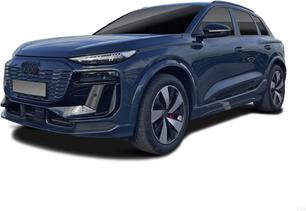
Stepping up to the Quattro adds a full suite of S-Line bodywork with black interior headlining as well as 20-inch Audi Sport alloys, sport leather seats with the S logo, a three-spoke steering wheel and sports pedals.
Finally, the top-spec SQ6 adds 21-inch two-tone alloys, red brake callipers, adaptive air suspension, aluminium-look mirror covers and roof rails, acoustic glazing for the front windows, a panoramic sunroof, rear privacy glass, colour ambient interior lighting, and an electrically adjustable steering column.
If you like the idea of some of those additional features further up the range, but would prefer a lower grade, Audi has you covered, with the ‘Tech Pro’ package adding the transformative air suspension, as well as OLED tail-lights and electric steering column ($4900).
Meanwhile the ‘Style Package’ adds the S-Line exterior features, black highlights, and privacy glass to the base car with 20-inch alloys for $5500, or black highlights, privacy glass and 21-inch wheels to the Quattro for $3600.
Finally, the Premium package adds a panoramic glass roof, the AR head-up display, Bang and Olufsen audio system, colour ambient lighting, acoustic glass and high-output USBs otherwise only available on the SQ6 for $8900 on the Performance or Quattro grades.
The level of customisation via packages is a nice touch, although the jumps between grades aren’t huge (in the context of a $100k+ car) to begin with, so I’d caution keen shoppers to keep an eye on the final price. For example, if you add the Tech Pro, Style Package and Premium Package to the Quattro, you end up at $139,900. At this price it’s not much of a stretch to get the additional power of the SQ6, no?
How does the range compare to its rivals? Well Audi promised it wouldn’t partake in the constant price adjusting some of its rivals have engaged in to try to maintain an edge. As a result, the Q6 range kicks off lower than equivalent versions of the BMW iX and Mercedes-Benz EQE SUV, while being neck-and-neck with the Polestar 3.
This segment’s biggest challenge will be ahead of it though with the introduction of alternative and often more ambitious offerings from Chinese automakers. Will the likes of the Zeekr 7X and BYD’s incoming Denza brand, both of which will undoubtedly be more affordable, make a mark on Audi’s customer base? Time will tell.








.png)


