What's the difference?
Audi’s flagship is the A8, a long, luxurious sedan where being driven is often as important as doing the driving.
To put this ultra-premium machine in context, it competes with other German heavyweights like BMW’s 7 Series and, of course, the Mercedes-Benz S-Class as well as Porsche’s Panamera. Not to mention the Lexus LS or Maserati’s Quattroporte.
What’s life like at the top of the Audi pyramid? Stay with us to find out.
It might not be as tribal as Ford vs Holden, but there’s a rivalry between BMW and Mercedes-Benz that occasionally becomes more obvious - the launch of the new Mercedes E-Class only months after the BMW 5 Series being one of those times.
But Mercedes has done something different. Instead of multiple variants and electric cars under the E-Class banner, Australia gets just one, the E300.
Is it enough to tackle the big Bavarian sedan in the sales race? We attended the Australian launch just north of Melbourne to find out.
The Audi A8 swims in a luxury car shark tank where those paying the big dollars expect top-shelf everything. It delivers a serene driving experience whether you’re in the front or the back, in a superbly engineered and executed luxury sedan package. Not perfect, but very, very impressive.
The E-Class is stacked with kit, looks great, and is an effective and comfortable way to get around in built-up areas or across the countryside.
While it’s not the most dynamically engaging - it’s pipped by its Bavarian rival there - it offers more comfort-oriented features than most, and the cabin is a pleasant place to spend a day driving.
If you're disposed towards stumping up the asking price, the extra outlay for the 'Plus Package' will probably be most relevant to you if you’re covering long distances due to the Airmatic suspension.
Otherwise, even a simple-spec E300 provides a step up from what you might expect from an executive sedan.
Note: CarsGuide attended this event as a guest of the manufacturer, with accommodation and meals provided.
The A8 is close to 5.2 metres long, yet instantly recognisable as an Audi thanks mainly to its evenly weighted proportions, gently curved roofline and overall high-waisted design. Worth noting its drag coefficient (Cd) is an impressively slippery 0.25.
The characteristic look is accentuated by the brand’s signature, six-sided grille, in this instance highlighted by a matrix of high-relief chrome accents. And typically angular LED Matrix headlights sit either side.
Check out our video review for the carefully orchestrated animation they run through when the car is unlocked.
The car looks equally svelte and contemporary from the rear, with just the right amount of chrome lifting the tone and multi-spoke 20-inch rims filling the wheel arches nicely.
As you’d expect, the top-shelf look and feel continues inside with the seats trimmed in aniline leather, perforated on the front and outer rear positions, with genuine hide also covering the centre console, door rails and armrests, steering wheel and upper dashboard.
Fine grain ash wood inserts sit alongside brushed metal elements and a meticulous attention to detail is obvious… everywhere.
For example, the interior door handle design has been thoroughly thought through, requiring a simple underhand tap to open the door, rather than the more conventional, and ergonomically convoluted, ‘over the top’ movement.
Three sleek screens dial up the tech - a 10.1-inch multimedia interface at the top of the centre stack, an 8.6-inch display below it for heating and ventilation, and a 12.3-inch version of Audi’s ‘Virtual Cockpit’ in the instrument binnacle.
And the spacious rear is the epitome of cool, calm Teutonic form and function. You feel relaxed the moment you get in, and isn’t that the primary aim of a car like this?
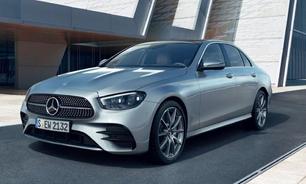
Evolution rather than revolution is obvious when it comes to the E-Class’ styling, but that’s in Mercedes’ best interests, because it’s still a good-looking thing, and being a bit subtle is warranted in the executive sedan game.
The biggest changes come in the headlights and tail-lights. Up-front there are now more than one million pixels in the LED headlights, which have adaptive high beam as standard and are more connected to the grille via black trim, as has been seen in EQ electric models.
Underneath, the bumper now features an AMG-style 'A-wing' apron as part of the 'AMG Line' exterior package as standard. A set of 20-inch AMG alloys are also included.
To the rear, and the digital tail-lights feature a Mercedes-Benz star motif, making its lighting signature now more recognisable from behind.
The German Rainbow is well-represented with mostly shades of grey, black, or white available, though 'Verde Silver Metallic' is a slightly retro green, and 'Nautic Blue Metallic' is a subtle and classy tone.
The daring ‘Manufaktur’ shade of 'Patagonia Red Metallic' is a $2500 option, as is 'Opalite White Bright' while 'Alpine Grey Solid' is $2900.
Space is luxury, be it a large house, a first class seat or a spacious car, and at nearly 5.2 metres long with a close to 3.0m wheelbase the Audi A8 measures up.
Even before you get in, the doors have an amazing sense of solidity and quality. It’s like opening and closing a bank vault… if that huge circular door had a power-assisted soft-close function.
There’s copious amounts of space for the driver and front passenger with lots of storage including a lidded box between the front seats, complete with a two-piece longitudinally split top design, so you can sneak your half’s open without displacing your neighbour’s elbow.
The door bins are decent but there isn’t a specific cut-out for bottles, so it’s more a case of laying them down than standing them up. There’s also a handy covered cubby at the end of the door armrests.
The glove box is a good size and there are two cupholders under a pop-up cover in the centre console.
Of course, the back is where space really counts, and there’s as much room as you’d find in, well… a limo.
Sitting behind the driver’s seat, set for my 183cm position, I enjoyed copious amounts of head, shoulder and legroom.
There are electric sunblinds for the rear and rear side windows, controlled by buttons in the door as well as the rear seat remote, a 5.7 inch OLED display housed in the beautifully trimmed fold-down centre armrest (which also has a soft close function!). The remote also allows adjustment of the lighting and climate control. Classy.
There’s a shallow storage box and twin cupholders in the armrest, medium size door bins and hard shell pockets on the front seat backs. The rear armrests also feature a small lidded cubby.
In terms of connectivity and power options there’s wireless Android Auto and Apple CarPlay, a USB-A and USB-C in the front, and an identical pair in the rear, as well as a 12-volt socket in the front and two in the back.
Boot volume is a useful 505 litres (VDA) and the lid is electric, with gesture control. It’s able to easily swallow our three-piece luggage set or the bulky CarsGuide pram. And while the rear seats don’t fold there’s a ski port door to accommodate long items. Just make sure you use the tie-down anchors in the boot to ensure they’re properly secured. There’s a handy netted section behind the left wheel well and a cargo net is included.
Maximum towing capacity, for a braked trailer, is 2.3 tonnes (750kg unbraked) and in more good news, the spare is a space-saver rather than the increasingly prevalent inflator/repair kit.
Inside, the E-Class should feel familiar to anyone who’s spent time in a recent Benz, though the Superscreen might be the main point of difference. It’s an immediately comfortable place, though, with a relatively visually busy cabin.
The seats and their adjustability mean most drivers and passengers, regardless of height and size, should feel supported (and ideally relaxed), while touch-points are mostly either leather upholstery or digital screens.
The steering wheel, also seen in plenty of other Mercedes models, is a bit of a let-down, however, with its haptic touch pads on a slightly busy two-tier layout. This millennial found it irritating, surely too will the usually older E-Class buyer.
There are a few other small annoyances, one being that the MBUX Assistant sometimes won’t hear a command, or that not everything seems to be able to be controlled by it. The climate control vent positions are electrically adjustable to certain pre-sets through the menu, but the MBUX Assistant isn’t able to do this for you.
And while the driver display and central multimedia screen are fairly user-friendly, it’s not always immediately apparent what the quickest way to find some information or a setting is.
Our test car was fitted with the 'Plus Package', which means four-zone climate control available to the rear seats, which my 180cm-tall self found spacious with plenty of headroom, kneeroom, and even a fair bit of room under the driver’s seat.
Behind the rear seats, there’s a generous 540 litres of boot space, exactly the same capacity as the previous generation E-Class.
With an entry price of $202,700, before on-road costs, the A8 is in the thick of it amongst its full-size primo sedan competitors from Europe and Japan. Specifically, BMW’s 740i MHEV ($272,900), the Lexus LS500h ($195,920), Maserati Quattroporte GT ($210,990), Mercedes-Benz S450 ($244,700) and Porsche’s Panamera ($207,800).
By definition, a luxury car should be loaded to the gunwales with features that make life on the road that little bit easier. And aside from the performance and safety tech we’ll cover shortly, the highlights from a very lengthy standard equipment list are - 20-inch alloy rims, metallic paint, adaptive cruise control, digital matrix LED headlights, digital OLED tail-lights, full keyless entry and start, power-assisted door closing, power boot lid (with gesture control), a panoramic sunroof, heated, ventilated and massaging electrically adjustable front seats, heated front armrests and extended leather trim (centre console, door rails and armrests, steering wheel and upper dashboard).
Also included are ambient interior lighting (with 30 colours and six colour profiles), four-zone climate control, electric sunblinds for the rear and rear side windows, ‘Audi Connect’ navigation and multimedia (with voice and handwriting recognition), wireless Android Auto and Apple CarPlay, 17-speaker 730-watt Bang & Olufsen audio (with digital radio) and a colour head-up display.
There’s a lot more, and the A8 can hold its head high in terms of pricing and features relative to its $200K price tag and the competition.
While cross-shopping the E-Class and a BMW 5 Series would normally be relatively easy, the Merc’s $131,500 starting price, before on-road costs, puts it plenty north of the base 520i, the only petrol one available, at $114,900. The electric i5 eDrive40 starts from $155,900, more than $20K over the Mercedes.
But the E-Class is stacked with features as standard, and while there are a couple of option packs, Mercedes Australia has tried to streamline the most popular features and specifications into the E300.
Its $131,500 price gets you a tech-heavy sedan with Merc’s latest 'MBUX' system housed in a visually impressive, if perhaps unnecessary, 'Superscreen' dash.
The dual-screen set-up incorporates a main 14.4-inch central multimedia touchscreen and a 12.3-inch display for the passenger, allowing the driver to keep, for example, a map visible while a passenger sorts out media or comfort settings.
The system is also designed to avoid taking users through sub-menus, though can be bypassed by wireless Android Auto or Apple CarPlay.
It also features a selfie camera mounted to the dash, which is disabled for the Australian market at present. Mercedes-Benz Australia hopes to change this soon.
Mercedes also plans to allow the MBUX system to learn what settings and functions will be most useful to the driver under certain conditions, but currently users are able to manually create so-called ‘Routines’ such as setting the climate control and seats to warm up if it’s below a certain temperature, and can even adjust the ambient lighting to a warmer colour.
More automation comes in the brand’s MBUX ‘Hey Mercedes’ system, which can now respond to commands without the driver needing to say “Hey Mercedes”.
Heated and vented front seats, leather upholstery, wireless phone charging, and a 17-speaker Burmester sound system with Dolby Atmos 4D sound are also standard - the latter being a clever feature that positions different elements of the audio, usually music, to give a 360-degree feeling, as well as turning bassier tones into a physical vibration via “tactile transducers” in each front seat’s backrest. Good for bassline junkies, then (apologies to Mr. Rascal).
With the $9400 'Plus Package', the E-Class also comes with 'Airmatic' suspension and rear-axle steering (which I’ll touch more on later), power-closing doors, 'Urban Guard' to monitor your vehicle while it’s parked, an illuminated grille up front, a more capable version of the MBUX 'Interior Assistant', four-zone climate control and Mercedes’ 'Digital Light' function, which uses the more-than one-million pixels in the headlights to project onto the road or surface in front of you when turning the car off or in driving situations to alert road users of potential danger.
A $6200 'Energising Package' adds multicontour front seats with comfort headrests, upgraded climate controls with 'Air-Balance' and fragrances, upgraded seat heating with armrest heating for the front occupants and heated seats for the rear.
The Audi A8 50TDI is powered by a 3.0-litre turbo-diesel V6 engine sending 210kW (from 3500-4000rpm) and 600Nm (from 1750-3250rpm) to all four wheels via an eight-speed automatic transmission (with ‘Tiptronic’ sequential manual shift function) and Audi’s quattro constant all-wheel drive system using a self-locking centre differential.
It also features a 48-volt electrical set-up for mild hybrid functionality built around a belt connected starter/generator, AC to DC converter and a 48-volt lithium-ion battery.
With energy recovery of up to 12kW from regenerative braking, it enables the A8 to regularly coast with the engine switched off and helps the extended stop-start system to operate smoothly.
This lone E-Class variant is powered by a turbocharged 2.0-litre engine pumping out 190kW and 400Nm, assisted by a 48-volt battery system. Under EQ boost, an extra 17kW and 205Nm is available for a short time.
It’s hooked up to a nine-speed auto that drives the rear wheels, and it’s all pretty traditional… for 2024, that is.
Mercedes says the E300 is able to hit 100km/h in a respectable 6.3 seconds.
Audi’s official fuel economy number for the combined (ADR 81/02 - urban, extra-urban) cycle is 6.6L/100km, the 3.0-litre turbo-diesel V6 emitting 175g/km of CO2 in the process.
Over a week of city, suburban, and some freeway running we averaged 11.1L/100km, which is acceptable for a 2.1-tonne luxury sedan.
Also worth noting the standard stop-start system works beautifully thanks to the 48-volt starter/generator.
You’ll need 82 litres of diesel to fill the tank and using the official number, that translates to a range of just over 1240km, which drops to around 740km using our real-world figure.
Mercedes claims the E-Class drinks 7.2L/100km on the combined cycle, and though we weren’t able to test that properly at the pump on the launch program, the trip computer showed up to 9.4L/100km after some quite spirited driving, which gradually averaged out to about 8.6L/100km in the afternoon once some more calm, E-Class-appropriate distance had been covered.
With its 50L fuel tank, the E-Class should theoretically be able to cover 694km on a single tank if the 7.2L/100km is achieved, though realistically it would be much less, 550-600km depending on driving style.
Despite extensive use of aluminium in the ‘ASF’ platform and body panels, the A8 tips the scales at a sturdy 2095kg, yet Audi says the A8 will accelerate from 0-100km/h in just 5.9 seconds. And with 600Nm of peak torque available across a flat plateau from 1750-3250rpm this big four-door gets up and goes hard when asked to.
At more sedate speeds you’re occasionally reminded there’s a diesel engine under the bonnet, with that characteristic engine and exhaust noise only making their presence felt under pressure.
In fact, under normal circumstances, noise, be it the engine, tyres or wind is minimal, thanks to a combination of the car’s aero-efficient shape, thick acoustic glass and other sound-deadening measures throughout the car.
The eight-speed auto transmission is suitably smooth, with the central shifter or wheel-mounted paddles able to make snappy sequential ‘manual’ shifts.
There are four drive modes in the ‘Drive Select’ system - ‘Comfort’, ‘Auto’, ‘Dynamic’ and ‘Individual’ - enabling tweaks to the steering, transmission, throttle and suspension. Comfort felt most appropriate most of the time, although dialling up the throttle and transmission to more aggressive modes in Individual adds an enjoyable edge.
The suspension is five-link front and rear with an adaptive air system smoothing even high-frequency bumps and ruts amazingly well.
Push into a corner and the A8 feels nicely balanced, its wide track, sophisticated suspension, plus the quattro AWD system seamlessly distributing drive between the front and rear axles, keeping the big body under control. In fact, you feel the ‘big car shrinking around you’ syndrome from the get-go.
The steering is precise without being overly sharp and road feel is good. Again, with that 2.1-tonne kerb weight in mind, braking is appropriately powerful with big ventilated discs front (350mm) and rear (330mm).
It pays to remember the turning circle is 12.5m, and it’s worth picking your spot for a U- or three-point turn.
Although there’s a lot going on for the driver in terms of screens, buttons and switches it all makes sense ergonomically. The head-up display is helpful and there’s a common sense mix of digital and physical controls, the latter including an audio volume knob. Yes.
While the E-Class has taken fairly sizeable steps in terms of its tech, it remains a fairly traditional car from behind the wheel, save for a few small changes like its mild-hybrid system and rear-wheel steering.
It’s still a petrol-powered rear-drive sedan, and it feels built more for eating up highway kilometres than it does tackling twisty turns. But that’s okay, because it will still do the latter.
Comfort is the main focus, clearly, for the E300, and the big Merc does it well. We weren’t offered a car without Airmatic air suspension on the launch, but the E-Class doesn’t seem like it would be particularly rough without it.
With it, however, large bumps and minor road annoyances only make their way into the cabin in the sense that you’re aware of them, but not bothered by them.
That slight dulling of feedback does extend to the steering wheel however, where, despite the rear-wheel steering making the car more nimble, the feedback to the driver is less encouraging of eager driving.
While 190kW on paper doesn’t seem like enough, the E-Class makes do with its meagre engine quite well - and even though it can seem like it’s working a bit too hard at times, the E-Class’ natural state isn’t responding to a planted foot, so it’s unlikely to be a daily bother.
Engine noise, as well as wind and road noise are suitably dulled by the E300’s NVH fitout, too.
The tuning of its drive modes, in particular Comfort and Sport, seemed well-judged on our drive loop, with the option to set the 'Individual' mode to a custom configuration, most elements in Comfort while the drivetrain is set to Sport is particularly helpful when on gentle, high-speed country roads.
If you do start to approach the limits of the big sedan’s capability, it’ll let you know fairly early on. The heavy E-Class isn’t prone to sudden lurching or poor handling, and isn’t much phased by mid-corner bumps.
It’s not as dynamically engaging as some rivals, particularly the 5 Series, but it does appear to be a better provider of cross-country comfort.
Even though the A8 hasn't been assessed by ANCAP, as you might expect, it goes to town when it comes to active safety tech, the car’s standard crash-avoidance features including auto emergency braking (AEB) (pedestrians/cyclists - 5.0-85km/h, vehicles - to 250km/h), ‘Active Lane Assist’, blind-spot monitoring, a reversing camera and 360-degree view (including kerb view function), front and rear parking sensors, ‘Collision Avoidance Assist’ (steering assistance in critical situations), ‘Turn Assist’ (monitors incoming traffic when turning right), and rear cross-traffic alert.
There’s also ‘Intersection Crossing Assist’, ‘Attention Assist’, tyre-pressure monitoring and an ‘Exit Warning System’ (detects cars and cyclists when opening doors).
If all that isn’t enough to avoid a crash the airbag count runs to nine, including front and side bags for the driver and front passenger, side airbags covering the outer rear passengers, full length curtains and a front centre airbag to minimise head clash injuries in a side impact. A first aid kit, warning triangle and high visibility vests are also on-board.
There are three top tethers for baby capsules/child seats across the back seat with ISOFIX anchors on the outer positions.
ANCAP hasn’t had a go at crash-testing the E-Class yet, and it might not given the relatively small number that will be sold here compared to volume models, but Mercedes’ track record with safety is pretty stellar, and it’s extremely rare for a Mercedes to not cop the maximum five stars.
In the new E300 there are 11 airbags - plenty for a sedan. Mercedes lists front airbags, knee bags and pelvic/thorax airbags for the driver and front passenger, side bags for the rear and a front centre airbag.
It also comes with a fairly extensive suite of safety tech, including the usual ABS, lane-keep assist, blind spot monitoring and surround-view parking cameras.
But on top of that, there’s also ‘Evasive Steering Assist’, semi-automated cruise control with sign recognition, distance assist for following leading vehicles and can even project light arrows onto the road if leaving your lane, when 'Digital Lights' are optioned.
The E-Class also has a function if an imminent collision is detected in which it can, depending on the type of collision, take occupant protection measures. In the case of a side-on collision, the E-Class can “move an affected front occupant towards the centre of the car” before impact.
The A8 is covered by Audi Australia’s five-year/unlimited km warranty, which is now par for the luxury market course, and 24-hour roadside assistance is included for the duration.
Paint defects are also covered for five years, with rust (to the point of perforation) covered for 12. Nice.
Service is required every 12 months or 15,000km with a five-year capped-price plan for the A8 coming in at $3830, or $766 per year. That’s a fair wedge but not outrageous for the category.
The E-Class comes with Mercedes’ fairly industry standard five-year, unlimited kilometre warranty, though Mercedes-Benz Australia was unable to confirm exact servicing pricing on the launch.
It does however list pricing for the E-Class on its website for a three-service pack at $3325, four at $4535, and five at $6800, the latter averaging out to $1360 each.
This could increase with the new generation car, and Mercedes doesn’t list estimated serving pricing for new E-Classes yet in its booking system (I checked with one of the test cars).
Servicing intervals are every 12 months or 25,000km, whichever comes first.