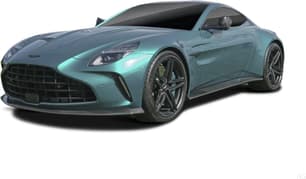
What's the difference?
Aston Martin says the 2024 Vantage is designed to put the brand back where it belongs. And by that, it means thrust into the same conversation as Ferrari and Lamborghini when it comes to the ultimate in driver-focused supercars.
Which is why everything – and I mean everything – about this new model has been tightened, tuned or turned way the hell up in pursuit of performance.
Really, it has been a no-stone-left-unturned approach here. And the result, the brand reckons, is a car that delivers not just more power and more torque, but a near-telepathic connection between car and driver, too.
Well, that’s the promise anyway.
So how does the Vantage stack up in the battle for supercar supremacy? I was quite looking forward to figuring that out, to be honest.
Holden's current Astra is the second go the car has had in this country, after first being badged an Opel to the sounds of crickets from the buying public. That hubristic exercise was followed by a brief withdrawal from the Australian market before returning, rather more sensibly badged (and sensibly-priced) as a Holden.
It chugged along quite nicely in 2017. It didn't break any records, no, but regularly broke the 1000 units per month mark to end up with about five percent of the small car market, which it shares with some serious competition from Europe and Japan.
The + in R+ means more safety, but also more money. Safety is good, but do you get anything else for your money?
It’s either a comfortable race car or a bonkers grand tourer, but it’s that best-of-both worlds positioning that makes this new Vantage so appealing. Think of it as like a supercar for proper grown-ups, and one you don’t need to grunt and groan to extract yourself from.
Note: CarsGuide attended this event as a guest of the manufacturer, with travel, accommodation and meals provided.
The Astra's biggest problem is probably the Holden badge. Despite the company's best efforts, some buyers are wary of the company's longevity and some of the other cars in the range do the Astra no favours - Trax, Colorado and Barina feel cheap, because they are. The Astra isn't cheaply made and holds up very well in excellent company.
Ok, so the first thing you notice is this massive grille, which I now know is exactly 38 per cent bigger than before. That’s mostly for cooling, sucking in great lung-fulls of air – and any stray pets unlucky enough to wander into its path, I’d imagine — to keep that engine humming.
That air has to go somewhere, and the new bonnet vents complete the engine-cooling.picture.
Then there are 21-inch alloys are wrapped in performance rubber, and I love the swollen haunches at the rear tyres, giving the Vantage a mean and menacing vibe. At the rear, a very new and very loud quad-exhaust completes the picture.
In the cabin you'll find nothing in the way of hand-me-down Mercedes switchgear, which makes for change. This is all Aston Martin, and actually it all feels really nice.
The twin-screen setup looks tech-savvy and premium, the materials are all nicer than you'd find in something more track-obsessed, and even the optional race seats managed to be both snug-fitting and comfortable.
The Astra is a sleek if slightly anonymous-looking thing. Having said that, it's a really nice design that looks more expensive than it is. That's important in this segment. Holden is at pains to tell us it's from Germany (the Astra is manufactured in Poland) and it does look Euro-influenced. Despite its coupe roofline, it's an easy in-and-out proposition but does sit a little lower than, say, an i30.
The odd blacked-out section of the C-pillar takes a bit of getting used to but the sheetmetal is otherwise faultless and well put together.
Inside it's a sea of grey plastic and various shades thereof, but again, it hangs together really well and is a welcome change from the Teutonically angular Golf. The materials are largely reasonable, but for some reason the stalks feel flimsy to touch and use.
The cloth trim is hardy but comfortable and I was grateful for its relative coolness versus what you might expect from the textile leather you're more likely to get at this level.
You’ll be shocked to hear that Aston Martin didn’t dedicate too much of its limited track time to extolling the practicality perks of its new Vantage, mostly because there simply aren’t that many of them.
But the most obvious one, I think, is that most of the people in the market for a $400k-plus vehicle in this category are likely to be, well, of a certain vintage, and it’s for these people that the more traditional layout of the Vantage will no doubt appeal.
See, the engine is up front, and the doors open in the usual fashion, making getting in and out of the cabin easy, and free of the human-origami antics sometimes required to climb in and out of a scissor-door supercar.
But there have been practical improvements made to performance here, too. There’s 30 per cent more power, 15 per cent more torque, new cooling, better aerodynamics, retuned suspension and anti-roll tech, new brake booster tuning, improvements to the ESP system, more body stiffness. And it goes on.
Riding in the front, there's room aplenty for passengers, with good headroom and a well-designed space to maximise what's available. Rear seat passengers do okay as long as the front occupants are being generous, but the seat itself is comfortable and there's even good headroom, despite the falling roofline.
Only the front scores cupholders, with the rear passengers making do with door pockets that might swallow a small bottle. There isn't an armrest or air vents back there either.
There's somewhere for one front occupant to put their phone, a horizontal slot that doesn't like phones with covers or the larger format iPhones or Androids. If your phone does fit (iPhone Xs do, as it happens), it's useful because it's in your eyeline, although a bit untidy if you're plugged into the USB.
The boot starts at a class-compeititve 360 litres, rising to 1210 when you fold the seats down.
Let’s start with the big number, and that is the $410,000 you’ll need to park the new Vantage on your driveway. Interestingly, I was also on the launch of the previous Vantage, back in 2018, and that one was just under $300k. That’s quite the jump.
Anyway, for that spend you get a whole bunch of improved performance, obviously, but also quite a bit in terms of cabin tech and comfort. This isn’t a stripped-back supercar, and that’s a good thing, I reckon.
It starts outside with 21-inch five-spoke forged wheels wrapped in Michelin Pilot Sport rubber, matrix LED headlights and LED tail-lights, while in the cabin, there’s a 10.25-inch central screen with Apple CarPlay, a second 10.25-inch screen in front of the driver, an 11-speaker stereo, and wireless phone charging.
The Astra range opens with the R which, typically, you'd expect at the other end of the range with a lot more power, but there you go. You'd think the R+ was even more of a beast, but marketing is an imprecise science... apparently.
R isn't for racing, in our case it was a very bright shade of red. Starting at $23,740 for the auto (you can get a manual for a few bucks less), you get 17-inch alloys, a six speaker stereo, cloth trim, air-conditioning, reversing camera, power windows and mirrors, rear parking sensors, cruise control, auto headlights and wipers, remote central locking and a space-saver spare tyre.
The seemingly tiny screen (it's actually a competitive 7.0-inch unit) runs Holden's 'MyLink' but also has Apple CarPlay and Android Auto. For some reason you have to tell it to use those two useful additions rather than the system picking them up through the USB. Mystifyingly the button is marked 'Projection'. Aside from that, the system works well and sounds alright.
The reversing camera is of limited use - you'll see what's behind you but it's very flattened out and super-grainy.
The 4.0-litre twin-turbo V8 is still borrowed from Mercedes-AMG, but this is the new-generation unit, making 489kW and 800Nm. It gets modified cylinder heads and bigger turbos, helping generate the extra grunt.
That’s fed through an eight-speed ZF automatic and channeled through to the rear tyres. The race to 100km/h? That 3.5 seconds. Meanwhile, the flying top speed is around 325km/h.
The whole Astra range is turbo, but here in the cheaper seats it's a surprisingly capable 1.4-litre unit with 110kW and a healthy 240Nm. Power finds the road via the front wheels and a six-speed automatic. It's an otherwise unremarkable technical story, with start-stop to help cut fuel use.
The Astra is rated to tow 750kg unbraked and 1200kg braked.
There’s the official figure, which is 12.1L/100km on the combined cycle, and then there’s the real-world figure. It’s not really fare to judge fuel use when you’ve just stepped off a racetrack, but rest assured it was a large number, which is to be expected really.
The Aston’s 73-litre fuel tank prefers 98RON fuel, too.
Holden claims the Astra will drink standard unleaded at the rate of 5.8L/100km on the combined cycle.
Our time with the car, which was a 70/30 mix of suburban and highway, yielded 8.3L/100km, and it's worth noting it was stinking hot for most of the time, so the air-con had to work hard.
The fuel tank is a little on the small side at 48 litres, between five and 10 litres smaller than some of its competitors, like i30 and Golf.
It's funny, I never felt like the old Vantage wanted for power, but now I suddenly wonder how we ever made do with it. This feels like the engine and the outputs that should have always been, such is the way it suits the nature of Aston’s most performance-focused model.
Everything is about the driver here. From the suspension tune to the gearbox mapping and the increase in stiffness everywhere. You’re supposed to feel like the main character, and you do.
Aston Martin have come under fire in the past for delivering cars that are a treat to look at, but didn't quite deliver the drive experience to match the appearance, and it's something the brand says it is actively rectifying with with the Vantage, and the Astons that will follow it.
The mission, it says, is to be spoken of in the same sentence as the Italian supercar makers when it comes to delivering driver engagement, and this 2024 Vantage is a considerable leap in that direction.
It is, above all else, fun. From the multi-stage ESP settings that you can pair to your bravery, to the retuned and raucous exhaust and the blistering acceleration.
More than that, it feels light and lithe on a racetrack, and super communicative, the front wheels talking through your wrists, and the back tyres through, well, the bit of you that hits the bottom half of the racing seat...
It is plenty fun, right across the park. The power is immense, but somehow it doesn't feel terrifying, partly because you're so dialled-in to the drive experience, and partly because the carbon brakes fitted to our test car were able to slow the Vantage so savagely it's as though we'd dropped anchor out the back window.
The Vantage does have a split personality, though, and it's one that really shows itself once you venture out onto the road. It's quiet, comfortable even, at suburban speeds, leaning more into grand tourer than bonkers track-day special.
The only downside being that, should you sit behind the wheel long enough, it becomes easy to forget you're driving something "super" at all. Well, until your right foot finds its way back to the accelerator, that is...
I'm going to get my biggest gripe with the Astra out of the way first - the driving position is rendered awkward by the pedal placement. Every other part of the driving experience is perfectly fine, with good adjustment in the seat and steering wheel but the pedals are Not Right. The transition from accelerator to brake means a big lift of the right foot rather than a sideways shuffle and that gets boring. Perhaps I'm getting old and my knees are weak, but I ended up left-foot braking for a lot of the time.
On with the show. The Astra's 1.4 litre turbo is a punchy thing, more than vaguely reminiscent of Peugeot's excellent 1.2 in the 308. The six-speed auto isn't quite as well sorted, occasionally lurching a bit on light throttle like a dual-clutch. The pay-off for that is crisp shifts and a positive feel for most of the time.
The thing about the Astra is that it really takes it to its competition from behind the wheel. It feels almost as good as a Golf, i30 and arguably is as good as a Mazda3 thanks to its extra torque and better refinement.
It's very quiet, composed and is good fun if you like that sort of thing. Otherwise, it's streets ahead of the Corolla which continues to sell like it's going out of fashion.
You’ll never see a Vantage crash-tested by ANCAP, but it does arrive with a solid safety package.
There are front and side airbags, plus a heap of active safety stuff like AEB, forward collision warning, adaptive cruise, lane keep assist, lane departure warning, lane change assist with centring and front and rear cross-traffic alert.
The Astra R+ has six airbags, ABS, stability and traction controls, reversing camera and forward AEB with a delightfully simple yet effective head-up warning.
The Astra range (with the exception of the lowest-spec R) scored a five-star ANCAP safety rating in November 2016.
Aston Martins in Australia are covered by a three-year/unlimited-kilometre warranty, but you can extend that for one or two years, at a price. You’ll be visiting the service centre annually, too.
Holden's three year/100,000km warranty includes roadside assist for the duration. You can also extend the warranty by up to three years or to 175,000km, for an extra cost.
Servicing is scheduled every nine months or 15,000km. Holden calls its fixed-price servicing 'Know Your Price' and it applies for the first six services (63 months or 105,000km). The first four services are set at $249 each, and the final three $309.