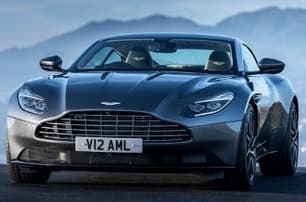
The moment you press the starter the DB11 begins a theatrical performance worthy of the Royal Shakespeare Company.
A high-pitched whine reminiscent of a Formula One air-starter precedes a raucous blast of exhaust noise as the twin-turbo V12 bursts into life.
It’s spine-tingling, but for those wanting to remain on good terms with their neighbours a quiet-start setting is available.
At this point, rocker buttons on either side of the steering wheel set the tone for what follows. The one on the left, marked with a shock-absorber graphic, allows you to scroll the adaptive damping set-up through Comfort, Sport, and Sport+ settings. Its ‘S’ branded partner on the right facilitates a similar trick with the drivetrain.
So, throwing urban serenity out the window, we pushed into maximum attack mode for the engine, and by extension the exhaust, selected D and began to enjoy the first act.
A launch-control function is standard, so purely in the interests of science we explored its function and can confirm it works exceptionally well.
Aston claims the DB11 AMR will accelerate from 0-100km/h in just 3.7sec, which is properly fast, and two tenths of a second faster than the standard DB11 it replaces.
Keep the pedal pinned and two things will happen; you’ll reach a maximum velocity of 334km/h and generate headline news across the country while making your way directly to jail.
With 700Nm available from just 1500rpm, and remaining on tap to 5000rpm, mid-range thrust is monumental and the thundering exhaust note accompanying it is the stuff automotive dreams are made of.
Peak power of 470kW (630hp) takes over at 6500rpm (with the rev ceiling sitting at 7000rpm) and delivery is impressively linear, without a hint of turbo hesitation.
Aston claims the DB11 AMR will accelerate from 0-100km/h in just 3.7sec, which is properly fast.
The eight-speed auto is simply superb, picking up gears at just the right point and holding on to them for exactly the right amount of time. Select manual mode and the slender shift levers on either side of the steering column allow even more control.
In Sport and Sport+ drivetrain modes the howling exhaust is accompanied by an entertaining array of pops and bangs on up and down shifts. Bravo!
The DB11 AMR is underpinned by an ultra-stiff bonded aluminium chassis, with a double wishbone front/multi-link rear suspension set-up attached to it.
Spring and damper rates are unchanged from the previous DB11 and even on enthusiastic back-road runs we found suspension in Comfort and driveline in Sport+ to be the best combination. Flicking the shocks into Sport+ is best kept for track days.
Steering is (speed dependent) electrically power-assisted. It’s beautifully progressive, yet pin-sharp with excellent road feel.
The big 20-inch forged alloy rims are shod with high-performance Bridgestone Potenza S007 rubber (255/40 front – 295/35 rear), developed as original equipment for this car and Ferrari’s F12 Berlinetta.
They combine with the 1870kg DB11’s near perfect 51/49 front to rear weight distribution and standard LSD to deliver confidence-inspiring balance and ferocious power down on (quick) corner exit.
Braking is handled by huge (steel) ventilated rotors (400mm front – 360mm rear) clamped by six-piston calipers at the front and four-piston at the rear. We might have put them under decent pressure from time-to-time, but stopping power remained prodigious and the pedal firm.
In the calm of urban traffic the DB11 AMR is civilised, quiet (if you prefer) and comfortable. The sports seats can be adjusted to grip like a vice at speed or provide more breathing room around town, the ergonomics are spot-on, and despite its striking looks, all around vision is surprisingly good.
Overall, driving the DB11 AMR is a special event, flooding the senses and raising the heart rate no matter what the speed.