What's the difference?
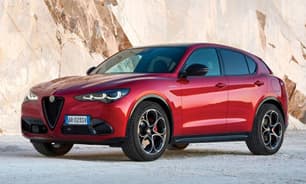
This week I’ve taken the recently updated Alfa Romeo Stelvio Veloce on a massive road trip and after the first few hours of driving it, I thought this is the sort of car you get when you need some extra boot space but still want that sports car vibe.
It helps that our test model is finished in the classic 'Alfa Red' but while its on-road performance can't be ignored, it has some tough medium SUV competition from the likes of the BMW X3, Genesis GV70 and Lexus NX.
So, is it just a fun car to drive or will it suit the family, too? I've been cruising around in it for the last week with my family of three to find out for you!
There’s no shortage of models to choose from if you’re after a family-friendly medium SUV. The problem is, it might take a while to get your hands on one, with lengthy wait times for some of the best sellers due to current delays caused by a global parts shortage and supply chain dramas.
But there are a handful of models with healthy stock in dealerships right now and available for immediate delivery. One of them is the Renault Koleos.
It's coming to the end of its life cycle and lacks the shine of some of its fresher rivals, but it’s a lot of car for the money.
We spent a week with the limited edition Koleos Black Edition to see if it is worth a trip to your Renault dealer, or if you should sit tight and wait for one of its newer rivals.
The Alfa Romeo Stelvio Veloce is the car you get when you want a sports car but happen to have a kid or two. Its ride comfort is on the lower end but it has heaps of power and enough features that it manages to slide into its price tag without feeling too cheeky. The back seat’s size will limit this to smaller families, though. And I would prefer to see better tech at this grade level, so this gets a 7.1/10 from me.
My son didn’t spend much time in this one but he liked the red paintwork. My mum, however, loved the power and sexy packaging. She gives it an 8/10.
To be fair to Renault, when the second-generation Koleos launched in 2016, it was a competitive offering. The problem is, a bunch of medium SUV rivals have been replaced in that time and some of them - Toyota RAV4, Kia Sportage, Mazda CX-5 and Hyundai Tucson, to name a few - are high-quality offerings with an engaging drive and the latest tech and in-car features.
Unfortunately, that leaves the Koleos towards the rear of the medium SUV pack.
It offers solid value-for-money, handles reasonably well and is still one the best-looking SUVs on the road. But beyond that, the Koleos can’t keep pace with those top-notch rivals.
While the Veloce has had a facelift, the changes are so minor I would dare to ask, why bother?
The daytime running light signature has been tweaked but only die-hard Stelvio fans will notice it. I do like the larger 12.3-inch digital instrument display but surprisingly the multimedia screen remains on the smaller side at 8.8 inches.
Otherwise, there’s no denying the Veloce looks like an Alfa Romeo, staying true to its Italian heritage. It’s solid, with a 1903mm wide stance, but so robust that it moves away from words like 'sleek' or 'sexy'.
The black grille, 20-inch alloy wheels and red brake calipers make it look sports car mean and hint at what's under the bonnet.
The interior looks well made and it's got a bat cave element with the black headliner and panoramic sunroof. There's a plethora of soft touchpoints throughout and the circular air-vents found in both rows add some flair.
Overall, though, the interior is understated and if you’re looking for something as flashy as the exterior, you may be disappointed.
An area that Renault has excelled at in the past decade has been exterior design. Under the stewardship of design chief Laurens van den Acker, Renault has transformed from somewhat quirky to modern and sleek.
The Koleos is getting on in years, having arrived in 2016, but it’s still a handsome SUV. A 2020 facelift sharpened its looks further and we reckon it’s one of the best-looking models in the medium-SUV segment.
Piano black inserts around the gear shifter are a nice touch, but the fake carbon-fibre inserts look and feel cheap. It’s all a bit generic.
But the appealing contrast yellow stitching on the seats, gear shifter housing, doors, centre armrest and more breaks up the grey with a little pop of colour.
The front row benefits the most in terms of space and features. I have stacks of headroom and legroom in the front seat and didn’t feel like I was too close to my passenger this week.
I like the comfortable electric seats and the fact you can adjust the side bolsters and under-thigh support.
Individual storage options are on the slim side throughout the car and it was something my mum and I found annoying on our road trip because there aren’t a lot of spots to put your little items up front. Think snacks, sunglasses, lip balm etc.
The two cupholders are really drink bottle holders because they’re too large to fit a small takeaway cup without popping the lid off but I like the large storage bins in each front door.
It's a tight squeeze in the back seat for my 168cm (5'6") height and that’s behind my driving position! It could feel a tad cramped back there for those with longer legs.
It’s also a bit awkward getting in and out of the back seat because of the large wheel arches.
The storage bins in the doors are too small to hold a drink bottle but the middle armrest has two cupholders and a phone holder.
Charging options are fantastic up front with two USB-A ports, one USB-C port, a 12-volt socket and a wireless charging pad to choose from. You even get an 'aux' jack, too.
The amenities in the back seat are okay and you get a couple of net map pockets, reading lights, a USB-A and C port, as well as directional air vents.
This Alfa has a no-nonsense approach with the other tech, though. I usually don’t mind that but the touchscreen multimedia system is a little too no-nonsense for this spec-level.
I found it to be laggy and too small. It also regularly turned itself off and rebooted. This happened a few times while needing satellite navigation directions, which was annoying.
Also on the sat nav, you can’t search for a general name of something, like a business, you have to input an address which meant using my iPhone anyway. It’s great that you get wired Apple CarPlay and Android Auto, though.
The digital instrument panel looks upmarket but isn’t properly customisable and I was disappointed the ambient lighting package only meant that there are lights in the footwells and a tiny overhead light. Adding some extra lighting would have transformed the night-time driving experience.
The boot is the highlight for me because you get a decent capacity at 499L. The load space is level and I like the back row's 40/20/40 split-fold. We had plenty of room on our road trip for luggage and shopping.
You get a temporary spare tyre and a retractable cargo blind. The latter is stiff enough to double as a shelf which is handy and a handsfree powered tailgate comes standard, as well.
It might lack the up-to-date styling of those rivals, but the Koleos is practical and spacious inside and great for family duties.
As with the outgoing fourth-generation Nissan X-Trail, the Koleos is one of the larger offerings in the medium SUV segment, and it’s evident when sitting in the front or rear seating row.
Rearward visibility could be better, with a small rear screen and thick C- and D-pillars impeding vision and creating a blind spot.
The front seats are well supported and comfortable and while the driver’s side is power adjustable, the front passenger seat is manually adjustable.
It has a deep central storage bin with a hidden shelf for coins and more. The Koleos features a sizeable glovebox and good bottle storage in the doors, with room for other items.
There’s a weird fixed cup holder in the centre console. It’s not adjustable and there’s room for two very narrow cups and two larger, but not wide, cups. It’s strange. Interior designers could have used that space better.
The CVT's position indicators are located to the left of the shifter and are thus obscured, so you have to rely on the instrument cluster display to confirm what gear you want.
The steering wheel looks and feels good, but the controls aren’t super logical. There are old school switches in the console to activate the cruise control and speed limiter, but then to adjust and reset the speed you have to hit buttons on the wheel that are not clearly marked.
The audio controls are housed on a panel-like stalk to the right side of the steering column, which isn’t ideal. These make more sense if they’re housed on the wheel itself.
Along with a number of cars we have sampled recently, the Koleos has split analogue and digital controls for the air conditioning. Just integrate it in the screen or have traditional controls - not both!
It has a part-digital instrument cluster which is fine, but there’s no head-up display.
Renault’s 'R-Link' multimedia set-up in the Koleos is old, with dated graphics and a small screen, but the menu layout is clear and logical.
The Koleos lacks wireless phone charging and it makes do with wired Apple CarPlay and Android Auto. The quality of the Bluetooth and CarPlay phone audio is poor and sounds tinny.
The proximity key that locks and unlocks the vehicle remotely when you walk towards or away from it works every single time. Many of these systems from other brands are patchy at best but the Renault system is faultless.
The rear seats recline and fold manually 60/40. They’re also surprisingly comfortable. There’s enough bucketing to sink in a bit, and the seats are set high up so kids can easily see out windows.
Space is ample in the second row, with loads of head, leg, toe and knee room, even behind my six-foot (183cm) driving position.
The rear pew has ISOFIX points on the outboard seats, lower air vents, a 12-volt outlet, map pockets, a centre folding armrest with two cupholders, but no USB ports. You have to make do with the two ports at the front.
Open the power tailgate and you’ll find a decent 458-litre boot with all seats in place (maximum 1690L), which is off the pace of its cousin, the Nissan X-Trail (565L), as well as the Toyota RAV4 (580L) and Hyundai Tucson (539L).
A 17-inch steel spare wheel is housed under the boot floor which might explain the lower boot capacity, and there are handy tie-down hooks, a couple of smaller storage nooks and a solid cargo blind.
There are three models for the Stelvio and ours is the mid-spec Veloce grade, which will cost you $82,950, before on-road costs. The pricing should make it competitive compared to its rivals but the features list isn’t as robust as it could be.
The interior gets most of the big-ticket items with leather upholstered sports front seats, extended leather trim on the doors and dashboard as well as a heated steering wheel.
Both front seats are electric with six-way power adjustment, powered side bolsters and four-way adjustable lumbar support. They also feature a heat function and extendable under-thigh support.
The luxury items continue with the panoramic sunroof, real aluminium accents throughout and a premium Harman Kardon sound system that boasts 14 speakers.
Other standard features include full LED adaptive 'Matrix' headlights, aluminium sports pedals, dual-zone climate control, keyless entry, push-button start and a handsfree powered tailgate.
It's the technology that lets the Stelvio down but I'll go into that later.
A European badge doesn’t always mean you pay more than say, Korean or Japanese offerings, and Renault is an example of that.
The Koleos line-up, for now, starts from $33,590, before on-road costs, for the two-wheel drive Life and tops out at $46,390 for the Intens all-wheel drive.
But after July 1, 2022, prices will increase across the Renault line-up, with the Koleos set to range from $35,000 to $47,500.
There’s only one petrol engine option since the diesel was dropped in 2019 and each variant is paired with a continuously variable transmission (CVT) driving either the front or all four wheels.
That pre-July pricing is competitive against its rivals, undercutting the opening price of automatic versions of the Hyundai Tucson, Kia Sportage, Mazda CX-5, Mitsubishi Outlander, Subaru Forester, Toyota RAV4, and more.
Our test car, the Koleos Black Edition, is priced at $40,090 (rising to $40,500 from July 1) and is based on the specification of the mid-range Zen front-wheel drive (FWD). It is limited to 400 units in Australia.
Renault is one of a number of car makers to offer a black-themed model in recent times, alongside Kia, Mitsubishi, Toyota, SsangYong, and others.
The Black Edition adds dark flourishes like 19-inch dark-grey alloy wheels, gloss black roof rails and door mirrors, sidesteps, French flags on the B-pillar (even though it’s built in South Korea) and a choice of three exterior metallic paint colours including black (of course), grey or white.
It also gets a hands-free powered tailgate, black synthetic leather upholstery with yellow stitching, matt carbon-look inserts, an 8.7-inch multimedia portrait touchscreen and ‘Limited’ badging on the chrome door sills.
That’s on top of features that are standard on the Zen, like a proximity key, push-button start, dusk-sensing headlights, rain-sensing wipers, auto-dimming rear-view mirror, auto-folding exterior mirrors, an electrically adjustable driver’s seat, heated front seats, a reclining rear seat, dual-zone air-conditioning, and heated and cooled front cupholder.
The multimedia system houses sat nav and comes with wired Apple CarPlay and Android Auto, Bluetooth, digital radio and an eight-speaker audio system.
There’s more details on the safety front below, and many rivals come with more modern in-car tech but there’s no question the Koleos offers very good value-for-money.
The Veloce has a 2.0-litre, four-cylinder turbo-petrol engine that gives a maximum power output of 206kW and 400Nm of torque. It’s an all-wheel drive and has an eight-speed auto transmission which is very smooth.
Checking out the specs I didn’t think this would be as powerful as it is. But it’s really fun when you need to put your foot down! I mean, it can go from 0-100km/h in just 5.7 seconds.
The Koleos shares its powertrain with the X-Trail. That means it uses a Euro 5-rated 2.5-litre four-cylinder, naturally aspirated petrol engine delivering 126kW of power at 6000rpm and 226Nm of torque at 4400rpm.
It is paired with a CVT and drives with the front, or all four wheels, depending on the grade.
The Koleos has a braked towing capacity of 2000kg.
The official combined cycle fuel economy figure is 7.0L/100km and my real-world usage came to 8.4L/100km.
I drove our test model hard but did A LOT of open road driving - 2051km to be exact - so I was happy with the average but I would expect it to be higher in the city.
Based on the official combined cycle number and 64L fuel tank, you theoretically should be able to get a driving range of around 914km but my real-world tests see that figure come in closer to 700km.
Alfa Romeo recommends a minimum 95 RON petrol be used for the Stelvio.
According to Renault, the combined fuel consumption figure for the FWD Koleos is 8.1 litres per 100 kilometres. The AWD Koleos sips 8.3L.
After a week of mixed urban, freeway and semi-rural driving, we recorded 11.3L/100km.
Koleos uses 91 RON petrol, has a 60-litre fuel tank and emits 188g/km of CO2 emissions.
The Veloce is downright fun to drive because of how damn responsive it is. There is plenty of power, so much so, that you’ll look forward to hitting the open road.
The sporty steering makes for sharp handling and the car moves decisively. I have felt confident all week that it would do what I wanted it to do. It's wide stance also makes it hug the road like an old friend.
However, the suspension is also sporty, aka firm! The padded seats help soften the impact when you hit a bump but you’ll still know it when you hit one. There's also a resonating 'ker-thump' in the cabin, in case you didn't feel it.
The big thing that marred the driving experience for me, at least for a longer trip, is how loud road and wind noise are at higher speeds. It’s loud enough that you need to raise your voice to talk, which I didn’t enjoy.
The Veloce earns back points with how easy it is to park and it handles those stupidly small hotel car parks extremely well.
I don't rate the reversing camera, though. The quality of the image is terrible for this grade-level.
The drive experience is a mixed bag with some highlights and lowlights.
The ageing 2.5-litre engine is responsive enough from a standing start - it has a 0-100km/h time of 9.5 seconds - but it lacks any real punch and becomes breathless the second you encounter a hill.
It is noisy and revs hard when pushed, with the CVT drone not making for a particularly pleasant aural experience. You’ll hear a fair bit of road and tyre noise in the cabin, too.
The steering is dull and feels quite artificial, but the brakes feel strong.
Unless you’re on a perfectly smooth road surface, the ride is a little busy and the damper tune fails to adequately soften corrugations, potholes and speed bumps.
It is, however, a more capable handler than expected. The chassis is well sorted, and aside from feeling top heavy with body roll when cornering, it has decent grip and displayed impressive roadholding characteristics, even on a sweeping bend with a loose shoulder surface.
There was a little understeer detected turning into a particularly tight bend.
It can’t match the dynamism of the Kia Sportage or Mazda CX-5, but it does engage the driver to some extent.
The Stelvio has most of the major items that I like to see on a family car and the standard safety features include adaptive cruise control, forward collision warning, driver attention monitor, traffic sign recognition, lane keeping aids, blind-spot monitoring, rear cross-traffic alert, a reversing camera, daytime-running lights, front and rear parking sensors, and a tyre pressure monitoring system.
It's important to note though that the safety systems only scored a 60 per cent with ANCAP.
It has autonomous emergency braking with pedestrian and car detection and is operational from 7.0 - 200km/h.
The Veloce has a maximum five-star ANCAP safety rating but it was done ages ago in 2017, which means it will expire this December. It also only has six airbags, which is low for a family car but the curtain airbags cover the back row.
There are ISOFIX child seat mounts on the outboard rear seats and three top tethers in the second row but two seats will fit best.
You can just squeeze a 0-4 rearward facing child seat in but it will encroach on front passenger comfort.
The Koleos was awarded a five-star ANCAP crash safety rating back in 2017.
It comes as standard with six airbags, auto emergency braking, forward collision warning, lane departure warning, blind spot monitoring, cruise control, a reversing camera, front and rear parking sensors, and a tyre pressure monitor.
It lacks some of the more modern active driver aids that are offered as standard in rivals, like an active lane-keeping system that helps ensure the vehicle doesn’t cross line markings. The Koleos makes do with an audible warning that, oddly, sounds like a whoopie cushion when activated.
The cruise control is not adaptive, instead it’s the old school version that doesn’t detect vehicles ahead and lower its speed accordingly.
Having more up-to-date safety gear would improve the Koleos’ appeal.
The ongoing costs aren’t too shabby on the Stelvio because it comes with a five-year/unlimited km warranty and you also get five years roadside assistance.
It’s a 24/7 complimentary service that covers a host of items but check out the terms and conditions for more information.
There’s capped priced servicing for five years or up to 75,000km, whichever occurs first.
Services cost an average of $573, which is competitive for the class and servicing intervals are good at every 12 months or 15,000km, whichever occurs first.
The Koleos is covered by Renault’s five-year/unlimited kilometre warranty, which is stadatd in the meainstream market, now.
It is available with a five-year capped-price servicing plan, with each service costing $429, except year four which will set you back $999.
The servicing schedule is every 12 months or 30,000km, whichever occurs first.