What's the difference?
Alfa Romeo. A brand with more re-boots than success stories. Yet one which driving enthusiasts the world over can’t seem to shake the allure of.
Of course, these are not cars for just everyone. Most mainstream buyers are scared away by what I like to call the three Rs. Rust. Reliability. Resale.
Alfa’s tumultuous (and often overstated) past is one it has trouble putting behind it. Reputations are hard earned and easily lost, and besides, the majority of the voting public aspire to own something German, which they see a lot more of on the road.
It doesn’t help that Alfa also dragged its feet on committing to a five-year warranty in Australia (in early 2022), hardly a statement of confidence in its product.
You’re probably wondering by now why anyone would buy one, and why it’s the car which most enthusiasts wish they were brave enough to own.
Well the Giulia is the Alfa Romeo. The low-slung, sporty, sexy car which a few of us out there still use as a reference-point for how to make a sedan in 2023 good-looking, and how to make one drive like it has heart.
The brand can throw all the SUVs at us it wants, but for those who see Alfa Romeo for the brand it should be, this car is it.
Parting sorrow, perhaps, the version we’re looking at for this review may be one of the last - under its new Stellantis management, Alfa has said it will leave this fantastic, promising Giorgio platform behind it in a move to be more electrified.
Travel with me, dear reader, as we celebrate a car which is the culmination of Alfa’s past, at a moment before it steps into the future.
Thinking of a Toyota GR Supra, eh? Well, come on in, your timing is perfect.
See, up until halfway through last year the Toyota GR Supra only came with an automatic transmission, so I was jumping up and down to drive this version with the six-speed manual.
To me, it’s the way the Supra should be. Not having a manual gearbox in a car like this is like spending the day at an amusement park but not going on any rides.
Not only that but the Supra now has more power than it did when this generation launched in 2019.
See what I mean about your timing?
In a lot of ways the Supra is now complete.
Well that was what I wanted to verify when I tested the entry grade GT, along with what it was like to live with daily, the fuel consumption, warranty and even its practicality; fitting all of me and my stuff.
The Giulia is a love letter to the increasingly lost art of the sporty executive sedan. As refined as it is beautiful and oh-so elegant to drive, it’s a reminder of why we always love Alfa Romeo, even when the odds are against it.
Emotional cars like this are hard to come by and they will soon be gone, replaced by something new. The future is not necessarily worse, but it will be different, so if a sporty European sedan with a combustion engine is calling out to you don’t miss your opportunity to drive the Giulia while it still exists in this form.
The Toyota GR Supra GT is a superb sports car that’s relatively easy to live with in the city even with the manual gearbox and incredibly fun to drive out where the roads are free from traffic.
Not only is the GT great for the price compared to rivals but it’s the pick of the Supra range.
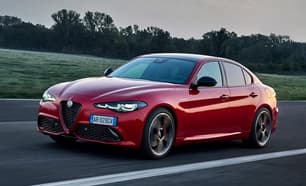
Like any good Alfa Romeo should be, the Giulia is a work of art. It’s sleek, sharp, and immaculately proportioned.
This most recent update has artfully refined a formula too good-looking to mess with. The increasingly dorky headlamps from the previous car have been swapped out for a more contemporary all-LED set, with a three-bar DRL pattern.
The grille has also been tweaked for this update for a more modern style, and the Veloce is now graced with the iconic and more aggressive sport two-tone alloy wheels in the traditional five-hole 'tele-dial' style.
It’s effortlessly attractive, and instantly recognisable as an Alfa on the road. I can’t think of a better way to stand out in today’s executive sedan landscape.
The interior has received less of an upgrade for the 2024 model year, with the same core parts. The major change is the old-school analogue instrument cluster being swapped out for a slick 12.3-inch digital unit.
The puzzling thing about this is the 8.8-inch central multimedia screen hasn’t been upgraded in-kind, making a strange contrast between the sharp and fast digital instruments, and the laggy and dull multimedia panel.
At least it effortlessly sits behind the curvaceous design of the dash as to not interrupt a good shape.
There are of course plenty of other touches which I love. The leather seats look and feel the part, as do the real metal paddle shifters which float behind the simple yet refined and sporty steering wheel.
The push-to-start button on the wheel is reminiscent of other Italian sports machines, while the tasteful smattering of leather, gloss plastic, and textured surfaces keep the premium feel on-track.
Some areas I’m not so keen about: Some of the interior plastics, particularly for buttons and toggles, feel cheaper than they should, and the door cards are oddly basic considering how much attention has been given to every other part of this car’s look and feel.
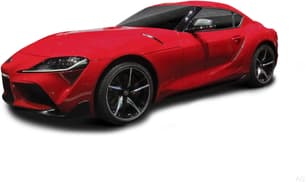
Perhaps it’s just me but I think the Supra looks exactly how it should look - like a Hot Wheels car.
Seriously, how good does the back view look? I love the spoiler that angles up like a crazy ski jump and the tail-lights integrated underneath it.
I love the huge rear hunches swollen like they’ve been stung by an enormous wasp. Check out the roof - see how it’s curved? And that bonnet with the vent above the wheel arches, I love the styling of every millimetre of this car.
But my neighbour doesn’t. I pulled up and said, “How good does this look?” And he gave me this stare like I was bonkers.
I don’t know, maybe you and I have the same excellent taste, but if there’s anything I hate it's anything that’s boring.
To me the BMW Z4 ‘twin’ is getting very close to the boring end in the styling department.
Talking of BMW, the Supra's interior is very BMW from the indicators stalks to the media system and climate control set-up.
It’s a modern and minimalist cabin… if only there wasn’t a cupholder right where my elbow goes. That’s a good place to stop and talk about the Supra GT’s practicality.
The Giulia is an old-school low-slung sports sedan. Many will prefer the SUV sensibilities of the Stelvio, with its bigger hatch-opening boot, and its higher ride height can better accommodate less mobile passengers, and makes it easier to fit child seats and the like.
For those willing to trade those things away for a superior drive experience, the Giulia is still solid to live with every day, but has a few drawbacks.
For example, those strangely basic door cards offer only a tiny map pocket with a nook I’d hardly describe as a bottle holder.
The centre console offers two larger bottle holders with variable edges, but there’s also not much else in the way of storage in the cabin aside from a smaller-than-average glove box and armrest console box.
The big win for me is the physical dial set and shortcut buttons for all the key climate functions, making it easy to operate while you’re concentrating on driving.
At least the seats are well bolstered, and front passengers are treated to plenty of adjustability. Visibility is okay, and it was easy for me to find a comfortable driving position at 182cm tall.
The rear seat is a similar story. It’s tighter, and you have to duck down below the roofline to get into it.
Once inside, I was pleasantly surprised to find enough room for my knees and somewhere for my feet to slide behind my own driving position, although the centre position is all but useless thanks to an enormous raise for the driveshaft.
Headroom is passable, but you wouldn’t want to be much taller than me.
There are, again, tiny bottle holders in the doors, and a further two in the drop-down armrest. Rear seat passengers get dual adjustable air vents on the back of the centre console, one USB 2.0 outlet, and elastic nets on the backs of the front seats.
The boot measures 480 litres which is up there with a lot of mid-size SUVs, but because it’s a sedan, access is more limited, and it won’t accommodate as many awkwardly-shaped objects.
The good news is that if you’re tall like me (189cm) and mainly legs then you’ll have more than enough legroom and headroom because the footwells are impossibly deep and the seats can be lowered to what feels like ground level.
Actually, you are almost at ground height in this car so the bad news if you’re as tall as me you’ll probably have to crawl out of the car on all fours.
The cabin of the Supra doesn’t do the storage space thing well. Sure there are two cupholders but their location is the same place my elbow frequents while changing gears and resting.
The wireless phone charging area is good and easy to access, but the door pockets are as thin as post box slots so if it’s letters you’re storing there you’re in luck.
If it’s anything thicker than that you’ll be left looking around for a place to put your purse or wallet and end up throwing it in the phone charger space if the passenger seat is taken.
You could always ask your co-pilot to hold onto your things which reminds me to tell you that the Supra is a two-seater only. There are no back seats, and there’s no option to have back seats.
If you’re looking for a sports car with rear seats (although space will be limited) for the same money then there’s the Audi A4 45 TFSI and at an even lower price is the Ford Mustang GT.
If you look over your left shoulder while in the driver’s seat of the Supra GT you’ll see into the boot - there’s no wall separating the cabin from the cargo area. This is handy for throwing a school bag in as I did for my son on the morning drop off, but also means your items may make an unexpected visit to the cockpit if you stop suddenly.
The boot is large for a sports car at 296 litres (VDA) and it managed to fit our large CarsGuide suitcase with space to spare as you can see in the images.
The Giulia we’re looking at for this review is the mid-spec Veloce, which costs $74,950 before on-road costs, sitting above the base Ti ($68,450) and below the top-spec Quadrifoglio ($153,700).
Natural rivals from Germany include the Audi A4 45 TFSI ($77,869), BMW 320i M Sport ($80,200) and Mercedes-Benz C200 ($89,900) all of which suddenly make the attractive Alfa look like a not-half-bad deal.
But then there’s always the Genesis G70 (from $63,000 in equivalent turbo 2.0L form) to bring the value equation back to reality.
Standard stuff at this grade includes 19-inch alloys, an 8.8-inch multimedia touchscreen and a 12.3-inch digital instrument cluster (new for the 2024 model year), dark contrast exterior highlights, leather seat trim with heated front seats and steering wheel, aluminium interior detailing and shift paddles with extended leather trim on the dash, updated LED headlights and DRLs, dual-zone climate, push-start ignition and keyless entry, tinted rear windows, and a 14-speaker Harman Kardon audio system.
Performance-wise, the Veloce also scores a limited-slip rear differential to match its punchy engine.
The tech feels a bit old, and the interior has a dated ambiance to it compared to the more open and digitised spaces of its rivals, but there’s something to be said for how organic the Alfa feels. More on this later.
The Toyota GR Supra GT with the manual gearbox lists for $87,380 and you’ll pay the same price for the same car with the automatic transmission.
Yes, almost $90K might sound like a lot of money for a Toyota (unless it’s a LandCruiser) but it’s actually a bargain considering the GTS grade above costs $10K more and has the same engine plus pretty much the same features apart from a fancier stereo, head-up display and 19-inch alloys (rather than the 18s on this GT).
Also, if you didn’t know already the Supra is a BMW/Toyota joint venture model aligned with the BMW Z4, and if you want the Beemer version with the same engine as the Supra GT you’ll pay $139,800 for it.
So see, it’s a bargain in comparison.
The standard features list of the GT has pretty much everything you need. There’s a proximity key, LED headlights with adaptive high beam, active cruise control, sat nav, wireless Apple CarPlay and Android Auto, a 10-speaker stereo, wireless phone charger, heated and power adjustable seats, shifting paddles and sports pedals.
Great features, but let down only by a small 8.8-inch screen for your media and nav. Still, that absolutely shouldn’t be a deal-breaker for you.
The rivals? Well, clearly the BMW Z4 which is way more expensive, but also there is the Nissan Z which costs between $70-$80K and is also a hoot to drive.
Add the Ford Mustang GT to your research list, as well. It’s not as agile as the Supra but it’s quick, fun and sounds better to my ears.
The Veloce might not pack a Ferrari-derived six-cylinder engine like the Quadrofoglio, but its smaller 2.0-litre four-cylinder turbocharged petrol engine hardly wants for power.
Packing 206kW/400Nm it outpunches six cylinders of old easily, and is still capable of sprinting to 100km/h in a hot-hatch baiting 5.7 seconds to a Vmax of 240km/h.
It even sounds fantastic, as it flies up the rev-range living up to every bit of the Alfa promise. Peak power arrives at 5250rpm, but peak torque hits at 2250rpm.
Smooth shifts are provided courtesy of an eight-speed traditional torque converter automatic transmission.
You’re looking at a Supra that could be the peak of its model evolution because since the generation’s arrival in 2019 Toyota has increased the power of the 3.0-litre turbo-petrol in-line six-cylinder from 250kW to 285kW (torque remains the same at 500Nm) and introduced a six-speed manual.
This 3.0-litre six-cylinder turbo-petrol is the only engine you can have with the Supra, there are no four cylinders or V8s - now there’s an idea.
Toyota says the 0-100km/h time for the GR Supra with the manual gearbox is 4.4 seconds and 4.1 seconds for the automatic which comes with a ‘launch control’ feature.
Of course, all Supras are rear-wheel drive.
The 2.0L turbocharged engine has an official combined cycle fuel consumption figure of just 6.1L/100km, although I saw 9.0L/100km in my time with it.
I’ll admit it was being enthusiastically driven, and treated to lots of urban commuting.
The Giulia has a 58-litre fuel tank and requires mid-shelf 95 RON premium unleaded fuel. Its approximate range on a full tank at the official consumption is 951km.
Toyota says the 3.0-litre six-cylinder straight-six turbo-petrol engine in the Supra GT paired with the six speed manual gearbox should use 8.9L/100km after a combination of open and urban roads.
I did a week’s worth of city commuting and then a couple of hundred kilometres on country roads, but no motorways and the trip computer told me I was averaging 10.3L/100km.
Not bad for a big engine in a car tuned for performance, driven by a big kid who feels like he’s playing with somebody else’s toys.
Premium 95 RON fuel is recommended, although 'standard' 91 is acceptable. A 52-litre fuel tank translates to a theoretical range of around 580km, dropping to approximately 500km using our real-world number.
Put simply: The Giulia is a celebration of Alfa Romeo. Yes. Even with a humble 2.0-litre turbocharged engine and an automatic transmission, this is a deeply emotional car. A riveting experience from behind the wheel.
Fly round corners, your eyes wide, exclaiming ‘magnifico!’ as the Giulia gracefully leans in, the rear LSD, sporty tyres, and wonderfully tight steering working together in harmony as you eke out just a smidge of tyre roar.
Laugh out loud to yourself, as you plant the accelerator, hear the muted rumble of the surprisingly angry little engine, and feel the turbocharger kick in half a second later as you power out.
‘Eccezionale!’ You’ll think, as you feel the click of the immensely satisfying metal paddle-shifters, and the transmission responds in-kind, the engine roaring up the revolutions with enthusiasm.
Sure, the Veloce grade is not as raw, or as wild, or near as fast as the top-grade Quadrofoglio, but all of the exciting spirit of that car is still here, and at a little over half the price, too. The Veloce is an absolute delight to drive.
It has such poise, makes such a fine sound, and does it all so gracefully. This is how you make a car feel as one with the driver.
Even the ride is deeply impressive. It’s not too harsh or noisy, while gifting the chassis just the right amount of lean in the corners and allowing enough play for it to remain controlled over bumps.
Not only does it work well when you’re driving as it's clearly intended to be driven, but around town it’s quiet and refined inside, living up to the promise of a luxury sedan.
The seats and bolstering are great, the visibility isn’t too bad, and while I’ll complain about the slightly laggy software on the multimedia screen, the digital dash is responsive and the physical climate controls are welcome.
It’s not all perfect. If it were, I think it might cease to be an Alfa Romeo and start sprouting BMW badges.
For example, our test car, with less than 2000km on the odometer, had various inconsistent rattles emanating from the plastic garnish around the digital dash, and somewhere behind the back seat.
Regardless, driving this car has made me a little sad Alfa will be putting this wonderful platform behind it in pursuit of more electrified goals.
I can only hope wherever the Giulia nameplate goes next, it retains the spirit of this version.
Ah, but what about living daily with a manual? As a car enthusiast most of the cars I’ve owned have been manuals and I’ve rarely cursed them because I love to drive.
But there were times when they were a pain, such as in traffic, or in traffic on steep streets and in traffic in shopping centres. Did I mention in traffic, also?
But on the nice roads with bends and dips, hills and sweeping corners, hairpins and twisty parts in places without traffic, then all is forgiven.
And so it goes with the manual version of the Supra.
Making life easier in the Supra GT is a clutch pedal without much travel so you don’t feel as though you’re at the gym doing a one-sided leg press.
I found the shifts themselves, while short, to be less than smooth. At first, I thought that the clunky changes might have been because the gearbox hadn’t been run in yet, but the odometer was saying 7500km, so this could just be the nature of the gearbox and after a few days I became used to it.
The rev-matching feature of this gearbox is a nice touch, especially on those sporty drives when you change into a gear and you’re thrown straight back into the power band again.
Superb balance, great steering with a nose which points exactly where you want it to and that magnificently smooth turbo-petrol in-line six posting all its meaty grunt to the rear wheels just behind your shoulders makes for a sports car that’s fun, talented and quick.
Good brakes (348mm ventilated rotors with four piston calipers at the front and 330mm discs with single piston calipers at the rear) and grippy Michelin Pilot Supersport tyres (255/40 fr - 275/40 rr) complete a great package.
A ride that’s still comfortable over bad Sydney roads and surprisingly good visibility made the Supra easy to live with in the city, from parking to school drop offs.
Yes, used it each day for the school run with my older child and the grocery shopping.
The same safety equipment suite is standard on every Giulia variant.
Advanced active gear includes auto emergency braking, lane keep tech, blind-spot monitoring with rear cross-traffic alert, driver attention alert, and adaptive cruise control.
It also scores front and rear parking sensors, and a reversing camera with guidelines.
The Giulia’s maximum five-star ANCAP safety rating expired at the end of last year, as it was originally rated back in 2016. The facelifted model is ‘unrated’ relative to ANCAP’s current standards.
The GR Supra GT has not been crash tested by ANCAP, but its BMW Z4 twin scored a maximum five stars when it was tested by the European equivalent Euro NCAP.
Still, the Supra has seven airbags, there’s AEB with pedestrian and cyclist detection, lane keeping assistance and blind spot warning, plus front and rear parking sensors. There are seven airbags on board.
There’s no spare wheel, but there is a tyre inflation kit which should get you out of trouble.
Alfa finally updated its warranty to a more industry-standard five-years and unlimited kilometres in 2022.
Service intervals occur at 12 monthly or 15,000km intervals for the 2.0-litre turbocharged variants. Pricing was not available for the model year 2024 version yet in the brand’s online calculator, but to give you an idea for the pre-facelift version, pricing came in between $345 and $1065 per visit, averaging $573 per year for the first five years of ownership. Not cheap, but not as expensive to run as you might expect.
One thing you might want to keep in mind is depreciation. Boring, I know, but even late model examples of the Giulia and Stelvio have been hit particularly hard by the depreciation stick according to residual values we searched up on Autotrader.
For reference, the Genesis G70 and BMW 3 Series have both fared much better in equivalent 2.0-litre turbo forms.
Toyota covers the GR Supra GT with its five-year, unlimited kilometre warranty. Servicing is required every 12 months or 15,000km and is capped at $415 per service.
The warranty is the industry standard in terms of time and kilometre length, and the capped service prices are very reasonable - a lot more affordable than a car with a prestige badge on the bonnet, too.