What's the difference?
Since 1949, Abarth has been giving the venerable Italian brand, Fiat, a patina of performance, based largely on giant-killing feats in small modified cars like the Fiat 600 of the 1960s.
More recently, the brand has been revived to boost the fortunes of the smallest Fiat on sale in Australia. Known formally as the Abarth 595, the tiny hatch packs a bit of a surprise under its distinctive snout.
Australia is experiencing a mass extinction event.
Like the dinosaurs before them, and hopefully not the bees in the near future, the sub-$20,000 car is nearing the bitter end.
An evolutionary dead-end, as higher emissions and safety regulations relegate older models (read Mitsubishi Mirage) to the great scrap-heap in the sky and prevent newer ones (read Honda Jazz) from leaving their local markets.
For you, this means there are quite literally a handful of brand-new vehicles left in Australia which wear before-on-road price-tags under the magic $20,000 number.
One of them is the car we’re looking at for this review: The Kia Rio S, with the catch being you’ll have to be happy changing gears yourself.
So, is this most basic Rio worth your while, or is it best left as a puzzling fossil for future generations to study? Let’s have a look.
It’s tough to be kind to the Abarth 595. Based on a platform that’s more than a decade old, the car has been left behind by its rivals in many ways, including basic ergonomics and its value equation.
The larger engine does work well in this smaller package, and its road-holding ability belies its size. However, only die-hard fans of the Abarth brand will be able to cope with the uncomfortable seating position and a complete lack of even the most perfunctory features that cars costing $10,000 less are able to offer.
The Rio S Manual is a fun-to-drive little car with a big practicality and multimedia offering in a segment rapidly heading towards extinction.
While some elements of the drive experience are reminiscent of budget cars from 10-20 years ago, Kia makes up for it by wrapping the Rio in a contemporary looking and feeling package, ready for the buyer who needs no frills and demands no nonsense. Until the manual transmission goes the way of the dodo, there is almost no better option.
Despite being based on a design that’s a decade old, the Abarths still stand out. Based on the classic Fiat 500 shape of the 1950 and '60s, it’s more cute than cut-throat, with a narrow track and tall roof giving it a toy-like presence.
The Abarth attempts to beef things up with deep front and rear bumper splitters, go-fast stripes, new headlights and alternate-colour wing mirrors.
The 595 rides on 16-inch rims, while the Competizione runs 17s.
Inside, it’s definitely different to most mainstream cars, with colour-coded plastic panels on the dash and a very upright seating position, along with a dual-tone steering wheel.
It’s a love-it-or-hate-it proposition. There’s no middle ground here.
While notable equipment is missing, the Rio reclaims lost ground with the way it looks, and to a degree, the way it feels.
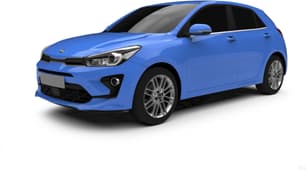
Ever since this new generation hatch launched, I’ve thought it brings a slick modern design to the city-car space, and even in its most rudimentary form as-tested (our car even came in the most basic ‘Clear White’ paint) it’s a great looking little hatch.
Sure, it doesn’t have the romance factor of the Fiat 500, nor the more delicate curvature of the much more expensive new-generation Toyota Yaris, but it certainly has a more refined visage than, say, the MG3 whilst feeling a bit more grown-up than the Suzuki Swift.
Solid, squared-off lines give this car a sporty pose, and its frowny-face and blocky rear round out a stout city-car persona, and I especially like the way even this most basic trim is adorned with contrast pieces, a spoiler above the boot lid, and body-coloured door handles and mirrors.
Sure, the 15-inch steelies dress it down a bit, but on the Rio these leave the impression of financial prudence rather than cost-cutting.
Inside is basic but tidy. The overall look maintains a hint of sportiness, with an appealing symmetrical finish to the dash.
There’s no question the Rio is a budget model when it comes to the touch though, with everything either a soft polyurethane or a nasty hard plastic, so while it all might look neat it’s far from the most comfortable place to be for long periods of time.
The basic dot-matrix multifunction display, chunky plastic air-conditioning controls, and polyurethane items from the wheel to the handbrake and shifter are reminders of a bygone era, but the overall aesthetic of the driver’s space is pleasing.
This is another area where the Abarth falls down. First and foremost, the seating position for the driver in both cars is utterly compromised.
The seat itself is mounted far, far, too high, and has little adjustment in any direction, and there is no reach adjustment in the steering wheel column to allow a taller (or even an average height) driver to get comfortable.
The more expensive Competizione we tested was fitted with a set of optional sports bucket seats from racing company Sabelt, but even they are mounted literally 10cm too high. They are also ultra firm, and even though they look supportive, lack decent side bolster support.
The tiny multimedia screen is okay to use, but the buttons are miniscule, while there’s a complete lack of storage places in the front.
There are two cupholders under the centre console, with two more in between the front seats for rear seat passengers. There are no bottle holders in the doors and no storage for rear seaters.
Speaking of the rear seats, they are the very definition of cramped, with little headroom for moderately sized adults and precious little knee or toe room. There are two sets of ISOFIX baby seat mounting points, though, should you fancy wrestling your wriggling toddlers through the narrow aperture.
The seats flip forward to reveal more cargo space (185 litres with the seats up, and 550 litres when the seats are down), but the seat backs don’t fold flat into the floor. Under the boot floor is a can of sealant and a pump, but no space saver spare.
In truth, it was a long day testing this car… at 187cm, I simply could not get comfortable in it at all.
I'd argue the key reason to buy the Rio at this end of the market is that it has the most space and largest cabin relative to its rivals, bar maybe the Suzuki Baleno.
All-round practicality is great, with front passengers scoring a low, sporty seating position with a high roof, and so much width in the cabin it almost feels like the Rio belongs in the next segment up.
Storage options up front include a large bottle holder and bin in each of the doors, dual cupholders next to the handbrake up front, and a large storage tray underneath the climate unit. Unlike the Yaris or Mazda2, the Rio features a small armrest console box, which gives a small lift to the ambiance of the cabin.
Back seat passengers are treated to great space for this segment, which feels nice and open courtesy of the large rear windows. At 182cm tall, I have airspace for my knees behind my own driving position, as well as relatively healthy headroom and ample width, which is again more like a car in the next segment up.
Rear passengers don’t get adjustable air vents, but there is a single USB port, a single pocket on the back of the passenger seat, and small bottle holders in each of the doors.
Perhaps the Rio’s biggest drawcard is its boot capacity, which at 325 litres is one of the largest in the city car class. Unlike the Yaris, Mazda2, or Suzuki Swift, the Rio will actually accept the CarsGuide three-piece luggage set with the rear seats up, although the rear view was obscured by the medium case.
Thanks to the boxy roofline, the Rio offers a cavernous 980L with the rear seats folded down, and despite its abundance of room, maintains a space saver spare wheel under the floor.
The range has been stripped back to just two cars, and costs has come down slightly, with the 595 now starting at $26,990, plus on-road costs.
A new 5.0-inch touchscreen multimedia system (with digital radio), a leather wrapped steering wheel, TFT dash display, rear parking sensors, alloy pedals, 16-inch alloy rims, and (front-only) adaptive dampers are standard on the base 595.
A convertible, or more accurately, a rag-top (cabriolet) version of the 595 is also available for $29,990.
The 595 Competizione is now a whopping $8010 cheaper at $31,990 with a manual gearbox, leather seats (Sabelt-branded sports buckets are optional), 17-inch alloys, a louder Monza exhaust, as well as front and rear adaptive Koni shocks, and Eibach springs.
Unfortunately, what stands out more on the Abarths is what they don’t come with. Auto lights and wipers, cruise control of any sort, driver aids including AEB and adaptive cruise… even a rear view camera is missing.
What’s more puzzling is that the Abarth’s architecture, though a decade old, has provision to accept at least a rear view camera.
Abarth’s explanation that the car’s home market doesn’t see these inclusions as important doesn’t really hold water, either.
In terms of value, the lack of basic content sends the Abarth to the bottom of a competitive pile that includes both the Ford Fiesta ST and the Volkswagen Polo GTI.
Value seems less important here when you’re contending with a limited list of potential options at this end of the market.
The Rio S manual currently wears an MSRP of $19,690, and if you’re able to shuffle cogs yourself, it counts its rivals as the Suzuki Baleno GL ($18,490), Suzuki Ignis GL ($19,490), or Fiat 500 Lounge ($19,550).
There’s also the option of the MG3 (from $18,990) or Kia’s own much smaller Picanto (from $15,990).
I’m pleased to report the Rio S is one of the best among these options, though. Not only is this car much more modern in terms of its platform and design than pretty much anything on that list, it packs great standard equipment, too.
The major wow-factor item is the Rio’s best-in-class multimedia system, consisting of an 8.0-inch touchscreen with wireless Apple CarPlay and Android Auto connectivity, just one of the areas where this car will grab eyes over rivals.
Elsewhere is a predictably honest list of standard equipment, including basic halogen headlights, 15-inch steel wheels, manual air conditioning, cloth seat trim with a polyurethane steering wheel, a small multifunction display in the dash, two USB ports, a six-speaker audio system, and surprisingly, steering-wheel mounted controls.
There’s no keyless entry or push-start ignition, and this level of equipment makes you feel lucky to have automatic headlights. Sadly, the S manual also misses out on the basic luxury of cruise control.
It’s cheap, missing a lot of gear, and feels it with an abundance of plastic trims, but somehow this car gets by with almost everything you really, truly need. Sure, it’s a bit of a hark back to the equipment lists of the early 2000s, but if you’re just looking for a basic car to get the job done, you could do far worse than this Kia with its impressive multimedia offering.
The Abarth 595 pair use the same 1.4-litre 'MultiJet' four-cylinder turbo engine in differing states of tune. The base car makes 107kW/206Nm, while the Competizione makes 132kW/250Nm, thanks to a freer-flowing exhaust, a larger Garrett-branded turbocharger and an ECU re-tune.
The base car can do 0-100km/h in 7.8 seconds, while the Competizione is 1.2 seconds quicker; the optional 'Dualogic' automatic is 0.2sec slower to the mark in both cars.
A five-speed manual gearbox is standard, and neither car is fitted with a limited slip diff.
The Rio is beginning to fall behind here with an antiquated 1.4-litre four-cylinder non-turbo petrol engine. Peak outputs aren’t far off where they should be for this segment, with 74kW of power and 133Nm of torque, although they arrive at the most distant end of the rpm range (6000rpm and 4000rpm respectively) so you need to rev it.
It can be clumsy to extract this power, too, with the engine paired in this circumstance to a six-speed manual which leaves a lot to be desired in terms of action and clutch feel.
While the abundance of ratios can be beneficial for fuel consumption, it’s clear this car was designed to be paired with the more modern three-cylinder turbocharged engine only available on the top GT-Line trim.
Over 150km of testing, the Competizione consumed a dash-indicated 8.7 litres per 100km, against a claimed combined fuel economy figure of 6.0L/100km. Our brief test of the 595 revealed a similar number, against the same claimed figure.
The Abarth will only accept 95 octane fuel or better, and its small 35-litre tank is good for a theoretical 583km between fills.
The Rio S manual has an official combined cycle fuel consumption rating of 5.6L/100km, which is about right for a light car with a small engine.
On test, covering largely urban kilometres, I saw a higher but not unreasonable 7.4L/100km. Still, this number isn’t too far off what some larger cars with 2.0-litre engines are capable of.
Rios with this engine accept entry-level 91RON unleaded fuel, and have 45-litre fuel tanks. They are only compliant with Euro 5 emissions regulations.
Ergonomics aside, the combination of torquey engine and lightweight car is always a good one, and the 1.4-litre turbocharged four is a good match with the front-drive Abarth.
There’s always enough mid-range urge to give the Abarth the hurry-up, and the longer-legged five-speed gearbox is a good match for the engine.
It also grips and turns surprisingly well, despite the Sport button adding too much artificial weight to the Abarth’s steering feel.
That same button also firms up the front dampers on the 595 and all four on the Competizione, which works well on smoother terrain, but stiffens it too much over more undulating surfaces.
Around town it can be hard to strike a good balance between ride and comfort. The difference between soft and firm is much more pronounced in the Competizione, but it will still get tiring if your commute is a bumpy one.
The turning circle, by the by, is ridiculously large for such a small car, making u-turns - already compromised by the lower front bumper - unnecessarily fraught.
The Monza exhaust on the Competizione gives it a bit more presence, but it could easily be louder (or at least more crackly) again; you’re not buying this car to be a wallflower, after all.
A six-speed manual with a tiny non-turbo engine is an absolute oddity in today’s new car market, but as a result of its rudimentary approach, there’s something refreshingly honest about the Rio S.
The engine requires a wringing to extract the desired result, and a lot of action on the gears, as six speeds proves to be quite a few to work your way through before you achieve cruising speed.
As so much interaction is required with the transmission, I wish it was tighter when it comes to the clutch which feels a bit doughy at the best of times.
The Rio is very organic, though, with next to no electrical assistance for any of its interaction points offering the driver a high level of control.
The steering is direct, but as a result of a cheaper rack (with less teeth compared to this car’s Stonic relation), it feels simple and brittle when it comes to feedback.
The same criticism can be levelled at the suspension, which errs on the side of firm. This attribute combines with the low seating position to make even this most basic Rio an absolute hoot in the corners.
But it can be a little crashy over every-day potholes and corrugations, despite the abundant amount of rubber cladding the 15-inch steel wheels.
Visibility is superb out of this little car’s big windows, making you feel in control of your surroundings (necessary in the multi-lane confines and tight parking conditions of a city), and ergonomics in the cabin are absolutely on-point with the large touchscreen elements easy to reach and the instruments taking a basic no-nonsense form.
While noise levels are okay at urban speeds, they pick up above 80km/h, making the Rio more unpleasant to drive over long distances than, say, the more upmarket-feeling Yaris.
The Rio does find its place in this price bracket as a fun-to-drive, but predictably rudimentary experience, for the niche audience of drivers seeking an entry-level car who are still able to shift gears themselves.
Despite a lack of electronic safety aids – and, somewhat amazingly in the current age, a rear-view camera – the Fiat 500 that forms the Abarth's basis still carries the maximum five-star rating from ANCAP it was awarded in 2008, by dint of its seven airbags and bodyshell strength.
It wouldn’t have the same luck if it were judged under new ANCAP regs coming into force in 2018, though.
Sadly, the Rio S misses out on any advanced active safety items. This is one area where city-sized cars are struggling to keep up, as expensive active safety systems tend to push them well into the mid-$20,000 region.
Unlike the mid-range Rio Sport, the S has no auto emergency braking, lane keep assist, or driver attention alert.
It makes do with the more basic array of brake, stability and traction controls, with the addition of a great reversing camera, three top-tether and two ISOFIX child seat mounting points, and six airbags.
The Rio carries a valid five-star ANCAP safety rating, to an earlier 2017 standard before its missing modern active safety items were mandated.
A three-year/150,000km warranty is offered as standard on the Abarth 595 range, with a suggested service interval of 12 months or 15,000km.
Abarth importer Fiat Chrysler Automobiles Australia offers three fixed-priced services for the 595 range at 15,000, 30,000 and 45,000km, with the first costing $275.06, the second $721.03 and the third $275.06.
The Rio again gets the edge on its budget competition with a lengthy seven-year, unlimited kilometre warranty. In this space it only butts heads with the MG3, which offers a matching promise.
Roadside assist is included for up to eight years if you continue to service with Kia, and there's also a capped price service program for the duration of the warranty, covering up to 105,000km.
The Rio needs to be serviced once every 12 months or 15,000km, and prices range from $269 and $608 per visit, for an annual average of $409.40.
Not the cheapest servicing schedule we’ve seen, particularly when compared with the likes of Toyota.