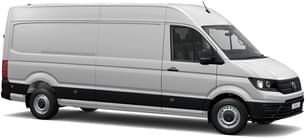
Volkswagen Crafter vs LDV Terron 9

What's the difference?

VS
Volkswagen Crafter
Volkswagen Crafter

2024 price

LDV Terron 9
LDV Terron 9

$53,674 - $58,937

2026 price

Summary

2024 Volkswagen Crafter
2026 LDV Terron 9
Safety Rating

Engine Type

Diesel Turbo 4, 2.5L
Fuel Type
-

Diesel
Fuel Efficiency
-

7.9L/100km (combined)
Seating
-

5
Dislikes
  • Good value, but still a lot of money
  • Won't cut it as a daily car outside holidays
  • Needs plenty of real estate for parking or storage

  • Intrusive, clumsy driver aids
  • No cab-chassis option
  • Tyres won't cope off-road
2024 Volkswagen Crafter Summary

Long before a hash-tag was anything more than a confusing symbol on a typewriter, vanlife was already a thing.

And you can largely thank Volkswagen for that because its Kombi models from the 1950s, '60s and '70s help cement the idea of roaming around the planet in a self-contained car-cum-house as a counter-culture favourite. More than that, the affordable, rugged Kombi made it actually possible.

Back then, there were a couple of paths to tread. You could take a second-hand butcher’s or florist’s Kombi van (windows optional) and trick it out with a bed, a table and whatever gear you needed to survive on the road.

Or, if the cash was around in sufficient quantities, you could buy a Kombi brand-new and have it converted to camper spec. And of all those brand-new conversion options, Volkswagen’s own, in-house conversion supplier, Westfalia was (and is) regarded as the pick of the crop.

So, when VW announces a 21st Century take on the concept of a factory campervan, those who like the idea of a lap of Australia but don’t like caravans or towing, are suddenly all ears.

Like most things, the latter-day VW camper has grown a size or two over the last six or seven decades. Which is why the factory Kampervan TD1410 4 Motion (to give it its full name) is based on the long-wheelbase, high-roof version of the Crafter van rather than the original Transporter layout. (There’s still the VW Multivan-based California if the Kampervan is too big.)

But just as commercial vehicles have become bigger and more sophisticated, and glamping has grown out of actual camping, does the modern take on a hippy legend make the grade in 2024? And does the Volkswagen offering retain any of the charm of the original campervan?

Oh, and forget about Westfalia. This conversion is the work of none other than Aussie caravan specialist Jayco.

The deal between Jayco and VW locally, means this variant of the Crafter Kampervan is an Australia-only deal.

View full pricing & specs
2026 LDV Terron 9 Summary

Need a dual-cab ute? You’re in luck. Not only does Australia have access to a huge variety of makes and models in the dual-cab space, there is also a huge range of prices and equipment levels.

The sweet spot for Aussie buyers, though, seems to be the dual-cab layout with four-wheel drive and enough convenience and safety gear to make the vehicle a viable family car as well as a work truck when necessary. Which is precisely where the Chinese brands including GWM, BYD and LDV have targeted their current ranges.

There’s been a lot of chat about such vehicles lately, but rather than let the formula stagnate, LDV has ushered in the Terron 9, a dual-cab that, size-wise, falls roughly between the familiar makes and models and the full-sized American-made stuff. This is a crucial point, too, as the Terron 9’s extra size might be a hint on where the dual-cab market is going generally. Certainly, every other class of car and ute is creeping up in size, why not dual-cabs too?

Like the other Chinese brands, of course, the Terron 9’s appeal will largely be based on value for money, so it’s worth picking the car apart to find out how it stands in that regard. But this is 2025, so the Terron 9 is also going to have to produce the goods in terms of driving ability and safety, that modern dual-cab buyers are looking for.

View full pricing & specs

Deep dive comparison

2024 Volkswagen Crafter 2026 LDV Terron 9

Change vehicle