What's the difference?
Some VW models, like the Golf, are household names. No doubt about it. But this? Well, it's probably not one of them. Or not yet.
This is the Arteon, the German's brand's flagship passenger vehicle. Put it this way, if VW's tag line is premium for the people, then this is the most premium. And the people? Well, they're the ones who might normally be shopping for a BMW, Mercedes or Audi.
The name, by the way, comes from the the Latin word for art, and it's a nod to the design focus that's been employed here. It comes in a shooting brake, or wagon, body shape, as well as this, the Liftback. And a quick spoiler alert, it looks pretty good, right?
But we'll get to all that. As well as the big question - can it mix it with the premium-brand big boys?
Anyone unfortunate enough to hear me banging on about electric cars - or perhaps more accurately, electrified cars - will be aware of my undying love for the existence of plug-in hybrid electric vehicles (PHEVs).
I love them because they offer a drama-free step into electrification. You don't need a big box on the wall to make sure you're charged overnight and because there's a petrol engine under the bonnet, as long as you've got fuel in the tank, your range anxiety disappears.
You can get around town in electrified silence and emissions-free smugness while still planning that around-Australia trip you'll never go on. It's absolutely the best of both worlds for those reluctant to take the next step. A genuine win-win, if you like.
Except that very few people buy them. Their existence in the catalogues of a number of car companies feels like a weary, "We should at least do something" from product planners. BMW has been trying with PHEVs for a while, with selected offerings in the 3, 5 and X5 range. Given the 5 Series has had its mid-life facelift, what BMW calls the LCI, it's time for another look.
The value, driving dynamics and appearance are on point for a premium play here. If you can forgo the badge snobbery attached to the German big three, then you'll find lots to like about Volkswagen's Arteon.
The G30 5 Series is an excellent car and unless you're looking for the serious punch of the V8 M550i, or want to run with the cops in the diesel, the 530e is a great option. No slower than the 530i, well-equipped and that rarest of things, a truly elegant BMW. Nobody buys a BMW with an eye on the budget, so at this level, the $3000 gap is nothing to worry too much about. For EV-sceptics, the range anxious or just for someone who just can't take the full EV plunge now, a PHEV is a great bridge between the two worlds.
And if nothing else, it's not a giant SUV.
It's really all about the looks here, and while the Shooting Brake is particularly handsome, the regular Arteon looks premium and polished, too.
VW tells us injecting a bit of sportiness was a key aim here, both inside and outside, and that's particularly true of the R-Line model, which rides on bigger 20-inch alloys, compared to the 19s on the Elegance, with their own bespoke design.
The body styling is more aggressive, too, but both trims get lashings of chrome along the body work, and a sleek, swept-back style that looks more premium than overtly sporty.
In the cabin, though, you can see that this is an important car to VW. The touchpoints are almost all soft to the touch, and it's both understated and tech-saturated at the same time, including the swipe-to-adjust function for the stereo and climate, with new touch-sensitive sections added to the centre console and steering wheel.
It feels, dare we say it, premium. Which is likely exactly what VW was going for...
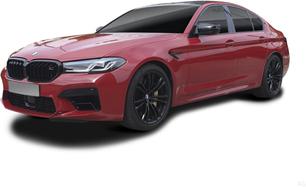
The G30 5 Series dates back to a time when people thought the grille on this was A Bit Much. How wrong they were. The 5, like the 3, used to be part of a clutch of executive sedans that formed the backbone of the company's expansion and success from the 1980s onwards. That means the styling is never too adventurous and even Chris Bangle's E60 5 Series, while striking, was not particularly controversial.
The only problem with the G30 is that it's hard to distinguish from its predecessor, but that's not a real issue when you see how elegant this car is. Easy on the chrome, proportional grille, big wheels, it's a proper smooth operator, visually speaking.
The cabin is holding up nicely and fits with the rest of the BMW range. It's impeccably well built, full of nice materials and even the wood trim is all right. The black Nappa leather is quite lovely but I can't tell you what the standard stuff is like, so you'll have to work that one out for yourself. It's very calm in here, with a good balance of buttons and screens with which to operate the car and while it doesn't have the you-beaut wow of its E Class rival, with its two massive slabs of screen in front of you, it has plenty to offer.
Interestingly, both body styles share near identical dimensions, with the Arteon stretching 4866mm in length, 1871 in width, and 1442mm in height (or 1447mm for the Shooting Brake).
Those numbers translate to a seriously spacious and practical cabin space, with an acreage of room for backseat riders. Sitting behind my own 175cm driving position, I had heaps of space between my knees and the seat in front, and even with the sloping roofline, plenty of headroom, too.
You'll find two cupholders in a pull-down divider that separates the back seat, and a bottle holder in each the four doors. Backseat riders also get their own air vents with temp controls, as well as USB connections, and phone or tablet pockets on the rear of each front seat.
Up front, the theme of space continues, with storage and cubbies sprinkled throughout the cabin, as well as USB-C connections for your phone or devices.
All that space means a sizeable boot area, too, with the Arteon serving up 563L with the rear seats in place, and 1557L with the back pews folded. The Shooting Brake ups those numbers - thought not any as much as you might think - to 565L and 1632L.
The 5 is almost five metres long, so as you might expect, it's big inside. Back-seat passengers have a ton of space to play with and even three across back there is doable for a distance. The outboard seats have some nice shapes to them, too, so they hold rear passengers in if the driver gets a bit ambitious. Loads of legroom, good headroom and very importantly, a good view out through the big side windows. Properly comfortable, then.
Front and rear passengers each score a pair of cupholders for a total of four as well as the same number of bottle holders. The centre-console bin is long and shallow, but does feature a USB-C port. The wireless-charging pad also has a USB-A port for those without the functionality and/or a phone too big to fit. Both the cupholders and charging pad have a sliding cover.
The boot is smaller than the standard car's as there is a lithium-ion battery hidden underneath the now-sloping floor. With 410 litres, it's smaller than a 3 Series' but it doesn't look that small. There is also a spot for the charging cable and its bag behind the left wheel arch.
The Arteon carries an unsurprisingly premium price tag in the VW family, but it can still be cheaper than an entry-level equivalent from some of the German premium brands.
Or, in the words of VW, the Arteon "challenges the luxury car makers without becoming one ourselves."
And you do get a lot of stuff. In fact, a panoramic sunroof, and some metallic paints, are the only cost options here.
The range is offered in 140TSI Elegance ($61,740 Liftback, $63,740 Shooting Brake) and 206TSI R-Line trims ($68,740/$70,740), and the former is offered with VW's Virtual Cockpit digital instrument cluster, along with a head-up display and a central 9.2-inch touchscreen that pairs wirelessly with your mobile phone.
Outside, you get 19-inch alloy wheels and full LED headlights and tail-lights. Inside, you'll find ambient interior lighting, multi-zone climate control, keyless entry and push-start ignition, as well as full leather interior trim with heated and ventilated front seats.
Also worth calling our here are the digital buttons on the dash or steering that control everything from the stereo to the climate, and work a bit like a mobile might, you can swipe left or right to control the volume or switch tracks, or change the temperature.
The R-Line model is the sportier-feeling option, and adds 'carbon' leather interior trim with bespoke bucket-style sports seats, 20-inch alloy wheels, and a more aggressive set of R-Line bodywork.
The 530e sits almost smack-bang in the middle of a still reasonably extensive 5 Series range. While you can have an "entry" level 520i for $99,900 (before on-roads), the 530e lands at $122,900 (before on roads), which itself is $3000 more than the 530i, and the same amount less than the NSW cops' favourite, the 530d.
Given the price, you'd expect some gear and boy howdy does BMW deliver. You get 19-inch alloys, a 16-speaker stereo, multi-zone climate control, ambient LED lighting, reversing camera to go with the front and side cameras, keyless entry and start, electronic dampers, active cruise control, electric and heated front seats, sat nav, auto LED headlights, heat-insulated glass, head-up display, a mostly real leather interior, auto parking, auto wipers, digital dashboard, wireless charging and run-flat tyres.
The huge touchscreen on the dash runs BMW OS7, which accepts inputs via touch, the console-mounted rotary dial and (optional) various hand wavey-movements. The speakers have harmon/kardon badges on them and there is DAB digital radio and wireless connectivity for both Apple CarPlay and Android Auto.
In something of a classic BMW own-goal, the wireless charge pad that is designed to keep your phone snug is too snug for bigger phones like my over-compensatory iPhone. Even with the cover off, it just won't fit. Thankfully there's also a USB-C port in the centre-console bin.
The 520e I had for the week also had the $5900 Enhance package (20-inch M alloy wheels, glass sunroof and the excellent BMW Laserlight headlights), $2300 Nappa Black leather package, comfort front seats ($500) and a built-in dash cam ($390) called BMW Drive Recorder. This brought the price up to $131,990 before on-roads. Just so you know, the Laserlights are $2400 on their own.
There are two drivetrains on offer here — the 140TSI with front-wheel drive in the Elegance, or the 206TSI with all-wheel drive in the R-Line.
The former's 2.0-litre turbo-petrol produces 140kW and 320Nm, which is enough for a sprint to 100km/h in around 7.9 seconds.
But the lust-worthy engine tune is definitely the R-Line, in which the 2.0-litre turbo-petrol ups the grunt to 206kW and 400Nm, and drops the sprint time to a brisk 5.5 seconds.
Both pair with VW's seven-speed DSG automatic.
The 530e comes with a 2.0-litre four-cylinder turbocharged engine developing 135kW and 290Nm, with the eight-speed ZF automatic sending power to the rear wheels. The electric motor spins up 83kW and 230Nm, also driving the rear wheels. When everything is working together, the combined output is 185kW and 420Nm, which delivers a quick 6.1-second dash to 100km/h, which isn't mucking about.
You can choose four drive modes. EV will (mostly) drain the battery, Hybrid will keep the two working together and Sport will deliver the most power. And drain the battery, albeit more slowly. Adaptive works the averages and decides what you need or want by how frisky you're being with your driving style.
Volkswagen says the Arteon Elegance will need 6.2L per hundred kilometres on the combined cycle, and will emit 142g/km of C02. The R-Line needs 7.7L/100km on the same cycle, with emissions pegged at 177g/km.
The Arteon is fitted with a 66-litre tank, and a PPF or petrol particulate filter, which strips some of the nasties out of the vehicle's emissions. But, VW says, it's “very important" that you only fill your Arteon with premium feel (95RON for the Elegance, 98RON for the R-Line) or you risk shortening the life of the PPF.
The 12kWh battery takes up the same amount of space as the old one, but has more capacity, extending its EV range. The claimed EV range is 57km on the WLTP standard.
The iDrive system has a bunch of settings that you can play with to squeeze more out of the silent-running mode and there's also a battery-charging mode button to force the ICE to charge the battery while you're on the move. Also useful is a timing system, so you can schedule when the car charges to take advantage of the cheap power available in the dead of night.
Recharging is easy but sadly a bit slow off a domestic power point. Having said that, if you plug it in after a day's commuting, you'll be topped up to 100 percent overnight. It's a long charge, but it's not as if you'll be stranded if you forget. You can get a wallbox, but there's not much point.
The fuel tank is just 46 litres. The WLTP combined cycle figure is a laughable 2.3L/100km. On that official figure, you'll cover an unlikely 2000km. My week with the car, which included 70km on EV-only power with one charge off my solar panels, got me an indicated 6.1L/100km in a mostly suburban week of driving. So based off that, you'll get about 530km from one full charge and a full tank, which is a bit confusing. Keep charging and, if you're an average Australian who travels little more than 30km per day, you won't use much petrol at all.
Having said all of that, out on the freeway, you'll probably slide towards that 2.3L/100km and make it from Sydney and Melbourne on a single tank. Just.
Full disclosure: we only spent time behind the wheel off the R-Line variant for this test, but even still, I feel pretty comfortable suggesting that it's the punchy powertrain you want.
Surely the very first hurdle any company hoping to play with the premium-brand big boys must clear is that of easy, effortless momentum? It's difficult to feel like you've made the premium choice when you're engine is straining and striving under acceleration, right?
And on this, the Arteon R-Line shines, with plenty of power underfoot whenever you need it, and a delivery style which means you rarely, if ever, fall into a hole waiting for the power to arrive.
For mine, the suspension might be a touch too firm for those seeking a truly wafting drive experience. For the record, it doesn't bother me — I always prefer to know what's happening underneath the tyres than be entirely removed from the experience — but a result of this sporty-feeling ride is the occasional registering of bigger bumps and road imperfections in the cabin.
The flip side of the firm(ish) ride is the ability for the Arteon - in R-Line guise - to swap personalities when you engage its sportier settings. Suddenly there's a snarl to the exhaust that's absent in its comfortable drive modes, and you're left with a vehicle that tempts you to head for a twisting back road to see what it's about.
But in the interests of science we instead headed for the freeway to put the Arteon's autonomous systems through their paces, with the brand promising Level 2 Autonomy on the highway.
While the technology still isn't perfect — some braking can occur when the vehicle's not entirely sure what's happening ahead of it — it's also pretty impressive, taking care of the steering, accelerating and braking for you, at least until you're reminded its time to put your hands back on the wheel.
It's also bloody big, the Arteon, with more space in the cabin - and especially the backseat - than you might be thinking. If you have kids, they'll be positively lost back there. But if you cart adults on the regular, then you'll hear no complaints.
The reason I like PHEVs as a tool for pushing people towards electrification is about more than the fact that it will likely cure buyers of range anxiety once they're realistic about their actual car usage. I mean it does do that, but it's more about the fact that PHEVs drive like a normal car, with few exceptions.
In EV mode, the acceleration is swift but not that brutal, YouTuber-friendly thrust EV fanboys use as proof that legacy car makers are dead. It's all very serene and very, very quiet as you move from traffic light to traffic light in near silence, while more than keeping up with traffic. The blue of the dashboard indicates your progress and the iDrive screen can keep you updated with power consumption.
The switch between EV and ICE propulsion is very smooth and it's almost like BMW has been doing this forever. You'll also discover an appreciable lift in performance, more in line with the M Sport badges. BMW's engineers have done nothing to make the 2.0-litre petrol sound better than a whirring mixmaster, though.
Slightly less M Sport-ey is the suspension. While there's absolutely nothing wrong with it, the adaptive dampers never dial things up too much for the average motorist. Granted the 5 will leave just about anything this size for dead as far as driver involvement goes, but it certainly keeps the dial closer to comfort than, say, the M550i does. Once again, it's a serene thing to get around in and passengers will love the quietness and easy flow of conversation. Or the lovely sound from the harmon kardon speakers.
You don't have to try too hard to cover a good chunk of the claimed 57km of EV range. Realistically you'll get close to 45km, even after my colleague Matt Campbell drained 20km of charge in a six-kilometre trip that he maintains was driven gently (snigger) and normally (guffaw). Without trying too hard, I managed 41km in pure EV after his attempts to ruin my numbers (not really, but I do enjoy the amusing false narrative).
Essentially, if VW makes it, the Arteon gets it. Think front, side, full-length curtain and driver's knee airbags, as well as VW's complete IQ.Drive safety suite, which includes a Fatigue Detection system, AEB with pedestrian detection, Park Assist, parking sensors, rear traffic assist, lane change assist, adaptive cruise control with lane guidance - which is essentially a level 2 autonomous system for highways - and an around view monitor.
The new model is yet to be crash-tested, but the last model scored a five-star rating in 2017.
The big price tag buys you a comprehensive safety package. It has seven airbags, ABS, stability and traction controls, blind-spot monitoring, active lane-departure warning, forward AEB, reversing AEB, forward collision warning, front cross traffic alert, reverse cross traffic alert, lane-keep assist, pedestrian alert in EV mode and tyre-pressure sensors.
The forward AEB works at high and low speeds. The pedestrian detection works at urban speeds and there does not appear to be cyclist detection.
There are also two ISOFIX and three top-tether anchors.
The 5 Series was last tested in 2017 and was awarded five ANCAP stars.
The Arteon is covered by VW's five-year, unlimited-kilometre warranty, and will require servicing every 12 months or 15,000kms. It will also get VW's capped price servicing offer.
BMW really needs to up its game, as do Audi and Porsche (among others). Munich is still sticking with a three-year/unlimited-kilometre warranty while German rival Mercedes is up at five years and Japanese competitor Lexus four. You do get three years roadside assist thrown in.
All 5 Series (excluding M5) are eligible for service plans. For $1950, you're covered for five years/80,000km of servicing. As with most BMWs, servicing is based on how you drive but really, if we're being honest, the car will get you into the dealer once every 12 months or 15,000km. Roughly.