What's the difference?
Fact: almost one in every two mid-sized (2.5-3.5-tonne GVM) commercial vans sold in Australia is a Toyota HiAce. And if you take note of the diverse range of businesses that rely on this ubiquitous workhorse, as we did recently, you can appreciate its widespread appeal.
Apart from countless couriers and tradies, the HiAce is favoured by a vast range of businesses from locksmiths and pool maintenance specialists to window cleaners and mobile coffee baristas.
To ensure the HiAce maintains its broad business appeal, Toyota has recently released an upgraded range with enhanced active and passive safety features, improved instrumentation, electric power steering and other refinements. We recently spent a week at work with the latest offering to determine if its market dominance is justified.
Most people that are wealthy enough to be ferried around in a car or limo choose a long luxurious sedan like a Mercedes-Benz S-Class, BMW 7 Series or a Lexus LS. Of course, there are now also SUVs that are used for the same purpose.
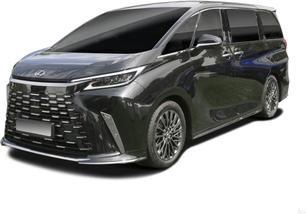
But what about a plush people mover? There are very few of these available in Australia and they don’t sell in huge numbers. But Lexus believes there is a market for such a model and it has just launched the big and bold LM. The hybrid-only range is a unique proposition and the LM should hold appeal for limo and tourism operators, and larger cashed-up families.
This initial launch drive was a slightly different format to usual. Given the intended use of the lounge-like model, Lexus arranged for us to be collected in the LM by a chauffeur and ferried from Melbourne to the Mornington Peninsula. From there we got behind the wheel for a brief drive, but many of my impressions will focus on the passenger cabin experience.
Note too that the LM500h does not land until early 2024, so we only sampled the LM350h AWD.
So jump aboard and let’s see if this Lexus can do everything the LS can do - and maybe even a little bit more.
The HiAce maintains its staggering 50 per cent share of the mid-size commercial van market for numerous compelling reasons including its versatility, as evidenced by the diverse range of Aussie businesses that rely on it. Toyota’s latest suite of safety and other upgrades makes it even better.
The Lexus LM is going to be a niche model. This was not designed to appeal to people that may have bought a Toyota Tarago back in the day, or even a Kia Carnival now.
It has a specific purpose for ferrying people around in absolute comfort and at that, it succeeds in a big way.
It’s just a bonus that it’s great to drive.
Welcome to the automotive equivalent of a business class airline suite.
Note: CarsGuide attended this event as a guest of the manufacturer, with accommodation and meals provided.
Apart from the recent safety upgrades, our LWB test vehicle resolutely adheres to a design that’s been perfected through decades of hard yakka.
Its simple and robust unitary chassis features MacPherson strut front suspension, a leaf-spring live rear axle, rack and pinion steering and (on all automatic variants) four-wheel disc brakes.
The HiAce’s traditional rear-wheel drive layout has an inherent traction advantage over front-wheel drive rivals, particularly when towing and hauling heavy loads on low-grip surfaces.
It also ensures the front wheels can be turned sharply enough for its 3210mm wheelbase to deliver an impressively tight 11.0-metre turning circle. And its 1990mm height also allows access to underground loading docks and multi-storey car parks.
There’s no load-floor liner or cabin bulkhead included as standard equipment, but both are available as Toyota genuine accessories. The use of unpainted plastic bumpers is designed to best withstand the wear and tear often evident in these areas on hard-working vans.
The cabin is spacious and airy, with a neat and functional dash design featuring large and clear instrumentation and (thankfully) physical dials and buttons rather than distracting touchscreens for the main controls that are easy to reach and operate. It’s a commercial van that’s easy to live with.
Look, people movers are not considered the sexiest of automotive body styles, but that’s changing.
The Kia Carnival and Hyundai Staria are examples of good MPV design.
And the Lexus LM steps it up again.
It is based on Toyota’s TNGA-K architecture that underpins a bunch of Toyota and Lexus models, including the Lexus RX, and it measures a whopping 5.1 metres long and has a three-metre wheelbase.
It shares its underpinnings with the latest generation Japanese-market Toyota Alphard, which is a cult hit in Australia among the grey import set.
The front-end design is bold, with the latest take on Lexus’ big ‘spindle grille’, pinched slimline headlights and a stubby nose.
I am a big fan of this design. It is far more than a box on wheels and it has quite a bit of presence.
The interior design up front is modern Lexus, with a few familiar Toyota touches, and while it’s not exactly minimal, it’s still visually appealing.
With its hefty 2260kg kerb weight and 3300kg GVM, our test vehicle has a 1040kg payload rating. So, it’s a genuine one-tonner and up to 120kg of that can be carried on Toyota’s triple roof-rack set.
The HiAce is also rated to tow up to 1500kg of braked trailer and with its 4800kg GCM rating (or how much weight it can legally carry and tow at the same time) it can carry its maximum payload while towing its maximum trailer weight. So, that’s more than 2.5 tonnes of combined cargo-carrying capacity, which would comfortably meet or exceed most job requirements.
Its cavernous cargo bay, which offers 6.2 cubic metres of load volume, is accessed from either side through sliding doors with 1010mm-wide openings, or through rear barn-doors with 180-degrees opening to allow easy forklift access.
The cargo bay is 2530mm long, 1760mm wide and 1340mm high, with 1268mm between the rear wheel housings allowing up to two standard Aussie pallets or three Euro pallets to be carried, secured by a choice of six load-anchorage points.
An unusual feature is the roof’s full-length internal lining, which we suspect contributes to at least some suppression of tyre noise emanating from the rear-wheel housings. The walls and doors are neatly lined to mid-height and there’s ample internal lighting.
Generous cabin storage includes a bottle-holder and bin in each front door, small bottle/cupholders in the centre and either side of the dash, plus a single glove box. The console between the seats offers another two bottle-holders plus generous internal storage, which is topped by a large hinged lid that can also serve as a storage tray or work desk.
While most of the fun happens in the second row of the Lexus LM, there is a lot to like in the front compartment.
The dash is dominated by a large touchscreen that houses Lexus’ latest multimedia setup. The logical menu and uncomplicated sub-menus ensure this is an easy system to navigate. Speaking of, the in-built sat-nav is one of the better systems I have experienced.
Comfort isn’t just the domain of the second row - the driver’s seat is very supportive and comfortable, with power adjustment.
There’s plenty of glass including a smaller front quarter window that helps eliminate front blind spots, so forward visibility is exceptional. Rearward visibility is aided by the digital rear-view mirror that is designed to ensure privacy for second and third-row occupants. You don’t want the chauffeur spying on you while you’re sleeping, do you?
The other big tick for me is the driving position. Other people movers, namely the Hyundai Staria and Mercedes-Benz EQV, have very low window lines and it leaves you with a feeling of sitting on the car, rather than in it. I am sure it helps with extra light and it probably makes it easier for kids to see out of, but from a driving perspective, I find it a little disconcerting.
But the LM has flipped that. The front compartment is designed in such a way that it feels like a cockpit that you’re ensconced in. This helps the driver feel more connected with the car, and in the LM it feels like you’re sitting in the driver’s seat of a sporty sedan, not a five-metre bus. Very well done, Lexus.
And now to the main event - the second row.
Where to begin. Let’s start with space. Because there is so much of it. Unsurprisingly given the seating layout, there is an unending amount of head, leg, knee, bum, shoulder and whatever-else room. I can’t imagine anyone complaining about space back there.
Also, getting in and out is a breeze thanks to the sliding power doors on both sides. These can be opened from the front seat, and via several buttons in the rear.
Those captain’s seats are plush. Not quite Benz S-Class plush, but still.
They are adjustable six ways - power adjustable, of course - and they’re heated and ventilated. They recline almost flat, too, if you need a nap on the way to the country estate. And while you do that you can look up through the split sunroof, or close the shade a number of ways.
Is there a massage function? Of course there is a massage function. And it’s not bad. You can choose two settings - weak and firm.
Adding to the feeling of a business class airline seat, there is a fold-out table in the armrest, although it’s a smallish one. And there is dual-zone climate control in the rear.
There is a roof-mounted control panel for things like climate, sunshades and sunroof blinds, but much of this can also be controlled by the Apple iPhone-like devices clipped into both rear seats. These are closer to the seats, so it is easier to access than the roof.
Another function in the device is the Climate Concierge that features different modes - Dream, Relax, Focus, Energise. Depending on which one you choose, it alters the seat settings, massage, climate and lights to suit.
I love the massively wide side windows that are tinted (or privacy glass), too.
Other amenities include map pockets, knee and roof-mounted air vents and a 14.0-inch display screen that retracts from the roof and connects to an HDMI cable, allowing you to watch whatever you want.
The third row is not as appealing as the second. It is technically a three-person row, but the width and the fact that it has a sizeable gap in the centre suggests that this is best thought of as a six-seater van.
The seats are not as plush of course, so you might not want to spend too much time in that row unless you are a small child. But you do get USB-C ports, cupholders, air vents, lights, sunglasses holder, power side shades and grab handles.
Getting in and out of the third row can take a while. It’s all power adjustable, so you don’t have to lift anything heavy - but it takes a while for the second row seats to move forward and up.
With all seats in place the cargo space is limited. In fact, it’s just 110 litres.
That’s similar to what you get in a seven-seat SUV. But it did fit all our overnight luggage easily.
Drop the rear row and that expands to a maximum of 1191 litres in the 350h or 752 litres in the 500h.
All grades have a space-saver spare wheel.
The base model LWB HiAce two-seater van comes standard with Toyota’s signature 2.8-litre four-cylinder turbo-diesel (shared by all HiAce models) and manual gearbox for a list price of $51,880, but our test vehicle is equipped with a six-speed automatic and rear barn-doors which raises the price to $54,630.
Other standard equipment includes Vanilla White paint, 16-inch steel wheels with replaceable plastic covers, 215/70R16 tyres and a full-size spare, halogen headlights and DRLs, leather-accented steering wheel with multiple remote functions, power-adjustable lumbar support on the driver’s seat, a USB port and 12-volt cabin sockets, an 8.0-inch touchscreen to control the two-speaker multimedia system with Apple CarPlay/Android Auto connectivity and more.
Recent upgrades to optimise driver comfort include a new 7.0-inch digital driver’s instrument cluster (previously analogue) with nine selectable displays, plus a new refrigerant to improve air conditioning performance (even though the previous system was always ice cold), an electronic parking brake on automatic models to replace the old-school mechanical lever and electric power steering to replace Toyota’s traditional hydraulic power assistance for reduced steering effort and more advanced lane-keeping smarts.
The latest safety upgrades include ‘lane trace assist’ which is designed to help the HiAce remain in the centre of its lane when the adaptive cruise is activated (see Driving).
There’s also a new ‘emergency driver support system’ which works with lane trace assist to detect if the driver has become unresponsive when adaptive cruise is activated. If the driver doesn't respond to audio and visual alerts, the system is designed to activate the hazard lights and bring the vehicle to a safe and steady stop.
Other upgrades include ‘safe exit assist’ which links with the van’s blind-spot monitor to improve safety when exiting the vehicle on the roadside, by issuing alerts when passing vehicles or cyclists are detected.
Cruise control functionality has also been expanded, with automatic grades like ours getting ‘full-speed function’ which can automatically stop the vehicle and then resume moving without the driver needing to intervene. This is especially useful in heavy stop-start city traffic.
Passive safety has also been improved with an additional centre airbag which protects driver and passenger from colliding in an accident.
From launch there will be two versions of the LM350h Sports Luxury on offer - front-wheel drive and all-wheel drive, priced from $160,888 and $165,888 before on-road costs respectively.
They both have seven seats across three rows and share the same four-cylinder hybrid powertrain, but an even more high-end version is on the horizon.
The LM500h will land in January 2024, priced from $220,888, and it adopts a newer more powerful hybrid powertrain. Something else that sets the LM500h apart is the seating layout - it is a four-seater. Behind the driver and front passenger compartment are two big captain’s chairs that recline flat if required. Decadent luxury. Or so the pictures suggest. We will have to wait until the New Year to sink into the sumptuous seats.
Given the positioning and interior layout, the LM will probably not appeal to people looking at a Kia Carnival, or who would have opted for the departed Toyota Tarago. It will, however, appeal to large families that aren’t short of a dollar, airport limo operators, and even as tourist transport.
Thankfully, there’s a substantial amount of standard gear fitted as standard in the LM.
The only difference in spec between the two 350h grades is the addition of all-wheel drive. Otherwise you’ll find keyless entry and start, front heated seats, automatic retractable side steps, power opening side doors, rear privacy glass, a pair of sunroofs, and semi-aniline or L-aniline upholstery.
Tech-wise, there is a digital rearview mirror, and a 14.0-inch touchscreen, a 12.3-inch digital instrument cluster, a head-up display, seven USB ports, a smartphone charger and a rear 14.0-inch multimedia display.
The 500h adds niceties like a separation partition with elevating and dimmable glass, that doubles as a 48.0-inch widescreen display to watch films and TV, or take conference calls with. It also gets two partition glove boxes, a pair of umbrella holders, two second-row phone chargers, a 23-speaker Mark Levinson 3D audio system and more.
In terms of rivals, there really aren’t many other luxury people movers on the market. Aside from the Mercedes-Benz V-Class and all-electric EQV, there are higher-grade versions of the Volkswagen Multivan, and the LDV Mifa 9 EV.
Toyota’s well-proven (1GD-FTV) 2.8-litre, four-cylinder, turbo-diesel produces 130kW of power at 3400rpm and, in auto models like ours, 450Nm of torque between 1600-2400rpm. Its Euro 5 emissions compliance doesn’t require AdBlue, which minimises maintenance and running costs.
The refined six-speed torque converter automatic offers the choice of sequential manual-shifting. Fuel efficiency is optimised with full torque converter lock-up on fourth, fifth and sixth gears, along with overdrive on fifth and sixth to minimise engine rpm when highway driving. The traction advantage of rear-wheel drive is enhanced by an electronically controlled automatic limited-slip diff.
There are two hybrid powertrains available. Coming next year, the LM500h combines a 2.4-litre turbocharged petrol engine and a hybrid setup, making for power and torque of 202kW and 460Nm respectively. It is all-wheel drive and is paired with a six-speed automatic transmission.
The LM350h comes with a 2.5-litre naturally aspirated petrol engine and a parallel hybrid system, offering up a total system output of 140kW and 239Nm. The 350h comes in front or all-wheel-drive guise and uses a continuously variable transmission (CVT).
Toyota claims combined cycle (urban/extra-urban) average consumption of 7.8L/100km. Our 328km of testing was conducted with the engine’s auto start/stop function switched off and comprised the usual mix of city, suburban and highway driving, of which about one third was hauling a near-maximum payload.
Our own figure, calculated from fuel bowser and tripmeter readings, was 10.7L/100km. That’s still within the usual 2.0-3.0L/100km discrepancy between official and real-world figures and not bad for a vehicle weighing more than 2.2 tonnes driven mostly in metro settings and hauling more than one tonne during our test. So, based on our real-world consumption, you could expect a driving range of around 650km from its 70-litre tank.
As you’d hope with an all-hybrid line-up, the LM excels when it comes to combined cycle fuel efficiency. The 350h FWD sips just 5.5 litres per 100 kilometres, while the AWD version is 5.6L/100km. The 500h is a little thirstier at 6.6L.
Our drive was so brief we did not get to record an on-test fuel figure.
The theoretical range of the LM, considering the 60-litre fuel tank and 5.5L/100km (350h) and 6.6L/100km (500h) fuel consumption figures is about 1000km.
The driving position is comfortable thanks to a well-sorted combination of supportive seating with power-adjustable lumbar support, a leather-rimmed steering wheel that’s adjustable for height and reach and a large left footrest for extra support.
The standard kerbside sliding door includes a large window, which partly reduces the huge blind spot over the driver’s left shoulder created by the cargo bay’s solid walls.
Fortunately, the HiAce also comes standard with blind-spot monitoring to ensure safe lane-changing on multi-lane roads, while its rear cross-traffic alert and rear-view camera are equally valuable when reversing out of driveways into busy traffic.
The new electric power steering has more noticeable changes in turning weight compared to the more linear hydraulic system it replaces. Its variable-ratio assistance feels even lighter at parking speeds for easier manoeuvrability and becomes increasingly firm and direct as road speeds increase.
Ride quality is reasonably supple when unladen or lightly loaded and the 2.8-litre turbo-diesel, with its sizeable 450Nm of torque, has strong low-rpm response and displays good flexibility in city and suburban driving.
Internal noise levels below 80km/h are acceptable, but like all vans can become intolerable at highway speeds due largely to tyre roar emanating from the rear-wheel housings. So, if you do lots of highway travel, we’d recommend fitting Toyota’s genuine accessory solid bulkhead to insulate the cabin from this noise.
The six-speed auto’s shift calibrations feel like they’re getting the best out of this engine, particularly fuel-efficient highway travel which requires less than 2000rpm to maintain 110km/h. The sequential manual-shifting function can be handy in certain situations, though, like hauling/towing heavy loads in hilly terrain.
To test its GVM rating we forklifted 830kg into the cargo bay, which combined with our crew of two equalled a total payload of 1010kg that was only about 30kg less than its 1040kg limit.
The stout rear leaf-springs only compressed about 30mm, which left more than 60mm of static bump-stop clearance that was more than enough to ensure there was no bottoming-out on our test route.
Its ample torque made light work of hauling this payload in city, suburban and highway driving as well as our 13 per cent gradient, 2.0km-long set climb at 60km/h, which it easily cleared in third gear.
Engine braking on the way down, in a manually-selected second gear, wasn’t as robust but within expectations given the one-tonne-plus payload it was trying to restrain.
We also tested what we safely could of the HiAce’s latest safety upgrades in road use, which all worked as intended. The ‘lane trace assist’ function when using adaptive cruise control was outstanding, as it resolutely kept the vehicle centred in its lane even around curved stretches of multi-lane highway, without the driver needing to intervene.
As mentioned earlier, I spent much more time in the second row as a passenger than I did behind the wheel of the LM350h. But it was enough time to capture some initial high-level drive impressions.
But let’s start in the rear. The ride in the second row is comfortable - as you’d hope. Our trek from Melbourne’s inner north down to the Mornington Peninsula included a lot of freeway, which was smooth. The only thing that disturbed the peace was a chunky bridge join that caused a bit of a thump. But we were hardly disturbed.
Back in the driver’s seat, there’s a lot to like about how the LM350h drives. First of all, it feels smaller on the road than its ample dimensions would otherwise suggest. It even feels relatively light on the road.
After the LM, I drove a Mercedes-Benz EQE SUV that has a similar kerb weight (the Lexus is about 2.4 tonnes), and the LM felt lighter.
The hybrid powertrain is responsive enough, offering decent acceleration from a standing start. The more potent 500h will of course be quicker.
The transition from electric to petrol propulsion is pretty smooth in Lexus (and Toyota) models these days, and the additional noise-deadening materials in the LM ensure it’s subtle.
The 2.5-litre petrol engine is really only noticeable when accelerating hard, and the CVT a slight drone, but it’s in no way unpleasant.
Otherwise it’s a superbly refined and quiet cabin on all but the absolute worst road surfaces. Whisper quiet power windows adds to that feeling of luxurious refinement.
Given the brief time behind the wheel, we didn’t get to test the handling capability of the LM, so that might have to wait for a review in the New Year.
The steering is heavily weighted and doesn’t feel overly responsive, but it’s perfectly suited to this sort of vehicle.
That supple ride we experienced in the rear was also evident behind the wheel.
This was especially impressive on a couple of pock-marked peninsular back roads. The ride is also much more compliant than the Mercedes-Benz EQV I tested early in 2023.
The HiAce comes with a fresh maximum five-star ANCAP rating awarded in 2025 and a top-tier Platinum rating in ANCAP’s commercial van collision avoidance assessment. Both rankings are courtesy of the latest safety upgrades, which enhance the HiAce’s existing suite of features that includes AEB with pedestrian and daytime cyclist detection, speed sign recognition, blind-spot monitoring, rear cross-traffic alert, front and rear parking sensors, reversing camera and lots more.
The airbag count runs to eight - dual front, side chest, side head, centre and driver's knee.
The LM is yet to be crash tested by ANCAP, and it is unclear if it will be given the fact that it’s a niche model. However, as with other current Lexus models, it has a long list of standard safety gear.
The safety suite, including intersection assist, and a pre-collision system with vehicle, pedestrian, bicyclist and daytime motorcyclist detection.
It also comes with emergency steering assist, full-speed radar cruise control, ‘Curve Speed Reduction’, ‘Lane Trace Assist’ with lane-departure alert, automatic high beam, ‘Road-Sign Assist’ (speed signs only), ‘Emergency Driver Stop System’, a blind-spot monitor and rear cross-traffic alert.
The HiAce is covered by Toyota's five-year/unlimited km warranty which is in line with competitors like the Ford Transit Custom and Hyundai Staria Load but lags behind the LDV Deliver 7's seven-year term.
Scheduled servicing is a relatively short six months/10,000km interval, whichever occurs first. Capped price for the first 10 scheduled services up to five years/100,000km totals $3650, which is $365 per service or $730 annually.
Toyota currently has 275 dealers across its vast Australian network located in metro, rural and regional areas. Toyota dealerships are also service centres.
When you buy a Lexus, you get a bit more than a car. The brand has a customer loyalty program - Lexus Encore - and depending on what model you buy, you are eligible for some pretty cool discounts, bonuses and experiences.
There are three tiers, depending on your model. UX, NX, RX and ES fall under regular Encore, and electric models the RZ and UX300e sit beneath Electrified Benefits. But the LM, as well as the LS, LC and LX are under Encore Platinum - the top tier.
That means access to the ‘On Demand’ program that allows access to another Lexus model for a few days or longer. So if you own an LC Convertible but need an RX for a few days to ferry people around, that’s all free. There’s valet parking service loans and more.
It also includes upgrades at Lexus partners. Our launch took us to Jackalope Hotel on the Mornington Peninsula, which is a Lexus partner, and you can get a bunch of extras here as a Lexus owner that other guests won’t get.
In terms of other ownership details, the LM is covered by a five-year, unlimited-kilometre warranty, and the servicing schedule is every 12 months or 15,000km.
Lexus is yet to announce the capped-price servicing details for LM, but it is expected to cover five years, and should be in the vicinity of approximately $700 per service.