What's the difference?
Never talk to strangers. That's (hopefully) what your parents taught you. Luckily some people ignored that good advice when it came to the Toyota Granvia VX people mover and me.
As you'll see in the video above, I tested it on the public – people I didn't know from a cake of soap or whatever the saying is. Seriously, I drove a bus route and somehow talked people into not getting on their regular bus and letting me give them a lift to wherever they were going instead.
I don't often conduct social experiments like this, but I figured the Granvia VX was different. First, here was a new-generation people mover based on the Toyota HiAce that effectively replaces the long-serving Toyota Tarago. Second, it's different from the Tarago and rivals such as the Kia Carnival and Hyundai iMax in that it seems like it's purpose in life could be more of a hire car 'shuttle bus' as it is for a Mercedes-Benz Valente.
So, either way its job is to carry more than one person nearly all the time and that's what I did. You can watch the video above and below is the full review taking into account how I found the Granvia VX to drive, along with its practicality when it comes to cargo capacity, fuel economy and passenger comfort.
Volkswagen’s new-generation Multivan is the brand’s family-oriented bus, and having just been to its Australian launch the people mover feels more high-end and somehow more practical than ever. But something has changed and it’s only now that it feels as though the final piece of the Multivan puzzle has been found and this van is complete.
Volkswagen’s entire vehicle range is mind-bogglingly big. From hatchbacks, wagons and SUVs to vans and buses, they all have two things in common - a high-quality feel and practicality. The Multivan has always adhered to this theme, as well.
Now, the new-generation Multivan has arrived and it’s clear Volkswagen has stuck to the same recipe of premium and practical, but there’s been a big change in the way it drives thanks to the decision to stop building the van on a truck-like platform and start building it on one used for cars.
You can read more about this below or watch my reaction to piloting the Multivan in my video.
Keep reading for more on the new-gen Multivan.
The Granvia VX is great at being plush, comfortable and easy to drive, but it's not as practical as a people mover should be. And while the engine provides a great driving experience, you'll be filling up the tank often if your trips are mainly urban and city focused.
The Australian launch of the new generation Multivan was confined to the Life grade with the 2.0-litre diesel engine. Later in 2025 the Style grade will arrive bringing a hybrid powertrain and even more features. We’ll be able to test both more thoroughly once we have them in the CarsGuide garage.
From this first drive, however, it's clear that while slightly pricier than its Kia Carnival rival the new generation Multivan is more practical than ever, and now that it rides on a car platform, far better to drive.
Note: CarsGuide attended this event as a guest of the manufacturer, with meals provided.
The Granvia is a new-generation people mover based on the Toyota HiAce commercial van and arrived in Australia in 2019. The resemblance to the HiAce is obvious although dressed up in its Granvia clothes it's a handsome and professional looking little bus.
I'm a fan of the protruding nose (which helped it earn the five-star ANCAP rating, see more on safety below) and I even like its big, shiny Transformer face and the 'L-shaped' tail-lights which aren't to everybody's taste.
Also, when I say little bus that's only in comparison to actual buses, like the one I convinced people not to get on in my video. Compared to a seven-seater SUV such as the Kia Sorento or Toyota Kluger, the Granvia is enormous.
Look at the dimensions. The Granvia is 5300mm long, 1990mm tall (not counting the aerial) and 1970mm wide, not counting the wing mirrors (which can be folded in).
While the length was hardly ever a problem for me while driving it over the week, the height saw me just make it under the 2.0m clearance in our underground carpark and I had to fold the aerial down to do it. Beware, many carparks have a max headroom of just 1.9m.
The cabin of the VX is impressively plush from the quilted leather reclining second-row seats to the 'woodgrain-look' trim throughout.
During my test I played bus driver to a number of passengers (no, seriously I picked up random strangers off the side of the road – see the video) and all were impressed by the Granvia's premium-feeling interior.
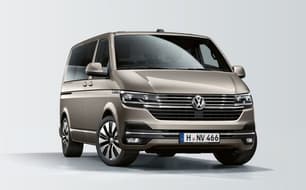
As with all Volkswagens the redesign of the new-gen Multivan is more about refining than redefining. Just like the Golf hatch which has kept its look through eight generations the Multivan is recognisable and familiar but new and modern looking, too.
Smoother lines, a more heavily raked windscreen and a flatter bonnet make for a cuter snub nose. The new Multivan is less boxy than before even though it is still a box on wheels, just a sleeker, more adorable one.
As mentioned, the Multivan comes in two lengths: the short wheelbase, which is 4973mm from the front bumper to the rear bumper, and the long wheelbase which is 5173mm long. Height for both is 1900mm.
Inside, the cabin is modern with large screens for media and driver instruments with a minimalist design to the dash, while the lack of a centre console frees up space. The sense of roominess is enhanced by daylight flooding in through oversized windows which can be taken a step further when combined with the optional panoramic (split panel) glass roof.
There are nine body colours to pick from including 'Candy White', 'Pure Grey', 'Reflex Silver Metallic', 'Copper Bronze Metallic', 'Deep Black Pearlescent', 'Energetic Orange Metallic', 'Medium Blue Metallic', 'Mono Silver Metallic' and 'Starlight Blue Metallic'.
The Granvia VX tested was an eight-seater (four rows of two seats) and being so tall and long would mean the space inside is going to be good, right? Nup. The Granvia doesn't seem to make the best use of its enormous cabin.
Seating, while undeniably comfortable and luxurious in the second and third rows, doesn't offer great legroom when you have a full load of people on board. I could only just sit behind my driving position in the second row and then behind that in the third row, but there was no way I could then fit in the fourth row.
And while cabin storage is great with the biggest centre console bin I've ever seen – I could fit my head in it (see the video) – and there are 10 cupholders, six coat hooks and a folding table, there isn't a boot or any room for cargo, not in the eight-seater (with all seats in use) I tested anyway. With all four rows in place there is only enough room for a few items no wider than a box of cereal (watch the video, to see what I mean).
Folding up the base on the fourth row seats means they can slide forward and that does free up a little bit of space for cargo, but if you are only going to be using the Granvia for six people, then my advice is to go with the six-seater and have a big boot at your disposal all of the time.
The Granvia VX is outfitted well with charging points – there are seven USB ports all the way back to the third row and two 12-volt outlets.
We'll get to what the Granvia is like to drive in a moment, but what I can say here is that the driver and passengers sit high, like looking-down-on-four-wheel-drive-utes high.
Access into the front seats is a bit of a climb up and proved tricky for my 75-year-old Dad with his gammy knee, but entry into the second-row seats was easy thanks to a wide step and a large aperture.
The small table between the second-row seats blocks the aisle, so the only way to get to the third row is by sliding the second row forward. Fourth row access is more difficult but compared to entry into the back row of most seven-seater SUVs it's a breeze.
Practicality is the Multivan's greatest strength. Seven seats come standard and the rear five can be configured into numerous variations. If you like you could have those rear seats facing each other or you can just have a second row with a large boot area or you could have two in the middle row and two in the third row or whatever other variation you can think up. Yes, you can remove all five rear seats and now that they're 25 per cent lighter it’s easier to do so.
People space is excellent and at 189cm tall I found it possible to not only sit comfortably in the second row behind my driving position, but also behind that in the third row with plenty of leg and headroom.
An optional multi-functional table is also available and this can slide on rails from the third row all the way up to between the driver and front passenger.
Second row cabin storage is outstanding. You’ll find drawers under the seats big enough for a pair of shoes, hidey holes and cupholders everywhere, seat-back tray tables and gigantic door pockets.
Up front is a double glove box, a dash-top storage bin, more cupholders as well as a multitude of pockets and small storage holes for bits and pieces.
For devices there’s a wireless phone charger and four USB ports.
You’ll also find three-zone climate control with air vents throughout the cabin and dark-tinted glass for the side windows.
Finally, the power sliding rear side doors are huge and allow easy entry and exit to and from both rear rows.
Being able to leave the driver or front passenger’s seat and walk through to the second row is also handy and fun. Not while driving, of course, although it’s tempting.
We tested the Toyota Granvia VX eight-seater which lists for $74,990, before on-road costs, and sits at the top of the range. That said, there are only two grades in the line-up – the entry point known simply as Granvia which comes in six- ($62,990) and eight-seat ($64,990) versions and the Granvia VX which also comes in those two seating configurations and costs the same for both.
Standard features on the VX eight-seater include LED head and tail-lights, proximity unlocking, auto sliding side doors, power retractable heated wing mirrors, 17-inch alloy wheels, sun shades for all rear side windows, a 7.0-inch touchscreen with sat nav, Apple CarPlay and Android Auto, and a 12-speaker Pioneer stereo.
A special shout-out goes to the seating. Coming standard are quilted leather seats for the first, second and third rows, while the rear (fourth row) is a vinyl bench seat with a 60/40 split.
The second row consists of power adjustable ottoman style recliners - think business class airline seats, while the third row is a pair of manually adjustable captain's chairs, similar to the front seats which are power adjustable. My passengers loved the second-row seats. One even said, "I've never flown business class by I feel like I have now."
Is it good value? Well, not really. See $75K is a lot to spend on a Toyota people mover, especially considering the Tarago (which has been axed and effectively replaced by the Granvia) at its priciest is $65,261.
The top-of-the-range Kia Carnival Platinum lists for $62,790 and a Hyundai iMax Elite is even cheaper at $48,490. But the Granvia is a more premium offering, up there with the likes of the Volkswagen Multivan Highline for $79,890 or Mercedes-Benz Valente for $59,850
Volkswagen has launched the new Multivan in one grade to begin with called Life and it comes exclusively with a diesel engine. A Style grade will come later in 2025 to sit above it with a higher price but more features and different powertrain - likely a petrol-electric hybrid.
For now, though, the Life is here and there are two versions - a long one and a short one. Volkswagen calls them short wheelbase and long wheelbase but the truth is their wheelbases (the distance between the front and rear wheels) are identical. It’s the back area of the car which differs in length and it’s only 20cm - the length of the boot, basically.
But let’s go with Volkswagen’s choice of words. The Life in short wheelbase form lists for $75,990 and the long wheelbase is $3000 more at $78,990, both before on-road costs.
Standard features on the Life include LED headlights, 17-inch alloy wheels, power sliding rear doors and power tailgate, a 10-inch media screen and 10.25-inch digital driver’s display, three-zone climate control, push-button start and eight-speaker audio plus wireless Apple CarPlay and Android Auto. Seven seats are standard, too.
The Granvia has a 2.8-litre four-cylinder turbo-diesel engine – the same one found in the Toyota HiAce van and with 130kW/450Nm I found there was more than enough grunt to handle city duties or overtaking on motorways.
Equipped with a diesel particulate filter there's a burn-off switch located near the driver's right knee. The Granvia will tell you when it's time to activate the burn-off function.
The 2.8-litre diesel is fairly quiet and responsive while the six-speed automatic shifts smoothly. There's not much to complain about in terms of the usability of the engine and transmission, they performed well – it's just that with it having to carry around a vehicle weighing nearly 2.7 tonnes fuel economy was never going to be great (you can read about this below).
At the moment there’s just the one grade of Multivan, the Life, and it's powered by a 2.0-litre four-cylinder diesel making 110kW and 360Nm. Transmission is a seven-speed dual-clutch automatic which sends drive to the front wheels.
Coming later in 2025 will be a petrol-electric variant but it will only be available in a more premium Style grade.
The specifications given by Toyota give the Granvia's combined fuel consumption as 8.0L/100km from the 2.8-litre four-cylinder turbo-diesel.
That sounds fantastic, but in reality after a combination of motorways and urban use the trip computer was reporting 12.9L/100km. A separate fuel test (carried out by myself) saw the Granvia use 21.4L over 127km of city and urban driving (measured at the fuel pump), which comes to 16.8L/100km.
That sounds like a lot, but it makes sense when you consider how heavy the Granvia is. It's 2660kg without anybody on board! If you're carrying eight people weighing 60kg your total mass is tipping the scales at 3140kg and your fuel economy is going to be significantly higher again. The GVM, by the way, is 3500kg.
Really, the Granvia is the perfect argument for a hybrid powertrain, because tour operators or parents ferrying their family around the city are going to want better fuel economy.
Volkswagen says that after a combination of open and urban roads the Multivan Life should use 6.4L/100km. While on the launch the trip computer was recording an average of about 8.5L/100km, but we’ll assess fuel efficiency again when this VW comes into the CarsGuide road test garage.
In theory, if you do use 6.4L/100km, the Multivan's 80-litre tank should give you 1250km of range.
The score for efficiency looks quite low here and that's because without having driven the Style grade and the hybrid powertrain all we have to go by currently is the diesel.
For a 5.3m long, 2.0m tall box on wheels the Granvia sure is easy to drive. I live in Sydney's Inner West (get your chai latte jokes out of the way now, please) and drove it daily through horrendous traffic on potholed roads, navigated through the tiniest streets and squashy car parks, went fishing in it and ate up motorway kays on the weekends.
There are going to be people who snort at that eight of 10, but I'm telling you it's down to three things: comfort, ease and engine.
The seats were comfortable and supportive (my passengers felt the same way – again see the video of me being a bus driver), the ride is composed thanks to the suspension and no doubt the weight and the wheelbase of the Granvia.
The visibility is excellent thanks to those giant windows, the ride height and tech such as that digital rear view mirror, while the steering is light, and the turning circle is excellent at 11.0m.
Finally, that 2.8-litre turbo-diesel engine. Yes, it's thirsty but from a driving perspective only it's great – smooth and responsive.
Often vans are prone to a booming sound reverberating around the cabin and the Granvia VX was also a victim of this phenomenon with road noise echoing around inside. It's not bad and I could still hear people in the second and third rows, however.
The missing piece of the Multivan puzzle for me has been the way it drives. Past versions have been less 'car-like' than rivals like the Kia Carnival. It felt like a commercial van to drive, because essentially it was. But that's been fixed.
One of the biggest changes to this new-generation Multivan is the platform on which it's built. Volkswagen has decided to swap the truck-like platform from the past for the 'MQB' platform which underpins vehicles such as the Golf and Tiguan.
Having spent a few hours driving this new generation Multivan around some great country roads during the launch I can testify that not only is the ride comfortable and composed but this van handles way better than you might imagine.
While the Multivan is in no way a sports car, good handling adds to the fun factor. It's easy to drive with light, accurate and direct steering, good acceleration and smooth gear changes from the transmission, great pedal feel under your feet and superb visibility from the high seating position and oversized windows all around.
That said, I enjoyed driving the previous generation Multivan. I loved its fun and easy piloting factor and the change in platform for this new-gen model makes the experience even more pleasurable.
The Granvia scored the maximum five-star ANCAP rating when it was tested in 2019. The amount of standard safety equipment is outstanding, particularly for a van with commercial origins.
Coming standard are nine airbags including ones which go all the way back to cover the fourth row and for child seats there are four ISOFIX points (second and third rows) and four top tether points (second and third rows).
The level of advanced safety equipment is also outstanding. Coming standard is Toyota's 'Safety Sense' pack which brings AEB with cyclist and pedestrian detection, lane departure alert with steering assistance, road sign recognition, auto high beam and active cruise control.
A full-sized spare wheel is located under the Granvia VX.
Volkswagen's Multivan scored the maximum five-star ANCAP rating under 2022 criteria (tested by Euro NCAP). Safety tech includes AEB, lane keeping assistance, rear cross-traffic alert, blind-spot warning, front and rear parking sensors and emergency assistance.
Importantly, side curtain airbags extend to cover all three rows; there's also a centre airbag between the driver and front passenger.
A pleasant surprise was finding how non-intrusive a lot of the safety tech onboard the Multivan is. While there's steering assistance there are no annoying alarms and bells as you'll find in other vehicles. In trying to focus your attention on the road they only distract you further.
The Granvia is covered by Toyota's five-year, unlimited kilometre warranty. Servicing is recommended by Toyota at six-month/10,000km intervals with capped price servicing of $240 per service for three years or 60,000km.
The Multivan is covered by Volkswagen’s five year/unlimited kilometre warranty.
Servicing is recommended every 15,000km or annually and will cost you between about $600-800 a year.