What's the difference?
Thank the automotive gods cars like the GR Yaris still exist.
Not only are hot hatches the funnest way to drive, but in a world that’s obsessed with electric vehicles, these combustion-powered beasties remind us what we’ve got before it's gone.
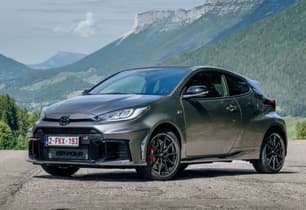
The GR Yaris arrived in 2020 and won praise for its rally-car-for-the-road feel with Toyota’s high-performance division Gazoo Racing heavily modifying the docile Yaris hatch - while adding a bit of Corolla - to create this little monster.
In early 2025 Toyota added more power and torque, along with an automatic transmission for the GR Yaris and now a new variant has been launched - the GTS Aero Performance Package and this is what we are testing.
Lamborghini's Aventador S is the last living link to supercars of old. Wild-looking bedroom-poster material, gigantic anti-socially loud V12 that actually spits flame and the kind of performance that will rustle the jimmies of even a seasoned supercar driver.
It harks back to a time when supercars actually sucked, but it didn't matter because they were proof you had both the money and patience to nurse it into life and then wring its neck, because that was the only way it made any sense. While the Huracan is a thoroughly modern supercar, the Aventador is an unashamed, unabashed, hairy-chested, head-banging, rock ape.
The GR Yaris GTS with the Aero Performance Package is a so wonderfully special with its brilliant engineering, mind-blowing dynamics and fun-to-drive nature. The new aero package makes an already angry beastie look furious, making it the perfect enhancement that's also functional.
The only lower marks here are for warranty, fuel use and practicality. But if there was a score for fun it'd be a 10/10.
The Aventador isn't the best car you can buy for the money and truth be told, it isn't the best Lamborghini, which is a bit tough when you remember the only other car they make at the moment is the V10 Huracan. But it's all about the theatre as much as being a very capable supercar.
I'm not a Lamborghini fanboy, but I completely get the Aventador. It's a because-we-can car, just like the Murcielago, Diablo and Countach before it. But unlike those cars, it's thoroughly modern and with the upgrades introduced to the S, it's faster, harder and enormously entertaining.
As the last of a dying breed it delivers on everything a Lamborghini should - amazing looks, nutty price tag and an engine that excites not just driver and passenger but anyone with a heartbeat. It's by far the most charismatic car you can buy, no matter how many zeroes are on the cheque.
The GR Yaris exists so that Toyota could go racing in the World Rally Championship. As with many racing series it required Toyota to build a road-going version of their Yaris race car, also known as a homologation vehicle. It’s a good deal, they get to race, you get a race car for the road. And so the GR Yaris was born.
Wildly different from a regular five-door garden variety Yaris, the GR Yaris is a hand-built three-door hatch with a wider track, wider and lower body and the use of forged carbon and aluminium for lightweight construction.
The GR Yaris already looks very angry, but the GTS Aero Performance Pack makes it look furious. It adds a huge adjustable rear wing, fender ducts that channel air, a front spoiler lip that aids stability, a giant bonnet scoop to help release air, and rear bumper ducts to reduce drag.
The GR Yaris’s cabin was redesigned for the 2025 update and that saw the dashboard angled more to the driver much like in a race car, but it's more functional than fancy and it’s all very plain.
Still, we’re not complaining. The seats are lovely and the red stitching is a nice touch but this isn’t a Lexus. It’s supposed to favour function over form and so the design is absolutely fitting. And by function I mean dynamics and not practicality.
Asking if there's anything interesting about a Lamborghini design is kind of like asking if the sun is warm.
While there are some geese out there in the corners of the internet who think Audi has ruined Lamborghini styling, there is absolutely nothing shy about the Aventador. It's an incredible looking machine and, if I may say so, shouldn't be had in black because you miss a lot of the madder details.
This car is all about the experience.
It might look close to the deck in the photos, but however low you think it is, it's lower. The roofline barely makes it to the bottom of a Mazda CX-5's windows - you need your wits about you in this car because people just don't see you.
It is absolutely spectacular - people stop and point, one chap sprinted an easy 200 metres to take a photo of it in the Sydney CBD. Hello, if you're reading.
Inside is pretty tight indeed. It's amazing to think that a car 4.8 metres long (a Hyundai Santa Fe is 4.7 metres) struggles to contain two people over six feet tall. My six foot two photographer's head left an impression in the headlining. It's a tiny cabin. It's not a bad one though, it even has a cupholder on the rear bulkhead behind the seats.
The centre console is covered in Audi-based switchgear and is all the better for it, even if it is starting to look a bit old (those bits are from a pre-facelift B8 A4). The alloy gearshift paddles are fixed to the column and are brilliant to look at and touch, while the digital dashboard - which changes with the driving mode - is fantastic even if the reversing camera is awful.
The regular Yaris is small, the GR Yaris is smaller at 3995mm end-to-end and with two fewer doors. As a tall person (I’m 1890mm end-to-end) the space on board is adequate up front with just enough knee, head and elbow room.
The GR Yaris is a four seater with the two rear seats accessed through the front doors. There’s not much room in there for adults and not even my lanky 11-year old would be happy in there. Still if you need to carry three other people, technically you can.
Cabin storage is limited to fairly large door pockets and two cupholders between the front seats. There is a little shelf carved into the dashboard which is great and a small glovebox below it.
Boot space is tiny at 174 litres but again this is a small car with other priorities.
Yes, well. There's not a lot of space because a V12 is not just big all on its own, all the ancillaries to support it rob a lot of the remaining space. Having said that, there's room in the front for soft bags with a 180-litre front boot, space for two people inside, a cupholder and a glove box.
And the doors open up into the sky rather than out like a normal car's. Who cares if it's impractical, it's hardly something that's going to stop someone buying one.
The GR Yaris GTS Aero Performance Pack sits at the top of the model range with the six-speed manual version listing for $64,990 before on-road costs, while the automatic is $67,490. That’s $4500 more than the standard GTS without the aero pack
The aero pack significantly toughens up the look of the GR Yaris, and also improves its dynamics. So if you plan to use the GR Yaris as a track car and drive it hard and fast, the kit will help.
That's thanks to improved down force from the giant rear wing, air ducts in the fenders to improve steering under braking, a front splitter for stability, underbody cladding to maximise airflow and a bonnet scoop to help release hot air from the engine bay.
The rest of the high-performance equipment comes on the regular GTS including a Torsen limited slip differential, high performance suspension tune and 18-inch forged wheels with Michelin Pilot Sport 4S tyres.
Standard features are the same as the regular GTS and include heated GR sports front seats with suede leather upholstery, a 12.3-inch digital instrument cluster, leather-wrapped steering wheel, aluminium pedals, dual-zone climate control, proximity unlocking and push-button start.
There's also an eight-speaker, eight-inch media screen with Apple CarPlay and Android Auto, and an eight-speaker JBL sound system.
The value is actually great considering all the high-performance engineering around you in the GR Yaris, and it will save you money from being tempted to go down the aftermarket route and buy equipment that hasn't been designed for the car by the people who made the car.
There are some nice comforts, too, like the leather seats, although the media screen is small.
As with any Italian supercar, the price-to-feature ratio is rather higher than your average humdrum hatchback. A 'naked' Aventador S starts at a horse-spooking $789,425 and basically has no direct competition. Ferrari's F12 is front-mid engined and any other V12 is either a decidedly different Rolls Royce-type machine or super-expensive niche manufacturer (yes, niche compared to Lamborghini) like Pagani. They're a rare very breed, Lambo knows it, and here we are a sneeze-on-the-spec sheet away from $800,000.
So you have to keep two things in mind when rating a car's value for money at this level. The first is that there isn't any real rival in a pure sense, and if there was, it would be the same price and have the same spec. That's not excusing it, by the way, it's an explanation.
Anyway.
For your eight hundy you get 20-inch front wheels and 21-inch rears, climate control, cruise control, 7.0-inch screen (backed by an older version of Audi's MMI), four-speaker stereo with Bluetooth and USB, car cover, bi-xenon headlights, carbon ceramic brakes, electric seats, windows and mirrors, leather trim, sat nav, keyless entry and start, four-wheel steering, leather trim, digital dashboard, power folding and heated mirrors, active rear wing and active suspension.
The number of out-of-the-box options is staggering and if you're keen to really get on it, you can commission your own options when it comes to trim and paint and wheels. Let's just say that as far as the interior went, our car had almost $29,000 of Alcantara, steering wheel and yellow. The telemetry system, heated seats, some extra branding and front and reversing camera (uh-huh) added up to $24,000, the cameras almost half that total.
With all the bits and bobs, the test car we had was a sobering $910,825 before on-roads.
It still boggles my mind how 221kW and 400Nm is extracted from a 1.6-litre three-cylinder petrol engine but here we are. The GR Yaris has this set up with this output, along with all-wheel drive.
Thanks to lightweight materials such as forged carbon and aluminium the GR Yaris weighs nothing in car terms - just 1300kg - so acceleration from 0-100km/h is a rapid 5.1 seconds.
I’ve already detailed the juicy engineering bits the GTS Aero Package is fitted with, from the limited slip diff to the adjustable rear wing, and it’s not an exaggeration to say that not many small hatches are this gifted with this kind of genius.
Our test car has an eight-speed automatic, which is easy to drive in city traffic. However, I'd opt for the six-speed manual because if you've come this far you may as well go the whole way.
The Aventador S is powered by Automobili Lamborghini's 6.5-litre V12. You know it's a V12 because there's a plate on top of the engine (which you can see through the optional glass cover) that says so, and handily, tells you the cylinder firing order. That's a neat touch.
Buried deep in the middle of the car, this monster engine develops an astonishing 544kW (30kW up on the standard Aventador) and 690Nm. Its dry sump means the engine sits lower in the car. The gearbox is slung across the back between the rear wheels - the rear pushrod suspension actually sits on top of and across the gearbox - and is apparently brand new.
The transmission is known as an ISR (Independent Shift Rod) and has seven forward speeds and still just the one clutch. Power goes through all four wheels to the road, but it's clear the rears get the lion's share.
The 0-100km/h time is the same as the standard car, which kind of tells you that 2.9 seconds is about as quick as you can go on road tyres when you don't have four electric motors with torque from zero rpm.
The GR Yaris is a hungry beastie that eats through its 50L petrol tank fairly quickly and then wants more. Toyota says you should see 9.1L/100km of 98 RON used in the automatic and 8.2L/100km with the manual over a combination of driving conditions.
Stop-start city driving in traffic saw fuel use increase dramatically to 13.0L/100km in the auto. According to our car's trip computer, my own testing used an average of 14.5L/100km after mainly suburban driving.
Hilariously, the official figure is 16.9L/100km. I doubled it without trying. Simple as that. If you're buying this car thinking it will be easy on the juice, you're insane.
Cheeringly, Lambo has at least tried, the V12 going silent when you sit at the lights, the best thing being the way it bursts back into life when you lift off the brake.
If you have the time available, it takes 90 litres of premium unleaded to fill the tank.
There’s been a multitude of electric cars through the test garage over the past six months and the GR Yaris is like a diamond found in a tub of Lego when it comes to driving.
So much sound. The three cylinder snarls on start up sending vibrations into the cockpit and up through the steering wheel, the transmission can be heard engaging gears, the big brakes creak as they’re released. And we’re hardly even moving yet. There’s so much theatre. It’s all real and I love it!
I even love that in the first 10 minutes of driving, a message appears on the instrument cluster asking that excessive acceleration be avoided while the engine is cool. You don’t get that beautiful inconvenience in an electric car.
But when you can excessively accelerate (on a race track of course, right?) it's wonderful and it's loud. Lift off, and the wastegate lets out a little "weeee!" in excitement.
I don't need to tell you that the GR Yaris handles better than just about anything in this price range and while the ride is firm and speed bumps feel like you’ve hit a gutter I still drove the GR Yaris every day, even to do the school run, because it is so much fun. Meanwhile my hybrid long0term test car looked lonely in the driveaway all week...
Being an automatic makes it easy to drive in traffic and the small size makes finding parking spots quick and simple.
Visibility is good, steering is excellent, the seats are big enough to accommodate me but snug enough to offer good lateral support, too.
In Strada or Street mode, awful. Everything is slow and doughy, particularly the gearshift which goes looking for a gear like dog looking for a stick you didn't throw, but instead hid behind your back. The low-speed ride is nothing less than terrible, fidgeting over every single lump and bump and is only slightly more appealing than being dragged along behind.
The gearbox is really the worst bit about it. Automotive history is littered with cars that laboured along with a single clutch semi-auto: Alfa Romeo 156, BMW's E60 M5 and today the Citroen Cactus is stuck with just such a dud transmission.
Like that old M5, however, there's a trick to making the gearbox work for you - show absolutely no mercy.
Switch the selector up to Sport, get off the highway or major arterial road and head for the hills. Or better still, a clear race track. Then the Aventador goes from a pain in the rear to a glorious, roaring, completely unhinged and unhinging battle cruiser. This car is all about the experience, from the second you lay eyes on it to the moment you put it to bed.
This isn't an everyday supercar and it's absurd to think Lamborghini thinks it is.
First up, there's the obvious entry point with those wacky doors. While it's tricky to get in, if you're under six feet and reasonably mobile, stick your backside in, keep your head down and you're in. If you've been clever, you've specified the glass engine cover so you can see out the back but the huge wing mirrors are surprisingly effective.
Has someone thoughtlessly parked the car in a tight spot? No trouble, the four wheel steer makes the car absurdly manoeuvrable given its extravagant length and width.
As we've already established, it's not much fun at low speeds, waiting until about 70km/h before things start to make a bit more sense. This isn't an everyday supercar and it's absurd to think Lamborghini thinks it is. It just isn't.
The old Aventador was not the most capable of machines but made up for it with its overall belligerence. The new S takes that aggro and dials it up. When you move the drive mode to Sport you are basically unleashing hell. You can pretend to be super-masculine and switch to Corsa (race) mode, but it's all about getting the car straight and getting you around the track in the most efficient way possible. Sport is where it's at if you want to have fun.
The Aventador is about being seen, but not before you've been heard - from two postcodes away. It really is utterly glorious when you have a stretch of road to yourself. The V12 revs furiously to its 8400rpm redline and the wallop of the upshift is accompanied with a fantastic bark and a burst of blue flame. And these aren't the best bits.
Approach a corner, stomp on the colossal carbon ceramic brakes and the exhaust erupts in a combination of bangs and pops and growls that puts a smile on even the most hardened car-hater's face. The fact it steers into corners with just a demure roll of the wrist, aided and abetted by that funky four-wheel steering system. It's just brilliant, addictive and truth be told, it gets under your skin.
The GR Yaris has not been crash tested by ANCAP and the score for the regular Yaris can't be applied to the GR version.
Still the GR Yaris comes equipped with an array of advanced safety tech such as auto emergency braking (AEB), lane keeping assistance and a blind spot warning.
There are six airbags, two child seat ISOFIX points and two top tether anchor mounts in the rear row.
The Aventador doesn't have an ANCAP safety rating but the carbon chassis also comes with four airbags, ABS, stability and traction controls.
The GR Yaris is covered by Toyota's five-year/unlimited-kilometre warranty which is lacking compared to many other mainstream manufacturers’ seven-year-plus warranties. The good news is that the engine and driveline is covered by an extra two-year warranty.
Servicing is capped at about $300 for the first six visits, although services are six months apart which means that after three years you’ll run out of capped-price servicing.
Still, Toyota’s reputation for reliability does provide some peace of mind.
In an unexpected twist, you'll get a three-year/100,000km warranty and the option to increase to four years ($11,600!) or five years ($22,200!)(!). Having recovered from typing that, given the cost of something going wrong, that's probably money well-spent.