What's the difference?
The Toyota Camry is one of the few cars that really needs no introduction. It's been on our shores for 41 years and has proven itself to be steadfastly popular, enough for Toyota to launch a ninth-generation version.
The entry grade Ascent is one of the few 'base-models' still available for the mid-sized sedan segment and offers an upgraded hybrid powertrain and transmission, new tech and a fresh take on its design.
Old fans will love it and in this review we discover if there's something for families to get excited about.
Mercedes has long been the leader in niche filling, and we’d argue that no other model encapsulates that more than the CLA four-door coupe.
Now in its second-generation form, the CLA is based on Mercedes’ MFA2 small car platform that also underpins the A-Class small car range, B-Class tallboy hatchback and GLA crossover, but is actually dimensionally longer than the one-size up C-Class.
However, while the C-Class might offer more conventional styling, Mercedes says the CLA is targeted towards a younger demographic that puts more weight on design and aesthetics.
The previous generation CLA was topped by a hardcore 45 version, which makes a return here, but new this time around is the less-potent, but still AMG-badged, 35 variant to plug the gap between mainstream grades and the range-topper.
After living with the car for a week, here are our thoughts on the new baby AMG CLA.
Ah, gotta love a sedan that knows its audience and the ninth-gen Toyota Camry Ascent proves once again why it’s a popular choice.
On top of the space and practicality, you get a shiny new design and technology. Overall the Camry Ascent is a well-rounded base-model - what’s not to love?
Is the Mercedes-AMG CLA 35 the perfect choice in the sleek sedan’s line-up?
Well, if you are after outright performance, then the answer still clearly lies with the CLA 45. But for those that just want a little more pep compared to the standard CLA range, the 35 is undoubtedly the one to get.
It’s not without its flaws, though, commanding a $15,000 price premium over the CLA 250 and a tougher-than-we’d-like ride, but if you value a more engaging drive and a brisk 0-100km/h time, the CLA 35 should definitely be on your shopping list.
There is a strong 'taxi'-association with the Camry because of how popular it is as a commercial fleet car and while the design has been updated and modernised, that vibe still remains. It's a Camry, after all.
But the new tapered nose with its slim LED headlights look sharper than the previous model and the rear slopes into a neat spoiler that accentuates a sharper rear end.
The new design looks far more modern and dare I say it: sporty.
A lot of the changes are in the cabin where the Camry benefits from a completely restyled dashboard that looks sleek and stylish, with the tech screens integrated into the panelling.
The cockpit still feels very driver-oriented, which is always appreciated, but now not at the expense of the front passenger.
The cloth seats look much nicer than the standard basic stuff you usually get and there are enough tactile dash and door panels to make it feel cosy, despite it's soft-touch points still looking too plasticky.
The overall feel for the cabin is one that is pleasant and well-built, although cloth seats always give me anxiety when kids are around.
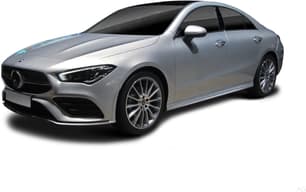
From the front, the CLA 35 exterior oozes style and luxury.
Up front, the sleek and slender headlights emphasise the width of the fascia, while the large Mercedes logo sits proudly front and centre of the CLA’s nose.
There are subtle hints to the CLA 35’s sportiness too, with a slightly bulging bonnet and chiselled lower chin.
The grille is also unique on the 35, with a dual-horizontal slat design instead of the non-AMG CLA’s diamond pattern or the CLA 45’s Panamericana grille.
To my eye, the front of the CLA 35 is actually a bit too tame in styling for an AMG model. I prefer the in-your-face aggression of the CLA 45’s widened track and front grille, while the CLA 35 opts for more subtle styling cues. To each their own, though.
The silver paintwork of our test car probably doesn’t help, and if it was my choice I'd pick 'Sun Yellow' or 'Denim Blue' to stand out a bit more from the sea of black, grey and white German cars out there.
Move to the rear of the car though, and a large rear diffuser, big dual-exhaust outlets and a bootlid spoiler are much more befitting an AMG model.
Step inside the CLA and you will see it adopts the same dashboard design as all new-generation Mercedes vehicles built on the MFA2 platform, with the 'MBUX' dual-screen layout, large air-vents and central touchpad.
Our car was specced out with red-leather interior, which is a bit too loud for my tastes, but a two-tone black leather/titanium grey combo can also be had at no extra cost.
Sitting inside the CLA 35, you can tell it’s a modern car thanks to the clean layout of all the controls, while the screen-heavy dashboard definitely makes it feel tech-focused.
Sedans tend to fly under the radar when people think of cabin space but that's a mistake. Head- and legroom in both rows will make taller occupants very happy and the transmission tunnel isn't massive, so middle seaters will still be able to get comfortable.
Despite being a low-profile car, access is easy enough and it's only the sloping roofline at the rear that might make you bump your head as you get in.
Seat comfort is excellent with thick padding and cushioning to be enjoyed. The front seats are manually adjustable but lack lumbar support, which you'll notice on a longer trip.
The window sills don't sit too high, so my seven-year old had a good view this week but the cloth seats have upped the anxiety as he tends to be messy. He also loves having directional air vents and that keeps him happy on hotter days.
Storage is great for the class with a 7.0L middle console, large glovebox that can hold a manual and other bits, two map pockets, four cupholders, four drink bottle holders, a sunglasses holder, and a functional centre console tray that has multiple cubbies to delight those that travel with lots of stuff.
The boot capacity hasn’t changed and sits at a large 524L capacity, which is decent for a sedan. The boot aperture isn’t too narrow either, so it's easy to access items that roll to the back. The rear seat has a 60/40 split, to open up storage as well.
The boot has a powered boot release that can be accessed via the key fob and while you have to manually close it, it's a super light lid to operate.
Technology feels well-rounded now with the upgrades and the touchscreen multimedia system sports the same system you'll find in Lexus models, which is far superior to the older Toyota software. Basically, it's simple to use and looks good, which is a great combo.
The phone mirroring apps are now wireless and that means one less cable to worry about and charging options are good with five USB-C ports (3/2), and a 12-volt socket but you do miss out on a wireless charging pad at this grade level.
Basically, the Camry now offers better technology and style but the practicality of the cabin remains at an all time high.
Measuring 4695mm long, 1834mm wide, 1399mm tall and with a 2729mm wheelbase, the CLA 35 is definitely a sizeable sedan in the metal.
This actually makes the CLA 35 slightly longer and wider than a non-AMG C-Class sedan that measures 4686 and 1810mm respectively, but don’t expect the same level of practical interior space.
With a heavily sloped roofline, rear-seat comfort takes a hit. My 183cm (6.0ft) frame could not sit upright behind my driving position without tilting my head, while legroom was also slightly lacking.
With such large C-pillars and a small rear window, the second-row can actually feel a little claustrophobic for full-sized adults, but will seat children quite comfortably.
Second-row amenities include air-vents, two USB-C ports, back-of-seat storage nets, bottle holders in the doors, and two cupholders in the fold-down arm rest.
Just like at a music concert though, the best seats in the CLA 35 are up front, with plenty of room for heads, shoulders and legs.
The cabin is also much more light-filled up front, making for a more pleasant experience.
The front seats are electronically adjustable, as is the steering column, but the headrests are fixed.
Storage options include sizeable door bins, a centre console cubby, glove box, two cupholders and a wireless smartphone charger.
Boot space is 460 litres, but can expand with the rear split-fold 40/20/40 rear seats stowed.
Though the boot looks small and shallow on the outside, the aperture is actually quite large, and can easily accommodate a large suitcase with plenty of room to spare.
There are now only three model grades available for the Camry and they are all offered exclusively with a hybrid powertrain. The model on test for this review is the enrtry-grade Ascent.
With the hybrid powertrain and new tech, the entry price is $4939 dearer than before and it now carries a $39,990 before on-road costs price tag. Of the mainstream medium sedan rivals, only the ageing Mazda6 Sport sedan is more affordable at $36,290 MSRP.
What’s interesting to note is that some of its other rivals, the new Honda Accord e:HEV RS and Skoda Superb, are only offered in one highly-specified grade and they come with corresponding price points. The Accord sits at $64,900 drive-away, and the Superb at $69,990 drive-away. So, if you’re in the market for a sedan, there is a good sense of value for the Camry at the moment, despite its price hike.
Standard equipment for the new Camry includes cloth upholstery, an 8.0-inch touchscreen multimedia system with satellite navigation, Toyota Connect app, wireless Apple CarPlay and Android Auto, dual-zone climate control, keyless entry and start, 7.0-inch digital instrument cluster, digital radio and Bluetooth connectivity.
Practical features include 17-inch alloy wheels, temporary spare tyre, power-release boot lid, and manual release buttons for the rear seats in the boot area.
Strangely though, the base model still misses out on rain-sensing windscreen wipers for some reason.
Priced at $85,500 before on-road costs, the CLA 35 sits $15,300 upstream of the CLA 250 but is $25,700 cheaper than the $111,200 CLA 45.
Standard equipment includes leather interior, dual-zone climate control, electronically adjustable front seats with heating and memory function, keyless entry and push-button start, 64-colour ambient lighting, and a wireless smartphone charger.
AMG specific appointments include 19-inch wheels, a flat-bottomed steering wheel, sports exhaust, high-performance brakes with silver-painted calipers, blacked-out exterior highlights, sports suspension, a racy bodykit and speed-sensitive steering.
Instrumentation is displayed on a 10.25-inch screen, which can be customised and features AMG readouts.
The multimedia system, which includes satellite navigation, digital radio and Apple CarPlay/Android Auto connectivity, is also outputted to a 10.25-inch screen, with inputs including touch, voice commands, centre touch pad or steering wheel controls.
Our test car also came with a ‘Mojave Silver Metallic’ paint finish and 'Vision Package', adding $1190 and $990 to the bottom line each.
The Vision Package adds LED headlights with adaptive high beams, a panoramic glass sunroof and surround-view monitor.
Straddling the lines between a small- and mid-size sedan, the CLA 35 doesn’t really have any direct competitors, which is reflected in its pricing that slots it between the Audi S3 and S4 sedans.
Though the CLA 35 features a long list of equipment, it is still a sizeable chunk of coin, costing more than the C300 sedan and Volvo S60 T8 PHEV, the latter boasting higher engine outputs.
The 2025 Camry has the new and improved hybrid system that Toyota is rolling out and a redesigned electronic continuously variable transmission (CVT) – both changes are welcome to the 2.5L four-cylinder engine.
This combo produces up to 170kW of power, which is up from the previous model but the torque remains the same at 221Nm.
Powered by a 2.0-litre, turbo-petrol four-cylinder engine, the CLA 35 punches out 225kW/400Nm.
Drive is sent through a seven-speed dual-clutch automatic transmissions to the road via Mercedes’ '4Matic' all-wheel-drive system, enabling a 0-100km/h sprint in the 1603kg sedan in just 4.7 seconds. Top speed is electronically limited to 250km/h.
Though I didn’t get a chance to test the latter, the former certainly feels accurate when taking off from a freeway on ramp, however, there is some hesitation from the turbo in getting on boost.
Peak power comes in at 5800rpm, while maximum torque is available from 3000-4000rpm.
The outgoing model had an excellent combined fuel cycle figure already but the new hybrid system improves it again to just 4.0L/100km. With the 50L fuel tank, that gives you a theoretical driving range of up to 1250km. Outstanding for a family car!
After doing 803km this week and those kilometres being mostly open-road driving, which is where hybrids are at their least efficient, my real-world figure was 4.4L, which is still great. Expect it to be even better in the city.
Officially, the CLA 35 sips 7.5 litres per 100km on the combined cycle, but we managed a 9.9L/100km figure in our week with the car.
The majority of our driving was done in inner-city environments, with the two trips down the freeway to seek out twisty country rounds.
Minimum fuel grade in the CLA 35 is 98 RON.
Toyota really does the hybrid thing well – the engine and electric motor handle duties effortlessly between them, with minimal fuss like noise or gear changes.
The well of power feels deep enough to really let it loose on the highway, if need be, but that also makes it zippy in the city.
This is sure-footed in most scenarios and I like the comfort that brings to the driving.
The steering is direct enough to feel responsive but not sporty. It handles corners well and suspension is well-tuned, so you don’t wince when you hit bumps.
Being set low and having average-sized windows means visibility can be a little hampered when heading down a hill as you bob and weave to see around the rear-view mirror and thick pillars.
The Camry is 4920mm long (33mm longer than previous gen) and it fills out a space. With it's low profile, you have to be careful not to scrape the bottom on anything but it’s still relatively nimble in a car park because of its tight steering and clear 360-degree camera system.
The CLA 35 might not offer the outright thrills or breadth of capability of the CLA 45, but don’t think the cut-price AMG offers up a cut-rate driving experience.
From the driver’s seat, one of the cool things about the CLA 35 is that it doesn’t actually look any different from its more expensive sibling.
The drive-mode selector that is now embedded on the steering wheel is fantastic, a feature first seen on the Mercedes-AMG GT 4-door, and makes changing the driving dynamics on the fly an absolute breeze.
In fact, we think all cars where you can select drive modes should have a selector on the steering wheel like this, which lets you quickly and easily dial it up or down while keeping your hands on the wheel.
'Comfort', 'Sport', 'Sport+' and 'Individual' modes are available, while the transmission can also be put into manual mode independently for those that prefer to use the flappy paddles.
Suspension settings can also be tweaked regardless of which drive mode you are in, and it’s this level of customisability that we appreciate.
You want loud exhaust pops and the engine in full attack with manual shifting and the softest suspension? Sure, that’s doable here in the CLA 35. And toning it down to its most comfortable settings is just a flick of the wrist away.
The steering feels a little numb on centre and at slower speeds, though feedback picks right up with speed and is communicative enough when the road starts to get twisty.
Fitted with wide and sticky Michelin rubber, as well as the aforementioned all-wheel drive system, the CLA 35 is certainly not lacking in grip.
The suspension does an okay job of absorbing bumps, but uneven surfaces, like Melbourne’s tram tracks, can send uncomfortable jolts into the cabin if travelling quickly.
In fact, we think the ride comfort of the CLA 35 is probably its weakest aspect, offering not enough variability in its Comfort and Sport settings, and instead settling somewhere in between, regardless of drive mode.
The CLA 35 is ultimately still a fun and engaging sports sedan, though there are some sacrifices made to get it there.
The Camry has a brand-spanking new five-star ANCAP safety rating from this year (2024) and now sports eight airbags, including a front-centre airbag.
The safety features list is impressively long with all of the biggies included like blind spot monitoring, SOS call button, driver attention alert, safe exit warning, rear occupant alert, forward collision warning, LED daytime running lights, rear cross-traffic alert, lane departure alert, lane keeping aid, traffic sign recognition, intelligent seatbelt warning, a 360-degree view camera system, and front and rear parking sensors.
The adaptive cruise control has a new cornering feature, which will slow your speed down in corners but it didn't always activate and when it did, it slowed down too dramatically to make the system feel smooth to use.
All other systems feel well-tuned for daily driving.
There are ISOFIX child-seat mounts on the outboard seats and three top-tether anchor points but two seats will fit best.
The new Camry has auto emergency braking (AEB) with car, pedestrian, motorcycle, cyclist and backover function, which is operational from 5.0 to 80km/h (up to 180km/h for car).
The CLA 35 has not been tested by ANCAP or Euro NCAP, but the standard CLA range was awarded a five-star rating in September 2019.
Standard safety equipment in the CLA 35 includes autonomous emergency braking, automatic high beams, nine airbags, drive attention alert, blind-spot monitoring with exit warning, lane-keep assist, traffic sign recognition and tyre pressure monitoring.
The standard CLA also comes with these features, and was awarded 96 and 92 per cent respectively in ANCAP adult occupant and child occupant protection tests.
For the vulnerable road user and safety assist examinations, the standard CLA scored 91 and 76 per cent respectively.
ANCAP says the AEB system works from seven-200km/h.
Of note, adaptive cruise control is not standard in the CLA 35 like it is in the CLA 45. Instead, buyers will have to tick the 'Driving Assistance Package' box for the feature, which also comes bundled with cross-traffic alert and lane change assist.
The Camry comes with a five-year/unlimited kilometre warranty but that can be upped to seven years if you exclusively service with Toyota and on schedule, which is good for the class.
You get five-years capped-priced servicing at just $255 per service, which is extremely reasonable and intervals are good at every 12-months or 15,000km, whichever occurs first.
The Camry likes the good stuff though and only drinks a minimum of 95 RON unleaded petrol.
As with all new Mercedes-Benz models, the CLA 35 comes with a five-year/unlimited kilometre warranty, which is one of the best assurance periods offered by a premium carmaker.
It also comes with five years of roadside assist.
Scheduled service intervals are every 25,000km or 12 months, whichever comes first.
A three-year service plan is available for $2150 for new CLA 35 buyers, saving $500 when priced individually.
Four- and five-year plans are also available, and are priced at $4200 and $4950 respectively.