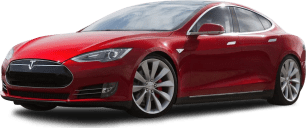
What's the difference?
If you have even a passing interest in the Tesla Model S, you'll have seen the endless internet videos where someone has lined up a Ferrari, Lamborghini, or another fast exotic car you could name, to race against it.
There's a long build-up, usually involving men who can't operate a baseball cap, a drag strip and idiotic words in the headline like "destroys" or "rips", or whatever. There's usually a bunch of honking bros with bad haircuts watching on, already planning their next viral video where they set a perfectly good mobile phone on fire.
It's facile and idiotic and doesn't give you any real clue as to the depth of whatever supercar it has "humiliated" or, just as importantly, the depth of the Model S and its spectacular engineering.
So, I won't be spending the next thousand words building up to the conclusion that the Model S P100D with Ludicrous Mode is up there with the world's fastest production cars from 0-100km/h, because I'll tell you now that it is, and it does it in a claimed 2.7 seconds.
Now that's out of the way, there's quite a bit more to the Model S than a "broken" Nissan GT-R owner weeping into their bento box.
In light of the large volume of dirt-road-friendly camper-trailers being seen on bush tracks of late you’d be safe in assuming that they are the flavor of the month.
Sure, lots of people buy into the idea of the off-road-camping lifestyle and may get a surprise when faced with the reality of it, but the number of those who swiftly grow to love the camper-trailer way, far out-weigh the number of those who don’t.
We took a Hawk Outback into the bush to check it out.
I spoke to a friend who bought a Model S before one had even hit the ground here in Australia. He chuckled when I told him how much this car cost but then said something I'd already suspected. "My mates who own a P100D would never drop that kind of money on a normal car. Buying a Tesla is like buying shares in the company, you're buying into the future."
And that's kind of the point. A $300,000 Audi RS7 (fully-loaded, obviously) is a bit slower in a straight line, looks just as good, is extremely well-built and emits noises that make people like me go as weak at the knees (just as the Model S' acceleration does). And would probably win a 10 lap race with the Tesla around Mount Panorama.
The Tesla is the future of cars. It may still be decades before the internal combustion engine is gone, but Tesla buyers are getting the jump, and today the Model S is the best car in which to make that leap.
The Jayco Hawk Outback is a solid, feature-packed camper-trailer without being flash about it. It looks good – checker plate is always a nice touch – and it is easy to tow and set up. Sure, it may not be as gung-ho an off-road unit as its name suggests, but it is more than capable of handling gravel or dirt tracks on the way to your campsite and will be a comfortable camper when you actually arrive there.
The Model S is a rare car in this class in that it has an almost completely flat floor, meaning rear seat passengers don't have to negotiate a transmission tunnel. The two motors run physically independently of each other so there's no crankshaft to get in the way.
The floor is thicker than a normal car, it's like a big skateboard underneath. That means your knees are up higher, which might cause numb bum on a long trip. The rear seats are comfortable enough, but middle seat occupants might feel like the outboard passengers are falling into them.
With all that torque, when you do load it up, the extra kilos barely make a dent on the performance.
The view out isn't too bad given the rising window line, and if you've got the big two piece sunroof (without cover, irritatingly... ), it's quite airy out back. And hot (with the sunroof), but you do get rear air-con vents.
The boot is an eminently sensible 744 litres with the seats up and 1795 with the seats down, although the floor doesn't fold flat. While it's a big boot, it's relatively shallow so your suitcases go in on their sides. Up in the front boot (or froot) there's another 150 litres, so you can pack a lot in to the Model S. And with all that torque, when you do load it up, the extra kilos barely make a dent on the performance.
Jayco camper-trailers have a nice touring-friendly floor-plan but where the Hawk Outback deviates from the line-up norm is that its kitchen is positioned to the left of the door as you step inside, rather than in front and to the right of you as you step inside on other models.
The interior height tops out at 2070mm high – pretty standard for these campers – and inside is roomy enough not to feel like a confined space, although it will get squeezy if all four adults and two kids are in here and milling about at the same time.
Looking from the door, to the left is the four-burner stove, then, as you look to the front, the extended lift-up bed and storage, and, swiveling to your right, the Dometic 95-litre fridge (Touring models get the 90-litre fridge), then stainless-steel sink, dinette seat, table, club lounge, double bed, then TV cabinet.
Drawers are all Ezi glide pull-out style. The pop-in/pop-out button on each handle – to lock it in place and unlock it – is generally a good system but can be prone to becoming fiddly, even sticking. This is a minor problem and can be found in many campers with a similar mechanism on their drawers.
Interior lighting includes overhead LEDs for the main area and reading lights for the beds. There’s a fan for the beds.
The first time I drove a Model S, I enjoyed the acceleration and the silence of the electric motor (this was back in the Dark Ages when even the P90 only had one motor). And that has remained, with the air suspension providing a firm but comfortable ride despite the P100D's 21-inch rims and very low profile tyres. Electric motoring in any electric car is addictive.
Much progress has been made (yes, I'm getting to the acceleration, stay with me) in the way it drives. The earlier cars felt too computer gamey, with little feel through the wheel or the seat of your pants. The steering is better, especially in Sport mode, but not a lot gets through the air suspension, so it takes a while to build confidence in the chassis.
One passenger became quite emotional, almost crying. And not just because they were stuck in a car with me.
On the freeway (look, you can read ahead if you must) it's amazingly quiet, with just a bit of a rustling around the mirrors. Well, of course it's quiet, it's electric. For chassis and NVH (noise, vibration and harshness) squashers, not having the marvellous engine noise means much harder work to dull the other noises you just don't hear when there's an internal combustion engine.
And there's the acceleration. As the driver, you obviously know it's quick. Mash the throttle and the response is instant, the horizon closing in on you like you're attached by a very stretched and immensely strong bungee strap that's just been released. The way cars disappear in your rear vision mirror is hilarious.
It's more fun as a passenger, though. The Model X elicited whooping and laughing, but the P100D's extra 0.6s-worth of acceleration over the P90D, delivered with a truckload more G-force, equals silence. One woman said she was glad I'd caught her before dinner rather than after, before bursting forth with a range of expletives. One passenger became quite emotional, almost crying. And not just because they were stuck in a car with me.
Because of its compact size – especially relative to caravans which are, by their very nature, generally bigger and bulkier than camper-trailers – the Hawk Outback is a very easy thing tow as it sits low and stable on all surfaces and well within the confines of even narrower bush tracks.
The single-axle camper – 5060mm long (including drawbar), 1910mm high, 2240mm wide, and with a 1285kg tare weight – hardly registered behind our tow vehicle, a 2019 Ford Everest, with the new 2.0-litre four-cylinder bi-turbo-diesel engine (157kW/500Nm).
It always felt secure on the towball (with a 145kg download) during highway, gravel track and undulating dirt-road driving.
The Hawk Outback, like other Outbacks, has a hot dip galvanised Endurance chassis on Jayco’s JTech coil-spring suspension set-up. (Note: Jayco’s Outback models are designed and engineered for, at worst, dirt roads and gravel roads, not 4WD tracks. They are not built for hard-core off-roading.)
Another bonus: visibility is clear and open along both of its sides and even over the top – no need for towing mirrors here.