What's the difference?
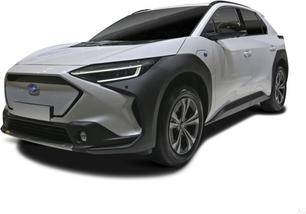
The Solterra AWD is the base grade in a two-model line-up and the first EV Subaru has offered in our market.
Created in partnership with Toyota, the Subaru Solterra is being launched alongside its Toyota twin, the bZ4X.
They share electrical and mechanical underpinnings, tech and even some internal styling but Subaru is only offering the Solterra as an AWD for the Australian market which reflects the brand's adventuring heart. Whereas, Toyota is offering some of its variants in a FWD format.
The Solterra competes against other medium SUV rivals, like the Kia EV6 and market-leading Tesla Model Y.
My family of three has put the base model through its paces so keep reading to see what we discovered!
The newly updated Polestar 2 Long range Single motor is an electric five-door fastback that has an understated sportiness about it.
There are some 'EV' vibes in the styling but this car sways more towards a conventional look than some other electric sedans on the market (I'm looking at you Ioniq 6).
And I'm all for it, as there's something charming about how it blends its electric underpinnings with its driver-orientated on-road experience.
With a driving range that is sure to ease any anxiety, it still has some hot rivals nipping at its heels, like the BMW i4, Hyundai Ioniq 6 and Tesla Model 3.
Read on to see how it handles a domesticated life with a small family of three.
The new Subaru Solterra AWD gets a lot right and is a well-rounded effort in showcasing an electric medium SUV that has passenger comfort, sharp external styling and is easy to drive.
Once you start comparing it to some rivals, it doesn’t always come out ahead of the pack but I still like it for what it is. My seven-year old thinks its fun and very comfortable. He enjoys the easy practicality of getting in and out without any assistance, too.
The Polestar 2 Long range Single motor showcases a beautiful build and design. Not including the features from those optional packs just makes you focus on their individual price and devalues the relative affordability of the car compared to its competitors. The back seat isn't super passenger friendly when it comes to space, either. However, once you get used to its little quirks, it's a great car to get around in and the long driving range eases any range anxiety, which is often a cause for worry with EV ownership! My son loved the sunroof because it made him feel like he was in a spaceship, so it's a hit with the kids, too.
The Solterra has its own vibe compared to the rest of the Subaru family and that’s most likely due to the Toyota partnering.
The tail-lights are sharply pronounced and the many pleats across the body panelling swing more towards Toyota styling than Subaru but it doesn't stick out like a sore thumb.
The heavy-use of black plastic mouldings on our test model's 'Smoked Carbon' paintwork looks okay but it wouldn't do any favours on a lighter colour.
The exterior on the whole looks bold and fun, and I like the fact that it's not pillowy in its shape as some of its rivals are. Those hunting for a sporty-looking EV will find something charming here.
The cabin is different from anything I’ve seen from Subaru so far. Some of it's fun, like the squared off steering wheel which looks rally car-ish but some of it’s odd, like the way the 7.0-inch digital instrument panel has been pushed back towards the windscreen in its own little nook.
The steering wheel can get in the way of viewing the graphics of the instrument panel and its placement looks disjointed from the rest of the dashboard elements.
The black and grey knit-looking cloth upholstery is warm and inviting and is found across the dashboard, seats and some door panels but there is enough cheap-looking black cloth throughout to detract from the general aesthetic. Had the Solterra not been pushing $70K, that wouldn't bother me, but it is, and it does.
The interior is pleasant but the exterior is definitely the highlight of the design.
The Polestar 2 has a more conventional design approach than some of its rivals but it maintains a futuristic EV vibe with its origami-like edges in the panelling and cool pixel LED lights at the front and rear.
It is not a large car and sits at 4606mm long, 1985mm wide and a low 1479mm high but that compact design makes it look sporty.
Expect a couple of grunts from the oldies (ahem) when exiting as ground clearance is 151mm at the front and 167mm at the rear.
The interior is pared back in true Scandinavian fashion but it's a nice to see some ethically-friendly design elements, like the vegan knit upholstery on the doors and dash and the Nappa leather is responsibly sourced. All of which makes an otherwise simple interior feel warm and inviting.
There is an overwhelming sense of the Polestar 2 being of a high-quality build. There are no squeaks or rattles, joinery is flush and the doors close with a soft thump.
However, the minor update still sees the dashboard headlined by a portrait-orientated iPad-looking 11.2-inch multimedia system. It seems at odds with the rest of the sleek design.
The panoramic sunroof creates a light-filled cabin and at certain times of the day, this makes it feel airy but underneath a blazing midday sun, you might miss having a sunblind for it.
The practicality of the cabin is good for the class and the 212mm ground clearance means it's an easy car to get in and out of.
The extra-wide centre console makes the front look cramped but it isn't. And the the backseat is huge on space. Seriously decent headroom and legroom for the class and the flat floor means middle seaters will be comfortable, too.
Both the front and rear seats are well-cushioned and comfortable. You could easily do a long trip.
The driver's is the only powered seat (it also has lumbar support) but it's great that all but the middle seat feature a heat function for added comfort.
My seven-year old finds the back row comfortable because of its directional air vents and tall seating position providing a good view out of the wide window.
Individual storage is a bit low for the class but it does feature a handy shelf underneath the centre console which is large enough for a small handbag or the manual and logbook... because there is no glove box in this model!
To be fair, most are too small to be of real use outside of storing the 'ahem' manual and logbook.
Each door gets storage pockets and a skinny drink bottle holder and both rows get two cupholders. The rear gets map pockets too but that's it.
The boot features a tyre puncture repair kit, level loading space and 410L of boot capacity with all seats in use. The capacity is a bit lower than its rivals but has been adequate for my grocery run and the odd errand. It's great both Solterra models have a powered tailgate as standard.
The 12.3-inch touchscreen multimedia system looks good and is pulled directly from Toyota so the graphics and accessibility are on-point for everyday use.
You also get built-in satellite navigation which is always handy to have but you miss out on any over-the-air updates or a dedicated Subaru connected services app.
The rest of the technology is solid with each row getting two USB-C ports and the front also featuring a USB-A socket and 12-volt outlet.
The Polestar 2's cabin is generous up front with plenty of leg- and headroom to enjoy. You don't have to jostle for premium armrest position, either, which is nice given you still feel 'tucked' into the car.
A feeling that is enhanced by the solid, and rather tall, centre console that divides you from your co-pilot.
The electric front seats are delightfully comfortable with their padding and Nappa leather trim. Both feature four-way adjustable lumbar support and extendable under thigh support.
The heat and ventilation functions will ensure comfort, no matter the season but the ventilation system is quite loud.
In the rear, space is tight with my 168cm (5'6") height just fitting behind my driving position. The footwells seem cosy as well due to the limited under-seat space but the seats are fairly comfortable, if narrow.
However, the small door apertures in the rear and the narrow seats make it feel more suited as a four- than a five-seater.
Individual storage options are okay throughout the car with a couple of cupholders in each row, drink bottle holders in the front door storage bins, as well as a middle console and glove box.
There are two skinny shelves on either side of the centre console that would reasonably fit a wallet or phone and the rear also get two map pockets.
Amenities in the rear are enough to satisfy a mature occupant on a longer journey as the outboard seats feature a heat function and there are directional air vents, a fold down armrest and two USB-C ports.
Front occupants enjoy two USB-C ports and a wireless charging pad to charge their devices.
The rest of the technology is a bit awkward to use. The 11.2-inch touchscreen multimedia system is responsive to touch but you can't access a lot of basic information on it and I didn't like how the climate control is embedded in it as you have to touch the screen a few times to even see the controls.
The 12.3-inch digital instrument panel looks nice but isn't all that customisable. It takes a while to get used to how to access all of its functions, too.
It's easy to connect to the wired Apple CarPlay and there is wired Android Auto and in-built google apps, too.
The optioned Harman Kardon sound system with its 13 speakers means you can listen to your music as if you're in a private show performed by your favourite artist!
To round out the practicality of this sedan, the boot is large enough to carry your gear at 405L and the large compartment underneath the floor is super handy to store smaller items.
There is a panel that lifts up to make a cosier storage area, say if you only had a couple of bags of groceries you didn't want rolling around.
And because the Polestar 2 lacks an engine, there is frunk storage of 41L at the front which is perfect for any charging cables.
The compromise for getting all of this space is that you only get a tyre inflator repair kit, which is housed in the frunk storage area.
And lastly, having a powered tailgate is always a bonus but I miss having a good old-fashioned button on the boot lid to open it.
There are two variants for the Solterra range and both come with dual-motored electric powertrains. Our test example is the base model, priced from $69,990, before on-road costs.
Compared to its dual-motored rivals it’s almost as affordable as the Tesla Model Y Long Range priced from $69,900 MSRP, with the Toyota bZ4X AWD at $74,900 MSRP and the Kia EV6 GT-Line almost $20K more expensive at $87,590 MSRP.
However, its rivals sit at higher grade levels and some items on the Solterra AWD, like its cloth seats and manually adjustable front passenger seat, remind you it is still a ‘base’ model.
That said, the Solterra AWD is well-specified for an entry model with standard features like heated front seats, a heated steering wheel, power-adjustable driver's seat, power-adjustable lumbar support (driver only) and even the rear outboard seats have a heat function.
The technology features a 12.3-inch touchscreen multimedia system, built-in satellite navigation, wireless Apple CarPlay and Android Auto, two fast USB-C ports in each row and a clear 360-degree camera system.
For practicality, it features a powered tailgate, tyre puncture repair kit and remote air-conditioning start (from the key fob) to set your ideal cabin climate before you get in.
There are four variants available for the Polestar 2 and our test model is the Long range Single motor which costs $71,400, before on road costs and before any optional packs or paintwork options.
Relative to its nearest competitors, it seems like the most affordable but our model has been optioned with a few packs, which add a host of features that mostly come standard on its rivals.
Standard items include 19-inch alloy wheels, frameless side mirrors (very cool), pixel LED headlights with adaptive high beam and some decent technology, like four USB-C ports, an 11.2-inch touchscreen multimedia system and a 12.3-inch digital instrument panel. But more on tech later.
Our test model has the 'Pilot Pack' fitted, which tacks on $3500 and includes safety items like 'Emergency Stop Assist', which brings the car to a halt safely if the driver is unresponsive, and adaptive cruise control with 'Pilot Assist' (helps keep the car in its lane).
Our test model also has the 'Plus Pack' which adds luxury items like a panoramic sunroof, a premium Harman Kardon sound system, powered front seats with four-way lumbar support, extendable under-thigh support and net map pockets.
You'll also enjoy 'vegan knit' upholstery trims on the doors, a heated steering wheel, heated front and rear outboard seats, as well as a powered tailgate with foot sensor, all for an additional $6000.
But wait, we're not done. Our model also has the optional Nappa leather upholstery which includes a ventilation function on the front seats for an eye-watering $6000 extra.
So, when it's all done and dusted… this model will actually set you back $86,900, before on roads. That puts it on par with its rivals but it's a bit of a bugbear of mine when the pricing is set out like this as it makes it feel more expensive for some reason.
I like the fact that Polestar throws in the carpet mats and a charging cable but the paintwork options are a little expensive at $1500 and only one colour ('Magnesium') is included.
The Solterra AWD has dual electric motors producing a combined 160kW for power and 337Nm of torque. It’s got enough grunt to be fun and zippy, even on the open road, but isn’t as powerful as some of its dual-motored rivals.
For example, the Kia EV6 GT-Line produces 239kW/605Nm, which looks almost indecent compared to the Solterra's specs.
The name of our model says it all, as it has a long range, single motor electric powertrain.
Coupled with a large 82kWh lithium-ion battery, which is a 4.0kWh increase from the previous model, the maximum power output is 220kW and 490Nm of torque, which is also up from the previous model.
The Polestar 2 is now rear-wheel drive, superceding the previous front-wheel drive model.
The regen braking isn't as strong as the previous model and although it is called 'one-pedal' braking on this system, it's not truly a one pedal driving experience.
You can change the strength levels from low to standard and I kept it in low for most of the week.
The benefit of motors which aren't 'performance' grade means you win out eventually with energy consumption and its here the Solterra AWD shines.
The official combined cycle energy consumption figure is a low 14.1kWh/100km and I averaged 15.2kWh after a week of mostly urban driving.
The consumption is fantastic but the official driving range from the large 71.4kWh lithium-ion battery is only up to 414km (WLTP), which, again, is lower than most of its rivals by a good portion. I would have range anxiety on a longer journey.
The Solterra has a Type 2 CCS charging port which means you can benefit from faster DC charging speeds (up to 150kW on DC power).
On a 150kW DC system you can go from 0-80 per cent in just 30 minutes.
On a 7.0kW AC power charger, you can go from 0-100 per cent in 9.5-hours and that drops to 6.5 hours on an 11kW system. Which isn’t as fast as it you might like but still makes it worthwhile plugging in while you're frequently the local shops.
The Polestar 2 Long range Single motor has a great driving range of up to 655km (WLTP). Goodbye range anxiety!
It also has a Type 2 CCS charging port and can accept charging speeds of up to 205kW, which is 50kW more than the previous model, and that means you can hook up to an ultra-fast 350kW charger.
On DC you can expect to see a charge time of 28 minutes to get from 10 to 80 per cent. On an 11kW AC charger, expect to see that time jump to around eight-hours for a zero to 100 per cent charge.
The official energy consumption figure is 14.8kWh (WTLP) but my on-road average was 15.0kWh after a fair bit of open-road driving, which is a great result.
The Solterra underlines in bold everything you would expect from a Subaru. The power delivery is well balanced, it grips the road and the handling is comfortable.
Even when cornering there’s not a lot of passenger movement and the steering is on the right side of firm. Manoeuvring is nimble and fun thanks to an the 11.2-metre turning circle that also makes it easy to park.
The 360-degree camera system is top notch and you get great visibility out of the windows. Being only 4690mm in length and 1650mm tall even the smallest city carparks shouldn't daunt you.
The ride comfort is very good with suspension that absorbs the bumps well enough that they don’t bother you. There is a little road noise but not enough to annoy and overall the ride is refined.
The Polestar 2 is a pretty conventional car to drive because an EV newbie will be comfortable behind the wheel… once they start driving it!
You see, there is no 'ignition' switch but so long as you have the key with you, you simply get in and shift into gear to 'start it' or get out and lock the car to 'turn it off'. It's weird and I'm not sure I will ever get used to it!
The motor has a lot of grunt and it's fun to put your foot down whenever you need to get up to speed or overtake. The power output is responsive and well-balanced with the rear-wheel drive delivering a sporty on-road experience.
If you're tackling winding roads or sharper corners, you can customise your steering responsiveness to 'light', 'standard' or 'firm' but remained on standard for most of the week. It's the best mode to handle stop-start running in town and highway cornering.
The Polestar 2 sits quite low to the ground and feels stable when you hit corners or the open-road. Although, the suspension feels on the firm side, which can make a bumpy road very noticeable.
Overall, the parking experience is good but the 360-degree view system is just too wiggy-woo for me to love it.
The images from the four cameras aren't well-stitched together and the angles seem to distort the overall image, too. It just looks confusing. So much so that you might not depend on it all that much.
The Solterra comes with great standard safety features like forward collision warning, blind-spot monitoring, driver attention alert, safe exit warning, LED DRLs, rear cross-traffic alert, lane-departure alert and keeping aid, adaptive cruise control, traffic sign recognition, front and rear parking sensors and a clear 360-degree camera system.
It also features a digital rearview mirror, which is handy when you have a carload of passengers or gear. While you're aware of all of the safety items none of them are intrusive, which is awesome.
The Solterra has seven airbags, including a front centre airbag and a maximum five-star ANCAP safety rating from testing done in 2022. Its twin, the Toyota bZ4X was the tested model.
The Solterra has AEB which is operational from 5.0-80km/h for pedestrian and cyclist detection and up to 180km/h for cars.
There are ISOFIX child-seat mounts on the rear outboard seats and three top-tether anchor points across the second row.
Two child seats will fit best and I had no trouble fitting my monster booster seat.
When it comes to safety the Polestar 2 doesn't quite have the same level of standard features as its parent company Volvo is renowned for.
It has the necessities for a family car, but having to fork out extra for adaptive cruise control feels a bit cheeky.
The update sees some previously optional features come as standard now, such as rear cross-traffic alert, a 360-degree view camera and blind-spot monitoring.
The following safety features come as standard at this grade level - LED daytime running lights, forward collision warning, intelligent seat belt reminders, lane keeping assist, lane departure alert, traffic sign recognition, driver attention monitor, as well as front and rear parking sensors.
The Polestar 2 achieved a maximum five-star ANCAP safety rating from testing done in 2021 and has a total of eight airbags, including a drivers' knee airbag and front centre bag.
The autonomous emergency braking with car, pedestrian and cyclist detection is operational from 4.0-85km/h (up to 205km/h for car detection).
If you need to fit a child seat or two (definitely not three), there are ISOFIX child seat mounts on the rear outboard seats and three top tethers.
The Solterra comes with a usual warranty term of five-years/unlimited km and the battery is covered by an eight-year or up to 160,000km warranty term.
However, one of the best things about the Solterra has to be the free servicing (yes, you read that right) for five years or up to 75,000km.
Servicing intervals are more in line with a fuel-based car at every 12 months or 15,000km. But, hey, free is free!
The ongoing costs for the Polestar 2 are fantastic because the servicing costs are complimentary for the first five-years or up to 100,000km, whichever occurs first!
Servicing intervals are reasonable at every two years or 30,000km, which is a usual term to see for an EV.
The normal car components are covered by a five-year/unlimited km warranty but the battery is covered by an eight-year or up to 160,000km warranty.