What's the difference?
Car companies don’t normally overhaul a vehicle so rapidly and comprehensively. But the updated Subaru Solterra EV is an exception. It had to be done and this isn’t just an update, it’s an act of survival for Subaru… and Toyota.
You knew the Solterra’s identical twin is the Toyota bZ4X, right? Together Subaru and Toyota developed an electric SUV. Subaru’s is the Solterra, Toyota’s is the bZ4X - same car, different styling, mostly.
The problem was the vehicle couldn’t compete with rivals like the Zeekr 7X and Tesla Model Y on price, driving range, power or charging speed.
Subaru and Toyota knew this had to be fixed ASAP. And so we now have the new Solterra. But is this revised version good enough? Read on to find out.
Hyundai Venue, Mazda CX-30, Mitsubishi Eclipse Cross, Toyota Corolla Cross… the list of box-fresh SUVs that have cropped up in the last decade could go on and on, and it’s no secret why.
SUVs are absolutely hot property right now and everyone wants to get onto the bandwagon with the right model and the right size, which explains the all-new Honda ZR-V.
Positioned above the HR-V but below the CR-V, Honda calls the ZR-V its mid-size SUV competitor that is designed to steal sales away from the in-demand Mazda CX-5 and Toyota RAV4.
So, does this new Honda really have what it takes to take on the best-selling SUVs in Australia?
The updated Subaru Solterra is now good enough to compete with rivals such as the Tesla Model Y and Zeekr 7X. The price is right as are the driving range and motor outputs.
There's room for improvement in terms of cabin packaging. The car doesn’t cater for taller, larger people up front, with the steering wheel placement and wide centre console. Cabin storage could also be much better.
Still, the Solterra is superb to drive. One of the best EVs I’ve piloted at this price.
Should you consider the Honda ZR-V if you are looking for a new family SUV? Absolutely, it offers the right blend of practicality, panache and poise to make it a serious consideration over the hot-selling Mazda CX-5.
What might dissuade some buyers is the smaller dimensions, but seriously, the ZR-V is a poster child for ‘making the most of what you got’. There are a few other nit-picky things about the new Honda, but those cons (collectively) aren't a deal-breaker.
Sorry, Civic Type R, the 2023 ZR-V might be the best car Honda Australia has in its line-up right now, and it deserves at least your attention and consideration, even if that doesn’t evolve into your outright commitment.
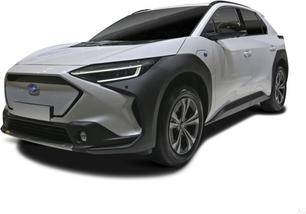
The Solterra is a mid-sized SUV with sporty coupe-like styling and this update has seen the front of the car receive a new look which to my eyes is better than the previous face.
The rest of the car’s exterior remains mainly unchanged in the design.
If you aren’t a fan of the Solterra’s look then check out Toyota’s bZ4X, which is its twin and has slightly more conservative styling, and while I do like the Subaru’s face, I think Toyota’s tail-light treatment is cleaner.
The cabin is modern with a large central media screen, a high-placed instrument display and a wide centre console with dual phone chargers. But the squareish steering wheel steals the show, completing the futuristic vibe.
This update has seen the centre console re-designed with the dual chargers added and the gear-shifter moved backwards away from the media display.
The cabin doesn’t have much in the way of glitzy touches, with dark materials dominating throughout. Hard plastics abound, but the interior still looks and feels premium.
Honda is on a bit of a tear in terms of design, at least to my eye.
All models in its line-up look modern, sophisticated and properly upmarket. And yes, that’s counting the Accord mid-size sedan, too.
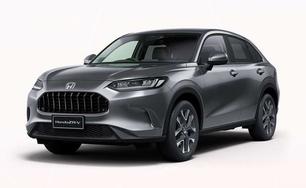
The ZR-V is certainly no different, and while it does crib more than a few design cues from the likes of the Porsche Macan and Maserati Grecale, for a mainstream mid-size SUV, that’s not necessarily a criticism.
The front end is characterised by tall headlights and a chiselled bonnet, but the component that draws the eye the most is the front grille.
With a trapezoidal shape and vertical slats, at first glance the ZR-V’s toothy grin sort of looks like the aforementioned Grecale, and it's a departure from the face of the Civic (on which it is based).
I’m still not one hundred per cent sold on the front styling of the ZR-V. It doesn’t look too cohesive or consistent with the rest of the Honda Australia line-up (the HR-V and CR-V SUVs have a horizontal-themed grille), but it’s not ugly.
Step to the side and there are shades of Macan thanks to its long bonnet, bulbous bodywork and short overhangs.
I like the top-spec VTi LX’s body-coloured wheel arches, too, invoking a little BMW vibe to make the ZR-V feel a touch more upmarket.
However, the rear is my favourite element of the ZR-V, thanks to a funky tail-light design, nicely-sized spoiler and a subtle contrasting diffuser with integrated twin exhaust outlets.
Step inside, and those familiar with the new Civic will feel right at home thanks to a honeycomb dashboard insert that hides the air vents, floating multimedia touchscreen and perfectly girthed steering wheel.
Everything about the cabin is laid out in a clear and sensible manner, but the soft-touch materials and contrast stitching throughout just elevate it from something you might expect from Honda.
And build quality in the ZR-V is excellent. Everything feels so solid and well put together, with nary a sign of squeak or rattle.
Is it the best-looking mainstream family SUV out there? It certainly comes close, but to my eye, Mazda’s CX-5 just edges it out due to a more consistent overall design.
The steering wheel’s square design is like that for a reason - it’s designed to provide the driver with a clearer view of the instrument cluster. But as noted in the past with other vehicles that choose this set up, the ergonomics don’t work for everybody - especially if you’re tall like me (I’m 189cm).
In my case the top of the steering wheel obstructs my visibility of the display, which shows vehicle speed among other crucial info.
There’s also a problem with the clearance of the steering wheel and my legs. This is caused by a combination of my height, the low steering wheel and the limitations of how much it can be raised, the low-hip point in the seating position and the shape of the wheel.
Add an overly wide centre console and space for larger and taller drives becomes even more cramped.
Moving the shifter back in this update also makes it more difficult to use for me and the mechanism is quite clunky.
Second row space is a much better story, with a flat floor, good headroom and lots of legroom even for me behind my driving position. The rear door aperture isn’t great and this has made installing child car seats and the corresponding child difficult.
Cabin storage could also be better. There’s no glove box, but there is space under the centre console, although this is now where the large driver’s manual lives. There’s a large centre console bin, big door pockets and four cupholders (two up front and two in the second row).
The second row has directional air vents and USB ports. There are USB ports up front, too.
Boot capacity isn't enormous at 421 litres in the entry-grade and 410 litres in the Touring. There’s no front boot, either. Under the bonnet is the Solterra’s front motor and electrical hardware.
The Solterra is a five seater SUV, so no third row here.
Measuring 4568mm long, 1840mm wide, 1620mm tall and with a 2655mm wheelbase, the ZR-V is one of the smallest mid-size SUVs in Australia.
But don’t let the figures fool you, as this pint-sized family hauler has a few tricks up its sleeve.
From the front row, there is ample room to get comfortable, while storage options extend to door pockets, a glove box, a generous wireless smartphone charging pad, two cupholders and a handy storage shelf under the shifter.
However, the front seats found in the VTi LX grade of ZR-V feel insufficiently bolstered and flat, at least to my back and bottom.
I found myself sinking and sliding around in the seat more than I would have liked in my time with the car, so this could be an area of concern for slimmer people like myself.
In the second row, there is sufficient space behind the driver’s seat, set for my 183cm frame, while map pockets and a fold-down armrest also come into play alongside the door’s bottle holder.
Worth noting, however, that while there's plenty of space to fit a forward-facing kids car seat and a front passenger, the door trims are a little chunky and leave little room for my toddler to slide in and out of said safety seat.
Open the boot and you will find enough room for 370 litres of volume, which can expand to 1302L with the rear seats stowed.
Although this isn’t close to class-leading (even the CX-5 manages a 438L/1340L rating), the flat floor and easy-to-remove cargo blind make it a breeze to throw a pram, shopping or any sort of gear into.
I think boot space is one of those stats that will always sound good on paper, but how you use that space in reality is a better indicator of practicality, and in this regard, I was never wanting for more space in my week with the car.
The updated Solterra is offered in two grades. An entry-grade model, simply called Solterra, lists for $63,990 and above that is the Solterra Touring for $69,990. That’s up to seven thousand dollars more affordable than pre-update.
We tested the top-of-the-range Touring, which comes loaded with standard features, the only option being leather seats.
If you were wondering if you needed to spend the extra money on the Touring you might be pleased to know both grades have exactly the same powertrain and the entry-grade comes with plenty of standard features.
Coming standard on the entry grade Solterra are 18-inch alloy wheels, LED headlights and LED tail-lights, power mirrors, puddle lamps, a powered tailgate with kick-sensor (new with the update) and roof rails.
There’s also synthetic leather seat trim, heated and eight-way power-adjustable front seats, a heated leather steering wheel, heated second row seats, dual-zone climate control, a 14-inch multimedia touchscreen (new) and 7.0-inch driver display, wireless Android Auto and Apple CarPlay, dual wireless phone chargers (new) and a six-speaker sound system.
The Solterra Touring comes standard with all this but adds 20-inch alloy wheels, a panoramic sun roof, ventilated front seats (new) and a 10-speaker Harman Kardon sound system.
The Touring also features a 220V vehicle-to-load (V2L) power outlet.
Honda’s 2023 ZR-V line-up can be had from as little as $40,200 drive-away for the base VTi X, while the top-spec e:HEV LX hybrid will set buyers back $54,900.
What we have is the highest grade available exclusive with petrol power, the VTi LX, priced at $48,500.
And for this sort of spend, you can expect a long list of equipment, similar to the fit-out you would usually see on luxury models wearing a German badge.
There’s a leather interior, heated and power-operated front seats, a heated steering wheel, heated rear seats, dual-zone climate control, a 10.2-inch digital instrument cluster, rear privacy glass, LED exterior lighting, a wireless smartphone charger and two-tone 18-inch alloy wheels.
Handling multimedia is a 9.0-inch touchscreen with Android Auto and wireless Apple CarPlay support, as well as in-built satellite navigation and digital radio.
Now, some might look at the ZR-V VTI LX’s near $50,000 price tag and think ‘Well, that’s just too expensive for a Honda’. But keep in mind that’s the drive-away price.
A similarly-priced Mazda CX-5 for example, the $44,300 before on-road costs Touring, misses out on features like rear heated seats and a powered tailgate, but also has a larger engine and all-wheel drive traction.
As for the Toyota RAV4, the equivalent variant would be the one-from-the-bottom $43,310 GXL that has a cloth interior, manually adjustable seats and an 8.0-inch multimedia screen.
All things considered, the ZR-V VTi-LX offers plenty of bang for buck for a family buyer, with enough of the modern conveniences that means you won’t be feeling the FOMO for many years to come.
The Solterra has two electric motors and as before there is one driving the front wheels, and one driving the rear wheels for all-wheel drive. Toyota’s bZ4X twin can be had in two-wheel drive and AWD.
The big news is the motors are now more powerful. Much more powerful. Combined output is 252KW (up from 160kW). That’s a huge increase but power is still less than the output of a Model Y or Zeekr 7X.
The front motor now makes 167kW/268Nm, while the rear motor produces 88kW/169Nm. Acceleration from 0-100km/h is about five seconds and that’s almost two seconds faster than the old version.
Powering the ZR-V VTi LX is a 1.5-litre turbo-petrol engine, the same one available across the model line barring the top-spec e:HEV hybrid.
The engine produces 131kW/240Nm, which isn’t all that much compared to larger engine rivals in the same segment.
Paired to the engine is a continuously variable transmission (CVT) that drives the front wheels.
And while a mid-size family SUV is never about outright power, and Honda’s powertrain options aren’t exactly plentiful at the moment, know that you aren’t getting the spiciest SUV with the ZR-V.
The updated Soltera’s battery size has increased to 74.7kWh. That’s up from 71.4kWh and means driving range has increased.
The new, larger lithium ion battery delivers a range of 566km (WLTP) in the entry-grade Solterra (up from 414km). That addresses a big concern about the old car. The Touring has a range of 517km and any range above 500km is acceptable in my book.
Also big news is the increase in maximum AC charging capacity from 11kW to 22kW. DC charging capacity is the same at 150kW with 0-80 per cent charge in about 30 minutes.
Consumption officially ranges from about 14.6kWh/100km in the entry-grade Solterra to 16.0kW/100km in the Touring. The Touring we tested was reporting 17.0kW/100km according to the trip computer after 163km of testing in mainly urban conditions.
Officially, the ZR-V VTi LX returns a combined cycle fuel economy figure of 7.4 litres per 100km, but in my week with the car I managed 9.8L/100km.
This figure is much closer to the city consumption number of 9.3L/100km and, given I only drove the car in Melbourne’s inner city, that explains why.
The ZR-V VTi LX needs just 91RON petrol at the bowser, helping to keep refill costs down.
The Solterra may slightly lag behind rivals in some areas such as range and power output, but where most rivals can barely touch it is when it comes to driving.
Currently there aren’t many electric vehicles that are good to drive, except for more prestige offerings from brands such as BMW, Mercedes-Benz and Porsche.
The Solterra is one of the best electric vehicles I have driven at this price point and it’s down to the outstanding platform it shares with the Toyota bZ4X which provides superb ride comfort, great handling and excellent steering.
Acceleration is strong and traction from the all-wheel drive is good.
Sure, while the driving position needs improvement, the car itself is excellent to drive.
Visibility is also good and sound intrusion is minimal. We noticed some materials making noises in the cabin. Although this is common, with no engine to mask it, it becomes more noticeable in EVs.
For a mid-sized family SUV, the ZR-V proves surprisingly fun and engaging behind the wheel.
A large part of this is due to the fact that the steering feel is just so good.
With enough weight and feedback coming from the tiller, it makes it an absolute delight to thread the ZR-V through traffic, around a roundabout or even a twisty road.
Some mainstream SUVs have opted for overly light steering feel, which ends up straying too close to unnatural. But the ZR-V, at least in this VTi LX form, nails it.
Backing up the steering is a comfortable ride, which is another pleasant surprise in the ZR-V.
The 18-inch wheels fitted are shod with thick 225/55 tyres, meaning there is plenty of sidewall to help soak up the bumps and ruts of Melbourne’s roads.
Don’t get me wrong, we're not talking premium levels of isolation here, but the plush ride is a welcome in a mainstream SUV.
Aiding this feeling of serenity is the 1.5-litre turbo-petrol engine and CVT that is as smooth as they come.
I’ve never really warmed to CVTs in the past, but the ZR-V has a great one, ‘shifting’ smartly to avoid excessive drone, while the engine delivers enough kick to move things along briskly.
And, in a way turning a negative into a positive, the smaller dimensions of the ZR-V mean it doesn’t feel that big on the road, which makes car parks that much easier to navigate despite also offering enough practicality for a small family and some gear.
The Solterra has been awarded the maximum five-star ANCAP rating - but that was given under 2022 testing criteria and the bar has been raised quite a lot higher since then.
Still, the level of safety technology is high with AEB, lane keeping assistance, blind spot warning and rear cross traffic alert onboard.
Front and rear parking sensors are standard on both grades, as is a 360 degree camera view. Auto parking is standard on the Touring.
A digital rear vision mirror is also standard on both grades providing a clear and unobstructed view.
There are seven airbags present, including a front centre bag. And there are three child seat top tether points across the second row with ISOFIX anchors in the two outer positions.
Honda’s new ZR-V is yet to be crash tested by ANCAP or Euro NCAP and does not have an independent safety rating.
However, standard safety equipment includes forward collision warning, autonomous emergency braking, adaptive cruise control, traffic sign recognition and lane keep assist as part of Honda’s 'Sensing Suite'.
The VTi LX adds rear cross-traffic alert and a surround-view monitor to the equipment list.
Rear cross-traffic alert should really be standard across the range and not just on the top-spec model. Its absence is a bit of a disappointment.
In my time with the car, I also found the automatic high beams to be overly aggressive. They were slow to turn off around other cars, leading to a more than a few flashes from oncoming traffic. I ended up just switching the auto high beams off.
The Solterra is covered by Subaru’s five-year, unlimited-kilometre warranty which is falling behind the seven-year warranty offered by many now. The battery is covered by an eight-year, 160,000km warranty.
There is also five years of capped price servicing with each yearly/15,000km service costing between $130-$300. That’s a very reasonable price.
Like all new Hondas sold in Australia, the ZR-V comes with a five-year/unlimited kilometre warranty, matching the period offered by many mainstream brands like Ford, Hyundai, Mazda and Toyota.
And while this falls short of Kia’s seven-year warranty and Mitsubishi’s (conditional) 10-year period, the ZR-V’s servicing costs are among some of the lowest in the segment.
For the first five years or five services, each is just $199, with scheduled maintenance every 12 months or 10,000km.