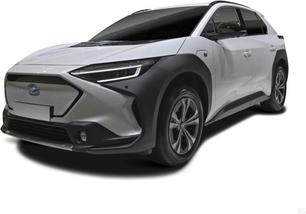
What's the difference?
Car companies don’t normally overhaul a vehicle so rapidly and comprehensively. But the updated Subaru Solterra EV is an exception. It had to be done and this isn’t just an update, it’s an act of survival for Subaru… and Toyota.
You knew the Solterra’s identical twin is the Toyota bZ4X, right? Together Subaru and Toyota developed an electric SUV. Subaru’s is the Solterra, Toyota’s is the bZ4X - same car, different styling, mostly.
The problem was the vehicle couldn’t compete with rivals like the Zeekr 7X and Tesla Model Y on price, driving range, power or charging speed.
Subaru and Toyota knew this had to be fixed ASAP. And so we now have the new Solterra. But is this revised version good enough? Read on to find out.
The camping world is so mad for forward-fold campers that it often forgets that, for a long time, the rear-fold, hard-floor camper were considered the 'In' thing.
That rings true for Sydney-based camper-trailer firm, Blue Tongue Campers, whose three hallmark campers are based on the forward-folding concept with an internal lounge. But it's the rear-fold, which quietly ticks along, almost in the background, which is still the most versatile, has the best storage and the best kitchen of the hard-floor campers. The Series 2 version has just been released so we took it out to see what's changed.
The updated Subaru Solterra is now good enough to compete with rivals such as the Tesla Model Y and Zeekr 7X. The price is right as are the driving range and motor outputs.
There's room for improvement in terms of cabin packaging. The car doesn’t cater for taller, larger people up front, with the steering wheel placement and wide centre console. Cabin storage could also be much better.
Still, the Solterra is superb to drive. One of the best EVs I’ve piloted at this price.
The Overland XR Series 2 isn't quite the perfect camper, there's a few little things in the set-up that preclude it from that. Still, at the price and with the features it gets as standard, it's a really good value trailer. It's comfortable, it'll handle off-road trips with ease, and it the kitchen is really quite good.
The steering wheel’s square design is like that for a reason - it’s designed to provide the driver with a clearer view of the instrument cluster. But as noted in the past with other vehicles that choose this set up, the ergonomics don’t work for everybody - especially if you’re tall like me (I’m 189cm).
In my case the top of the steering wheel obstructs my visibility of the display, which shows vehicle speed among other crucial info.
There’s also a problem with the clearance of the steering wheel and my legs. This is caused by a combination of my height, the low steering wheel and the limitations of how much it can be raised, the low-hip point in the seating position and the shape of the wheel.
Add an overly wide centre console and space for larger and taller drives becomes even more cramped.
Moving the shifter back in this update also makes it more difficult to use for me and the mechanism is quite clunky.
Second row space is a much better story, with a flat floor, good headroom and lots of legroom even for me behind my driving position. The rear door aperture isn’t great and this has made installing child car seats and the corresponding child difficult.
Cabin storage could also be better. There’s no glove box, but there is space under the centre console, although this is now where the large driver’s manual lives. There’s a large centre console bin, big door pockets and four cupholders (two up front and two in the second row).
The second row has directional air vents and USB ports. There are USB ports up front, too.
Boot capacity isn't enormous at 421 litres in the entry-grade and 410 litres in the Touring. There’s no front boot, either. Under the bonnet is the Solterra’s front motor and electrical hardware.
The Solterra is a five seater SUV, so no third row here.
As the lid becomes the floor, it's quite open inside the camper, with plenty of room to move around and space to do everyday things standing up, like get dressed, which is often more difficult in a forward fold, as there's not a lot of standing room inside them. There's also no stairs to climb getting in or out, as the hard floor is almost at ground level.
The tent seems quite well made. It's a 450gsm waterproof canvas with a tropical roof, windows all around the bed and three doors, one each side of the hard floor. Almost the whole passenger side can be rolled away, too, creating a giant opening into the camper, which offers a pretty good outlook on hot summer days at campsites by the beach.
There's no shortage of extra canvas, either. There are two awnings (although only one you'll use often, an ensuite tent and an optional kids room. The best of the awnings is the quick version, which is simply a rectangle of canvas that shelters the kitchen and only needs two poles to hold it up. A more complete awning, which also comes with walls and a floor, goes up reasonably easily, but it'd only be used if you were settling in for a week or more, I reckon, and then only if the weather was questionable. Its pitch has been improved over the Series 1, which had a flatter roofline and was more susceptible to pooling water. The ensuite room is gigantic – about the size of an actual small bathroom.
One of the biggest reasons to get a rear-fold over a forward-fold is the internal access to storage. As the rear-fold's is all under the bed, the four steel drawers make it easy to get to. Two of them are even accessible when the camper is shut, which just isn't the case in a forward-folding camper. A large, wide step makes climbing up into the bed easy, too. It has an innerspring mattress which is firm but comfortable and plenty big enough to spread out on if you are sharing it.
The Overland XR Series 1 was very well equipped electrically, maybe too well equipped. It was fitted with three 100ah batteries, which is not only a lot of extra weight, but that much battery takes ages to charge – if they were all flat, a day's driving probably wouldn't do it, especially if the car also had a second it needed to attend to. The Series 2 has dropped back to two batteries, which is far better suited to the camper and should easily be maintained by one of the optional 144W solar panel blankets. It can also be fitted with Redarc's Redvision, offering phone connectivity to the camper's electronics so you can not only monitor everything, but turn things on or off remotely.
The other side of the camper's forward storage is large enough to fit a generator or any other bulky camping appliance. As it can be accessed when the camper's open or closed, it's perfect for all manner of gear. A smaller box facing forwards is great for hoses and recovery gear or even a couple of jerry cans. Beware of loading this area up with too much really heavy gear, though, as the ball-weight's already on the heavy side. Fortunately, the camper has a flip-over luggage rack, which is ideal for heavier or bulkier items. Underneath, it can carry 155-litres of water in two tanks.
The Solterra may slightly lag behind rivals in some areas such as range and power output, but where most rivals can barely touch it is when it comes to driving.
Currently there aren’t many electric vehicles that are good to drive, except for more prestige offerings from brands such as BMW, Mercedes-Benz and Porsche.
The Solterra is one of the best electric vehicles I have driven at this price point and it’s down to the outstanding platform it shares with the Toyota bZ4X which provides superb ride comfort, great handling and excellent steering.
Acceleration is strong and traction from the all-wheel drive is good.
Sure, while the driving position needs improvement, the car itself is excellent to drive.
Visibility is also good and sound intrusion is minimal. We noticed some materials making noises in the cabin. Although this is common, with no engine to mask it, it becomes more noticeable in EVs.
The Overland XR is very stable under tow, which has a lot to do with its ball-weight. Weight to the front of a trailer improves trailer stability (although reduces braking and steering efficiency), so there needs to be a compromise. At 180kg, that's actually a reduction on Series 1, and although that's quite heavy for a camper trailer, is on par with other modern rear-folds, like the Kimberley Kamper.
Well and truly off-road ready, the XR has independent coil-spring suspension and dual shock absorbers, standard, as well as an AL-KO 360° ball hitch, so obscure angles on a rough track won't cause any trouble.
The camper is quite tall, thanks to the spacing of the suspension arms, so clearance will rarely be an issue – when level, the ride height suits a lifted four-wheel drive.
Alloy wheels and 265/75 R16 all terrain tyres fit the bill nicely, and as they're a six-stud LandCruiser pattern, they, and the two tonne bearings, are easy to replace anywhere you find yourself.