What's the difference?
Renault chairman and CEO Carlos Ghosn may look like a Bond villain, but rather than threatening to end the world he's intent on saving it.
In October last year he launched Groupe Renault's 'Drive the Future 2022' strategic plan, which included a commitment to "eight pure electric and 12 electrified models as part of the [Renault] range" within five years.
But he didn't mention the head start, because Renault already had several pure electric vehicles in its line-up at that point, including the subject of this review.
In fact, the Renault Zoe has been on sale in France since 2012, and stands as Europe's best-selling electric vehicle.
In late 2017, Renault Australia dipped its toe in the electrified waters (risky...) by bringing the Zoe here within a "business-to-business and business-to-government framework."
And in July this year, due to allegedly popular demand, it was made available to private buyers through "selected dealerships"; currently two in Melbourne, and one each in Sydney, Adelaide, Perth and Brisbane.
Just under $50,000 for a city-sized hatch is hardly cheap, but it's entry-level territory for electric vehicles in this market. And what price can you put on helping to save civilisation as we know it?
Let's find out.
Andrew Chesterton road tests and reviews the updated Holden Spark LT with specs, fuel consumption and verdict.
The micro-car segment in Australia has driven off a cliff. We are shunning our smallest cars in a way we never have before, and nobody seems to be entirely sure why.
The strength of the second-hand market is one suspected culprit, while another is the tempting price point of vehicles that are one size bigger, with city-car shoppers able to upsize for relative peanuts.
Whatever the reason, the segment is stuck in neutral and halfway along Struggle Street. It needs a spark. And Holden's hoping theirs is just the ticket.
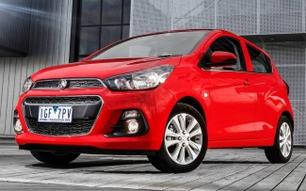
Now you might recognise it as a Barina, but Holden dropped that part of the moniker when this new model launched in March. It is now simply known as the Holden Spark, tested here in top-spec LT guise and wearing a sticker price of $18,990. It sits above only the entry-level, bargain-basement LS ($13,990 manual, $15,690 automatic) in the two-model Spark range.
Designed and built in Korea, the Spark seems to have little to do with our unique marketplace, but Holden promises us this new model couldn't be more dinky-di if it ran on vegemite. Australia had crucial input into its design in Korea, while Holden's Aussie engineers put the new model though its paces on the company's proving ground, tweaking the suspension and steering for Australia's road surfaces.
So the question now is, is the Spark bright enough to lure buyers back to the micro-car segment?
The Renault Zoe is a fun to drive, ultra-efficient, practical little hatch. But the dollar-shaped elephant in the room is its price. Without the government ZEV subsidies offered in other markets, it's wickedly expensive, and with fresh competition in the shape of a new 'normalised' Nissan Leaf coming soon it'll have to work hard to wean more than a handful of small-car buyers off their fossil-fuel addiction.
The marvels of local engineering strike again: the Spark LT definitely feels a cut above some of its budget competition from behind the wheel. It is well-equipped, too, and packed with connectivity and technology features. In short, it could be just the spark Australia's city-car segment needs.