What's the difference?
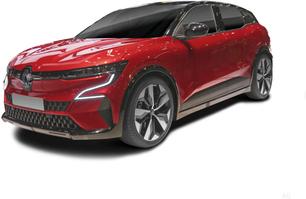
The hotly anticipated Renault Megane E-Tech has arrived on our shores but we're only getting the mid-spec variant for now.
Renault's newest EV is related to the well-known Megane in name only because it has been built from the ground up as an EV. It’s not a hatchback, like its namesake, either, rather a crossover, which means it’s a bit lower than some of its small SUV rivals.
It faces firm competition in the likes of the Hyundai Kona Electric, Volvo C40 and newcomer bZ4X from Toyota. In this review we'll see how Renault's cutest EV handles life with my family of three.
Never talk to strangers. That's (hopefully) what your parents taught you. Luckily some people ignored that good advice when it came to the Toyota Granvia VX people mover and me.
As you'll see in the video above, I tested it on the public – people I didn't know from a cake of soap or whatever the saying is. Seriously, I drove a bus route and somehow talked people into not getting on their regular bus and letting me give them a lift to wherever they were going instead.
I don't often conduct social experiments like this, but I figured the Granvia VX was different. First, here was a new-generation people mover based on the Toyota HiAce that effectively replaces the long-serving Toyota Tarago. Second, it's different from the Tarago and rivals such as the Kia Carnival and Hyundai iMax in that it seems like it's purpose in life could be more of a hire car 'shuttle bus' as it is for a Mercedes-Benz Valente.
So, either way its job is to carry more than one person nearly all the time and that's what I did. You can watch the video above and below is the full review taking into account how I found the Granvia VX to drive, along with its practicality when it comes to cargo capacity, fuel economy and passenger comfort.
The design for the Renault Megane E-Tech is top-notch and the eco-conscious footprint is even better. It’s an easy and comfortable car to be in but the price is a smidge too high in my opinion when you consider there’s currently only one choice for us Aussies and it’s a mid-spec variant at that. It also misses out on some items its rivals have but is a solid EV to consider for urban dwellers.
The Granvia VX is great at being plush, comfortable and easy to drive, but it's not as practical as a people mover should be. And while the engine provides a great driving experience, you'll be filling up the tank often if your trips are mainly urban and city focused.
The E-Tech’s plump body panelling gives me some cute marshmallow vibes from certain angles but there are enough features to keep it looking slick, like the fun LED headlights, massive 20-inch alloys and optional two-tone paintwork.
I’m also a fan of the door handles on the E-Tech as they add some nice focal points, because the front has auto-flush handles that pop out on approach and the back door handles are positioned on the C-pillar.
If you're eco-conscious the E-Tech ticks the box because Renault has designed it to be 90 per cent recyclable.
The body is made of aluminium and can be reformed and shaped into new products at the end of its life. The interior materials are made from recycled fabrics and trims; even the lithium-ion battery is free from any rare earth minerals.
Head inside the cabin and the grey knit trims and upholstery on the seats, doors and dashboard creates a cabin space that feels warm and inviting. It's a similar feel to the Polestar 2 - simple but refined.
Although, with my kid around I have higher anxiety about dirtying them!
The Granvia is a new-generation people mover based on the Toyota HiAce commercial van and arrived in Australia in 2019. The resemblance to the HiAce is obvious although dressed up in its Granvia clothes it's a handsome and professional looking little bus.
I'm a fan of the protruding nose (which helped it earn the five-star ANCAP rating, see more on safety below) and I even like its big, shiny Transformer face and the 'L-shaped' tail-lights which aren't to everybody's taste.
Also, when I say little bus that's only in comparison to actual buses, like the one I convinced people not to get on in my video. Compared to a seven-seater SUV such as the Kia Sorento or Toyota Kluger, the Granvia is enormous.
Look at the dimensions. The Granvia is 5300mm long, 1990mm tall (not counting the aerial) and 1970mm wide, not counting the wing mirrors (which can be folded in).
While the length was hardly ever a problem for me while driving it over the week, the height saw me just make it under the 2.0m clearance in our underground carpark and I had to fold the aerial down to do it. Beware, many carparks have a max headroom of just 1.9m.
The cabin of the VX is impressively plush from the quilted leather reclining second-row seats to the 'woodgrain-look' trim throughout.
During my test I played bus driver to a number of passengers (no, seriously I picked up random strangers off the side of the road – see the video) and all were impressed by the Granvia's premium-feeling interior.
The E-Tech’s cabin is fairly roomy up front with plenty of head- and legroom. The front seats are super comfortable with powered lumbar support and I wouldn’t mind them not being powered if the price point was a bit lower.
The rear seat is comfortable enough once you get seated but the top of the door apertures are low, and I have to duck my head to get in and out.
Your head also brushes against the roof lining in the back which isn't terribly comfortable, especially considering there is no fold-down armrest to lean on.
The front row benefits the most with individual storage and you get a lot of options to choose from but the centre console is one of the most practical I’ve seen for the class. Lots of pockets and nooks that feature adjustable 'walls'.
You get a single permanent cupholder but with the removable walls, accommodation for a second cup or bottle, can be catered for.
Underneath the multimedia screen you get a dedicated phone shelf, which I love using.
In the rear, you get two map pockets and shallow bin storage in each door.
The charging options are good with two USB-C ports in each row as well as a 12-volt outlet and a wireless charging pad up front but you miss out on V2L (Vehicle to Load) functionality in this model.
The 9.0-inch touchscreen multimedia system looks great headlining the dash and is easy to access and use. The system rebooted once on me while driving but other than that everything is responsive.
You get wireless Apple CarPlay and Android Auto and the CarPlay is easy to get started.
The steering wheel has numerous stalks, controls, regen paddle shifters and even the gearshifter on the column, too. It takes a beat to get used to it but I like how driver orientated it is.
The boot offers great storage at 440L but it’s a deep well, which might be annoying if you’re unloading heavier gear. There is underfloor storage for the cables, too, and like I said, you miss out on a powered tailgate.
The Granvia VX tested was an eight-seater (four rows of two seats) and being so tall and long would mean the space inside is going to be good, right? Nup. The Granvia doesn't seem to make the best use of its enormous cabin.
Seating, while undeniably comfortable and luxurious in the second and third rows, doesn't offer great legroom when you have a full load of people on board. I could only just sit behind my driving position in the second row and then behind that in the third row, but there was no way I could then fit in the fourth row.
And while cabin storage is great with the biggest centre console bin I've ever seen – I could fit my head in it (see the video) – and there are 10 cupholders, six coat hooks and a folding table, there isn't a boot or any room for cargo, not in the eight-seater (with all seats in use) I tested anyway. With all four rows in place there is only enough room for a few items no wider than a box of cereal (watch the video, to see what I mean).
Folding up the base on the fourth row seats means they can slide forward and that does free up a little bit of space for cargo, but if you are only going to be using the Granvia for six people, then my advice is to go with the six-seater and have a big boot at your disposal all of the time.
The Granvia VX is outfitted well with charging points – there are seven USB ports all the way back to the third row and two 12-volt outlets.
We'll get to what the Granvia is like to drive in a moment, but what I can say here is that the driver and passengers sit high, like looking-down-on-four-wheel-drive-utes high.
Access into the front seats is a bit of a climb up and proved tricky for my 75-year-old Dad with his gammy knee, but entry into the second-row seats was easy thanks to a wide step and a large aperture.
The small table between the second-row seats blocks the aisle, so the only way to get to the third row is by sliding the second row forward. Fourth row access is more difficult but compared to entry into the back row of most seven-seater SUVs it's a breeze.
For the moment, the Megane E-Tech is being offered in only one grade for the Australian market and that’s the Techno EV60, which is the mid-level version of Renault’s brand new EV.
The EV60 is priced from $64,990, before on-road costs, and that positions it right in the middle of its rivals. The nearest competitor is the Hyundai Kona Extended Range at $60,500 MSRP, newcomer Toyota bZ4X 2WD slides in at $66,000 MSRP and the Volvo C40 Plus sits at $78,990 MSRP.
The E-Tech comes with a decent array of features for a mid-spec variant and premium items include heated front seats, a heated steering wheel, a digital rear view mirror and wireless functionality for Apple CarPlay and Android Auto but you do miss out on items like a powered tailgate and electric front seats which most of its rivals sport.
Technology looks good with a 9.0-inch touchscreen multimedia system, 12.3-inch digital instrument cluster, dual-zone climate control, faster USB-C ports (four total) and a wireless charging pad.
Sound is covered by the Arkamys Auditorium sound system with six speakers and the mood can be set with the 48-way configurable ambient lighting system.
Despite missing out on a powered tailgate, the EV60 has some features that still offer convenience like keyless entry, heated and auto-folding side mirrors and auto-folding flush door handles that pop out on approach (front only).
We tested the Toyota Granvia VX eight-seater which lists for $74,990, before on-road costs, and sits at the top of the range. That said, there are only two grades in the line-up – the entry point known simply as Granvia which comes in six- ($62,990) and eight-seat ($64,990) versions and the Granvia VX which also comes in those two seating configurations and costs the same for both.
Standard features on the VX eight-seater include LED head and tail-lights, proximity unlocking, auto sliding side doors, power retractable heated wing mirrors, 17-inch alloy wheels, sun shades for all rear side windows, a 7.0-inch touchscreen with sat nav, Apple CarPlay and Android Auto, and a 12-speaker Pioneer stereo.
A special shout-out goes to the seating. Coming standard are quilted leather seats for the first, second and third rows, while the rear (fourth row) is a vinyl bench seat with a 60/40 split.
The second row consists of power adjustable ottoman style recliners - think business class airline seats, while the third row is a pair of manually adjustable captain's chairs, similar to the front seats which are power adjustable. My passengers loved the second-row seats. One even said, "I've never flown business class by I feel like I have now."
Is it good value? Well, not really. See $75K is a lot to spend on a Toyota people mover, especially considering the Tarago (which has been axed and effectively replaced by the Granvia) at its priciest is $65,261.
The top-of-the-range Kia Carnival Platinum lists for $62,790 and a Hyundai iMax Elite is even cheaper at $48,490. But the Granvia is a more premium offering, up there with the likes of the Volkswagen Multivan Highline for $79,890 or Mercedes-Benz Valente for $59,850
The Techno EV60 has a single electric motor. It produces a power output of 160kW and 300Nm of torque, and Renault says it will sprint from 0-100km/h in 7.4-seconds.
That's perfectly adequate for keeping up with traffic or getting around town. You only notice a sluggishness with power when you have a full load of gear. Flipping it to 'Sport' mode make it feel peppier, if you ever need it.
The Granvia has a 2.8-litre four-cylinder turbo-diesel engine – the same one found in the Toyota HiAce van and with 130kW/450Nm I found there was more than enough grunt to handle city duties or overtaking on motorways.
Equipped with a diesel particulate filter there's a burn-off switch located near the driver's right knee. The Granvia will tell you when it's time to activate the burn-off function.
The 2.8-litre diesel is fairly quiet and responsive while the six-speed automatic shifts smoothly. There's not much to complain about in terms of the usability of the engine and transmission, they performed well – it's just that with it having to carry around a vehicle weighing nearly 2.7 tonnes fuel economy was never going to be great (you can read about this below).
The official energy consumption figure is 15.6kWh/100km and I averaged 13.9kWh after a fair mix between urban and open-road driving.
That’s outstanding consumption but the official driving range for this E-Tech’s 60kWh lithium-ion battery is up to 454km, which is similar to the Hyundai Kona Electric but I still had an eye on the range during longer trips.
The E-Tech has a Type 2 CCS charging port which means you can benefit from faster DC charging speeds, however, it can only accept a top speed of 7.4kW on AC power.
On a 7.4kW AC charger, you can go from 0-100 per cent in a little over nine hours but on a standard 2.3kW house plug, that jumps up to over 30-hours.
On a 130kW DC charger expect to go from 15-80 per cent in as little as 30 minutes, which is pretty convenient if you have access to one.
Sadly, the E-Tech doesn’t have vehicle-to-load capability, so you can’t power or charge bigger items.
The specifications given by Toyota give the Granvia's combined fuel consumption as 8.0L/100km from the 2.8-litre four-cylinder turbo-diesel.
That sounds fantastic, but in reality after a combination of motorways and urban use the trip computer was reporting 12.9L/100km. A separate fuel test (carried out by myself) saw the Granvia use 21.4L over 127km of city and urban driving (measured at the fuel pump), which comes to 16.8L/100km.
That sounds like a lot, but it makes sense when you consider how heavy the Granvia is. It's 2660kg without anybody on board! If you're carrying eight people weighing 60kg your total mass is tipping the scales at 3140kg and your fuel economy is going to be significantly higher again. The GVM, by the way, is 3500kg.
Really, the Granvia is the perfect argument for a hybrid powertrain, because tour operators or parents ferrying their family around the city are going to want better fuel economy.
I have mostly loved driving the E-Tech. It's easy to cruise around in and the power is adequate for open-road driving but it prefers an urban environment.
The power can feel a bit lacklustre when you are carrying lots of people or gear but you mostly feel that when you're on a steep incline and trying to keep up your speed.
The steering is crisp and that makes the E-Tech very responsive to drive. The power is delivered smoothly and it feels well-balanced when you put your foot down.
There is more roll in corners than I was expecting but the car still feels firmly planted.
The ride comfort is great. The suspension is more firm than soft which means you feel the road but it's not a major bother. There is a bit of wind noise at higher speeds, as if the door isn’t properly sealed by a millimetre but it doesn't annoy me.
The regenerative braking is controlled by paddles on the steering wheel and you have three levels plus a one-pedal function to choose from.
The single pedal set-up is pretty smooth, even in stop/start traffic, but it’s great to be able to quickly change modes on the go.
The smaller size of the E-Tech makes it an easy car to manoeuvre in a small car park. You get front, rear and side parking sensors which is great because the reversing camera isn’t as clear as it should be for this price level.
For a 5.3m long, 2.0m tall box on wheels the Granvia sure is easy to drive. I live in Sydney's Inner West (get your chai latte jokes out of the way now, please) and drove it daily through horrendous traffic on potholed roads, navigated through the tiniest streets and squashy car parks, went fishing in it and ate up motorway kays on the weekends.
There are going to be people who snort at that eight of 10, but I'm telling you it's down to three things: comfort, ease and engine.
The seats were comfortable and supportive (my passengers felt the same way – again see the video of me being a bus driver), the ride is composed thanks to the suspension and no doubt the weight and the wheelbase of the Granvia.
The visibility is excellent thanks to those giant windows, the ride height and tech such as that digital rear view mirror, while the steering is light, and the turning circle is excellent at 11.0m.
Finally, that 2.8-litre turbo-diesel engine. Yes, it's thirsty but from a driving perspective only it's great – smooth and responsive.
Often vans are prone to a booming sound reverberating around the cabin and the Granvia VX was also a victim of this phenomenon with road noise echoing around inside. It's not bad and I could still hear people in the second and third rows, however.
The E-Tech has a maximum five-star ANCAP safety rating from testing in 2022 and has seven airbags, including a front centre airbag.
The EV60 comes with lots of passive safety features including dusk sensing auto LED headlights, LED DRLs, a rear fog light, child safety locks, tyre pressure monitoring, traffic sign recognition tech, an intelligent seatbelt warning, a reversing camera plus front, rear and side parking sensors.
Active safety equipment includes items like blind-spot monitoring, driver attention alert, rear collision warning, forward collision warning, rear cross-traffic alert, lane departure alert, lane keeping aid, and adaptive cruise control (with stop and go).
You also get a digital rear view mirror which is essential as the back window is narrow and the camera feed provides a clearer view than you’d have without it.
The rear row also features ISOFIX child seat mounts on the outboard seats and three top tethers but two seats will fit best. The front passenger seat also has ISOFIX child seat mounts and a top tether.
AEB with car, pedestrian, cyclist and junction turning assist function is operational from 8.0-80km/h (160km/h for cars) but it is common to see that starting figure sit closer to 5.0km/h.
The Granvia scored the maximum five-star ANCAP rating when it was tested in 2019. The amount of standard safety equipment is outstanding, particularly for a van with commercial origins.
Coming standard are nine airbags including ones which go all the way back to cover the fourth row and for child seats there are four ISOFIX points (second and third rows) and four top tether points (second and third rows).
The level of advanced safety equipment is also outstanding. Coming standard is Toyota's 'Safety Sense' pack which brings AEB with cyclist and pedestrian detection, lane departure alert with steering assistance, road sign recognition, auto high beam and active cruise control.
A full-sized spare wheel is located under the Granvia VX.
The E-Tech comes with a five-year/100,000km warranty, but it’s usual to see an unlimited km term for the class. The battery is covered by an eight-year or up to 160,000km warranty term.
Service intervals are reasonable at every 12 months or 30,000km and you also get five-years roadside assistance included.
Pricing over the first five years ranges from a low of $230.04 to a high of $519.62, averaging out at pretty competitive $317.72 per service. No capped-price deal is available.
The Granvia is covered by Toyota's five-year, unlimited kilometre warranty. Servicing is recommended by Toyota at six-month/10,000km intervals with capped price servicing of $240 per service for three years or 60,000km.