What's the difference?
I'm going to reveal something of myself here - I used to be a RenaultSport Clio owner. This is what the purists call what we now know as Clio RS, and I find myself constantly corrected yet unrepentant. It was a 172 - a nuggety three-door with wheels that looked too small, a weird seating position and a 2.0-litre naturally aspirated engine that was big on torque as long as you belted it.
It was a classic and you could still see the links back to the epoch-making Renault Clio Williams, that blue and gold Mk 1 Clio we never saw in Australia that redefined the genre. The current Clio has been around for four years now and I even drove this current RS Clio at its launch in 2013, memorable for the sudden bucketing rain that drenched the circuit and made things very interesting indeed.
This Clio was a big change from the cars that went before - slimmer-hipped, less aggressive-looking and with a 1.6-litre turbo engine, five-door-only body and (gasp!) no manual, just Renault's twin-clutch EDC transmission. It was a hit, at least with enthusiasts. Back then it was the dawn of a golden age in small hot hatches. But that was then, this is now. With a small power bump and a couple of features thrown in, is the ageing RS still at the pointy end?
If you're after a hot hatch with a boot, you can't have one because it wouldn't be a hatch anymore.
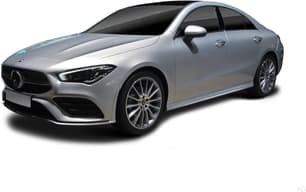
What you can have is this little beast - the new, second-generation Mercedes-AMG CLA 45 S, a small coupe-style sedan sharing its high-performance DNA with the hot as bubbling lava A 45 S hatch.
Packing 300kW – that's just over 420hp – and 500Nm its 2.0-litre engine is claimed to be the most powerful series production turbo four ever made.
And Australian deliveries are scheduled for early 2020, with a likely price tag in the mid-$90k bracket.
Mercedes-AMG invited us to the car's global launch in Madrid, Spain, where we got behind the wheel on road and track.
The Clio RS is still a ton of fun and in Cup spec, probably the best compromise between price and livability. Despite its advancing years (it turns five this year, so ready to start kindy) and big brother Megane hogging the limelight with a fancy new model on the way, the Clio is a stayer. It's missing some frustratingly obvious things like CarPlay, AEB, rear airbags and rear cross-traffic alert, but it's hardly alone in the segment.
With the departure of the Fiesta ST, though, the Clio returns to the top of the list of best small hot hatches on sale today.
The Mercedes-AMG CLA 45 S is more glorious madness from the hot-rodders in Affalterbach. A design and engineering master-class putting a slightly more mature spin on the fast and furious small AMG formula. But only slightly. It's brilliantly outrageous.
The Clio is a handsome small car but nothing out of the ordinary until you apply the very cool Liquid Yellow paint. That hue really is quite something and works even better with the black alloys of the Cup chassis.
The car has some lovely surfacing and in a recent-ish refresh, the slightly odd headlights were reworked, as were the front and rear bumpers which now link to the RenaultSport Megane. Sorry, Megane RS. The RS flag signature lighting is a nice touch, acting as DRLs at the bottom corners of the front bumper.
The lovely organic shapes of the Clio's sides still look good and the rather tough rear end with the chunky diffuser leaves you in no doubt that it's the proper RS not the halfway-house, 1.2-litre GT-Line.
Inside is starting to look its age, but graceful, a bit like Jamie-Lee Curtis' or George Clooney's embrace of grey hair. There are still some of the sharp edges I didn't like. It's certainly a Renault to look at and ergonomically works pretty well. One thing that has been fixed at some point is the switch on the gear selector - it won't bite you if you curl your finger underneath when you press it. You might think that's a small thing, but when you did it, damn it hurt.
Claimed to blaze from 0-100km/h in 4.0 seconds the second-generation CLA 45 has the performance credentials of a mid-engine supercar, wrapped in a relatively unassuming three-box body. And while it might look mild-mannered from a distance, this devil's differences are in the detail.
Like it's A 45 sibling the CLA 45 S features AMG's now signature Panamericana grille with 12 vertical louvres, a winged front spoiler treatment, extra aero bits around the front air intakes and 'Power Dome' bumps in the bonnet.
The side skirts are wider, and the 19-inch twin five-spoke rims are standard. While at the back the diffuser treatment is more pronounced than the hatch, but the fat 90mm exhaust pipes are the same, and the lip spoiler is on the boot lid rather than the roof.
The interior is virtually identical to the hatch, the biggest difference being the four-door coupe's frameless doors.
A combination of Merc's 'Artico' faux leather and 'Dinamica' microfibre trim is accented with racy yellow highlights, with a nappa leather and Dinamica AMG Performance wheel and sports pedals completing the picture.
And the twin widescreen MBUX instrument and media display boasts AMG-specific read-outs on everything from gear selection, warm-up menu, car set-up, a G-metre, race timer and engine data. The standard 'Track Pack' even includes specific circuit layouts and data.
The Clio's interior is certainly snug. Rear seat passengers do okay for legroom but headroom is a mite marginal with the falling roofline for six footers. There are no cupholders out back, that curious French habit of supplying just a couple of cup receptacles of different and weird sizes persists. The front doors have space for bottles, the rears do not.
The boot is class-competitive at 300 litres (worth knowing the Trophy loses 70 litres to the Cup) and with the seats down stretches to a claimed 1146L.
At just under 4.7m long (248mm longer than the A 45 S hatch), a bit under 1.9m wide, and fraction over 1.4m tall the A 45 S in the dimensional bullseye for a compact four-door.
The CLA A 45 S driver is presented with the same sleek 'MBUX' widescreen display found in the Mercedes-Benz A-Class, and storage runs to two cupholders in the centre console, a lidded bin/armrest between the seats (including twin USB ports), decent door pockets with room for bottles and a medium-size glove box.
In a swap to the rear, sitting behind the driver's seat set to my (183cm) position, I enjoyed adequate knee and foot room, although headroom isn't as generous.
A centre fold-down armrest incorporates two cupholders, again there are generous pockets in the doors with room for bottles, and adjustable ventilation outlets are set into the back of the front centre console is a welcome inclusion. No map pockets on the racy, hard shell sports front seats, though.
There are three belted positions across the rear, but the adults using them for anything other than short journeys will have to be good friends and flexible. Best for two grown-ups, and three kids will be fine.
Boot volume is a healthy 460 litres (VDA), expanding further with the 40/20/40 split-folding rear seat down. There are tie-down hooks, a 12-volt outlet and elasticised storage pockets either side of the load space to further enhance useability. But beware, the Merc-AMG CLA 45 S is a no-tow zone.
The iconic 'Liquid Yellow' ($750 option) Clio I had for the week was the Cup spec chassis. The Clio RS 200, as it is officially known, comes in two specs - Sport and Cup - and there's a Trophy 220 at the top of the range. I had the Cup, which retails at $32,490 (plus on-road costs). The RS220 Trophy, with a bit more poke and stuff, weighs in at $38,990 if you're interested.
The Cup spec is heavily based on the more affordable ($30,990) Sport, which means you get 18-inch alloy wheels (painted black, so watch those kerbs), climate control, four speaker stereo, keyless entry and start (the "key" is still that unwieldy keycard style thing), reversing camera, cruise control, front and rear parking sensors, fog lamps, LED daytime running lights, sat nav, auto LED headlights, auto wipers, launch control, leather bits and pieces and a tyre inflation kit instead of any kind of spare.
The 7.0-inch 'R-Link' touch screen software runs the four speaker stereo with DAB digital radio, Bluetooth and USB. If you get the optional RS Monitor, there is a full-on telemetry system from which you can save your, er, "track day" data and overlay in Google Maps to compare with your mates' or past efforts. You can also change the piped-in engine sound to various different sound effects which are delightfully silly.
Android Auto is part of the breathtaking $1500 'Entertainment Pack' option that includes RS Monitor (which used to be standard) and no, there's no Apple CarPlay. Leather is a further $1500.
Bottom line is that you do get a decent spec bump from the $30,990 Sport along with the more capable (and less comfortable) Cup chassis.
The new CLA 45 is launching in the premium S variant only (a 'base' non-S version is offered in other markets). The outgoing model was tagged at $93,800, before on-road costs, prior to its discontinuation in January this year, and Mercedes-Benz Australia has hinted strongly that a price increase is likely. So, expect a list price in the mid-$90k range.
We'll cover active and passive safety tech in the safety section, and although final Australian specification is yet to be confirmed you can expect the stand ard features list to include the 19-inch alloys, 'Artico' faux leather and 'Dinamica' microfibre trim upholstery, the 'MBUX' widescreen cockpit display (two 10.25-inch digital screens) and 'MercedesMe' voice recognition, heated and electrically-adjustable sports front seats, auto adaptive LED headlights, LED tail-lights and DRLs, keyless entry and start, auto-dimming rear-view mirror, dual-zone climate-control, sat-nav, multi-function sports steering wheel, active cruise control, rain-sensing wipers, Active Parking Assist' (with ultrasonic proximity sensors front and rear), rear privacy glass, plus premium audio with digital radio, as well as Apple CarPlay and Android Auto.
The 200-equipped RSes pony up 147kW/260Nm, which is pretty much bang-on the obvious competition (Peugeot 208 GTI and the outgoing Fiesta ST), driving the front wheels through Renault's six-speed EDC twin-clutch. Unlike those two, there is no overboost function.
Dieppe's finest sprints from 0-100km/h in a claimed 6.7 seconds, pulling along a kerb weight of 1204kg.
The A 45 S's all-new 2.0-litre (M139) engine is claimed to be the most powerful series production turbo four ever made, pumping out 310kW at 6750rpm and a monumental 500Nm, peaking between 5000-5250rpm. . That's up from an already impressive 280kW/470Nm on the out-going model.
It's an all-alloy, closed deck design fed by a combined direct and port fuel-injection system, with a single, twin-scroll turbo featuring low-friction roller bearings for quick spool up.
It's transversely mounted, but compared to the previous model has been spun 1 80-degrees on its vertical axis so the turbo's near the firewall and the intake system sits at the front to simplify and shorten ducting on the intake and exhaust sides.
The cylinder linings are treated with Merc's patented 'Nanoslide' coating, which delivers an ultra-hard, mirror-like surface for less friction and greater durability. And 'Camtronic' variable valve control sits on the exhaust side.
Drive goes to all four wheels via an eight-speed 'AMG Speedshift DCT 8G' dual-clutch auto, with manual shift paddles attached to the steering wheel.
Renault claims 5.9L/100km on the combined cycle but, yeah, nah. My week was admittedly filled with plenty of horseplay and spirited driving, yielding 11.4L/100km. If you were careful you may fare better - but not that much better.
The fuel tank is a fairly standard 45 litres. It requires 98RON premium unleaded.
Claimed fuel economy to the combined cycle NEDC (New European Driving Cycle) standard is 8.1L/100km, the engine emitting 186g/km of CO2 in the process. Figures for the Australian (ADR 81/02) standard will be issued at the time of the car's local launch in early 2020.
Stop-start is standard, minimum fuel requirement is 98 RON premium unleaded, and you'll need 51 litres of it to fill the tank.
Our combination of furious hot-lapping on the circuit and relatively enthusiastic open road driving on the launch program means we'll wait until we test the car on home soil to log a real world average.
The RS has always had a belter of a chassis. The Cup chassis became a thing just over a decade ago and is lauded by the fans as The One To Have. I've not always been convinced of this as my earlier drives of the Cup-equipped machines have usually been in close proximity to the Sport chassis.
The Cup is slightly lower than the Sport, with 15 per cent stiffer springs and dampers and perhaps more importantly it scores 18-inch wheels with Dunlop Sport Maxx RT2 tyres, which you can reasonably expect to be a bit firmer than the 17s with Goodyear F1s on the Sport. And they are.
However, in most situations, the Cup chassis is perfectly benign. You certainly feel the bumps and lumps, but you haven't bought a Cup chassis for Lexus-like isolation. It's certainly sharper than the Sport chassis and when you're really giving it a go around the bends, the comfort deficit is more than made up for by the extra grip and poise.
The RS has always had a belter of a chassis.
The chassis is aided and abetted by a torquey 1.6-turbo that cheerfully...no, gleefully spins to the redline which could do with another thousand revs, but that's forced induction for you. The aluminium shift paddles need a good positive pull to get a gear, but that gear is delivered quickly and effortlessly. The Clio is a great deal of fun in Sport and Race modes, with throttle mappings and gearshifts becoming more aggressive as you switch through the modes.
The brakes are tremendously effective and the electronic limited slip diff (*cough* brake-based torque vectoring) ensures you'll hit your apexes and the tyres spend more time gripping than spinning.
But it's not all hairpins and off-camber left-right-lefts, is it? Plenty of owners have to live with the car in traffic day to day. Driving the Cup in isolation, I've changed my mind about it. I reckon it's the best of the two chassis settings. The city ride is better than decent, with the hard edges potholes chamfered off by the dampers and decent compliance. It's not too noisy, either.
Mercedes-AMG invited us to the Jarama race circuit just outside Madrid in Central Spain, and the twisting B-roads nearby, to sample its latest pride and joy.
In the AMG tradition the engine is assembled by hand, by one technician. And hats off to the spanner twirlers, they do a great job. It's a spectacular unit. Torque delivery is shaped to mimic a naturally aspirated engine, with the maximum figure arriving between 5000-5250rpm.
But that's not to say it's hollow in the mid-range. Around 90 per cent of that peak number is available from below 3000rpm and low-end throttle response is brilliantly crisp and linear, helped in no small part by roller bearings on the turbo for a quicker spool up.
Merc-AMG claims 4.0 seconds for the sprint from 0-100km/h, which is supercar fast and with drive going to all four wheels entertainment is the name of the game.
The eight-speed dual-clutch auto is positive and sharp, especially in manual mode where shifts flick through in much less than the blink of an eye.
And as the A 45 S beefs up the A-Class on the outside, it's the same underneath the skin with body reinforcement including an alloy sheering plate under the engine, a front strut tower brace, extra reinforcement between side members and A-pillars, and diagonal struts on the front and rear of the underbody.
So, the strut front, four-link rear suspension has an extra stiff platform to hang from, and the three-mode 'Ride Control' active damping can transform the ride from soft and compliant to tightly buttoned down.
The speed-sensitive, electromechanical steering is specifically tuned for this car, and it points accurately with good road feel and pleasantly firm weight in Sport and Sport+ modes.
Rubber is Michelin Pilot Sport 4 S, and it grips hard. On the fast and technical Jarama circuit they performed flawlessly, helping the A 45 S transform its prodigious power into maximum forward velocity without fuss.
The icing on the dynamic cake is 'AMG Dynamic Select' with six modes from 'Comfort' to 'Race' adjusting the engine, transmission, steering, suspension, and exhaust.
On top of that 'AMG Dynamics' uses the ESP and torque vectoring (by braking) to vary the level of stability and slip through four levels from 'Basic' up to 'Master'.
We played with all the toys including 'Race Start' and a 'Drift Mode' made possible by a new rear axle featuring two multi-disc clutches - one for each rear wheel.
Torque is split variably between front and rear axles with a default setting of 50/50 rising to around 70 per cent to the rear when pushing hard. Drive is also continuously managed across the rear axle, and like a swan gliding across the lake all the action happens seamlessly out of sight, turning you into a track hero in the process.
The first-gen A45's exhaust was a mass of pops, bangs and crackles, while this car's more rasping and rorty exhaust note is controlled by a flap in the system adjusted by engine speed and load. It's also amplified by the 'AMG Real Performance Sound' system, which puts some actual engine and exhaust noise (nothing is synthesised) through the speakers.
Open road ride comfort in the softest setting is surprisingly good, with rough surfaces unsettling the car only slightly despite the big 19s and high-performance rubber. Body control is S and S+ settings is spot-on, the car feeling planted, predictable and ultra-responsive on tight, twisting backroads.
Braking power is professional grade with six-piston calipers at the front and single piston rear, on vented and perforated rotors all around. Even following session after session on the track there wasn't a hint of fade.
On board the Clio is four airbags (no curtain coverage for those in the rear), ABS, stability and traction controls, a reversing camera and two ISOFIX points along with three top-tether anchors.
The Clio was awarded a five-star ANCAP rating in November 2013.
Although final Australian spec is yet to be finalised, you can expect a host of active safety tech including ABS, BA, EBD, stability and traction controls, a reversing camera (with dynamic guidelines), 'Active Brake Assist' (Merc-speak fo AEB), 'Adaptive Brake', 'Attention Assist', 'Blind Spot Assist', 'Cross-wind Assist', 'Lane Keep Assist', a tyre pressure warning system, the 'Pre-Safe' accident anticipatory system, 'Traffic Sign Assist' and 'Adaptive Highbeam Assist'.
If all that fails to prevent an impact you'll be protected by nine airbags (front, pelvis and window for driver and front passenger, side airbags for rear seat occupants and a driver's knee bag), and the 'Active Bonnet' automatically tilts to minimise pedestrian injuries. A first-aid kit and hi-vis vests in the boot are thoughtful additions.
The A-Class was awarded a maximum five ANCAP stars in 2018, and for smaller occupants there are three child restraint/baby capsule top tether points across the back seat, with isofix anchors on the two outer positions.
Renault says it was the first European maker to offer a five-year/unlimited kilometre warranty in Australia, and who are we to argue? The package also includes up to four years of roadside assist and three years of capped-price servicing.
Renault expects to see you just once a year or every 20,000km, which gives you a bit more headroom than some similar service plans, at least on the mileage. The first three services will cost no more than $369 unless you need a new air filter ($38) or pollen filter ($46). At 60,000km or four years you'll cop $262 for a set of spark plugs. The company's website also suggests if the Clio doesn't like the state of its oil, it will beep at you until you have that attended to.
The Mercedes-AMG range is covered by a three year/unlimited km warranty, which, like Audi and BMW lags behind the mainstream market where the majority of players are now at five years/unlimited km, with some at seven years.
On the upside, Mercedes-Benz Road Care assistance is included in the deal for three years.
Service is likely to be scheduled (as per the out-going CLA 45) for 12 months/20,000km (whichever comes first) with pricing available on an 'Up-front' or 'Pay-as-you-go' basis.
For the first-gen CLA 45 pre-payment delivers a $500 saving with the first three services set at a total of $2950, compared to $3650 PAYG. Fourth and fifth services are also available for pre-purchase.