What's the difference?
The Polestar 2 was one of the first electric vehicles (EVs) in Australia to break through to the mainstream, however it has always been relegated to the Tesla Model 3’s shadow.
As a result Polestar is constantly playing catch up, releasing update after update for this premium-pushing electric liftback. The most notable was a major mid-life update in 2024.
Two years after this, Polestar has just rolled out the 2026 model year (MY26) update which introduces a range of subtle changes, largely under the surface.
It comes as Polestar is now introducing newer models, there’s mounting pressure from legacy carmakers who are only now catching up to EV tech, and Australians are moving away from buying passenger cars to SUVs.
Has this latest update improved the appeal? Read on to find out.
Mazda has a tendency to have a lot of similar looking horses in the stable; blink and you'll miss the (very) subtle differences between the CX-8 and the CX-9 but if you're not super keen on the bulk of the CX-9 and you've outgrown the space of the CX-5... this one's for you.
Especially, if you've been considering its competition - the Hyundai Santa Fe Elite CRDi AWD and Toyota Kluger GXL AWD. Both of which have become known for their features and space.
So, how does it compare? The CX-8 GT SP diesel all-wheel drive seats seven, has a decent boot space (albeit, when the third row isn't in use) and handles like a dream.
Perfect combination? Maybe. I've been driving it for the last week with my family to find out for you.
This latest update for the Polestar 2 is lovely, but driving the original is a reminder of how solid this car has always been if you overlook the inherent impracticalities of being an EV on a combustion-engine platform.
The fact you still get steady flow of over-the-air software updates bringing new features, plus you can now upgrade to the new Qualcomm processor chip, saving some coin and getting a second-hand model that’s a couple of years old isn’t a bad option at all.
Note: CarsGuide attended this event as a guest of the manufacturer, with meals provided.
So, what did my family think about the Mazda CX-8 GT SP diesel all-wheel drive? I love how it performs on the road - it's super easy to drive and you don't notice how large it is in a car park.
There are some great family-friendly features scattered throughout and I like how practical this is too with the extra seats and top-tether points. The multimedia system isn’t my favourite and I would have preferred to have seen a few extra airbags and a 360-degree view camera, but overall, it’s a good family car and gets an 8.0/10 from me.
My son loved the sun blinds and the cool colour of the seats. He also gives it an 8.0/10.
I’ve always been a fan of the Polestar 2’s exterior design and unlike many new cars it has aged like fine wine over the years. You need to remember the Polestar 2 dates back to 2016 when it was first revealed as a Volvo concept.
It still has clean lines, iconic lightning signatures, plus a tough stance that evokes just a touch of muscle car.
While it has taken me a while to come around to the new blanked-out grille insert, it suits the character of this car given it’s an EV. It also aligns with the wider Polestar design language.
For 2026 there haven’t been any major changes to the exterior. There’s a new sandy-like ‘Dune’ exterior paint colour replacing the silver ‘Jupiter’, plus a new 20-inch forged alloy wheel design for the Long range Dual motor Performance.
Inside, the Polestar 2 looks fundamentally the same as it did when it first launched, in the best and worst ways.
I appreciate how traditional car-like the layouts of the steering wheel, digital instrument cluster and touchscreen multimedia system are. Sure it doesn’t scream ultra high-tech anymore like some of its rivals, but there’s still an understated premium feel to it.
The same can be said for the rest of the Polestar 2’s interior. Everything feels purposeful in a minimalist way which helps make for a clean design.
Speaking of purposefulness, the optional Bowers and Wilkins sound system features a prominent tweeter on top of the dashboard. It looks stunning and is functional, helping to create an incredibly punchy and full sound stage in the cabin.
One of the few finishes I dislike in the interior is the glossy piano black on the steering wheel buttons. You interact with these frequently and it doesn’t take long for fingerprints to present themselves.
There’s now a new synthetic leather upholstery finish for those who opt for the $4700 Plus package. It’s quilted which helps emulate a premium puffer jacket-like look.
Although it’s expensive, the $4400 ‘Bridge of Weir’ Nappa leather upholstery is beautiful and required if you want ventilated front seats. You can only get black and white finishes, which is fine, but bringing back a tan or caramel option would be delicious.
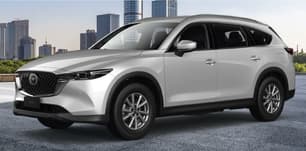
To be honest, I can't really tell the CX-8 and CX-9 apart on the road. They're both large SUVs that sport the classic Mazda bonnet - sharp and long. Up close, the CX-9 has a bulkier shape but otherwise they are remarkably similar.
The CX-8's darkened grille generates some interest with its lattice-work and there are enough shiny chrome accents scattered about the car that it looks pretty.
Yet, the sporty sharpness that Mazda is known for is still hinted at with its shaping and the 19-inch black alloy wheels.
Our model is finished in 'Platinum Quartz Metallic' and it is the highlight for the exterior styling for me. I think because it's such an interesting colour to look at - it varies a lot depending on lighting conditions. Sometimes, it almost has a sheen of pink to it and at others, it looks like pearly sand.
The interior looks polished and refined with its burgundy leather trim and soft-touchpoints. Again, there is a lot of chrome inside to make otherwise dull features, like air vents, pop out.
This has always been the downfall of Polestar 2 and it remains true.
While it’s pretty and has a cockpit-like design, the cabin can feel compromised in terms of space and storage. This is primarily due to the centre console which angles upwards sharply, aggressively segmenting the driver and front passenger space.
The only storage spots on the centre console include a shallow shelf under the centre console, a wireless phone charger and another uncovered storage nook under the touchscreen.
It doesn’t help that the cupholder situation doesn’t allow for a proper centre armrest. You either have no cupholders and an armrest, one cupholder and your arm barely reaches the armrest, or two cupholders and the centre armrest flops into the backseat space. It’s not ideal.
Gripes aside, there are still positives to the Polestar 2’s front row. The seats are comfortable on longer drives and allow for a large degree of electric adjustment.
Ahead of the driver the steering wheel thankfully has physical buttons, allowing for easy use on the move. I also love how satisfying the indicator stalk thwack is. It’s the little things that count.
The digital instrument cluster has a minimalist look and can be customised with a few layouts. I particularly like the Google Maps layout which shows your navigation when using the in-built app.
Moving across, the Google Built-in software for the multimedia system is still up there as one of the most usable out there currently. It’s easy to navigate, plus if you get lost there’s a convenient home button at the bottom of the screen.
Both screens are now driven by a more powerful Qualcomm processor chip which allows for better responsiveness, smoother performance and higher download speeds for in-car apps.
Although we didn’t get a huge opportunity to stress test this new chip, it’s definitely an improvement on the old one. You can technically upgrade your old Polestar 2’s chip through a Polestar service centre, though it conveniently doesn’t list how much this costs.
While physical switchgear is limited, there’s still enough to get by. Over the years I’ve grown accustomed to using the touchscreen to change the climate control, though some physical dials and buttons would be nice.
Apple CarPlay and Android Auto are available in wired form only, which is surprising as wireless smartphone mirroring is now commonplace. It does mean however that your phone will charge up reliably.
Moving to the second row, it’s arguably where the Polestar 2 is at its worst. At a leggy 182cm I do fit behind my driving position but headroom is tight.
It doesn’t help that there’s a huge transmission tunnel which technically isn’t needed given this car is fully electric. That’s a downside of using a combustion-engine platform.
Second-row amenities include air vents, two USB-C ports, as well as a fold-down armrest with cupholders. Heated outboard seats are optional.
At the back the button to pop the boot is down where the number plate is. It’s not overtly obvious unless you know where to look.
As standard the tailgate is manually operated and you need to get the $4700 Plus pack in order to get it electrically operated. It also gets a hands-free function which is handy if you’ve got your hands full with bags.
Boot space is 407L with the rear seats upright, expanding to 1097L with them folded. This includes a 43L underfloor section which is large enough for some cables. The boot size is fairly standard for a vehicle of this size and type.
There’s also a 41L front boot which can be used for further cable storage or other various storage needs.
The CX-8 is a very practical family hauler because there's ample room in all three rows. Yes, even adults will be able to squeeze into that third row without too many complaints!
All rows enjoy well-cushioned seats and up front they are electrically adjustable, but unfortunately, only the driver's side has lumbar support.
The middle row can slide forward manually or by using the electric button found on the side of the seats... but doing it yourself is way faster.
They do slide far enough forward that you won't embarrass yourself too much when you have to clamber into the third row. Where the seats have a 50/50 split-fold and manual adjustments (accessed via the boot).
In the first two rows there are lots of individual storage options but the front enjoys the most. The middle console is deep enough to be useful and I like the dual opening lid. Each row gets a couple of cupholders and drink bottle holders, too.
The charging options are great, with each row getting two USB-C ports and the front getting a wireless charging pad and 12-volt socket.
All of the controls and dials feel within easy reach and the 10.25-inch touchscreen multimedia system graphics are clear.
You can use it as a touchscreen or opt for the rotary dial but switching between the two was awkward for me. Especially, since the touchscreen function is disabled when you are using the wireless Apple CarPlay. This also has wired Android Auto, for those users.
The amenities are practical throughout with a dark headliner, three-zone climate control and heated outboard seats and retractable sun-blinds in the middle row.
Good news for families because there are five top-tether points across the back rows and ISOFIX child seat mounts on the outboard seats in middle row, in case you need them.
You can fit a 0-4 rearward facing child seat and it shouldn’t impact on front passenger comfort.
My six-year old found it super easy to get in and out of this car because of the 205mm ground clearance and wide door apertures. He enjoyed the high seating position, too, but was disappointed he couldn’t see out of the sunroof!
The boot space is a bit cramped with all three rows are in use at 209L but folding the third row opens up a more respectable 775L - perfect for the average family and its stuff!
The loading space is level, with the temporary spare tyre and clever storage compartments housed underneath. There is a retractable cargo blind and net, luggage anchor points and a 12-volt port, too.
And, as always, I love a powered tailgate, which this has!
The 2026 Polestar 2 starts at $62,400, before on-road costs, for the Standard range Single motor and extends all the way to $85,080, before on-road costs, for the Long range Dual motor with the Plus and Performance packages.
This is more expensive than the similarly premium-pushing Tesla Model 3 ($54,990 to $80,900, before on-roads), as well as the more budget-oriented BYD Seal ($46,990 to $61,990, before on-roads).
Despite this, Polestar currently has some major deals and offers on new 2026 Polestar 2 stock to the tune of up to $13,000 off the drive-away price. This can see you drive away in a brand-new model for as little as $55,763, drive-away, in Victoria, which is around $5000 less than a base Model 3 RWD.
There’s a catch though… options. There is a slew of option packages and singular options available and they add up quickly.
Most notable is the new $3500 14-speaker Bowers & Wilkins sound system that must be bought in conjunction with the 'Plus package' which is $4700 on all trims besides the Long range Dual motor as it’s already standard.
Annoyingly, a heat pump is part of the $1500 'Climate package' which also brings heated rear seats, a heated steering wheel and heated wiper nozzles. So many carmakers now include heat pumps as standard fare in EVs as they help reduce energy consumption during colder months.
Beyond this, there’s a standard base of equipment which is fine for the price point. Highlights include LED headlights, a 12.3-inch digital instrument cluster, 11.2-inch touchscreen multimedia system, wired Apple CarPlay and Android Auto, wireless charger, dual-zone climate control and heated front seats with electric adjustment.
The GT SP diesel AWD is one of the premium models, sitting third from the top and will cost you $65,560, before on road costs.
However, its price tag positions it as the most expensive compared to its rivals. With the closest rival being the Kluger at $65,310 and the most affordable being the Santa Fe at $60,000.
You do get a stylish-looking package with lots of features for your cash, like heated front seats, heated rear outboard seats, a tilt and slide sunroof, and premium leather interior trim.
There's some great tech scattered throughout, too, like the 10.25-inch touchscreen multimedia system, wireless charging pad, USB-A ports in the third row, Bose Premium sound system with 10 speakers, wireless Apple CarPlay and wired Android Auto.