What's the difference?
The Nissan Pathfinder has evolved over the years from what was quite a rough-and-tumble Ford Everest style vehicle to a remarkably plush three-row family SUV.
Although it took a while to reach Australia, when the fifth-generation version landed in late 2022 it was a huge leap over its predecessor. And yet it has been a relatively slow seller in Australia.
In the first half of 2024 only 405 were registered, less than a tenth of the segment benchmark Toyota Kluger (5861 sales).
This can be largely attributed to a lack of choice in the Pathfinder range, following Nissan culling entry-grade variants early on leaving only the relatively expensive Ti and Ti-L grades, both fitted with a V6 petrol engine.
To increase customer choice, Nissan has reintroduced the ST-L mid-spec trim with the option of front-wheel drive for under $60,000, before on-road costs. But is it a good buy?
The sixth-generation of Subaru’s Forester has landed and while the new hybrid versions constitute the biggest news of this batch, the petrol-only variants should not be ignored.
The five-seat mid-size SUV has a 2.5-litre four-cylinder 'boxer' engine, Subaru’s well-regarded 'symmetrical all-wheel drive' system and some new changes inside and out.
So, does the top-spec Touring offer the best value-for-money in the petrol Forester line-up?
Read on.
There’s a lot to like about the Nissan Pathfinder. The current model not only looks a lot better than its predecessor but in ST-L trim — and with an even cheaper front-wheel drive model — it offers the kind of value Australian families are chasing.
For all its practicalities, towing capacity and refined driving experience, the Pathfinder’s fatal flaw is its limited engine choice. A thirsty petrol V6 with no engine start-stop tech stunts its appeal for those who live in suburban areas where a Kluger hybrid just works better.
The ST-L is a worthy consideration for your next purchase if you’re less bothered about fuel use, and it's the pick of the line-up, offering just about every creature comfort and safety feature you'd want in a good-value package.
The MY26 Subaru Forester packs plenty of punch in terms of standard features, a roomy and functional interior and overall driveability. Sure, it’s not the most exciting vehicle to drive on- or off-road but to get stuck on that is to miss the point entirely. This is a decent all-rounder with a solid background and an AWD system that long ago set the gold standard for vehicles of this type.
In a tough mid-size SUV market segment aimed more at those intent on driving through car parks rather than adventuring through national parks, the Forester offers greater versatility than most and should not be ignored.
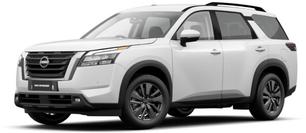
The Pathfinder has a lot going for it in the looks department. Lead designer Ken Lee leaned into the nameplate’s past, incorporating the three horizontal strips between the broad bonnet and 'V-Motion' grille which is encircled in chrome.
There’s real presence to this SUV (partially down to the Pathfinder's sheer size) with chunky wheel arches and plenty of vertical surfaces. The most eye catching colour is 'Scarlet Ember' red ($750) but the pearlescent 'Deep Ocean Blue' seen here is a classy look.
Every manufacturer is doing the spaced out nameplates on the boot lid now, but the Pathfinder was an early adopter and it is particularly well executed on this car. There's also the massive (in proportion to the vehicle) Nissan badges.
Inside, the Pathfinder focuses more on practicality and usability than wow-factor. There are no tacky design flourishes and the three-row SUV manages to stay on the right side of Americana, a trick the Toyota Kluger could learn.
This Forester is 4655mm long (with a 2670mm wheelbase), 1830mm wide and 1730mm high.
The new generation retains more than enough of the previous Forester – blocky profile included – to remain clearly recognisable.
Traditionalists may chafe at the slicker, more citified appearance of this Forester over previous generations but the overall package is inoffensive enough to not elicit any howls of outrage from passers-by on the street.
The Forester’s interior maintains a similar cabin look and feel as before but with a 11.6-inch portrait-oriented multimedia touchscreen dominating up front, a mix of physical and on-screen buttons, as well as soft-touch surfaces and durable plastics.
The Pathfinder is a thoughtfully packaged and practical vehicle, trading on more than just size with plenty of clever storage solutions.
In the front there are generous door bins, twin cupholders and a deep central cubby. But there’s more, with a thin rubberised storage shelf above the glove box perfect for phones or sunglasses and a pass-through space below the centre console for larger items.
A storage space for a smartphone is found in close proximity to USB-A, a USC-C and 12-volt sockets. All of thus is beneath a physical switch panel for the dual-zone climate control.
The 9.0-inch multimedia touchscreen is the only letdown, feeling quite small in the Pathfinder's vast cabin. It is still responsive and features wireless Apple CarPlay and Android Auto, though. The Pathfinder’s sound system is passable after tweaking the bass and treble balance.
The analogue speedometer and tachometer sits either side of a 7.0-inch media screen that gives driving information along with settings for safety systems. There are switches on the steering wheel to control major functions, including cruise control, media and the screen operation.
Among its competitive set, the US-built Pathfinder’s build quality is excellent. There are cleverly positioned soft-touch plastics and we didn’t notice any rattles over our week of testing, unlike Palisades and Klugers. The steering wheel, especially, is appointed in a high quality, smooth-grained leather.
While the ST-L may only get cloth upholstery, which is admittedly harder to clean than leather, the high-quality material is more temperature stable than the imitation cow hide often seen at this price. It’s also combined with heated front seats.
Adding to the comfort factor is power adjustment for the driver’s seat including in/out and up/down lumbar control. The passenger seat is manually adjustable but with a lever for height and the driving position is pleasingly low-set.
The low front seats open up a world of excellence for the second row’s stadium seating which gives passengers a fantastic view out. Not only is this just nice, it also helps kill travel sickness for kids (and grown-ups).
The second row is on front/back sliding rails with fine backrest adjustment to dial in a comfortable position. There’s ample room even for adults over 185cm with plenty of head, leg and toe-room.
Amenities include a third climate zone, USB-A and USB-C charge points, a total of six beverage holders and a fold-out armrest.
The Nissan Pathfinder has ISOFIX tabs in the two outboard rear seat positions. The anchors are not hidden behind a cover so there is nothing to lose and the three top tether points are big and meaty for easy access.
Nissan deserves praise for its wide opening doors, the Pathfinder’s go almost perpendicular to the body with a large square aperture making loading dogs, children or shopping extremely easy.
But there’s one crucial flaw — the back windows don’t go all the way down leaving around a third of the glass sticking up.
The Pathfinder’s three-wide third row is vast in the third row, with enough space for adults in a pinch — at least two across the three-wide bench — and up to four beverages.
The power-actuated second row gets out of the way quickly (perhaps a little too fast!) and slides back into place easily. The rear bench is split 60/40 with the long portion on the Australian kerbside.
There are no ISOFIX or top tether points in the third row of the Pathfinder ST-L which does hurt its practicality. The Ti-L features ISOFIX and top tether for one third row seat.
Aside from that, the Pathfinder is about as good as an SUV gets for practicality, though a Kia Carnival people mover has the edge for outright human carrying ability.
Behind the shapely power tailgate, the Pathfinder offers either 205L, 554L or 782L of cargo space depending on how many seats are in use. And while the smallest figure sounds compact, the space is tall and square making it quite practical. Four school bags would fit easily or five at a pinch.
With the third row stored elegantly in the floor, the space is generous although interrupted by the roof-mounted middle third-row seat belt which is a faff to unbuckle.
Amenities include two shopping bag hooks, a 12-volt socket, four tie-down points and a spacious wet storage area below the boot floor.
The spare tyre is hung beneath the Pathfinder however it is a temporary space saver, rather than a full-size item.
Despite no diesel powerplant, the Pathfinder’s towing capacity is best in class, beating both Palisade and Kluger with its 2700kg braked limit (750kg unbraked).
Though still shy of the ladder frame Ford Everest and Isuzu MU-X (3500kg), the monocoque Pathfinder’s high limit is impressive.
The Forester is quite roomy for a mid-size SUV and this is the top-spec variant so there’s leather everywhere.
The interior layout is neat and tidy and lands firmly on the correct side of being practical and familiar, with all controls easy to locate and operate.
The touchscreen offers mostly simple intuitive functionality with infrequent need to cycle through numerous menus and sub-menus to access what you want.
The aforementioned mix of physical and on-screen buttons, as well as soft-touch surfaces and durable plastic are welcome here because, you know... real life.
The front seats offer ample support and the driver is able to dial-in their preferred position via power controls on the eight-way power-adjustable seat (with dual memory). The front passenger has an eight-way power-adjustable seat. Both seats are heated and ventilated.
The 60/40 split folding second-row seats aren’t too shabby either, in terms of comfort and amenities, with a fold-down arm-rest with cupholders and directional air vents etc.
Cargo volume is 496 litres (with rear seat in use) and 1174 litres (with the rear seat down, 1667 litres to ceiling.
The tailgate is powered and hands-free with a kick sensor (apparently). But I never tried that, instead opting for the tailgate-mounted button to open and close it.
The ST-L is not lacking for features, with 18-inch alloy wheels, a 360-degree camera view system, tri-zone climate control, a head-up display, built-in navigation, wireless Apple CarPlay and Android Auto, front and rear parking sensors, cloth upholstery and heated seats.
The front-wheel drive ST-L starts at an impressive $59,670, undercutting the Hyundai Palisade Elite ($66,800) and more spartan Toyota Kluger GX hybrid ($60,920). The all-wheel drive ST-L seen here costs $64,170, with all prices before on-road costs.
As for other Pathfinder trims, the Ti adds a more powerful stereo, leather-accented upholstery and different wheel designs for $67,990 (in front-wheel drive) and the full-fat Ti brings a digital driver’s display, 20-inch alloy wheels and second row captain’s chairs — dropping seat capacity to seven — for $82,490, all before on-road costs.
The Forester AWD Touring (petrol) is priced at $50,990 MLP while its hybrid sibling is $55,990.
Standard features include an 11.6-inch multimedia touchscreen (with wireless Android Auto and Apple CarPlay), 18-inch alloy wheels, auto LED headlights, dual-zone climate, heated front seats and electric folding rear seats as well as a wireless phone charger.
Top-grade additions include a sunroof, low-profile roof rails, a digital driver display, leather-accented seats, a leather auto-shifter, ventilated front seats and a 10-speaker Harman Kardon audio system.
It also has power-adjustable front seats, sat-nav, auto-dipping and folding door mirrors and a hands-free tailgate.
Exterior paint choices include 'Crystal White Pearl', 'Ice Silver Metallic', 'Magnetite Grey Metallic', 'Crystal Black Silica', 'Crimson Red Pearl', 'Brilliant Bronze Metallic', 'Daybreak Blue Pearl', 'Sapphire Blue Pearl', 'Cashmere Gold Opal', 'Autumn Green Metallic' and 'River Rock Pearl'.
The Nissan Pathfinder is only available with a petrol engine. It is an all-aluminium dual overhead cam direct and multi-point injection 3.5-litre V6. It's part of Nissan’s ‘VQ’ engine family that has been around since 1994.
The V6 develops 202kW at 6400rpm and 340Nm at 4800rpm which are respectable outputs. The torque builds steadily from around 3000rpm and starts to really move the Pathfinder above 4000rpm.
The lusty engine note is a nice touch in a world dominated by down-sized turbo-petrols and hybrids. There’s something refreshing about the natural response of a large capacity naturally aspirated engine, too, interfacing slickly with the nine-speed automatic transmission.
The Forester has the line-up’s 2.5-litre four-cylinder naturally aspirated boxer engine (producing 136kW at 5800rpm and 247Nm at 3700rpm) matched to a constantly variable transmission (CVT), which some people detest, and some people couldn’t give a rat’s whether it’s there or not.
Also onboard is Subaru’s all-wheel drive system, driving modes (including 'Normal', 'Deep snow/Mud', and 'Snow/Dirt') and 'X-Mode' “that constantly monitors the traction available to each wheel and centralises the control of key components including the engine, transmission, drivetrain and brakes to help manage slippery conditions”, according to Subaru.
For all the benefits of that large capacity V6 it has a fatal flaw and that is fuel efficiency — particularly around the suburbs.
The Pathfinder’s rated fuel consumption is 10.5L/100km in the ADR combined (urban/extra urban) cycle with 245g/km CO2 outputs, however it is much thirstier around town.
After 100km of suburban driving in Sydney, the Pathfinder’s trip computer read 15.3L/100km. It lacks an engine start-stop system to save precious millilitres when sitting at traffic lights.
Other large V6 vehicles will be similar, or probably slightly higher in the case of the multi-point injected Palisade, but the gold standard in this segment is the Toyota Kluger hybrid which easily returns figures of 6.0L/100km or less in pretty much all driving.
A longer 200km loop taking in motorways and country roads saw the Pathfinder consume fuel at 11.4L/100km which is an improvement but still very high.
Our observed fuel consumption gives the Pathfinder, with its 71L tank, a theoretical driving range of 602km. It will happily take standard 91 RON unleaded at the pump.
Official fuel consumption on the combined (urban/extra-urban) cycle for the Forester is 7.9L/100km and it uses 91RON 'standard' unleaded petrol at a minimum.
On this test, I recorded 8.1L/100km. But fuel consumption was as low as a dash-indicated 1.7L/100km while driving the Forester with adaptive cruise control engaged.
The Forester has a 63-litre fuel tank, so, going by our on-test fuel-use figures you could reasonably expect a driving range of almost 780km from a full tank. However, as with any vehicle, once you’ve loaded the Forester with any real-world burdens (e.g kids, dogs, camping gear, etc) you’ll soon see the fuel consumption increase.
The Nissan Pathfinder is a remarkably pleasant drive. It is smooth and quiet on the motorway, comfortable around town and talented on testing Australian country roads.
Nissan has managed to nail the fundamentals including a well-weighted electronic power steering system, good ride comfort at high and low speeds and impressive body control for a high-set 2052kg vehicle that rides on passive dampers.
The 18-inch alloys are wrapped in 255/60 Kumho Crugen HP71 tyres which are notably cushier than the Ti-L’s bigger 20-inch alloy wheels shod with 255/50 rubber.
Being a car-based SUV, the Nissan Pathfinder is more comfortable and a sportier drive than more off-road focused vehicles such as the Ford Everest and Mitsubishi Pajero Sport. It is not as dynamic as smaller seven seaters such as the Kia Sorento but is still secure and stable.
There are seven drive modes in total, with three ('Sand', 'Mud' and 'Snow') dedicated to off-roading, a further trio ('Auto', 'Eco', 'Sport') for the tarmac and a dedicated 'Tow' mode.
Along with adjusting steering weight and shift logic, the all-wheel drive Pathfinder adjusts the torque split settings. It can be a little slow to shift torque to the front wheels leading to chirping on fast getaways but it is mostly solid and a worthy $4500 investment over the new front-wheel drive only model.
Visibility is not great with a high belt line and low-set driving position. With the third row's large headrests up it's hard to see out the rear window, too, so it can be difficult to judge kerbs and walls while parking. A standard 360-degree camera system helps in low-speed manoeuvring.
The Forester feels comfortable and composed on sealed surfaces and offers some degree of dynamism to the driving experience – so in line with previous generations.
It feels more refined, sharper to steer and more responsive than before. There’s ample visibility to the front but a substantial B pillar obscures the driver’s vision back over their right shoulder.
The Boxer engine and CVT work well together, power and torque outputs are more than adequate in this package, and that much-maligned transmission is not intrusive if the Forester is driven with care and common sense.
However, acceleration from a full stop is sluggish.
The suspension set-up – MacPherson struts up front and double wishbones at the rear – yields a firm but not jarring sense of ride and handling.
The 1662kg Forester proved nimble to manoeuvre around the Big Smoke, the suburbs and in the bush (more about that soon) with a neat 10.8m turning circle.
All-wheel drive vehicles are capable of tackling off-road adventures in their own right but, for safety’s sake, AWD drivers should avoid anything beyond well-maintained dirt tracks in dry weather. AWD cars are designed for use on bitumen roads with some dirt or light-duty off-road use.
And so it was with our test of this Forester. On-test off-road terrain equalled firm-packed sand and gravel/dirt bush tracks in dry weather, although we did drive through one shin-deep mudhole with no trouble.
The Forester has a listed 220mm of ground clearance, the suspension held up well over a brief stint on mild corrugations and Subaru AWD proved more than up to the task when things became a little trickier, providing improved grip and traction in slippery conditions that demanded to be driven at very low speeds.
If push comes to shove, it’s capable of more than light off-roading, but the Forester’s ground clearance and off-road angles ultimately limit its off-road capabilities.
The Forester’s 'all season' tyres – Falken Ziex Z001A A/S (225/55 R18 98V) – are fine for light to moderate off-roading but anything more difficult than that and you’ll need to get a set of more aggressive all-terrain tyres. It does have a full-sized spare onboard.
It has maximum towing capacities of 750kg (unbraked trailer), 1800kg (braked) and a maximum towball download of 180kg. GVM is 2223kg; GCM is 4023kg.
Some niggles: The driver awareness system is annoyingly over-reactive.
The Nissan Pathfinder received a maximum five-star ANCAP safety rating in 2022.
It has a total of nine airbags including dual front, a front centre, side chest for first and second rows and curtain airbags covering all three rows, unlike some smaller rivals.
Active driver assistance systems include autonomous emergency braking (AEB) that can detect cars, pedestrians, cyclists and motorcycles.
The AEB system functions front and rear and includes junction cross-traffic detection. Lane-keep assist, blind-spot monitoring and speed sign detection are also standard. Stability control and ABS systems intervene early and smoothly.
Going further than just having the systems, the Pathfinder’s integration is very good. The adaptive cruise control is smooth, the lane-trace assist is mostly good. They can all be easily disabled if you like, too.
The Forester has the maximum five-star ANCAP safety rating from testing in 2024.
It has nine airbags (dual front, dual front side, dual curtain, driver’s knee, far side and front passenger seat cushion), adaptive cruise control, emergency lane-keep and centring (with departure warnings), pre-collision braking, auto emergency steering, a 360-degree view monitor system, and a driver monitoring system which includes a ‘safe stop’ feature that – if the vehicle detects that the driver is non-responsive – will bring the vehicle to a gradual, you guessed it, safe stop.
Nissan recommends the Pathfinder is serviced every 12 months or 15,000km, whichever comes first.
You can pay-as-you-go ($2592) or up front ($2333) which saves $259 over five years ($518.40/$466.60 average per workshop visit).
Those service price options are closely aligned with the Hyundai Palisade ($2345) but Toyota’s $1325 Kluger offer remains unbeaten.
A five-year, unlimited kilometre warranty covers all Nissan vehicles in Australia. It is now the standard with other marques, including Kia, MG and Mitsubishi pushing boundaries with longer seven and 10-year offers.
The MY26 Subaru range is covered by a five-year/unlimited kilometre warranty, five-year/75,000km capped price servicing, and 12 months roadside assistance.
A service is required every 12 months or 15,000km, whichever occurs soonest. After your free “1 Month Health Check and Chat”, cost per service is $347.95 (at the 15,000km/12 month mark), $520.45 (30,000km or 24 months), $393.10 (45,000km or 36 months), $679.30 (60,000km or 48 months) and $358.20 (75,000km or 60 months). Average over the five years is $459.80.
Subaru Australia has more than 140 dealerships across the country with a decent spread over metro and regional areas. Foresters may be serviced at those dealers or by approved mechanics.