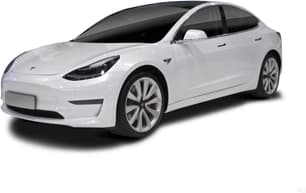
What's the difference?
If I had told you even just a few years ago that one of Nissan’s most promising vehicles, and one the brand partially hangs its future on, was an all-electric hatchback, you probably wouldn’t have believed me.
But here we are, and after already having been on sale for years in Europe, the second-generation Leaf has arrived in Australia.
In Europe it has even been remarkably successful, counting itself as a best-seller in Norway, where Nissan has managed to sell more than 50,000 of them.
By now, I already know what your questions are: What’s the range? How long does it take to charge? How much does it cost?
For all those answers and more, read on.
If the Tesla Model 3 Performance appeals to you, you're probably a different kind of electric car buyer.
Instead of outright range and efficiency, you're probably prioritising performance - I mean it's in the name of this spec of Model 3, after all. And this grade essentially takes the regular Model 3 and makes it a bit mental.
Let's go through how it does that.
With its tall asking price, limited government initiatives and geography working against it, I don’t quite think the Leaf is going to revolutionise the EV landscape in Australia quite the way it has in Europe. It’s still a compelling option for those who want to (and can afford to) jump on the EV train a little early, and who don’t necessarily need to traverse the distance between cities often. It also looks to the future of those wanting to smooth out their electricity bills or go 'off-the-grid', so the Leaf is certainly one to watch in this space.
It is fun. It is fast (actually, it's incredibly quick). It is functional. But it's also flawed.
The interior ergonomic quirks may be something you get used to, or you might actually appreciate. But the quality of workmanship - or lack thereof - is something that is harder to overlook, especially for a car at this price point.
If someone told you that this was the new-generation Nissan Pulsar, would it really be a stretch to believe them? I think not. Today’s electric cars are looking less and less zany.
Sure, the Leaf still has some wacky Japanese design points, but so does the current-generation Civic hatch.
Nissan’s “Zero Emissions” insignia is emblazoned across the sides and rear of the car, and it has Nissan’s EV design points in the gloss black body highlights, and blue ripple pattern in the grille. There are some rather anonymous-looking alloys compared to the sci-fi turbofan ones opted for by Hyundai’s EV range, and that’s about it really.
Inside, the Leaf isn’t too far removed from the brand’s regular passenger car range. There’s the same D-shaped steering wheel as the one that now appears in the Qashqai small SUV, as well as a vastly improved centre stack, with a fantastic new 8.0-inch screen. The interior has subtle blue highlights to remind you of its electric underpinnings in the seat stitching, oddly designed gear selector knob and through the dash insert on the passenger side.
You have to admire how subtle it all is. The doorcards and dash-top are clad in soft-touch materials to match those lovely seats. If there’s anything I could complain about here it’s just that aside from a few highlights it’s all a bit samey in the colour department.
So the Leaf is styled so subtly it could be anonymous… Some will see that as a very good thing, especially for an EV.
It might seem harsh for the design score to be so low, but this is more about quality and physical fit and finish than the aesthetic of the car. I actually like the look of the Performance model, even if it is a bit amorphous at the front.
But it was the panel gaps and joins that were of most concern to me. If this particular model had come down the production line of one of the German brands, it would have been sent to the recycling centre. The workmanship for a car of this price is appalling.
One shouldn't be able to fit the tip of their finger in the gap between the front and rear doors. Nor should one be able to see a shadow on the rear door based on poor fitment of the front door. It was so poor on our test car, it made me think of a vehicle that had been crashed and put back together... and not very well.
This type of shoddy workmanship makes you wonder what other corners may have been cut. It has been widely reported that Model 3s were being assembled in a makeshift marquee-style tent in order for the company to hit its ambitious build targets.
The interior isn't without its fit and finish issues, either. Our car had a squeaky centre console (even though it had less than 700km on the odometer), and some of the plastics inside weren't fitted as well as they should have been.
See the interior images below for a closer look.
The Leaf is on the larger side for a hatchback, and with its electric drivetrain layout comes some inherent benefits.
No fuel tank, for example, brings a deep and wide boot space, rated at 405 litres, which isn’t the biggest space in the hatch segment, but definitely on the larger side, and rear seat space is decent, too.
Sadly the rear seats don’t get air vents, a common faux-pas in cars this size, but they do get heated seats which is pretty special. The rear seats are also clad in the same thick padding and leather trim which makes the front ones so comfortable.
Up front there are decently-sized trenches and bottle holders in the doors, decent cupholders in the centre stack as well as a half-way decent console box. Under the centre stack, there is also a spot well suited to a phone, as that’s also where the USB port is for screen mirroring.
The seats are wide and comfortable, but the driver’s position is a little high, giving an SUV-like feel. Annoyingly, the steering column doesn’t have telescopic reach adjust, making the wheel feel too far away, perhaps too close to the dash, for many people.
The Model 3 is a bit of a storage marvel.
It has a boot, which measures 425 litres and has 60:40 split fold seats, plus a hidden storage compartment rear of the back axle for cables or other luggage. But there's also the 'frunk' (front trunk) which is large enough to house some backpacks or shopping bags (there are even curry hooks to stop the bags moving around too much) and it increases total storage to 542L.
Then in the cabin you have door pockets with bottle holders all around, a set of cup holders in the rear centre armrest, plus another set of cupholders and what can best be described as a cupboard between the front seats. There is a deep well of storage, between front occupants' legs, and a smaller section up between the seats, too. Plus there's a glovebox which operates using the touchscreen, because of course it does.
Space for adults is good up front, and the seat comfort and adjustment is pretty decent, too. The back seat space isn't great - there's limited toe room, the knee room could be better (anyone my height - 182cm - will feel a little cramped behind someone of a similar size) and you sit in a bit of a knees-up position, too. Headroom, too, isn't terrific - the roof angle is almost coupe-like, meaning you need to watch your noggin on entry and exit, and because it's all glass above, anyone with a bald spot might feel the sun a touch too much.
Now, about that screen...
It's a 15.0-inch unit that is located centrally, and it allows you control of basically everything in the car aside from the gear selection, engaging the cruise control or Autopilot (two quick taps of the gear selector - just don't get confused and tip it back into Neutral at speed...) and also the windscreen washers - oh, and there's a volume scroller on the steering wheel, thank goodness for that.
Everything else can be done using the touchscreen, from setting your side mirrors and the electric steering wheel adjustment (which will save to your profile), and you can Bluetooth stream music or connect via USB. The lack of Apple CarPlay and Android Auto is questionable though.
If you're into games, there's a selection of arcade options to choose when you're parked, and there are other things like Santa Mode, Mars mode for the maps, and even a whoopee cushion app...because farts are funny.
Honestly, I dislike this gimmickry because I know the company could have been spending its time, money and resources making a better-built car, rather than a nerdy amusement park cockpit.
But I can see the point that 'no-one else is doing cars like this', and that it will have appeal to people who are maybe a little more light-hearted about the idea of spending $100,000 on a toy.
The odds are stacked against the Leaf in this department, as it arrives in Australia in just one spec level, priced at $49,990 (plus on-road costs).
You’re probably thinking: "Are you serious? Fifty grand for a hatchback?" And you’d be right. Without any EV rebates like the Leaf receives in Europe, the pricing is a tall order. You’d have to really be going out of your way to choose an EV lifestyle, it’s not simply a $2k to $5k spec switch like from petrol to diesel.
That having been said, Nissan has helped soften the blow a bit by giving the Leaf a plush set of specs. This is a nice hatchback, with all the tech and connectivity items you could realistically want. In fact, it’s by far the best-specified Nissan you can buy right now.
First of all, the Leaf that’s finally arrived in Australia has received some sort of minor update over the one we drove just a few months ago.
Included is a new centre stack with a new 8.0-inch multimedia touchscreen, the first for Nissan in Australia to host Apple CarPlay and Android Auto (better late than never…), as well as built-in navigation, Bluetooth connectivity, backed by a seven-speaker Bose-branded audio system.
There’s also plush leather seats which you seem to sink into, with Alcantara highlight trim, a leather steering wheel, a power adjustable driver’s seat and heated seats across the front and back rows, and a heated steering wheel.
Nissan says heated seats are the most power efficient way to heat occupants up, rather than just blasting the single-zone climate control.
Other spec items you get include keyless entry, push-start ignition, 17-inch alloy wheels, a 7.0-inch partially-digital dash, as well as full LED lighting front and rear.
There’s also Nissan’s full suite of active safety technology, which is impressive stuff, explored more in the safety section of this review.
The Leaf is the only EV in Australia which is capable of two-way charging via its Japanese-standard CHAdeMO charging port. The brand says you’ll be able to use this feature to use the Leaf as a “portable energy asset” – this means the car will be capable of storing energy in off-peak power-grid times, then using it to power your home cheaply in on-peak times.
This will require a piece of hardware which is not yet available in Australia, but will be “in around 12 months” after Nissan and its energy tech partner, JetCharge, get it approved by Australian regulators.
The hardware will appear like a "wall box" device, and will cost "less than $2000".
You could argue a similarly-specified hatchback this size with a petrol engine would only cost in the mid-to-late $30k price bracket. So, you’re paying about $15,000 for the EV drivetrain and everything that involves.
You can slide into the less-powerful and slightly more limited-on-range Hyundai Ioniq EV, which is this car’s closest competitor, for about $5000 less. You’ll miss out on the two-way charging tech though.
The all-wheel drive Performance variant tops the Model 3 range at $91,200 before on-roads.
That's a comparative performance bargain if you're thinking of it as a competitor to the likes of the outgoing BMW M3 ($141,610), Audi RS4 Avant ($152,529) and Mercedes-AMG C63 ($160,540).
This is what it says on the label - the most performance-oriented model in the line-up, with blistering acceleration figures we'll cover off in a sec.
It also adds 20-inch wheels, performance brakes, a carbon-fibre lip spoiler on the boot, lowered sports suspension, aluminium pedals, a higher top speed (up from 233km/h to 261km/h) and Track Mode setting.
It also has the "Premium Interior" with a 14-speaker premium audio system, in-car internet service with music and media streaming and satellite view mapping. That's all controlled by the 15-inch multimedia touchscreen that doubles as the car's dashboard, and it has Bluetooth plus controls for the dual-zone climate control. There are four USB ports (2x front, 2x rear).
Other standard gear includes LED front lighting, a fixed glass roof, auto-dimming mirrors (with auto folding and heating for the side mirrors), a key card (but no proximity entry), driver profile setups, and smartphone app controllability.
A couple of omissions: there is no Apple CarPlay or Android Auto phone mirroring, which could be a deal breaker for some. Plus you don't get wireless phone charging, and you can't get a 360-degree surround view camera system, and nor is there a head-up display (which you get standard on a $25k Mazda 3).
The Leaf is driven by a 350V electric motor on the front axle, providing a max output of 110kW/320Nm. Being an electric motor, the torque is available almost instantaneously.
Despite its almost-1600kg kerb weight (batteries are heavy!) Nissan claims those motor specs will have the Leaf doing 0-100km/h in just 7.9 seconds.
It’s not the most powerful electric motor, even among a limited pool of competitors, but it still outshoots its main competitor, the Hyundai Ioniq EV (88kW/295Nm).
How backwards is it that Tesla is one of the most high-tech companies on the planet, yet still offers outputs in horsepower and pound feet? This grade of Model 3 has a combined output from its front and rear motors of 450 horsepower (335kW) and 471 lb-ft of torque (638Nm).
That's from 0rpm, which is important - and because it's all-wheel drive, the Model 3 Performance has a 0-100km/h claim of just 3.4 seconds.
The maximum speed for this variant is 261km/h.
The Leaf consumes no petrol for obvious reasons, and how much it will cost you to charge for a year will depend where you get your electricity from.
If you have solar panels or you can steal your electricity from a wall socket at work, for example, it can cost you next to nothing. If you exclusively charge up at home, Nissan reckons it will cost you just north of $700 a year to charge the Leaf at peak times, or just over $300 at non-peak times.
The other thing you’ll need to know are the types of connectors available to you. The Leaf has two. It has a Type-2 ‘Mennekes’ connector - one of the most popular types of connector globally - and a two-prong CHAdeMO port, a Japanese standard, which is capable of higher kW inputs.
How fast you’ll charge will depend on the kW output of the station you connect to. A 50kW output via the CHAdeMO connector will see a charge time from zero to 80 per cent in about an hour, while a Type 2 home wall connector has a charge time Nissan estimates at 7.5 hours, and connecting to a good old-fashioned three-pin wall outlet will see a charge time of “about 24 hours.”
How efficient the Leaf is once the energy is actually in the battery is another question. Electric cars are measured in efficiency by kWh/100km. I can’t comment on what the Leaf got at the launch as the short distance would be an unfair reflection, but on my earlier range-test I scored around 15.3kWh/100km. For context, I found the Kona Electric to be slightly more efficient at 14.1kWh/100km (hence the less than 10 score for the Leaf).
To be fair, the Kona’s extra weight probably helps regain more energy around town.
Battery range. We all know fun is only fun if it isn't over too quickly...
The claimed range based on NEDC standard testing for this spec of Model 3 is 560 kilometres - that's 100km more than the entry-grade car because this model has a bigger battery pack. According to the Green Vehicle Guide, it will use an average of 20.7kWh/100km.
So what sort of range have we seen on test? Well based on my driving - which included some, ahem, rigorous testing of the acceleration and a few jaunts up and down a hilly, twisty section (and more than 150km of highway driving), I calculated a real-world range of 387 kilometres based on covering 309km and using 56kWh to do so.
Charging is dependent on your circumstance. Most people will get a home charger installed, and you can choose between different outputs (single phase, three phase) which will change the rate of charge. If you're going to buy a Tesla, be sure to speak to the company about your options to recharge it at home.
You can use the brand's Supercharger network, at a cost of $0.42 per kWh (about $25 and a bit over an hour from empty to full - or about a quarter of tank of 98RON premium unleaded in a similarly sized luxury performance car).
Like almost all electric cars, the Leaf is slick to drive, but it will be a little different from what you are used to.
Much of this is down to regenerative braking which fundamentally changes the way you interact with this car’s pedals.
Nissan has an 'on' or 'off' regen braking system, dubbed e-Pedal. This essentially uses aggressive regenerative braking to allow you to drive the car with the accelerator pedal alone. Let your foot completely off the pedal, and the car will roll to a halt fairly quickly.
It’s an off-putting feeling at first, but it’s also what makes this car kind of fun to drive. It becomes a bit of a game rolling around town trying to re-gain energy anywhere you can. It’s this feature and ones like it that make electric vehicles get significantly higher milage, and thus improved range around town.
Every opportunity to stop at the lights, drive down a hill or gradually roll to a halt in traffic is an opportunity to regain energy.
If it’s simply too unsettling for you, you can entirely switch e-Pedal off, which means you’ll only regenerate energy when manually braking or when cruising from the motion of the wheels alone. It’s more like a traditional car to drive this way, but you might be surprised how much range you’ll lose by doing this.
I’d argue Hyundai’s execution of regen braking is a little more flexible, giving you control over three different levels of braking and also providing a little more feedback on energy recovery.
Outside of that, with 320Nm on tap, the Leaf does feel powerful. You’ll cringe to use it, knowing how much energy your draining, but when it’s time to go, the Leaf delivers.
It’s not quite thumping though, it seems as though the traction control, via some software wizardry, smooths out the acceleration experience. The power is there, but the car won’t let you spin the wheels and it smooths the instantaneous torque out as you accelerate.
Also like most electric cars, the extra weight of the battery under the floor makes for a very low centre of gravity. This lends the Leaf excellent handling in the corners, and the steering is weighted about right for a hatch this size. The Leaf’s suspension is on the softer side, but not unreasonably so. It deals with the extra weight well.
It’s also relatively quiet, especially at commuting speeds, with tyre roar alone starting to infiltrate the cabin at velocities north of 80km/h.
It’s a slick, if not totally inspiring drive, but it does make the entire concept of energy recovery just a little bit addictive.
Sit-ups. Crunches. Squats.
Do some of those before you go getting into the Model 3, because you'll need your core strength if you plan to launch the car from 0-100km/h regularly.
In Sport mode, the acceleration is frightful. It's truly gobsmacking, so much so that it might make passengers feel ill if they're not expecting it. That it happens in near-silence is a compounding factor, as the only noise is a whirr from the electric motors and the whoosh of the wind as you cut through it.
It's a great party trick (like all those silly screen games!) but you won't be able to use it all the time, as it does eat battery range every time you do.
There are practical benefits of this level of immense acceleration - if you find yourself needing to get out of the way of an oncoming car, for instance, or if you just need to overtake a slow moving vehicle over a short opportunity. It's immensely helpful.
But what's more, the fact you can select Chill mode and have a considerably more sedate driving experience - presumably with the benefit of added range - is an advantage. It dulls things dramatically, but not too much.
There are other modes. The steering has Comfort, Standard and Sport variations, all of which have different weight and response to suit. I think Comfort is the best and most natural of the three - the Model 3 has quick a fast steering rack, and a lighter action makes for better involvement. Standard is just a touch too heavy, and Sport is numb.
Part of that, of course, comes down to the fact the AWD system means the front tyres have to steer and put power down at the same time, and like any AWD model, there's a compromise to the feeling of the way the car corners. I prefer the entry-grade RWD model from a purist perspective.
And in urban driving, you will note that the turning circle is bigger than you might think of a car of this size. At 11.8m, it takes more turning room than any of the equivalent luxury cars.
While we know its main wow factor is straight-line speed, it goes through corners well. The Michelin Pilot Sport 4 S rubber is superbly sticky in the twisty stuff, and the mechanical grip is great too, though you can feel the weight of the car (1847kg) in tighter bends. There's some road noise to contend with a higher speeds on coarser road surfaces, too.
We didn't sample Track mode, but based on my drive in Sport mode through a twisty mountain pass, I'd suggest I'd want more than just a mode to choose - I'd want more braking power (these were okay, but not as good as I'd hoped), more supportive seats (these are okay, but they don't hold you in place like you might want), and I'd want better steering.
The ride comfort of the Model 3 Performance was surprisingly just a touch better than the standard base model car, and that's despite it having 20-inch wheels and lowered sports suspension. It could have something to do with extra weight helping tie it down a little more, but I will say this - it's still not a terrific ride, as it tends to bobble over repetitive bumps, and can clunk down on sharp edges.
The Nissan Leaf recently received a maximum five-star ANCAP safety rating, tested to 2019’s more stringent standards.
It more than earns it on the active safety front. The Leaf is packed with about every active safety technology which Nissan offers.
Included is auto emergency braking (AEB) with forward collision warning (FCW), lane departure warning (LDW) with lane keep assist (LKAS), rear cross-traffic alert (RCTA), driver attention alert (DAA), active cruise control, blind-spot monitoring (BSM) and auto high-beam headlights.
An added bonus, there’s also Nissan’s ‘Around-View Monitor’ 360-degree parking suite, which makes manoeuvring into a parking spot a cinch.
According to Nissan, the problem of the virtually silent drivetrain is ambient noise beamed at nearby pedestrians, which is targeted thanks to a forward-facing camera suite. Weird.
In terms of the expected refinements, there are six airbags, a more advanced traction control system (likely to deal with the electric motor’s extra torque), tyre pressure monitoring and dual ISOFIX child-seat mounting points on the outer two rear seats.
Tesla scored a five-star ANCAP safety rating for the Model 3 range, and of particular note was the car's 94 pert cent score for Safety Assist tech, which is the highest ever. It also got 96 per cent for adult occupant protection.
All Model 3s come with six airbags (dual front, front side, full-length curtain), plus an advanced safety suite consisting of autonomous emergency braking (AEB) that works at city and highway pace and has pedestrian and cyclist detection. There's also blind-spot monitoring, lane departure warning, lane keeping assist, and that's all wrapped up in the 'A' word... Autopilot.
There's also the brand's "Full Self-Driving Capability" option ($8500) available apparently later in 2019, which includes auto lane change, auto parking, the ability to recognise and act upon red lights and stop signs, automated driving on city streets, the company's Summon system (where your parked car will come and find you autonomously) and navigation-linked Autopilot. You can option this after the fact, but it could cost more.
There are dual ISOFIX child seat anchor points and three top-tether restraints, but parents take note: because the rear seat has integrated headrests, your baby seat may not be able to be fitted as tightly as you'd like in the outboard rear seats. This is a common complaint when the headrests aren't removable.
Nissan offers the Leaf with the brand’s standard five-year, unlimited kilometre warranty promise, alongside an eight-year, unlimited kilometre battery warranty. “We’ve found from the first-generation Leaf that the battery will outlast the car,” the brand’s EV director said at the launch. He also claimed the Leaf’s Lithium-ion battery pack is 98 per cent recyclable, if that’s a concern of yours.
The Leaf has a service interval of 12 months or 20,000km whichever occurs first, and service pricing is fixed for the life of the warranty.
It'll cost you betweem $237 and $343 per service, for an average yearly service cost of $346.20.
Tesla backs the Model 3 with a less-than-excellent four year/80,000km warranty for the car itself, which doesn't really instill confidence - especially considering it was quietly rolled back from eight years/160,000km.
You get a longer warranty on the powertrain, though - for the RWD model it's eight years/160,000km, while AWD versions have eight years/192,000km cover.
Tesla doesn't offer maintenance plans anymore - it used to have a selection of three- or four-year cover plans, but the brand says its maintenance requirements are so minimal it doesn't need to have that level of cover anymore.
But there is an inspection checklist that customers should abide by. Every two years the cabin air filter and brake fluid should be seen to, while the High Efficiency Particulate Air (HEPA) filter requires checking every three years, and the air conditioner needs service every six years, too.
There are wheel balance/alignment/tyre rotations to consider, too.