From
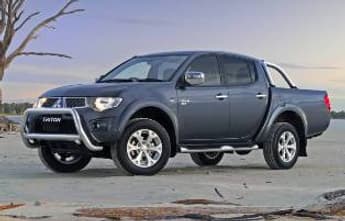
The Mitsubishi Triton 2011 prices range from $5,060 for the basic trim level Single Cab Triton Gl to $17,600 for the top of the range Dual Cab Triton Activ (4x4).
The Mitsubishi Triton 2011 comes in Dual Cab, Extra Cab and Single Cab.
The Mitsubishi Triton 2011 is available in Unleaded Petrol and Diesel. Engine sizes and transmissions vary from the Dual Cab 2.4L 5 SP Manual to the Single Cab 2.5L 5SP Manual 4X4.
Read More
$4,988
$22,950
| 2011 Mitsubishi Triton | Specs | Price |
|---|---|---|
| Gl-R (4X4) | Specs: 2.5L, Diesel, 5 SPEED MANUAL | Price: $12,320 - $16,500 |
| Glx (4X4) | Specs: 2.5L, Diesel, 5 SPEED MANUAL | Price: $12,650 - $16,830 |
A dirty or clogged fuel filter will stop a modern turbo-diesel engine dead in its tracks. In fact, it’s one of the first things a switched-on mechanic will check on vehicles like yours. So if the mechanic has changed the filter and restored to car to full health, then I reckon he or she has probably nailed the cause and fixed it very simply and cheaply for you.
Let’s be honest; there are literally thousands of things that could go wrong that might make your vehicle stop. Modern cars are very complex things, but you need to have faith that sometimes, simple problems occur and can be fixed simply.
Show more
This sounds like a classic case of worn synchromesh rings inside the gearbox. These rings are designed to make smooth, easy shifts between gears but as they wear (or even break) they lose that ability and the gears become difficult to change. It’s also common for this problem to be worse on downshifts compared with upshifts which is why you can shift all the way up to fifth, but have trouble coming back down through the gears.
My money is on third-gear synchromesh being your problem. By shifting from fourth back to second and then third, you’re effectively `borrowing’ the second-gear synchromesh to soften the shift into third.
Unfortunately, the fix is a gearbox rebuild. But before that, it would be worth changing the oil in the gearbox and checking out a gearbox additive that helps with shifting feel and smoothness. If that makes a difference, great, but you may still ultimately be looking at a new or rebuilt transmission.
The other thing to know is whether the gearbox is reluctant to select reverse gear with the engine running. If it is, you might instead be dealing with a worn clutch which is much cheaper to replace.
Show more
The sound of air hissing on a turbocharged engine is often down to a leak in the intake trunking that takes air from the turbocharger, through the intercooler and into the engine. As this air is under pressure (from the turbo) you’re likely to hear it above the rest of the engine noise. If it’s only a small leak, you might not notice the fall-off in performance (or boost as you’ve described it) but it will only get worse as the damaged part of the trunking deteriorates further. Eventually, you’ll start to feel the leak’s effect as it allows more and more air to escape rather than being forced into the engine.
Checking the boost pressure with an accurate gauge will tell you if any boost is going AWOL, as can an electronic scan which might throw up a low-boost fault-code. But if you can hear the noise and have found the leak, replacing that section of plumbing is the logical first step. If that makes the noise go away, you’ve solved the issue.
Sometimes the leak is down to a split in the trunking, other times it can be as simple as a clamp that has been loosened by the constant pressurisation of the system every time the turbo boosts up. But it needs to be fixed as it can throw the air-fuel mixture way off target and lead to internal engine damage. If you can’t find the leak but suspect that there is one, a specialist workshop can perform what’s called an EVAP smoke test where the intake tract is filled with smoke. At the point where the (visible) smoke escapes, there’s your leak.
Show more
* Price is based on Glass's Information Services third party pricing data for the lowest priced Mitsubishi Triton 2011 variant.
The Price excludes costs such as stamp duty, other government charges and options.Disclaimer: Glass's Information Services (GIS) and CarsGuide Autotrader Media Solutions Pty Ltd. (CarsGuide) provide this information based on data from a range of sources including third parties. Whilst all care has been taken to ensure its accuracy and reliability, GIS and CarsGuide do not warrant or represent that the information is accurate, reliable, complete, current or suitable for any particular purpose. You should not use or rely upon this information without conducting an independent assessment and valuation of the vehicle.
To the maximum extent permitted by law, GIS and CarsGuide exclude all liability for any direct, indirect, special or incidental loss, damage, expense or injury resulting from, arising out of, or in connection with your use of or reliance upon this information.