What's the difference?
A number of established small cars are becoming more expensive and less popular. The Toyota Yaris, Mazda2 and Suzuki Swift were once the go-to first car, but now start at around $25,000.
This repositioning was great for MG and its sub-$20,000 MG3, which has spent much of the last few years as Australia's most popular light car. It’s hard to deny a low price will open many wallets.
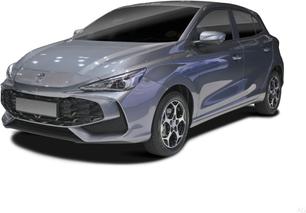
But now in its new generation, the MG3 is thousands of dollars more expensive than before, starting in the mid-$20K range and headed even further up with a new hybrid drivetrain option. We jump in the base petrol Excite to find out if the value is still there for this British-branded, Chinese-built hatchback.
I'm going to reveal something of myself here - I used to be a RenaultSport Clio owner. This is what the purists call what we now know as Clio RS, and I find myself constantly corrected yet unrepentant. It was a 172 - a nuggety three-door with wheels that looked too small, a weird seating position and a 2.0-litre naturally aspirated engine that was big on torque as long as you belted it.
It was a classic and you could still see the links back to the epoch-making Renault Clio Williams, that blue and gold Mk 1 Clio we never saw in Australia that redefined the genre. The current Clio has been around for four years now and I even drove this current RS Clio at its launch in 2013, memorable for the sudden bucketing rain that drenched the circuit and made things very interesting indeed.
This Clio was a big change from the cars that went before - slimmer-hipped, less aggressive-looking and with a 1.6-litre turbo engine, five-door-only body and (gasp!) no manual, just Renault's twin-clutch EDC transmission. It was a hit, at least with enthusiasts. Back then it was the dawn of a golden age in small hot hatches. But that was then, this is now. With a small power bump and a couple of features thrown in, is the ageing RS still at the pointy end?
The MG3 still makes a strong argument for a low-cost, low-fuss option just like the models it now beats on price (Yaris, Mazda2, etc) used to.
While it also falls short in some areas like dynamics when pushed, the improvements to interior tech and comfort mean the MG3 should be considered if you're looking for a city runabout.
However, with the MG3’s price jump, rivals from Japanese and Korean brands are closer in cost than they were for the sub-$20K first-gen MG3, and their ability to handle Australia’s conditions outside the city mean they’ll prove a more useful long-term companion for many.
The MG3 nails its brief as a convincing option for first-car buyers or as a second runabout when there’s another option for long trips. It has taken a big step up from the ‘budget-friendly’ vibe of the original.
The Clio RS is still a ton of fun and in Cup spec, probably the best compromise between price and livability. Despite its advancing years (it turns five this year, so ready to start kindy) and big brother Megane hogging the limelight with a fancy new model on the way, the Clio is a stayer. It's missing some frustratingly obvious things like CarPlay, AEB, rear airbags and rear cross-traffic alert, but it's hardly alone in the segment.
With the departure of the Fiesta ST, though, the Clio returns to the top of the list of best small hot hatches on sale today.
Following the new design language pioneered here by the MG5 sedan and MG4 electric hatch, the MG3 looks like it’s trying for a sportier vibe than its predecessor, and maybe even a hint of European flair.
A grinning front grille and pointed set of headlights are followed around the side by a couple of body creases that give the hatchback a sweeping look, an attempt perhaps to seem longer than it is.
It doesn’t look like any of its rivals, unlike the MG5 which is easily mistaken for a small Mercedes CLA at glance.
Here on our Dover White test car, some angles are unflattering (it's giving 'hire car'), though the model’s available Diamond Red or Brighton Blue are fairly distinctive. Yes, some of the colours reference the brand’s UK heritage, despite being built in China.
Inside, the cabin benefits from a fairly tidy layout, with some genuinely thoughtful attempts at making the otherwise budget-focused model feel a little nice. A cross-hatch design through the dash mirrors, the seat stitching and the steering wheel and its buttons are nicely angular.
The Clio is a handsome small car but nothing out of the ordinary until you apply the very cool Liquid Yellow paint. That hue really is quite something and works even better with the black alloys of the Cup chassis.
The car has some lovely surfacing and in a recent-ish refresh, the slightly odd headlights were reworked, as were the front and rear bumpers which now link to the RenaultSport Megane. Sorry, Megane RS. The RS flag signature lighting is a nice touch, acting as DRLs at the bottom corners of the front bumper.
The lovely organic shapes of the Clio's sides still look good and the rather tough rear end with the chunky diffuser leaves you in no doubt that it's the proper RS not the halfway-house, 1.2-litre GT-Line.
Inside is starting to look its age, but graceful, a bit like Jamie-Lee Curtis' or George Clooney's embrace of grey hair. There are still some of the sharp edges I didn't like. It's certainly a Renault to look at and ergonomically works pretty well. One thing that has been fixed at some point is the switch on the gear selector - it won't bite you if you curl your finger underneath when you press it. You might think that's a small thing, but when you did it, damn it hurt.
That tidy design inside helps when it comes to making use of the space, as well as offering some generous storage spaces.
For starters, while the clean layout means the screen looks like the main point of access for much of the car’s function, there’s an all-important shortcut button for the climate control which means you don't waste time navigating to the vent and temperature controls.
The only issue is that while my phone was connected to the system for Android Auto, I had to navigate away from the mirroring screen back to the MG3’s home screen before being able to shortcut to the climate settings.
Demister and volume control buttons are also present, but the screen itself has an easy-to-navigate menu.
The steering wheel controls are similarly straightforward and clearly labelled, while the driver display is tidy and shows important information clearly.
While the steering wheel isn’t telescopically adjustable, it's easy to find a comfortable seating position thanks to the adjustability of the seats. The material on the seats doesn't feel rough or cheap.
Behind that, there is enough space for my 178cm frame in the second row for the most part, but headroom isn’t incredibly generous.
The rear pew is a single unit, rather than a 60/40 split, so the whole backrest folds down if you need to load anything long through the boot. There’s not even an armrest or little ski hatch for long, thin items.
Its 293-litre boot isn’t small, and there’s a space-saver spare tyre in both petrol variants, but the hybrids are stuck with repair kits.
The Clio's interior is certainly snug. Rear seat passengers do okay for legroom but headroom is a mite marginal with the falling roofline for six footers. There are no cupholders out back, that curious French habit of supplying just a couple of cup receptacles of different and weird sizes persists. The front doors have space for bottles, the rears do not.
The boot is class-competitive at 300 litres (worth knowing the Trophy loses 70 litres to the Cup) and with the seats down stretches to a claimed 1146L.
Even though it’s now more expensive with its $23,990 before on-roads price, it’s hard to deny the petrol-only MG3 Excite is a compelling offering when it comes to inexpensive runabouts.
Not only has the price been bumped up, but so has the apparent interior quality and features list.
A new 13.25-inch multimedia touchscreen is paired with a 7.0-inch driver display and both look pretty slick for the price point and operate well.
Apple CarPlay and Android Auto are both available, but are wired only and can’t be accessed with a Bluetooth connection, while a six-speaker sound system handles entertainment duties.
In terms of seating and material, the Excite gets cloth pews with some contrast stitching.
On the outside, folding mirrors and a set of 16-inch alloy wheels join the new MG3’s design, while this base model Excite is left with halogen headlights like it’s 2015.
The Essence scores a set of LED units and is otherwise distinguishable by its sunroof, though it shares the same wheels as our base car, so it won’t feel like you’re missing out on heaps.
The iconic 'Liquid Yellow' ($750 option) Clio I had for the week was the Cup spec chassis. The Clio RS 200, as it is officially known, comes in two specs - Sport and Cup - and there's a Trophy 220 at the top of the range. I had the Cup, which retails at $32,490 (plus on-road costs). The RS220 Trophy, with a bit more poke and stuff, weighs in at $38,990 if you're interested.
The Cup spec is heavily based on the more affordable ($30,990) Sport, which means you get 18-inch alloy wheels (painted black, so watch those kerbs), climate control, four speaker stereo, keyless entry and start (the "key" is still that unwieldy keycard style thing), reversing camera, cruise control, front and rear parking sensors, fog lamps, LED daytime running lights, sat nav, auto LED headlights, auto wipers, launch control, leather bits and pieces and a tyre inflation kit instead of any kind of spare.
The 7.0-inch 'R-Link' touch screen software runs the four speaker stereo with DAB digital radio, Bluetooth and USB. If you get the optional RS Monitor, there is a full-on telemetry system from which you can save your, er, "track day" data and overlay in Google Maps to compare with your mates' or past efforts. You can also change the piped-in engine sound to various different sound effects which are delightfully silly.
Android Auto is part of the breathtaking $1500 'Entertainment Pack' option that includes RS Monitor (which used to be standard) and no, there's no Apple CarPlay. Leather is a further $1500.
Bottom line is that you do get a decent spec bump from the $30,990 Sport along with the more capable (and less comfortable) Cup chassis.
On paper, the MG3’s 1.5-litre four-cylinder engine is fairly underwhelming with its 81kW (peaking at 6000rpm) and 142Nm (at 4500rpm).
But these figures, including the engine size and even peak RPMs are not far off the likes of the Mazda2, which is a fairly peppy and fun car despite its lack of grunt.
Keen drivers will, however, be disappointed to hear the MG3 drives the front wheels via a continuously variable transmission (CVT) rather than a traditional torque-converter auto, taking much of the pep out of its power unit.
You can expect to hit 100km/h in a bit over 10 seconds.
The 200-equipped RSes pony up 147kW/260Nm, which is pretty much bang-on the obvious competition (Peugeot 208 GTI and the outgoing Fiesta ST), driving the front wheels through Renault's six-speed EDC twin-clutch. Unlike those two, there is no overboost function.
Dieppe's finest sprints from 0-100km/h in a claimed 6.7 seconds, pulling along a kerb weight of 1204kg.
MG claims the MG3 uses just 6.0 litres of 91 RON petrol every 100km on the combined fuel cycle, so with its 45-litre tank you can hypothetically bank on a 750km range.
Of course, that might be achievable in lab conditions, but on test we found the trip computer’s estimates looking closer to 500km on a tank for the kind of urban driving it was undertaking with us.
On a dynamic test drive route, the trip computer settled at a displayed consumption figure of 7.7L/100km, but stop-start driving was not great for efficiency, as you'd expect.
Renault claims 5.9L/100km on the combined cycle but, yeah, nah. My week was admittedly filled with plenty of horseplay and spirited driving, yielding 11.4L/100km. If you were careful you may fare better - but not that much better.
The fuel tank is a fairly standard 45 litres. It requires 98RON premium unleaded.
The higher quality look and feel of the new MG3 carries through to its day-to-day driving. Some of the car’s Chinese compatriots seem to fall down when it comes to the on-road part, which for some is the most important part of a car.
But for a small city car the MG3 is very user friendly, with light and direct steering, good visibility, and just enough power and torque to not feel like everyone’s getting the green light a couple of seconds earlier than you.
It’s comfortable at urban speeds when it comes to the suspension, and doesn't get rattled too much in the front end by tram tracks or other road imperfections.
In narrow streets, three-point turns aren’t a hassle and the car’s size means it’s easy to reverse parallel park, although the reversing camera takes a second to appear when using phone mirroring.
On the highway, however, and when it comes to high-speed cornering, the MG3 can feel a little uneasy.
The road noise becomes more and more obvious. Driving on well-maintained metro freeways at around 80km/h or above produces unpleasant noise, and a during a particularly breezy week the car felt susceptible to swaying in high wind.
Its power delivery starts to feel lacking out of town, too, and taking corners on fast back roads means plenty of slowing down to avoid the front-end sliding or the feeling of the MG3 leaning unsettlingly around corners.
If you’re considering the MG3 but you need to head out of town regularly, take a proper long test drive before opening your wallet.
But if you just need it as an urban runabout, the MG3 does a fine job.
The RS has always had a belter of a chassis. The Cup chassis became a thing just over a decade ago and is lauded by the fans as The One To Have. I've not always been convinced of this as my earlier drives of the Cup-equipped machines have usually been in close proximity to the Sport chassis.
The Cup is slightly lower than the Sport, with 15 per cent stiffer springs and dampers and perhaps more importantly it scores 18-inch wheels with Dunlop Sport Maxx RT2 tyres, which you can reasonably expect to be a bit firmer than the 17s with Goodyear F1s on the Sport. And they are.
However, in most situations, the Cup chassis is perfectly benign. You certainly feel the bumps and lumps, but you haven't bought a Cup chassis for Lexus-like isolation. It's certainly sharper than the Sport chassis and when you're really giving it a go around the bends, the comfort deficit is more than made up for by the extra grip and poise.
The RS has always had a belter of a chassis.
The chassis is aided and abetted by a torquey 1.6-turbo that cheerfully...no, gleefully spins to the redline which could do with another thousand revs, but that's forced induction for you. The aluminium shift paddles need a good positive pull to get a gear, but that gear is delivered quickly and effortlessly. The Clio is a great deal of fun in Sport and Race modes, with throttle mappings and gearshifts becoming more aggressive as you switch through the modes.
The brakes are tremendously effective and the electronic limited slip diff (*cough* brake-based torque vectoring) ensures you'll hit your apexes and the tyres spend more time gripping than spinning.
But it's not all hairpins and off-camber left-right-lefts, is it? Plenty of owners have to live with the car in traffic day to day. Driving the Cup in isolation, I've changed my mind about it. I reckon it's the best of the two chassis settings. The city ride is better than decent, with the hard edges potholes chamfered off by the dampers and decent compliance. It's not too noisy, either.
ANCAP hasn’t tested the MG3 yet, so there’s no crash safety information available. It’s worth noting ANCAP gave the MG5 a zero star score for its lack of active safety equipment, but the MG3 comes with more under its belt than its sedan stablemate.
Six airbags, two front, two side and two curtain, are joined by adaptive cruise control, blind spot detection, rear cross-traffic assist, forward collision warning, lane departure warning, lane keeping assist and speed limit assist.
None of these systems were intrusive on test, though lane-keep assist feels like it could do with some more fine tuning.
On board the Clio is four airbags (no curtain coverage for those in the rear), ABS, stability and traction controls, a reversing camera and two ISOFIX points along with three top-tether anchors.
The Clio was awarded a five-star ANCAP rating in November 2013.
MG has a 10-year/250,000km warranty which is unmatched in the small-car market.
Servicing is scheduled at every 10,000km or 12-month intervals, with the first seven services averaging out at a fairly hefty $360 - the cheapest being $234 and the priciest $536.
Renault says it was the first European maker to offer a five-year/unlimited kilometre warranty in Australia, and who are we to argue? The package also includes up to four years of roadside assist and three years of capped-price servicing.
Renault expects to see you just once a year or every 20,000km, which gives you a bit more headroom than some similar service plans, at least on the mileage. The first three services will cost no more than $369 unless you need a new air filter ($38) or pollen filter ($46). At 60,000km or four years you'll cop $262 for a set of spark plugs. The company's website also suggests if the Clio doesn't like the state of its oil, it will beep at you until you have that attended to.