What's the difference?
The Mercedes-Benz V-Class van isn’t made for ferrying parcels from point to point. No, even though it is based on the Vito courier van, the V-Class is all about human cargo.
And let’s be clear, here: we’re not talking about chucking people in the back and hoping they get to their destination without cracks or breakages. This is a luxury van made to move people in comfort and style, with all the trimmings you’d expect of a vehicle bearing the three-pointed star badge.
So, is it any good? I played hire-car driver to find out.
Ask any opinionated car enthusiast why it is that they hate electric cars, and you’re going to hear the same word revving them up - “noise”.
Sure, EVs might be fast, and even the most old-world-loving petrol head (are we going to have to come up with a new term, soon? Power crazed? Amp-head? Copper top?) will grant you that they can be fun to drive, but the argument is that you just can’t love a car as much if it doesn’t make shouty sounds.
But there is one bunch of well-heeled car lovers who will demur on this topic, and for whom the idea of switching a big, stupidly powerful V12 engine for whispering electric motors seems to be no issue at all - Rolls-Royce fans.
They have, allegedly, been knocking down the doors at Goodwood, demanding that Rolls build them an EV, and finally it has arrived, in the stunning shape of the Spectre, and the orders are pouring in.
We flew to the Napa Valley in California to try it out.
The Mercedes-Benz V-Class, and in particular the Mercedes-Benz V220d, lives up to the notion of a luxury people-mover – for the most part. The leaking door is a concern, but may be confined to this vehicle only.
But in most every other way it has the whole prestige bus thing sorted. There is no denying that a more affordable van from a less, shall we say, desirable brand would do just as good a job.
But if you need to be seen to be offering the most luxurious people-mover you can buy in Australia, then you really ought to be looking at the V-Class…. just maybe go for the V250d, if the budget can stretch that far.
Personally, I was very much taken with the looks, and the feels, of the new Rolls-Royce Spectre, which delivers everything you’d expect from this brand, and seems to have lost nothing by switching to electric propulsion. The trick, it seems, in turning your brand into an EV one is to have made your cars silent in the first place.
But the real verdict comes from the people hurling their Spectre orders at the company, which has received so many of them it’s being forced to ramp up production. And 40 per cent of pre-orders are from new customers. Honestly, it’s as if they were all just waiting for an EV to drop a million on.
This doesn’t look like your everyday Mercedes-Benz commercial van – the V-Class is certainly more at home parked in the driveway of a luxury hotel than alongside the back door in the alley behind it.
Admittedly it isn’t as attractive as the Avantgarde flagship, but it has the whole Benz ‘family look’ thing going on, with a stylish grille, swept headlights and a streamlined body. A box on wheels it may be, but it’s a box with nicely rounded edges.
The 17-inch, five-spoke alloy wheels are plain, and the halogen headlights and daytime running lights don’t have quite the same wow factor as the LED units in the high-end model, but it wears that Benz badge loud and proud. And the extremely dark tinted rear windows ensure the privacy of your occupants, as well as giving off the vibe of high-end plush.
I know it’s hard to stray from the formula for a van, but I particularly like the back end of the V-Class – it is reminiscent of the original Vito, with low, broad-set tail-lights and a near-flat backside with a huge tailgate, which doubles as an awning to stand under if the weather is a bit Melbourne.
The interior is typical Benz, or, in the case of the V220d, Benz on a slight budget.
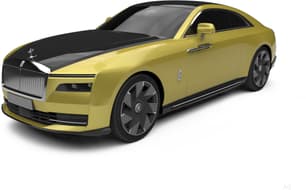
Making a vehicle as enormous as the Spectre look good is no mean feat, but Rolls has done a hell of a job, from most angles. The massive Pantheon Grille is something to behold in the metal, and because it doesn’t need to let air into an engine bay, it’s been designed for airflow, as has so much else. Rolls achieved a drag coefficient of 0.25, which is good for extending EV range, and they even spent more than 800 hours in a wind tunnel working on making the Spirt of Ecstasy hood ornament as aerodynamic as possible (she’s had her wings clipped, apparently).
The modern take on the classic grille combined with a chesty bonnet and very cool DRLs give the Spectre a look of classic modernity from the front, while the proportions over all give it a great side profile.
Apparently the design brief was based on some majestic cliffs, the Seven Sisters of Sussex, and the car definitely has that level of grandiosity.
The only weak point is the rear, which had to be sheer for aero reasons - and features the narrowest legally possible rear lights, which are supposed to look like “islands in a lake”, apparently. To me, driving behind one, the rear view is just a little dull.
The luscious interior is meant to be an example of “Automotive Haute Couture”, meaning hand made and stupidly expensive, and Rolls also humbly refers to it as a “cosseting art lounge”. It all sounds a bit over the top until you sit in it, and discover that it really does feel beyond special.
With the optional eight-seat setup, it’d be hard to think of this van as impractical. And if you consider that it also has a boot capacity of 1030L in its most downsized form (and 4630L with the rear seats removed), any argument seems null and void.
The fact the boot is electrically operated, and that it has a separate tailgate glass opening section, and that you can open the boot using the keyfob – not to mention the kerbside door – just adds to the pragmatic appeal of this van.
The six rear seat backs can all be flattened down, and you can tumble them forward, too – the kerbside seats in a one-by-one motion, the driver’s side ones tumble two-at-a-time. It takes a bit of muscle to do those ones.
Essentially you can set it up as a parcel van if you want, or even as a mobile office – the rear seats can be configured to face each other, in ‘conference’ style. But you need to know that this isn’t an easy process, and once you’ve got it set how you want it, you’ll probably end up just leaving it as is.
Loose-item storage isn’t great, but at least the door pockets are large enough for some bottles and documents.
No matter which way you like it, those in the back will have good ventilation (it has a three-zone climate control system with a separate fan controller in the back above the second-row seats), and a decent amount of space. Crucially, there are no cup or bottle-holders, nor any loose item storage in the back two rows – there are mesh nets on the backrests of the very front seats, but that’s it.
If you plan to use this as a mover of smaller people, the V-Class’s child-seat anchor-point game will not disappoint. It has four ISOFIX anchors (two in each row) and six top tether points – yep, every spot in the back!
Up front there’s a problem with the cup-holder situation, too – there are two, but they’re way down on the floor, meaning it’s hard to access your cuppa on the move. In fact, loose-item storage isn’t great, but at least the door pockets are large enough for some bottles and documents. There’s a sunglass holder, too. The little media screen is a bit disappointing in its size, and the Comand controller codpiece that juts out from the centre console can take some getting used to.
Connecting and reconnecting a phone isn’t too difficult (although you have to pair audio streaming separately to phone streaming – which is weird), and there’s no extended smartphone capability such as Apple CarPlay or Android Auto. Using the navigation system is very simple, but the graphics are extremely aftermarket looking – that’s no bad thing, because Benz’s maps always looked a bit 1990s, but these ones are somewhat cartoonish.
If you’re looking for the modern EV style interior, you can forget it, because Rolls says it didn’t want “any of that funky stuff” in the Spectre, so no giant screens in here. Indeed, I switched into a Rolls-Royce Ghost at one stage to be driven somewhere and the interior was almost exactly the same, although the new car gets a more modern fully digital dash.
There’s plenty of room for water bottles and oddment storage and the sense of space for the driver and front passenger is suitably grand, but the rear seats are really for spoilt teenagers rather than Rolls owners. They’re not uncomfortable, at all, but they just feel a bit squeezed, you wouldn’t ask to be chauffeured in a Spectre, clearly it’s a Rolls you’d choose to drive yourself.
The boot is wide, deep and long with a volume of 380 litres.
There are two V-Class models you can buy; this newly added V220d variant, at $74,990, or the high-spec V250d Avantgarde, which is listed at $87,200.
That’s a pretty huge difference, especially considering you get plenty of equipment in the lower-spec version. To get a better understanding, let’s list off what’s standard, and what you get if you fork out the extra $12,210 for the top model.
The V220d has a 7.0-inch media screen with Garmin maps, dual USB ports, Bluetooth phone and audio streaming, auto headlights and wipers, DAB+ digital radio, CD, auxiliary and SD input, electric parking brake, electric front-seat adjustment with memory settings, cruise control, colour driver information screen with digital speedometer, black leather trim and sports pedals.
There’s three-zone climate control and velour floor mats up front, too, while parking moves are made easy with the brand’s Active Parking Assist system, which can semi-autonomously park the van for you. Other niceties include front and rear parking sensors, a reversing camera, dark tinted rear glass, heated/folding/auto-dimming side mirrors, and electric side doors and tailgate (with opening glass section).
Stepping up to the V250d sees the addition of a 15-speaker Burmester sound system, ambient lighting (three colours), a higher-resolution 8.0-inch media screen with integrated Wi-Fi hotspot and online access and navigation with live traffic updates, a 360-degree surround-view camera, adaptive cruise control, illuminated door sills in stainless steel, a rear parcel shelf, 18-inch alloy wheels, anodised roof rails, a body kit, chrome exterior trimming, LED adaptive headlights with automated high-beam and LED daytime running lights, and tyre-pressure monitoring.
There’s some separation between the two in terms of engines as well – see below for more detail on that.
And for a little bit of context, there are no other luxury-branded people-movers out there. Buyers may consider alternatives like the Volkswagen Multivan Executive at $83,390 (wait, how much?), but in all honesty, if you can forego the badge and just want space for your money, the Kia Carnival Platinum ($61,290) offers a considerably better value equation.
The car we tested had the optional roof rails ($649) and parking system with surround-view camera ($616) fitted, and was an eight-seat model rather than a seven-seater, which adds $1346 to the price.
Australian pricing for the Rolls-Royce Spectre starts from $770,000 before on-road costs, and on the point of whether that represents value, well not to me, but certainly the huge number of orders Rolls claims to have been hit by suggests otherwise.
You do get a lot of car for your money, because the Spectre is vast and weighs almost three tonnes, and there’s no doubt that the interior is nicer than most people’s houses, or even the nicest hotel you’ve ever seen, and that the top-notch umbrellas hidden in each door are a nice touch.
One of the nifty and unexpected features the Spectre offers is a “Rolls-Royce Sound”, which you can toggle on and off. With the fake noise off, the car is freakishly quiet - apparently during testing they achieved a level of EV silence so incredible that people found it “disturbing” and had to engineer some sound back in - but with it on you get just the most subtle of guttural sounds. Every other company so far has gotten fake noise wrong, but Rolls has nailed it with the Spectre; it’s just loud enough, but suitably restrained as well.
You also get the wondrous Starlight Headliner, which uses optic fibre cables to paint the night sky on the roof, complete with shooting stars, and in the Spectre you can now have the stars fitted to the inside of its massive coach doors as well.
Both the V220d and V250d are powered by 2.1-litre turbo diesel engines, but in differing states of tune.
The V220d has 120kW of power and 380Nm of torque, while the V250d pumps out 140kW and 440Nm. Those figures are decent given the capacity of the engine, and to help keep fuel use down it has stop-start, sadly it’s a bit grumbly and overactive.
Both run seven-speed automatic transmissions and are rear-wheel drive. The Benz vans have strong towing capability, with an unbraked towing capacity of 750kg, while it can deal with braked trailers up to 2500kg.
For the first time ever, this Rolls-Royce has no magnificent engine, no throbbing 12 cylinders, no, it has two separately excited synchronous motors, one on each axle for seamless all-wheel drive. The front motor makes 190kW and 365Nm while they’ve sensibly sent more grunt to the rear, which gets 360kW and 710Nm. Either motor on its own would be enough to power a normal car. The total figures are 430kW and 900Nm, which is supercar like.
The battery is made up 804 cells, weighs 700kg and has a net capacity of 102kWh, and the designers used it as a sound-deadening agent for road noise, because it’s so massive.
The Spectre can hit 100km/h in 4.5 seconds, which feels very fast indeed when you’re piloting something that weighs 2890kg and is 5.5m long.
Mercedes-Benz claims that over a mix of urban and highway driving, the V-Class will return 6.3 litres per 100km, no matter whether you choose the V220d or the V250d – which is pretty good given the thing is long (5140mm), wide (1928mm) and relatively heavy (almost two tonnes).
Over a lengthy drive in the V220d – some of it on a twisty mountain road, some in stop-start traffic, most on the freeway – I managed 7.2L/100km. This will rise with added bodies, but not by much.
The Spectre is rated at 520km on the WLTP scale, but Rolls claims it can do a lot better (like 600km). Efficiency is claimed to be 21.5kWh per 100km.
We drove 210km and had 300km of indicated range left at the end, which is pretty close to the claim.
The Spectre can be charged at up to 200kW on a DC fast charger, on which it will take 35 minutes to go from 10 to 80 per cent charge.
On an 11kWh home system it will take 10 hours and 45 minutes to go from zero to 90 per cent charge.
My drive saw me chauffeur my partner and our dog down to Cooma, where we then took my parents down the coast. We put the V-Class’s flexible seating to the test, as we had to buy a massive bathtub and bring it back with us. This proved that, although this thing is a luxury van, it can also be a hugely practical delivery van.
The comfort on offer was perhaps the biggest advantage for my passengers – with superb suspension composure, ride comfort and body control, the V-Class is like a big boxy limousine.
It won’t set your heart racing in corners as there’s quite a lot of body roll to contend with, but the steering is direct and very nicely weighted, making for easy progress whether you’re piloting it down a mountain pass or dealing with roundabouts or parking lots. The turning circle is small, which in turn makes the van feel smaller than it actually is.
The brakes can feel a little numb underfoot, meaning you might find yourself pushing a little harder on the pedal than you think you ought to. The response is good, though, even with weight on board.
The extra, effortless grunt of the V250d would be advantageous.
What was a little surprising was a lack of torque at higher speeds for overtaking moves. On a slightly sloping country back road with four adults on board, I expected there to be well and truly enough for a quick overtaking move – but the drivetrain didn’t quite have the grunt to get the job done. At least, not in the Comfort drive mode.
By using the ‘Dynamic’ drive selector and choosing Sport mode, there was extra push on offer – the gearing changed, and so did the throttle response – and that made overtaking moves a little easier. But still, the extra, effortless grunt of the V250d would be advantageous, and I know I wouldn’t like having to play with the drive-mode switch every time I overtook. Just leave it in Sport mode? You’ll pay the price on fuel use.
Around town the seven-speed auto went about its job really well, offering smooth shifts in all situations. The transmission can clunk when you engage park or shift to reverse, though, which isn’t overly premium, and there is some turbo lag that you’ll have to remember when you prepare to take off from traffic lights. Another thing that didn’t necessarily persuade my passengers of the premiumness on offer was the fact that the kerbside door leaked when it was raining. Not good.
The short answer to this question is that the Spectre drives just like a Rolls-Royce, but that answer is deceptively simple, because, for an electric vehicle, that’s actually a hell of an achievement.
Most EVs do not feel like cars to drive - the electric Hyundai Kona is not much like a petrol one at all - but what Rolls set out to do with its first EV was to make a vehicle that feels, handles and accelerates just like one of its famous and fabulously over-powered combustion-engined Ghosts, Phantoms or Wraiths.
This meant it had to be “Silent”, which it nails with ease - and the important thing to remember here is that even its V12 cars were always incredibly quiet, unless you really misbehaved. And it had to be “Effortless”, another brand pillar. Again, nailed it, because a Roller has never bothered with things like shift paddles, Sports modes or even the option to do anything but stick it in D for Drive and go.
The sensation Rolls owners demand is endless, otiose acceleration, particularly off the line, and the Spectre delivers this in a typical EV fashion, but also one that’s very familiar to anyone who’s driven a Ghost, for example. It’s just a sense of overwhelming, prole-crushing progress, and it’s magnificent.
The third and final brand pillar is “Waftability” and despite all the weight that it’s carrying (imagine how far over three tonnes this thing would have gone if they didn’t build their cars out of aluminium), the Spectre rides with a kind of hovercraft air of being just above, or barely in touch with, the ground. Bumps are no longer your concern, sir.
As mentioned, Rolls could have chosen a limousine-style vehicle as its first EV, but it has made a driver’s car instead - no CEO will sit in the back of a coupe like the Spectre. So it had to deliver when it comes to being fun, or at least a little frisky at times, when driven.
Again, quite incredibly, despite its mass and weight, it does reward enthusiastic driving and can carve up even relatively narrow winding roads with aplomb, displaying very little body roll or pitching. The steering is almost absurdly light - because it must be “effortless” - but there’s still enough feedback to keep you interested.
Most of the time, of course, the essentially laid back aura of being in a Rolls-Royce will seep into your body and brain and you will simply cruise along, patting yourself on the back for being so rich and clever.
And now, with an EV option finally available, you can tell yourself you’re saving the planet as well (as long as you don’t think about the 28 other cars in your garage).
The V-Class has been awarded the highest possible ANCAP crash test score of five stars – it achieved that in 2014, based on a EuroNCAP score that was put through local screening.
It has plenty of safety kit to keep your mind at ease – whether you’re a driver or passenger.
There are six airbags, including full-length curtain coverage, and the V-Class has a reversing camera with dynamic guide lines, an adaptive electronic stability control system (ESP) with load sensitivity and cross-wind assist, rollover mitigation, trailer-sway control (when fitted with a genuine Benz towbar), hill-hold assist, flashing brake lights under emergency braking and driver-drowsiness detection.
There are other handy features, including auto headlights and rain-sensing wipers, auto-dimming interior and exterior mirrors, forward collision warning (not AEB), blind-spot monitoring, lane-keeping assist (but not with steering intervention).
You’ve got spend up to the V250d to get the adaptive cruise control system, but there’s still no AEB on that variant.
The Spectre has not been crash tested for ANCAP. Its safety offerings include adaptive cruise control, lane-change assist, lane departure with active steer, a reversing assistant - "to support with parking and long reverses, eg country lanes or driveways, Spectre will reverse the previous 200m driven" - and collision warning with active braking.
Rolls tell us the Spectre has "Four airbags (does not need more)". So that's good news.
Mercedes-Benz Vans backs the V-Class with a three-year/200,000km warranty plan, which is good.
The company has also introduced a new capped-price servicing plan for the V-Class, with maintenance due every 12 months or 25,000km, whichever occurs first. The fact the distance intervals are so far apart could be a bonus for business operators, but the costs are high: the first service costs $556, then the following two visits will set you back $1112 each time. Yikes.
A longer capped-price plan with lower prices would make this van a lot more attractive to business owners. A Kia Carnival could make a lot of sense in that regard, too – even business operators get a seven-year/150,000km warranty with a seven-year/105,000km capped-price plan, and the same cover for roadside assist.
Now, I would assume you'd get a lifetime warranty at Rolls prices, but apparently you get only four years, but it is unlimited mileage.
The Spectre's battery is covered by a 10-year warranty.
An extended service and warranty package is "TBC".
Rolls also offers 24/7 roadside assistance, and if your battery goes flat the company will take your Spectre to the nearest charging station.
A "regional flying doctor" is on standby 24/7 in extreme cases if Spectre “fails to proceed”.