What's the difference?
The Mercedes-Benz Sprinter has long been a formidable competitor in the Light Duty (3501-8000kg GVM) division of Australia’s highly competitive Heavy Commercial vehicle market.
The popular range offers a choice of panel van, cab-chassis and minibus body styles, four turbo-diesel engine variants (plus an all-electric drivetrain), three wheelbase lengths and for panel vans plus the choice of two roof heights.
An extensive overhaul of the Sprinter range in 2024 brought extra safety technologies, new comfort and convenience features and other benefits, which Mercedes-Benz claims can help drivers work more efficiently. We recently put one of the latest models to the test.
Feels like lately all the Mercedes-AMG buzz has been at the smaller end of the scale.
Most recently, the screaming GLA 45 S has arrived in Australia, pumping out more kilowatts and newton-metres than any compact SUV has a right to.
But here, we're doubling the cylinder count to eight, arranging them in a vee, and lighting the wick on AMG's powerhouse mid-size sedan, the recently upgraded E 63 S.
While the ferocious twin-turbo V8 and the rest of this beast's powertrain are unchanged, the car has been brought up to speed with some aero-focused styling tweaks, Merc's latest 'Widescreen' digital cockpit, as well as the MBUX multimedia system, and a tricky new multi-function sports steering wheel.
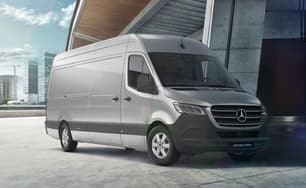
Given the original Sprinter was released in 1995, it’s not surprising the current third-generation model feels like it’s benefitted greatly from decades of continuous refinement. Although the list price difference between our test vehicle and its closest Chinese rival is substantial, the 417 MWB Panel Van is hard to fault in terms of driver comfort, safety and all-round competence. It really is very good.
The E 63 S fills its niche in AMG's Australian line-up perfectly. More mature than the brand's four-cylinder hatches and SUVs, but not as overbearing as some of its bigger sedan, GT and SUV stablemates. And its ability to seamlessly switch between serene comfort and dynamic performance has nailed the objective for this 2021 update.
The 417 MWB Panel Van rides on a 3665mm wheelbase (the shortest of three Sprinter wheelbases) and is almost 6.0 metres long (5932mm), more than 2.0 metres wide (2020mm) and stands almost 2.4 metres tall (2378mm). Its 12.4 metres kerb-to-kerb turning circle is impressively tight for a vehicle of this length.
It rides on simple and rugged MacPherson strut front suspension, with a robust live axle/leaf-spring arrangement under the tail. Steering is via rack and pinion and it has disc brakes all around.
Look beyond the optional silver metallic paint on our example and there’s extensive use of unpainted dark grey plastic on all the external surfaces where hard-working vans are most prone to wear and tear, including the hubcaps, front/rear bumpers, grille, door-handles/mirror shells and along the sides.
Its work-focused exterior styling is nicely integrated, combined with an equally neat and functional interior design that offers a visually-pleasing combination of patterned fabric seat-facings and hard surfaces that blend different shades of grey with splashes of satin chrome and piano black.
We also like the feel and response of mechanical switches (rather than touchscreen prompts) for adjusting settings like cabin temperature, fan speed and media volume.
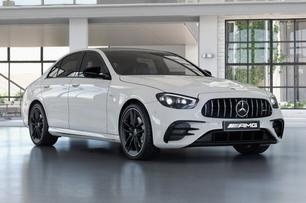
The E 63 S has been massaged for 2021 starting with flatter headlights, AMG's now signature 'Panamericana' grille, and a high gloss black flap across the top of the curved 'Jet Wing' section defining the lower part of the nose.
At the same time, the vents on either end of it are larger and feature twin transverse louvers to guide cooling air to wherever it's needed.
It's all about what AMG calls 'optimised aerobalance' but the form is just as appealing as the function. The characteristic 'Power Domes' in the bonnet dial up the muscle, as do the fat wheel arches (+27mm each side), and 20-inch rims with distinctive aero inserts.
This car's optional exterior carbon package consists of a front splitter, side sills, a flash near the fender badges, the exterior mirror covers, the boot lid lip spoiler, as well as the lower apron around the redesigned diffuser and quad tailpipes.
New, intricately styled LED tail-lights are also flatter, but there's even more going on inside.
A new AMG sports steering wheel features three rounded twin-spokes with new switches on the bottom to control the car's dynamic set-up.
It also picks up a new take on the small touch-sensitive controllers used to adjust the instrumentation and manage other functions like phone calls, audio and the cruise control.
Not sure I'm in love with them at this stage. In fact, the words fiddly, imprecise, and frustrating come to mind.
Nappa leather covering the superb AMG sports seats, upper dash, and door beltlines remains standard, but the show-stopper is the 'Widescreen Cockpit' - twin 12.25-inch digital screens for the MBUX multimedia interface on the left and instruments on the right.
The instrument cluster can be set to 'Modern Classic', 'Sport' and 'Supersport' displays, with specific AMG read-outs such as engine data, gear speed indicator, warm-up status, car set-up, as well as a G-meter and 'RaceTimer.'
To borrow an official automotive design term, it looks schmick. Overall, with touches like open-pore black ash wood trim, and brushed metal highlights, the interior looks efficient but classy, with an obvious attention to detail in the layout and its execution.
With its 2215kg kerb weight and 4100kg GVM, our test vehicle has a sizeable 1885kg payload rating.
It’s also rated to tow up to 2000kg of braked trailer and with its 6100kg GCM (or how it can legally carry and tow at the same time), that means it can tow its maximum trailer weight while hauling its maximum payload to ensure optimum versatility.
The cargo bay, which offers a cave-like 9.0 cubic metres of load volume and internal lighting front and rear, has internal dimensions of 3316mm length (with bulkhead), 1732mm width and 1719mm height.
So, with 1350mm between the rear wheel-housings, it can comfortably fit two standard 1165mm-square Aussie pallets or up to four 1200 x 800mm Euro pallets, held in place by a choice of 10 floor-mounted load-anchorage points.
The cargo bay is accessed through a single kerbside sliding door with a wide 1260mm opening, or symmetrical rear barn-doors with large handles on each pillar to assist operator access.
The barn-doors also have internal storage bins and open to a full 180-degrees to assist forklift and loading dock access. Thoughtfully, their hinge design also holds the doors firmly open at 180 degrees, to minimise the chance of wind gusts slamming them shut with potential injury to the operator.
There’s also plenty of cabin storage starting with two tiers of bins in each door, with the highest being spacious enough to hold large bottles.
There's also a deep shelf on the passenger side lower dash, a large lidded compartment in the central dash-pad and overhead shelves with lockable storage on the passenger side. Plus, the dash offers a total of eight cup/small-bottle holders.
The base cushion of the two-passenger bench seat is also hinged at the front, which allows it to tilt forward and provide access to a large hidden storage area beneath.
A crew of three can travel in relative comfort (for a commercial van that is) thanks to a central seating position that provides a sturdy hoop-handle for support, sufficient knee clearance from the dash even for tall people, and a reasonably flat and spacious floor area.
The cabin also features the latest next-gen 'MBUX' multimedia system with 10.25-inch touchscreen, which for the first time offers wireless connectivity for Apple CarPlay and Android Auto.
There’s also digital radio and enhanced functionality including an optional navigation upgrade with seven years of map updates.
At just under 5.0m end-to-end the E-Class sits in the upper range of the mid-size luxury spectrum. And almost 3.0m of that is accounted for by the distance between the axles, so there's plenty of space inside.
The driver and front passenger are provided with heaps of room to breathe, and there's a surprising amount of space for those in the back as well.
Sitting behind the driver's seat set for my 183cm (6'0”) position I had more than adequate head and legroom. But access to and from the back is a struggle for full-size adults.
The rear doors open out a long way, but the limiting factor is the size of the aperture, necessitating excessive contortion of the head and limbs to fold in and out of the car.
Connectivity runs to two (power-only) USB-C sockets in the front centre storage bin, as well as another USB-C (for power and multimedia) and 12-volt power outlet in the centre console.
Speaking of the front centre storage bin, it's a decent size and has a padded split lid so it can double as an armrest. There are two cupholders in the front console, a generous glove box, as well as long door compartments with recesses for large bottles provided.
There's a pair of USB-Cs along with another 12-volt socket in the back, sitting under the climate control panel with adjustable vents in the rear of the front centre console. Nice.
The fold down centre armrest incorporates a lidded (and lined) storage box as well as two pop-out cupholders. Again, there are bins in the doors with room for smaller bottles.
The boot offers 540 litres (VDA) of volume, and is able to swallow our three-piece hard suitcase set (124L, 95L, 36L) with room to spare, or the substantial CarsGuide pram, or the largest suitcase and pram combined! There are tie-down hooks to help secure loads, too.
Don't bother looking for a spare of any description, a repair/inflator kit is your only option. And the E 63 S is a no-tow zone.
Our test vehicle is the 417CDI MWB (Medium Wheelbase) Panel Van with standard roof height, which comes equipped with a 2.0-litre, four-cylinder, turbo-diesel engine and nine-speed automatic transmission for a list price of $86,018.
Our example is fitted with a couple of factory options, including the 'Cargo Pack' ($2265) which comprises a two-passenger bench seat, solid cabin bulkhead with fixed window and side-entrance assist handle, wooden cargo bay load floor and floor-to-roof wall-trim using 5.0mm-thick wood panelling.
It also has optional 'High-Tech Silver' metallic paint ($2534) which combined with the Cargo Pack raises the total price to $90,817.
In addition to the latest model’s upgraded safety (see Safety) and comfort/convenience (see Design) features, our test vehicle comes standard with 16-inch steel wheels and 235/65 R16C tyres plus a full-size spare, keyless start, steering wheel paddles for manual shifting, multi-function leather steering wheel, three USB-C ports and two 12-volt sockets, side marker lights and heated exterior mirrors.
There’s also daytime running lights, a parking package with reversing camera and front/rear parking sensors, traffic sign assist, tyre pressure monitoring and lots more.
So, first of all, let's get the price out of the way. At $253,900, before on-road costs, this car's competitive set is a bruising, all-German trio comprising the Audi RS 7 Sportback ($224,000), BMW M5 Competition ($244,900), and Porsche Panamera GTS ($309,500).
And no surprise, it's loaded with all the luxury features you'd expect in this part of the market. Here are the highlights.
On top of the standard performance tech and safety equipment fitted to the E 63 S (covered later in this review), you'll also find: Nappa leather trim (seats, upper dash, upper door cards, and steering wheel), MBUX multimedia (with touchscreen, touchpad, and 'Hey Mercedes' voice control), 20-inch alloys, three-zone climate-control, interior ambient lighting, auto LED headlights (with 'Active High Beam Assist Plus'), eight “energising comfort programs” (with 'Energising Coach'), an 'Active Multicontour' front seat package, the 'Air Balance' package (including ionisation), and keyless entry and start.
Also included are the the 'Widescreen' digital cockpit (twin 12.25-inch digital screens), 13-speaker Burmester audio with digital radio, Apple CarPlay and Android Auto, a panoramic sunroof, adaptive cruise control, a head-up display, augmented reality satellite navigation, 'Parktronic' self-parking, electric front seats, seat cooling and heating front (heated rear), heated front centre armrest, a power-adjustable steering column, auto rain-sensing wipers, a wireless device charger, illuminated door sills, as well Amazon Alexa, etc, etc, etc.
And our test car also featured a couple of tasty options. An exterior carbon package ($7500), and AMG's professional grade ceramic composite brakes ($15,900), for an as-tested price of $277,300.
The (OM654) 2.0-litre, four-cylinder, turbo-diesel, which meets Euro 6 emissions standards using AdBlue, produces 125kW of power at 3800rpm with peak torque of 400Nm served between 1700-2400rpm. The nine-speed torque converter automatic offers the choice of sequential manual-shifting using the steering wheel-mounted paddles.
The E 63 S is powered by the M178 version of the all-alloy 4.0-litre twin-turbo V8 engine used across numerous AMG models from the C-Class up.
Thanks in no small part to direct injection and a pair of twin-scroll turbos (located in the engine's 'hot vee' to optimise throttle response), this all-alloy unit produces 450kW (that's 612hp) from 5750-6500rpm, and 850Nm from 2500-4500rpm.
And as per standard AMG practice for its Vee engines, this car's powerplant was built from scratch by a single engineer in Affalterbach. Thank you Robin Jäger.
AMG calls the nine-speed transmission used in the E 63 S an MCT, which stands for Multi-Clutch Technology. But it's not a dual-clutch, rather a normal auto transmission using a wet clutch as opposed to a conventional torque converter, to connect it to the engine on take-off.
Drive goes to all four wheels via Merc's '4Matic+' AWD system, built around an electromechanically controlled clutch connecting the permanently driven rear axle (with locking diff) variably to the front axle.
The dash display was claiming average combined consumption of 9.5L/100km when we stopped to refuel at the completion of our 281km test, of which about one third of that distance was hauling a heavy payload (see Driving).
Our own figure of 11.7 (based on actual fuel bowser and tripmeter figures) was higher but still reasonable economy for a vehicle in this GVM class in mostly urban use.
So, based on our own figures, you could expect a ‘real world’ driving range of around 800km from its 93-litre tank, which has been enlarged from 71 litres as part of the latest upgrades.
Claimed fuel economy for the combined (ADR 81/02 - urban, extra-urban) cycle is 12.3L/100km, the E 63 S emitting 280g/km of CO2 in the process.
That's a pretty hefty number, but in line with this car's proportions and performance potential.
And Merc-AMG has gone to great lengths to minimise fuel use. As well as the standard 'Eco' stop-start function, in the 'Comfort' drive program cylinder deactivation becomes active, the system able to drop four cylinders anywhere between 1000 to 3250rpm.
There's no physical hint of half the cylinders leaving the party. The only clue is a blue icon on the dash indicating a temporary shift to V4 operation.
Despite all that effort, however, we saw a dash-indicated 17.9L/100km over a mix of urban trundling, highway cruising, and some spirited dynamic assessment.
Recommended fuel is 98 RON premium unleaded (although it'll run on 95 at a pinch), and you'll need 80 litres of it to fill the tank. That capacity translates to a range of 650km according to the factory claim, and 447km using our real world result.
Large handles on the doors and overhead shelves assist climbing aboard and there’s enough adjustment in the well-bolstered seat and leather-rimmed steering wheel to find a comfortable position.
Driver views from all angles are excellent thanks to well-designed mirrors along with cameras supported by active aids like blind-spot monitoring etc.
The cabin, with its high roof relative to seat height, has a spacious and airy feel and all controls are reasonably intuitive and easy to reach.
Unladen ride quality is surprisingly supple for a vehicle with a 6.0-tonne-plus GCM rating, combined with excellent steering feel that strikes a fine balance between minimal turning effort at low speeds (for loading etc) and firm handling response at higher speeds.
The drivetrain is also energetic, pulling strongly and cleanly from 1000rpm even though its maximum torque is tapped higher in the 1700-2400rpm zone. The automatic transmission has admirable refinement, with near-seamless shifting between its nine ratios.
The Sprinter is also impressively quiet at speeds up to 80km/h. Tyre and wind noise (the latter mainly around the large door mirrors) naturally increase at highway speeds, but remain far from intrusive. And with the engine requiring less than 2000rpm to maintain 110km/h, it’s well-suited to highway work.
To test its load-carrying ability, we forklifted 1.3 tonnes into the cargo bay which with driver equalled a payload of 1.4 tonnes. That's still almost half a tonne less than its limit.
Not surprisingly, it handled this load with ease, as handling and braking were largely unaffected and the ride quality became smoother thanks to such a big increase in sprung weight. Even so, the rear springs only compressed about 30mm.
It easily conquered our 13 per cent gradient, 2.0km-long set climb at 60km/h with this load onboard, as the auto downshifted to fourth gear to tap maximum torque when hauling this load to the summit.
Engine-braking on the way down, in a manually-selected second gear, wasn’t as robust but not unexpected given a 2.0-litre engine trying to restrain 1.4 tonnes of payload on a steep descent. Even so, the quartet of disc brakes efficiently kept speeds in check.
Overall, it was an impressive performance. However, we did note that the speed sign recognition function was not working for the duration of our test. And some welcome enhancements would be a driver’s left footrest and a fold-down inboard armrest for the driver’s seat, as fitted to its smaller Vito sibling.
AMG's major goal with this upgrade of the E 63 S was to maintain its dynamic response and ferocious performance, but dial in the extra comfort customers had said they wanted.
So, the 4Matic+ AWD system has been fine-tuned for more smoothness as has the Comfort option in the dynamic set-up. But we'll investigate that shortly.
First, that 4.0-litre turbo V8 in the nose is claimed to slingshot this roughly 2.0-tonne sedan from 0-100km/h in just 3.4 seconds, and it feels every bit that fast.
With 850Nm available from 2500-4500rpm and nine gear ratios to help keep you operating in that Goldilocks band, mid-range thrust is monumental. And thanks to the bi-modal sports exhaust it sounds beautifully brutal.
The nine-speed auto's wet clutch, as opposed to a conventional torque converter, is designed to save weight and optimise response. And while some will tell you an auto with one input shaft is never going to be as fast as a dual-clutch with two, shifts are rapid and direct. The wheel-mounted shift paddles are larger and set lower, as well.
The AMG 'Ride Control+' suspension with multi-chamber air suspension and adaptive damping is amazingly good. The underlying set-up is by multi-links front and rear, and despite riding on big 20-inch rims wrapped with low-profile, high-performance Pirelli P Zero rubber (265/35 fr - 295/30 rr) the Comfort setting is incredibly... comfortable.
Slip into 'Sport' or 'Sport+' and the car immediately feels tauter but far less compliant and forgiving. An impression reinforced by the engine, transmission, and steering shifting to a more buttoned-down mode at the same time.
The standard dynamic engine mounts play a big part here. Able to make a soft connection for maximum comfort, but switch to a rigid link when required.
But no matter which mode you're in, the car is well damped and feels beautifully balanced in quick cornering. And the E 63 S's electro-mechanically-assisted variable-rate steering is progressive, feelsome, and accurate.
The 4Matic+ AWD system is built around an electromechanically controlled clutch connecting the permanently driven rear axle (with locking diff) variably to the front axle.
Torque distribution happens imperceptibly, the big V8 putting its power down emphatically, with various electronic systems tieing up the loose ends as you aim up for the next corner.
There's even a 100 per cent RWD Drift mode available in the Race setting, but without a race circuit at our disposal this time around that'll have to wait for another time.
The optional ceramic brakes feature huge rotors and six-piston front calipers, and stopping power is immense. And the good news is they operate quickly but progressively at normal pottering around town speeds. No warming up required to get them in an optimal temperature zone (as can be the case with other ceramic set-ups).
ANCAP ratings do not apply to Heavy Commercial vehicles. Even so, in addition to the Sprinter’s existing long menu of passive and active safety features, the latest range adds significant enhancements as standard equipment including thorax-protecting airbags for driver and passenger, lane-keeping assist, traffic sign assist, rain-sensing wipers, tyre pressure monitoring and a parking package with reversing camera and front/rear sensors.
Also new is ‘Moving Off Information Assist’ which utilises a camera mounted in the grille plus six ultrasonic sensors to monitor an area 3.7 metres in front of the steered direction of the vehicle and 0.5 metres to the side.
This automatically activates at start-up and remains active up to 10km/h. So, if a road user is detected in the monitored area, the driver is alerted by audible and visual signals.
The latest range also introduces ‘Sideguard Assist’ which provides extended detection in the blind-spot on the passenger side. It activates when the vehicle is stationary and at low speeds, providing an extra set of eyes during parking, low-speed manoeuvring and traffic congestion.
The three-pointed star's white-coated boffins have gone to town on the E 63 S, and the car is as good as it currently gets in terms of active and passive safety technology.
You could argue this car's dynamic ability is its strongest contributor to crash-avoidance. But a broad suite of features, specifically designed to keep you out of trouble includes, forward and reverse AEB (with pedestrian, cyclist, and cross-traffic detection), traffic sign recognition, 'Attention Assist', 'Active Blind Spot Assist', 'Active Distance Assist', 'Active High Beam Assist Plus', 'Active Lane Change Assist', 'Active Lane Keeping Assist', and 'Evasive Steering Assist.' That's a lot of assists.
There's also a tyre pressure monitoring and pressure loss warning system, as well as a brake priming function (monitors release speed on the accelerator pedal, moving pads factionally closer to the discs when required), and brake drying (when the windscreen wipers are active the system periodically applies just enough brake pressure to wipe water off the brake rotors to optimise wet weather efficiency).
But if an impact is unavoidable the 'Pre-Safe Plus' system is able to recognise an imminent rear-end collision and fire up the rear hazard lights (at high frequency) to warn following traffic. It will also firmly apply the brakes once the vehicle is stationary to minimise the risk of whiplash injuries if the car's then hit from behind.
If the potential crash is coming from the side, 'Pre-Safe Impulse' inflates air chambers in the side bolsters of the front seat backrest (within a fraction of a second) moving the occupant to the side towards the centre of the car, away from the impact area. Amazing.
As well as that, there's an active bonnet to minimise pedestrian injuries, an auto emergency call function, 'Crash Response Emergency Lighting', even a first aid kit and hi-vis vests for all occupants.
For the record, the current E-Class received a maximum five-star ANCAP assessment in 2016.
Warranty is five years/250,000km whichever occurs first and includes a roadside assist support package.
Scheduled servicing is every 12 months/40,000km. Pay-as-you-go capped-pricing for the first five scheduled services totals $5905, or a pricey average of $1181 per year. Service plans are also available.
All AMG models sold in Australia are covered by Mercedes-Benz's five year/unlimited km warranty, with 24-hour roadside and accident assistance included for the duration.
Recommended service interval is 12 months or 20,000km, with pricing for a three-year (pre-paid) plan set at $4300, a $950 saving overall relative to its three year, pay-as-you-go 'Service Solutions' capped price program.
And if you're happy to fork over a little more up-front, there's a four-year service deal at $6300, and five years coming in at $7050.