What's the difference?
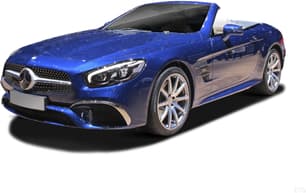
Peter Anderson road tests and reviews the 2016 Mercedes-AMG SL63 with specs, fuel consumption and verdict.
Well. They don't make cars like this anymore, do they? Time was, a big coupe or convertible were de rigeur for the well-heeled banker, with 12 cylinders almost a given and fuel consumption measured in super tankers, or more likely just not talked about at all.
The world has changed but Mercedes’ SL hasn't. That's not strictly true, of course. The SL63 may drop four of the SL65's 12 cylinders, but at just half a litre smaller and still with twin-turbos it generates the enormous thrust a luxo-barge like this needs. The things that made it an icon are indeed still there - lots of tech, a style all its own and a name everyone recognises.
The Renault Megane RS is still here, in case you were wondering.
You may have let it slip your mind in recent times, because there’s been a lot of action in the hot hatch scene with the release of the new-generation Ford Focus ST, a fond farewell to the VW Golf R, and consistent talk of the upcoming Toyota Corolla GR hot hatch.
The Megane RS is more than just ‘here’, though. The RenaultSport Megane hatch range has expanded in recent times, and we’ve just spent some time with the Trophy model which first arrived in Australia late in 2019.
It is certainly keeping its presence known in 2020 Renault Megane RS Trophy spec, which represents the most powerful and fastest version of the standard model range before you get to the rip-snorting (and eye-wateringly expensive) Trophy R.
So what’s it like? Read on and you’ll find out all about it.
The SL's overall score is somewhat skewed by everyday concerns, and rules are rules - an average punter will find the price of this car somewhat confusing and the devil-may-care attitude to fuel consumption bewildering.
If neither of these things are a problem, then the SL63 makes plenty of - well, not sense, because it's not a particularly clever or considered car - but it fills a niche that not so long ago we all thought would go the way of the dodo.
The fact it sells so few examples is betrayed by some of the cabin amenities and the fact that Mercedes hasn't put much effort into reducing the car's weight to improve its consumption or sharpen up the handling.
The fact it still exists at all is pretty damn cool, though, and for certain people an SL63 purchase is the culmination of a lot of hard work.
If it is your dream car, the SL63 won't disappoint. Everyone who rode with me said it was mightily impressive, but you've got to really want it. When you're not far off buying a Ferrari California T or Aston Martin V12 Vantage S for the money, you'll need a real yearning for the three-pointed star to go this way. And if you do, good luck to you - you've probably worked quite hard to get here.
If the Renault Megane RS Trophy is your dream car let me say this: there’s no overarching reason that I’d say you shouldn’t go ahead and buy it.
But with so much amazing competition in this part of the market, it’s hard to put it ahead of its rivals. And it’s going to be even harder for it to stay high on the contenders list as more new metal arrives in the coming years.
The SL has always been completely unapologetic about its size and seems to be designed to accentuate rather than hide its length and width. The long bonnet screams power and prestige, and get out of my way, and is reminiscent of the little-loved McLaren SLR project of some years ago.
The size of the Mercedes logo on the huge front grille leaves you in little doubt about the brand of car that’s about to pass you at speed and some might say (okay, I would) that its large surface area is a little vulgar.
Like the SLR, the design doesn't seem to have a particularly cohesive strategy, with a number of Mercedes elements from around the traps that climb over each other. Roof up it looks awkward because of the gigantic posterior while with the roof down it looks overly long and, again, tail-heavy.
Folding hardtops are notoriously cumbersome and need a lot of room to hide them, but the silent operation is something to behold.
Elements that are worth deleting if possible are the dodgy 'Biturbo' badges. It's that kind of bling that gets people raising their little finger at you.
The Megane RS Trophy’s dimensions don’t really communicate just how chunky it really is. At 4364mm long on a 2670mm wheelbase, 1875mm wide and 1435mm tall, it is pretty conventional in terms of size for the segment.
But it packs a lot of style into that size. I for one love those broad hipped wheel-arches, the signature LED headlights and chequered flag lighting signature at the bottom of the bumper, and the bright, eye-catching colours available really just ram the message home that this isn’t your average Megane.
I could happily leave behind the red flecks on the wheels, which look a bit too blingy and not quite ‘lightweight racing-spec’ to me. But they obviously appeal to a certain buyer - maybe someone who wants a bit more drive-by flair, as opposed to track-day talking points.
The Trophy model builds upon the Cup variant, using the same chassis and hardware under the skin, and therefore running the brand’s 4Control four-wheel steering and a mechanical Torsen limited slip diff. More on that in the driving section below.
Exterior design and styling are one thing - but you probably spend more time sitting inside your car than just admiring it from a distance. How does the interior of the RS Trophy stack up? Check out the interior images to make up your own mind.
“Practicality” is about as relevant to this car as a code of ethics is to a drug dealer or a contract killer, because the SL63 buyer is hardly worried about cupholders and boot space. For what it's worth, there are four cupholders in the two-seater cabin (which might explain why owners aren't worried about their liquid carrying prospects) and a minimum boot space of 364 litres and a maximum - with roof up - of 504, which is actually not bad.
Cleverly, there's a little robot-operated luggage cover inside the deep boot that stops your gear from being crushed when the roof goes down.
There's also space in the long doors where you might secrete a bottle of wine that would get a NSW Premier fired if he thanks you for it, and a bin in the console to hide your phone.
The Megane RS Trophy’s cabin carries over some of the design cues from the exterior. It looks and feels like a hot hatch should.
There’s a lovely part-Nappa leather, part-Alcantara steering wheel with paddle shifters and a ‘centre line’ marker - but some may lament the lack of a flat-bottom to the wheel, which is a current trend in the “trust me I’m actually very sporty” breed of cars.
The manually adjustable seats are very supportive though they are a bit firm, so those wishing for ultimate comfort over long distance trips might be left wanting. But there is good adjustment to the seats, and they’re heated, too.
There are some nice elements to the cabin including soft plastics on the dashboard, but the lower plastics - below the eye-line - are quite hard and not very pleasant. However, the inclusion of ambient lighting does distract from that, and add a bit of flair to the cabin.
The portrait-style media screen is fine most of the time, though it does take some learning. The menus aren’t as intuitive as you might hope, with a mix of on-screen buttons and off-screen touchpad-style controls that can be difficult to hit when you’re driving. We also had a couple of instances of glitching while using Apple CarPlay and Android Auto smartphone mirroring.
Storage is okay. There are shallow cupholders between the seats, a covered centre console bin, as well as a storage section in front of the gear selector that’s big enough for a wallet and phone, and bottle holders in the doors.
In the rear seat there’s enough space for someone my size (182cm) to sit behind their own driving position, albeit with limited knee room and toe room. Headroom is good, and there are dual ISOFIX child-seat anchor points and three top-tethers for baby seats.
You’ll find a pair of small door pockets, two map pockets, and rear-seat directional air vents, which is nice. There’s a flip-down arm-rest with cupholders, too, and unlike some other high-price hatches with ambient lighting up front, the Megane gets LED light strips on its rear doors, too.
The boot space is good in the Megane RS Trophy, with luggage capacity claimed at a healthy 434 litres. On test, the car fit all three CarsGuide suitcases (124L, 95L and 36L) with room to spare. Speaking of spare (ahem), there isn’t one: it comes with a repair kit and tyre pressure monitoring, but no spare wheel of any kind.
It’s difficult to ponder the idea of value when a car is already approaching $400,000 at a rapid rate even before you start piling on the options. On the plus side, for a list price of $368,715 you do get an extremely long list of standard equipment.
The SL has always been completely unapologetic about its size.
Edited highlights include leather on almost every available surface, heated and cooled electric seats with a fan heater for your neck, a B&O stereo that will shatter the windscreen on request, aluminium trim that's real aluminium (mostly), Active Ride suspension, sat nav, dual-zone climate control, active cruise, LED headlights and a huge swag of safety gear.
The 12-speaker stereo also has DVD, limited smartphone integration via Mercedes' COMAND system, a seven-inch screen and, of course, Bluetooth.
The Renault Megane RS Trophy has a list price of $52,990 for the six-speed manual, or $55,900 for the six-speed dual-clutch auto model, as tested here. Those costs are RRP/MSRP, and don't include on-roads.
Standard equipment for this range-topping ‘regular’ RS model includes 19-inch ‘Jerez’ alloy wheels with Bridgestone Potenza S001 tyres, an active valve exhaust system, Brembo brakes, LED headlights with LED daytime running lights, rear fog lights, front/rear/side parking sensors, semi-autonomous parking system, reversing camera, auto locking, smart key card and push-button start, and steering column-mounted paddle shifters.
There’s also auto headlights, auto wipers, dual zone climate control, an auto dimming rearview mirror, heated front seats with manual adjustment, a nine-speaker Bose sound system with subwoofer and amplifier, an 8.7-inch touchscreen media system with aux port, 2x USB ports, Bluetooth phone and audio, Apple CarPlay and Android Auto, sat nav, the brand’s RS Monitor track timing software, and a 7.0-inch TFT colour screen for the driver with configurable modes and digital speedo.
You can find a run down of the safety tech and equipment fitted in the safety section below.
Options available include an electric sunroof ($1990), and there is also the choice of a few metallic paint colours: Diamond Black and Pearl White metallic are both $800, while the Signature Metallic Paint colours - Liquid Yellow and Orange Tonic as you see here - are $1000. Only Glacier White will cost you no extra.
Wondering where it sits among its closest rivals? If you’re thinking about a Ford Focus ST (from $44,690 - manual or auto), Hyundai i30 N (from $41,400 - manual only), the outgoing VW Golf GTI (from $46,690 - auto only), or the mighty Honda Civic Type R (from $51,990 - manual only) the Megane RS Trophy is expensive. Only the VW Golf R Final Edition ($57,990 - auto only) is dearer… unless you’re thinking of comparing to the likes of a Mercedes-AMG A35 ($69,300).
The SL63 is powered by Mercedes’ increasingly famous V8, with two turbos along for the ride to add oomph and cut the car's famous consumption, at least slightly. The 5.5-litre unit produces a massive 430kW and a scarcely believable 900Nm of torque.
All of that heads rearward via a seven-speed dual-clutch transmission that helps sling the 4.6m, 1848kg machine to 100km/h in 4.1 seconds.
Engine specs matter if you’re talking about performance hatchbacks, and the Megane RS Trophy is no exception.
It has a 1.8-litre four-cylinder turbo-petrol engine that punches hard for its size, with 221kW of power (at 6000rpm) and 420Nm of torque (at 3200rpm). That’s for the six-speed dual-clutch automatic transmission, as was fitted to our test car. If you buy the six-speed manual, you miss out on a bit of grunt - it has 400Nm (at 3200rpm) and the same peak power.
In auto spec the RS Trophy “300” offers higher figure vs the Sport and Cup “280” models (205kW/390Nm), and more engine performance per litre of capacity than the Focus ST (2.3-litre: 206kW/420Nm), Golf GTI (2.0-litre: 180kW/370Nm; TCR 2.0-litre: 213kW/400Nm), and even the Golf R (2.0-litre: 213kW/380Nm).
All Megane RS models are front-wheel drive (FWD/2WD) and no Megane RS is all-wheel drive (AWD). The Trophy and Cup models both get 4Control four-wheel steering, which is an interesting aspect of the drive experience. More on that below.
There are multiple drive modes to choose from, including Comfort, Neutral, Sport, Race and the configurable Perso mode. These can alter engine, transmission, throttle, traction control, exhaust noise, fake engine sound and steering sharpness - but not suspension, because the dampers aren’t adaptive units.
Much as is the case with the price, there's no real way to soften the blow here - the SL63 drinks like a footballer on Mad Monday, except it does it every day. The official combined cycle figure of 10.2L/100km is quite easy to double, as we did, averaging 21L/100km in mostly flowing suburban traffic. In the car’s defence, the accelerator pedal spent a good deal of time near the firewall.
The SL does have stop-start to help reduce its considerable environmental impact.
The claimed official combined fuel consumption for the Megane RS Trophy is 8.0 litres per 100 kilometres. That’s for the EDC auto model as tested. The manual is said to use 8.3L/100km.
You might achieve that if you drive gently, though over my testing - which incorporated hundreds of kilometres of highway and country road driving, as well as a few spirited stints and some urban snarls - I saw a return of 10.8L/100km at the pump.
The Megane RS requires 98RON premium unleaded, and the fuel tank capacity is 50 litres.
There are a number of impressive things about the way the SL drives. Firstly, astronauts will be familiar with the galactic thrust of the V8. It seems endless, seamless and ready to sling the big coupe into the outer atmosphere. Few engines of any kind can match the relentless go on offer in the SL and much of the credit should go to the seven-speed twin-clutch transmission.
When you jump on the brakes and shift down, the exhaust keeps the show going with angry crackles and pops.
Containing a torque figure like the twin-turbo V8's requires a lot of electro-trickery to stop you from being launched off the road. The great thing about all that stuff is that it works unobtrusively and smoothly.
Mashing the carpet in an SL without traction control would create much sound and smoke but little forward progress, such is the twist on tap. The SL has a range of modes from full-nanny (which is meant to keep you on the slippery Alpine road you've chosen to get you to some Swiss ski resort) while turning the dial all the way around to Race loosens the bonds.
It's in this mode you'll have the most fun and it does seem that the intermediate settings are a bit of a waste of time. Race mode does little to diminish the amazing ride quality provided by the active suspension setup, but relaxes the reins on the huge rear tyres. Exiting roundabouts is suddenly a huge laugh, with the tail cheerfully breaking traction and the two-mode exhaust thundering in a most pleasant way.
Better still is that when you jump on the brakes and shift down, the exhaust keeps the show going with angry crackles and pops, with more on the way when you lift off. There's little to match the aural pleasures of a properly tuned V8 and Mercedes has resisted the temptation to quieten it down on the outside and generate a fake noise for the inside. Although that would be stupid in a convertible, if you think about it.
The SL63, despite its AMG badge, isn't about all-out handling, of course. The Ferrari California would definitely show it how it’s done on a winding country road. The SL is more about flow, building momentum and rarely shifting down to second gear. The monstrous torque is enough to keep things rolling but should you wish for a bit more of the exhaust bellow, second is there for the taking.
Hustling the big convertible feels wrong, not because it can't do it, but because it's not really what it's for. Having said that, it offers a kind of fun that nothing else on Earth will provide, not even a Bentley GTC.
With the roof up, the SL63 is a quiet place but not remarkably so. The huge sticky tyres do the cabin's hush no favours, with an annoying roar on a wider range of surfaces than you might expect.
Roof down, it's hardly a paragon of virtue. A lot of wind noise reaches the cabin, even well below the huge speeds the SL can reach. So if you want to talk, it's windows up you'll need to deploy the mesh screen that bridges the roll hoops.
The Megane RS Trophy has the ingredients to be an all-time legendary hot hatch, but they don’t work together well enough for it to be a truly great car to drive.
That is, they don’t work together on public roads. I didn’t get a chance to sample the RS Trophy at the track, and I’m sure that may well alter some of my opinions. But this was a review focused around everyday driving first and foremost, because - unless you’ve got quite a fleet of cars - you’ll be spending a lot of time in mundane motoring in your Megane RS, too.
Other hot hatches in the segment manage to combine big power and torque with immense traction and steering prowess. The Megane RS used to, as well.
But this new version seemingly has some issues harnessing the grunt, and the 4Control four-wheel steering system simply isn’t as rewarding as it should be.
I had several instances where the traction on slippery surfaces was lacking, while even in the dry I noticed distinct torque steer and the Bridgestone tyres struggled to cope under hard acceleration. That’s despite the fact the Trophy gets a mechanical LSD.
Further, that four-wheel steering actually makes it pretty hard to judge the behaviour of the car at times, with an artificial feel to it that just doesn’t do it justice. There will be some who say that the four-wheel steering - which can angle in the rear tyres to help you pivot in corners more adeptly - is excellent. But I’m not one of them. I really found it hard to predict this car’s behaviour. I never really gelled with it.
At the very least there’s a non-interventional lane keeping assist system, which emits a pulsing sound through the speakers rather than actively vibrating or adjusting the steering.
The ride is unapologetic in its firmness – although, if you’re across the history of RS Megane models, that is to be expected for a Trophy chassis. It can be tiring on longer road trips especially if the surface isn’t great.
While it is extremely fast in a straight line - 0-100km/h is claimed at just 5.7 seconds - it wasn’t as quick through corners as I was expecting it might be, and that comes down to its four-wheel steering mostly, along with a lack of usable traction at times. It simply isn’t as connected to the road as the previous RSs have been.
It was also a bit laggy then lurchy at lower speeds when taking off from a standstill, such is the nature of the dual-clutch in stop-start situations.
To put it bluntly, I didn’t enjoy this car anywhere near as much as I thought I might. It just isn’t as pure a driving machine as I’ve come to expect from the RS brand. Perhaps I should aim to try it on a track!
Six airbags, ABS, stability and traction controls, blind-spot sensor, lane-departure warning, brake assist, active safety bonnet, lane-keep assist, driver attention detection, AEB.
The Renault Megane has not been awarded an ANCAP crash test rating, but the regular (non-RS) model scored five stars against EuroNCAP criteria back in 2015.
The RS Trophy (manual or automatic) comes fitted with adaptive cruise control with speed limiter, auto emergency braking (AEB) at speeds between 30km/h and 140km/h, blind spot monitoring, lane departure warning with audio alert, reversing camera, surround parking sensors and semi-autonomous parking.
Missing is rear cross-traffic alert, front cross-traffic alert, rear AEB, pedestrian detection and cyclist detection.
The SL63 is covered by Mercedes' three-year/unlimited kilometre warranty. And, er, that's it.
The Renault Megane RS range is covered by a five-year/unlimited kilometre warranty, which adds some peace of mind for owners.
Further, the service intervals are generous, at 12 months/20,000km - though the brand states the Megane RS is actually “subject to adaptive servicing requirements” as the oil condition sensor may trigger a service check requirement prior to the standard intervals.
Unlike other Renault models with a five-year capped price servicing plan, the Megane RS is only covered for three years/60,000km. The service costs for the EDC dual-clutch auto models are higher than the manual versions, due to replacement transmission oil being needed (adding $400 to the first service).
The costs for the first three services are: $799 (12 months/20,000km); $299 (24 months/40,000km); $399 (36 months/60,000km). Consumables beyond those service intervals include: every 24 months or 20,000km - air filter replacement ($49) and pollen filter replacement ($63); every 48 months or 60,000km - accessory belt replacement ($306). Spark plugs are included at no cost, due every 36 months/60,000km.
The car is backed for up to four years of roadside assistance when serviced within the Renault dealership/service network.