What's the difference?
Hybrid is no longer a dirty word.
Australians have now embraced the semi-electrified powertrain in a big way, with the popularity of eponymous fuel-sipping Toyota hybrid models speaking for themselves.
But this sales-volume love has not extended to the tangled and often confusing world of plug-in hybrids, which puts Mercedes' latest offering in a bit of a tough spot.
The A 250 e is the late-arriving plug-in hybrid variant of the brand's popular A-Class range, and it offers some innovations which make living with an electrified car a lot more convenient.
With a tall asking price, though, is it a step too far into the electrified landscape, or a compelling option for Australians curious about electrifying their daily commute? We drove the A 250 e at its local launch to find out.
In a world where car upgrades often feel like saying, “Can I upsize that?”, it’s refreshing to hop into the updated Audi S3 Sportback.
The flagship RS 3 may still be the holy grail of hot hatch dreams, but with boosted engine outputs and upgraded tech, the S3 is stepping up.
Is the S3 Sportback the smarter pick over pricier rivals? It delivers serious performance and polish without stretching into RS 3 territory. With fierce competition in the segment, let’s see what this contender brings to the table.
The A 250 e is a really interesting option in an evolving electrified landscape.
Not only is it a demonstration Mercedes is going to have a real go at plug-in hybrid cars in Australia, it also offers those who may be curious about an electrified vehicle a way of experiencing it on their terms.
The compromises are clear-cut, though. You can drive the A 250 e in any way you're comfortable with, but it's never going to be quite as good as a purpose-built EV, hybrid, or combustion car.
The updated Audi S3 Sportback is a fun-sized dynamo with impressive outputs and athletic road manners. It’s missing a few premium features, but its compact size paired with a gutsy engine makes it a compelling option for drivers who don’t want to compromise on performance (just space).
Similar to its GLC 300 e bigger sibling, you'd be hard-pressed to tell the A 250 e is a PHEV at all. There's very little about it which screams ‘eco' until you look a little closer. Only keen Mercedes enthusiasts will pick the eco-look wheels, with the only other two give aways being the lack of an exhaust and fuel flaps on both sides.
Other than those items, the A 250 e's exterior is the normal A-Class fare of slick but conservative Mercedes styling, gently accented with elements of chrome and black.
Inside is the same deal. It has all the same elements which make Mercedes' small car range unique and flashy to be behind the wheel of.
Our car had a controversial contrasting crème interior, but I have to say I much prefer the piano black trim items to the in-your-face chrome ones which usually come in these Benz small cars.
Obviously, there's a healthy options list to help you customise it further, but I'm a fan of the soft dash elements, and how the ‘Artico' trim is generously placed throughout to remind you this is a premium badged car.
I do like how Mercedes stands out from the crowd when it comes to its signature vent layout, dual-screens and everything from the lavish front seats to the wheel.
I especially like the blue colour our hatch came in, as you usually only see Benz cars in white, grey, silver, or black. Buy colours!
The 'MBUX' multimedia suite is also lightening fast and very customisable when it comes to its layout and look. I'd say its one of the best suites on the market, although interacting with it via the touch elements on the wheel and centre pad can be a bit fiddly.
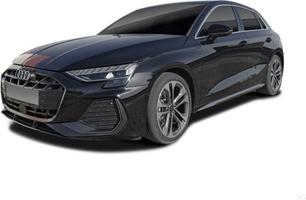
The S3 Sportback may be a small car, but its S design features, like the stylised blackout grille, matrix LED headlights, and 19-inch alloys with red brake calipers, give it a distinctly athletic and fun-loving vibe. It’s compact, but definitely not diminutive and carries serious road presence. It’s hot hatch meets fun-size.
Inside, the S3 looks fabulous. Integrated ambient lighting, a sharp dashboard treatment and a driver-focused cockpit all lend it a premium feel.
The front seats look properly sporty with their integrated headrests, and the quilted Nappa leather upholstery feels great, especially with the eye-catching red contrast stitching.
As for technology, it’s as high-end as you’d expect with a 10.1-inch touchscreen multimedia display and 12.3-inch digital instrument cluster taking centre stage.
The only drawback? No sunroof. Combined with the black headliner and compact cabin, it can feel a little gloomy at times. Still, it’s a cabin you’ll enjoy spending time in.
Like all A-Class hatchbacks, this Benz is centred pretty much solely around the front two passengers. Both get lavish seat trims and lovely touchpoints, easily a cut above mass market rivals.
Space perhaps isn't this car's forte, with the A- and B-pillars cascading inwards for a low roofline and a comfortable but not spacious interior width.
Raised console elements and elbow resting points add to the primo feel, but visibility is limited from the tiny wing mirrors and small rear window.
Front passengers get some large binnacles in the door trims, cupholders in the front, a decently sized centre console box housing two USB ports, a surprisingly large glove box, and a shallow bay for wireless phone charging up front.
All three USB ports available to front passengers are USB-C type so you'll also need to be ready with some adapters.
Rear passengers get the same lovely sculpted seat trims, but it is limited back there for someone my 182cm (6'0") height and the large front passenger seats, low roofline, and smallish window apertures make for a tight-feeling space.
There are nettings on the back of the front seats, small binnacles in the doors and a tiny shelf on the back of the centre console.
There are no amenities like adjustable air vents or charging ports for rear passengers, although the two USB-C jacks located in the centre console box should be within reach.
Boot space is an interesting story. Mercedes has packaged the electric elements in this car to consume the least amount of space possible. So, despite a relatively large and water-cooed lithium-ion battery under the boot floor, and 35-litre fuel tank in front of the rear axle, the hatchback as tested here only loses 45-litres compared to its non-hybrid version. No mean feat.
This makes total space available a decent 310 litres (VDA). You'll get a little more in the sedan version of this car, and it is larger than the Audi A3 40 TFSI e which offers 280L.
Like most hatches, the front row enjoys the most space. While it’s cosy, it never feels cramped. The seats are firm yet comfortable, thanks to their adjustability and expandable under-thigh supports. Access is fairly easy with wide door apertures, though the low seating position might earn a few grunts, especially from taller folks.
Storage up front is well sorted, with a glove box, a small centre console, a dedicated phone cradle and a couple of cup and bottle holders. It’s about what you'd expect for a car this size, but it's enough to keep things tidy.
There are plenty of charging options, with two USB-C ports in each row and a wireless charging pad up front.
The multimedia system is intuitive and easy to use. The touchscreen is responsive, and wireless Apple CarPlay connected without fuss and stayed connected all week. Wireless Android Auto is available, too.
Built-in sat nav is clear, and I love the way directions pull through to the digital instrument panel. The Sonos sound system? Pretty darn good. My son and I had more than one mini-concert on the school run.
As for the rear row, it definitely reminds you this is a small car. At 168cm, I found it on the cramped side of cosy and my husband just laughed when I asked him to try it! The wheel arch also cuts into the door aperture, making access a little awkward. Best to think of it as occasional adult seating. But given the size, that’s no surprise.
Amenities in the back are decent with a couple of map pockets, cup and bottle holders, as well as a fold-down armrest, those USB ports and rear temperature control (but curiously, no fan control). The seats are comfortable enough, but space is limited. Realistically, it’s best suited for two passengers, not three.
Boot space is quite practical. The wide opening and manageable load lip height make it easy to slide items in and out. It offers 325L of space, less than its key rivals, but expands to 1145L with the rear seats folded flat. The handy 40/20/40 split also adds versatility. Under the boot floor, you’ll find a tyre repair kit.
The A 250 e is not wildly expensive when you consider its plug-in hybrid credentials and premium market position, but then, $63,400 (MSRP) is asking a lot for any non-performance hatchback this size.
Value is also lost in the fact there's no all-wheel drive like the A 250 4Matic which sits below it in the A-Class range. This car isn't quite the same value proposition as its larger plug-in GLC 300 e sibling.
At least in terms of interior features and multimedia this car feels as premium as it is priced. Interior features include ‘Artico' faux-leather seats, premium soft-touch materials throughout the cabin, and Benz's now signature dual 10.25-inch screens it uses for a fully digital dash cluster and multimedia screen.
This car has Apple CarPlay and Android Auto connectivity, voice recognition and controls, built-in nav with live traffic and the ability to search for nearby charging points, and it also gets LED headlights and some unique 18-inch alloy wheels to sweeten the deal.
To read about how different this car is under the skin from a regular A-Class hatch when it comes to drivetrain, check out the ‘engine and transmission' part of this review, and there are also some caveats when it comes to this car's safety suite, so check that section out, too.
The biggest challenge for the A 250 e will be in the fact there are a lot of compelling rivals. A Corolla hybrid, for instance, can offer similar efficiency gains, depending on how you drive it, and a much lower ownership cost for half the upfront price.
The A 250 e is a bit of a step beyond in terms of electrification and we fully understand many buyers will be willing to take the plunge just because it's a Mercedes product. However, there is a compelling direct rival on the way in the form of the Audi A3 40 TFSI e. Watch this space.
The A3 Sportback comes in three trim levels, with the S3 technically sitting in the middle, just below the performance-focused RS 3. It's priced from $78,800, before on-road costs, and it shares the same platform and underpinnings as the Volkswagen Golf R. Surprisingly, our test vehicle isn’t significantly more expensive than its Golf R rival which comes in at $70,990 MSRP.
That makes it a more affordable option when compared to premium rivals like the BMW M135 xDrive which starts at $83,600 MSRP and the Mercedes-AMG A35 which comes in at $89,700 MSRP.
The update sees engine outputs improve with it gaining 17kW and 20Nm of torque, resulting in a total of 245kW and 420Nm.
Feature highlights include 19-inch alloy wheels, red brake calipers, electrically-adjustable and heated front seats (with expandable under-thigh support), rear privacy glass, quilted Nappa leather upholstery and 'S Sport' suspension with damper control which lowers the ride height lowered by 15mm.
The updated technology is well-rounded and now comes with wireless Apple CarPlay and Android Auto. There's also three-zone climate control, a 10.1-inch touchscreen multimedia display, a 12.3-inch digital instrument cluster, digital radio, four USB-C ports, a wireless charging pad, built-in satellite navigation and a 15-speaker Sonos 3D sound system.
Still, despite its premium hot hatch status, this grade skips a few luxury touches. Ventilated front seats, a heated steering wheel, heated rear outboard seats and a sunroof are all missing. The BMW M135 xDrive, notably, includes all of these as standard.
Even the powered tailgate with kick-functionality is an optional extra here, adding $660 to the price. At this level that should be standard.
This is where most of your money goes. Up front, the A 250 e gets a familiar 1.3-litre four-cylinder petrol engine, used elsewhere in Mercedes range.
This engine produces 118kW/250Nm and drives the front-wheels via an eight-speed dual-clutch automatic transmission.
This transmission also houses the electric motor, which is powerful for a hybrid this size, offering 75kW/300Nm for a healthy amount of cruising power without engine assistance.
These two combine for a massive output of 160kW/450Nm, with the electric motor and petrol engine working in tandem under heavy acceleration for a 0-100km/h sprint time of 6.6 seconds.
The A 250 e houses a 15.6kWh water-cooled lithium-ion battery under the boot floor to power said motor. This is, again, large for a hybrid this size, and grants an electric-only range of 73 kilometres (ADR) despite weighing in at just 150kg.
As the battery and fuel tank have moved in the way of where the exhaust port normally is, Mercedes has placed the entire exhaust system in the transmission tunnel which normally houses the 4Matic all-wheel drive system on the A 250 variant. Interesting stuff.
The S3 Sportback wears the quattro badge proudly, meaning it’s all-wheel drive and it pairs a tweaked seven-speed automatic transmission with a 2.0-litre turbocharged, four-cylinder petrol engine.
This update brings a bump in performance over the previous model, including the addition of a rear torque splitter. Power is now up to a gutsy 245kW and 420Nm of torque, launching the S3 from 0 - 100km/h in just 4.7 seconds. That’s proper hot hatch territory.
All this jiggery-pokery makes for all sorts of very impressive fuel consumption numbers. This car's official one is just 1.6L/100km, although this is going to vary wildly by how you drive it (more on this in the driving section).
Fuel consumption is just one element of this car's drivetrain though. You'll also need to consider energy consumption which is officially rated at 14.8kWh/100km.
You can think of these two consumption elements as a sliding scale. The more you can use the electric motor and regeneration features, the lower your fuel consumption will be, conversely if you drive under primarily petrol or hybrid power, you'll be able to lower your energy consumption.
Read the driving section for more on how this particular car gives you unprecedented control over this.
We had the A 250 e for just three days and managed to cover roughly 250km, I was thoroughly testing each drive mode as much as possible, and my final consumption figures came out 6.9L/100km of fuel consumption, and 5.9Kwh/100km of energy consumption.
If I had more time to charge, it was evident these numbers would have been altered drastically. Hopefully we'll be able to bring you a longer and more comprehensive Urban Guide test of this vehicle in the future.
Somehow, there is still more to the story, with this Mercedes offering a fascinating option pack which makes it even more flexible when it comes to charging.
The DC charging pack comes in at $1490 and lets you charge not just at regular public Type 2 ports, but also at ultra-fast DC locations. It also doubles the amount of power this car can pull from public outlets or a wallbox.
Keep in mind this car only comes with a regular wall socket to Type2 charger. This means to make use of fast charging at home (up to 7.2kW) you'll need to add the Mercedes-Benz Wallbox ($1200 not including installation by JetCharge) and to make the most of it when you're out and about (or if you don't have a garage) you'll need the public (Type2 to Type2) charging cable ($565.16).
See below for Mercedes' estimate of charging time for each of the charging options.
The A 250 e has a 35-litre fuel tank and a thirst for mid-grade 95 RON unleaded petrol. Oh, and if it's emissions you're conscious of, the A 250 e officially emits just 34g/km of CO2, far lower than the roughly 140g/km industry targets.
The S3 Sportback has an official combined fuel consumption figure of 7.9L/100km and a 55-litre fuel tank, giving it a theoretical driving range of up to 696km.
Its key rivals hover around similar numbers, so it's right on the mark for the segment. After a mix of long-distance drives and my usual urban errands, my real-world figure came in at 8.0L/100km - very close to the claim, which I’m pretty happy with.
The A 250 e is as interesting behind the wheel as it is on paper. To really explore it though, you'll need to delve into its complex drive modes.
It's more than just your usual comfort, eco, and sport. Each mode transforms the way you'll think about and drive this car.
The default is comfort, where the A 250 e behaves like you might expect from a plug-in. This means it will prefer to use electric drive unless you push the accelerator very hard. It makes for smooth and quiet motoring, although you'll find it chews through the electric range quite quickly, especially if you venture to the open road.
Sport mode prefers instead to primarily rely on the 1.3-litre four-cylinder engine. It's notably less refined, with this engine having a loud, gruff tone, and the introduction of vibrations and jerkiness from the dual-clutch automatic becomes immediately apparent.
It also firms up the steering, changes the transmission characteristics, and offers faster engine response from the accelerator pedal. As a side note, sport mode becomes a good tool for charging the battery quickly when you don't have access to a charging port.
The more interesting modes are electric, eco, and battery level. Battery level attempts to maintain the level the battery is currently at, while still using the car's hybrid features. This is so you can save the lion's share of charge for when it's most useful, like trawling in traffic.
Electric does what it says on the tin. Operates the car as an EV, not using its combustion engine at all. It also changes the car's paddle shifters from operating the transmission to altering the regenerative braking.
It offers modes varying from D+ which uses electric drive but coasts like a combustion car, to D-- which makes the car drive like a ‘single pedal' vehicle. This means it ups the regen braking to the point where the car will come to a full stop as you let your foot off the accelerator. It's the most efficient electric motoring mode.
Finally, eco mode lets you drive the A 250 e more like a conventional hybrid, limiting the electric motor to just taking off and cruising, preferring to switch to combustion more rapidly on acceleration.
While this car offers you unparalleled choice when it comes to electric motoring, it's worth noting it comes with its fair share of compromise.
This is far from the most refined car to drive in combustion mode, and it lacks the polish of, say, a Toyota hybrid when operating as a more traditional hybrid car.
I find it particularly interesting this car's best traits are found when it's operating as a purely electric vehicle. It's quieter, more refined, and the overpowered electric motor helps it feel just as good as a pure EV in terms of acceleration.
This car's downfalls as a combustion vehicle will be a real challenge for it. Again, it's a trade-off. The A 250 e doesn't feeel any heavier or more cumbersome than a 'normal' A-Class despite the extra battery size. But the ride is a bit harsh, and the dual-clutch leaves a lot to be desired in terms of refinement.
Asking more than $60 grand still seems tall when it's not as slick as a VW combustion car, and not as polished as a Toyota hybrid, either of which are half the price.
The S3 Sportback sounds as mean as it looks, and it delivers on that promise with effortless grunt. Acceleration is immediate, with plenty of power on tap when you need it. It’s just fun all around.
The lowered sports suspension and wide tyres do bring some extra noise into the cabin, even at lower speeds. You might find yourself repeating things to rear passengers now and then, but it never feels overwhelming.
Steering and suspension are on the firmer side, so yes, you’ll feel the bumps but the payoff is sharp, responsive handling. Quick lane changes and winding coastal roads are where this car shines.
Visibility is about what you’d expect from a low-slung hot hatch. The pillars don’t obstruct the view, but sitting beside a towering SUV at the lights can make you feel a bit... compact.
Cornering is a strong suit, thanks to the car’s wide stance and AWD system. It feels confidently planted in most conditions. That said, I noticed the occasional wobble through the rear frame on rough sections in heavy rain.
Its compact size makes parking a breeze, especially with the help of multiple sensors. The reversing camera is crisp, but at this price point, the lack of a 360-degree camera view feels like a missed opportunity.
The A 250 e comes with the standard compliment of A-Class safety features, but there's one big-ticket item missing
On the active front the A 250 e scores auto emergency braking (freeway speed detects pedestrians and cyclists), blind spot monitoring, lane keep assist with lane departure warning, active high-beam assist, and traffic sign assist.
Notably, the excellent adaptive cruise suite which appears elsewhere in Benz's range is missing. The brand tells us this is because the A 250 e does not have the higher-end radar or 3D camera suite available elsewhere in the range.
The A 250 e also has an impressive complement of nine airbags as well as the usual stability, brake, and traction controls. Petrol variants of the A-Class were awarded a maximum five-star ANCAP safety rating in August 2018 scoring well across all categories.
The S3 isn’t covered by its 2WD sibling's maximum five-star ANCAP safety rating but it is well-equipped with safety features all the same.
Safety equipment includes blind-spot monitoring, side exit assist, rear cross-traffic alert, lane departure alert, lane keeping aid, park assist, reversing camera, front/rear parking sensors, forward collision warning, autonomous emergency braking and adaptive cruise control with stop and go function.
It also has six airbags but misses out on a front centre airbag. None of the driver assist systems are intrusive to daily driving, which I always like.
The rear row has ISOFIX child seat mounts and three top-tether anchor points but only two child seats will fit.
Mercedes has caught up with most of the mainstream pack, now offering a five-year and unlimited kilometre warranty across its whole passenger car range. It's ahead of many of its rivals in the luxury segment, but matched by Korean newcomer, Genesis.
The A 250 e needs to be serviced once a year or every 25,000km, and pricing is no different from a non-electrified A 250. Pre-packaged service pricing for three years is $2050, four years is $2950, and five years is $3500.
Not ‘cheap' in the grander scheme, but there's no downside for picking this particular variant despite all of its extra equipment.
Audi backs the S3 Sportback with a five-year/unlimited kilometre warranty, which is on par with its European rivals. A five-year pre-paid servicing plan is available for $2890 which is cheaper than pay-as-you-go and reasonable for the class.
For those looking to go the extra mile, the 'Audi Advantage' package lets you extend the warranty and capped-price servicing by an additional two years, which represents solid value overall.
Servicing intervals are every 12 months or 15,000km, whichever comes first.