What's the difference?
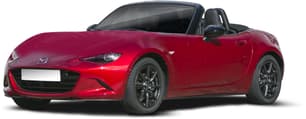
It's not often a car is elevated to 'icon' status, cars like the VW Beetle, Porsche 911, Toyota LandCruiser or Ford Mustang - but the Mazda MX-5 has quietly been the best choice for keen drivers who don't want to break the bank with a big sticker price or costly maintenance.
The ND MX-5 has been around since 2015, and while it’s been praised as a return to the original, simple formula of the NA MX-5 from the late 80s and early 90s, it’s getting close to a decade old.
So, a little refresh with some new tech and a mechanical tweak is here to make the roadster feel like a playful pup once more.
And what better place to test that out than a combination of the winding roads of the Adelaide Hills wine region, paired nicely with a main course of track driving at The Bend Motorsport Park?
I know what you're thinking: "How is this thing legal?" And to be honest, somewhere between a rock flung from the tyre of a passing car colliding with my forehead like it had been fired from a pistol, and the pouring rain lashing my exposed face like a damp cat-o'-nine-tails, I'd begun wondering the same thing.
The answer is barely. The product of a years-long fight to overcome our import rules, this madhouse KTM X-Bow R is now finally free to roam Australian roads and racetracks - though, with sales capped at 25 per year to comply with the Specialist Enthusiast Vehicle Scheme.
The price? A slightly eye-watering $169,990. That's quite a lot, and places the X-Bow R miles above its closest lightweight, carbon fibre-tubbed competitor, the Alfa Romeo 4C ($89,000).
But then, the KTM X-Bow R is unlike anything else on the road today. Part super bike, part open-wheeler and all mobile madness, the 'Crossbow' is fast, furious and completely insane.
Expect no doors, no windscreen, no roof. On-board entertainment is limited to the turbo whistling behind your head, the car's standard safety list is as barren as the interior and the climate control is dependent on the temperature of the wind that's smashing into your exposed face.
And we couldn't wait to take it for a spin.
Ultimately, the design and tech changes to the ND MX-5 will be the biggest day-to-day advantages of the updated model, because the mechanical changes don’t make themselves hugely obvious on the road.
If you’re into track days, it’s still a satisfying car to hustle as fast as you can, but it’s at its most accessible on winding roads for weekend drives, where the new differential and track DSC mode won’t come into play as much.
But in a world where accessible sports cars are becoming a rarity, there’s only one rear-drive convertible with a sticker price appropriate for financial mortals, and it’s a pretty damn good thing that it’s the ND MX-5.
Note: CarsGuide attended this event as a guest of the manufacturer, with travel, accommodation and meals provided.
Okay, so rain is not your friend. Neither is brutal sunshine, strong winds or any speed bump anywhere. There are probably a handful of times you'll want to drive it, and when you do you will definitely get hit in the face with rocks and bugs, and spend most of your time wondering just how the hell this thing is legal.
And yet, we are hopelessly, head-over-heels in love with it. It's an absolute weapon on a track, a joy on anything even resembling a twisting road and it is one of the few genuinely unique cars on the road today. And the fact it exists at all is a cause for absolute celebration.
Alright, we’ve all seen ND MX-5s, you don’t need me to tell you about its proportions or explain its design elements to you in too much detail, so I’ll give you the headline changes.
At the front and rear are new pairs of LED head- and tail-lights, respectively… obviously, fitting into the spaces the old ones took up.
The DRLS and reverse lights have come off the bumpers for both, and are now part of the main lights at each end - no more DRLs in the front bumper, and the reverse lights have been replaced by reflectors.
There are new 17-inch wheel designs for the base and GT trim levels, too, and there’s a new colour - Aero Grey.
Inside, it’s a shame that the tan Nappa leather interior of the RF Black Roof can’t be had in a manual roadster, because it’s gorgeous, even though the inside still looks refined enough for a simple sports car in its base cloth trim.
The X-Bow R is built for purpose in the most wonderful of ways. From the visible suspension components to the rocket-style exhausts, to the stripped-bare interior, it's fairly obvious that form came a distant second to function in the X-Bow's design process.
And, for us at least, that's a tremendous thing. It looks raw and visceral, and a bit like Harvey Dent post-fire - you can see all the normally hidden components doing their thing. It's mesmerising.
One thing Mazda has significantly changed for the ND is the multimedia screen, now a larger 8.8-inch touchscreen running Mazda’s updated software.
It brings the MX-5 up to date without sacrificing simplicity and makes it a little easier to use. The physical dial and buttons for controlling the screen also remain. The USB-C ports are also new.
Oh, and the MX-5 is the first Mazda model to get Connected Services, which is coming to other Mazda models eventually.
Connected Services allows owners to find, lock, and get alerts for their cars from a phone app, even letting them set curfews to notify them if the car is started during certain hours.
Aside from that, another small tweak is the simplified instrument cluster, which aims to be easier to read even when the roof is open and the sun is bright.
The cabin isn’t built to be plush, it’s built for ‘Jinba Ittai’, Mazda’s philosophy that applies most strongly to the MX-5 which means ‘horse and rider as one’.
And trust me, you feel one with the horse- er, car, when there’s not ample room to move. It’s not restrictive, but it’s cosy.
Everything’s quite well-placed and it’s not busy with buttons or features in here though, it’s made for focusing on driving.
One downside is the lack of storage, not even a glovebox, in front of the passenger, and the central storage spot under where your elbow sits is tiny, good for keeping the key fob snug though. Also, the cupholders are able to be removed or swapped between the space behind your elbow, or above the passenger footwell.
There’s also a small storage space between the seats behind where your elbow would sit, though it’s tricky to access while you’re driving.
Then there’s the boot, which is usable for a small amount of luggage at 130 litres in the Roadster and 127L in the RF hardtop.
Finally, as a huge positive, probably the biggest advantage of the ND over any other convertible is how easy it is to open and close the roof in the Roadster. You can do it single-handed, which is great if it starts raining and you’re at a traffic light or able to quickly pull over.
The RF hard-top has a switch that automatically opens and closes the roof section.
Short answer? It's not. People are unlikely to test drive an X-Bow R and start looking for cupholders and storage space, but if they did, it wouldn't take long.
Aside from the twin seats, a four-point racing harness, a high-mounted gearshift, a pull-lever handbrake, and detachable steering wheel, the cabin is as bare as Old Mother Hubbard's cupboard.
Luggage space is limited to what you can carry in your pockets (though wearing cargo pants will help) and even getting in and out of the thing takes some fleet-footed antics. With no doors you need to literally jump in. And the side sills are only rated to 120kg, so heavier types will need to avoid stepping on them at all, and instead attempt a kind of running leap into the cockpit.
Getting into an MX-5 is now a little more expensive, with the base manual Roadster up by $2310 to now start from $41,520 before on-roads.
The top-spec soft-top GT RS is now $51,640, or $2800 more than before.
Pricing for the RF hard top is also similarly bumped up, a base manual costing $46,250, and the most expensive GT RS at $56,140.
There’s also a Black Roof edition which comes with tan Nappa leather inside, but that’s only available in an automatic RF, which is possibly the biggest downside to the 2024 range.
Base models get cloth seats, while GT and GT RS models get heated leather seats. The GT RS also comes with stiffer Bilstein dampers, Brembo front brakes, a bracing strut between the front suspension towers and a DSC-Track mode. The difference there is noticeable, so it's worth the extra spend for the more keen driver.
The higher overall costs bring updated tech, a new 8.8-inch touchscreen and a new limited slip-diff in manual versions, plus tweaked mechanicals like improved acceleration response and lower steering rack friction.
But they do look a tiny bit different too.
Keen readers of this site will recognise this as the area where we outline the many and varied features that come along with a normal new car purchase, but that's just not going to work this time. In fact, it'll be considerably easier to talk about what's missing, so let's start with the obvious: doors, windows, roof, windscreen. All conspicuously absent from this weird and utterly wonderful X-Bow.
Inside, you'll find two thinly (and we mean thin - we've seen thicker contact lenses) padded seats fixed into the tub. You'll also find push-button start, a digital screen reminiscent of those found on motorbikes (KTM is an Austrian-based motorcycle company, after all) and a pedal box that slides backward and forwards to offset the height of the pilot. Oh, and that steering wheel can pop off to make getting in and out easier.
Climate control? Nope. Stereo? Nope. Proximity unlocking? Well, kind of. With no doors, you'll always find it unlocked when you enter its proximity. Does that count?
But what it does have is a turbocharged two-litre engine. And in a car that weighs a sprightly 790kg, that means it's quick, pulling like a rabid sled dog in every gear, rear tyres chirping with every change.
Up front, you get one option: a 2.0-litre naturally aspirated four-pot. It makes 135kW and 205Nm, and it’s a delightful little thing, driving the rear wheels only - as it should.
It used to be that the smaller 1.5-litre engine was the more revvy, keen option, rest its soul, but Mazda updated the 2.0-litre to be more eager (and deliver more power) at high revs and basically made the little 1.5-litre redundant.
Anyway, you can have it with a six-speed manual in any variant, or a six-speed automatic in GT guise if you find manual gearboxes difficult or a hassle.
The X-Bow R's power comes from an Audi-sourced, turbocharged 2.0-litre engine, paired with a VW Group six-speed manual transmission (and one of the stubbiest gearsticks in existence). That mid-mounted marvel produces 220kW at 6300rpm and 400Nm at 3300rpm, and ships it off to the rear tyres with the assistance of a Drexler mechanical limited-slip differential.
Thanks to its lithe and lightweight body, that's enough to propel the X-Bow R from 0-100km/h in a blistering 3.9 seconds, and on to a top speed of 230km/h.
Mazda says the MX-5 uses 6.8L/100km as a manual Roadster, or 7.0L/100km with an automatic gearbox. Or, in the heavier RF 6.9L for a manual and 7.2L for auto.
Not great for a tiny car like this, but pretty good for a sports car!
It’s got a 45-litre fuel tank, takes premium 95 RON or higher, and while it should hypothetically be able to travel more than 600km with its on-paper claims, expect fuel use to sit closer to 8.0L/100km if you’re driving it anything like it deserves.
KTM lists the X-Bow R's claimed/combined fuel figure at 8.3 litres per hundred kilometres (though we were managing mid-12s after an, ahem, very spirited test), with emissions pegged at 189 grams per kilometre.
The X-Bow R is also fitted with a 40-litre fuel tank, accessed via a side-mounted inlet. Instead of a fuel gauge, expect a digital reading showing how many litres you have left.
It feels like every motoring journo under the sun (literally if the roof is off) owns or has owned an MX-5 of some sort.
And the first time you drive one, you might understand why.
If you spend your days testing and driving a bunch of different cars that aim to be many things at once, it’s refreshing to drive something that aims to be one: fun.
That’s it, the MX-5 feels like it was built to be fun. Not for convenience, not for power, certainly not for the school run.
And fortunately its simplicity remains with this update. All Mazda has done to change the way it drives is attempt to improve the rear limited-slip differential and improve the steering a little by reducing friction in the rack, as well as improve throttle response.
Has any of that changed the way it feels to drive on-road? No, not massively, but the ND was already such a delight that Mazda could have kept this update to purely design and interior tech changes and it would have still been one of the best-value buys around in terms of fun.
The MX-5 still feels relatively softly sprung while still being a dynamic and communicative sports car that’s engaging to drive even at low speeds, and rewarding (or frustrating) to drive fast.
On tight, winding roads, the MX-5 is at home, its soft suspension keeps you humble with its shifting weight and its relatively meagre outputs keep your licence safe.
In fact, despite being slightly compromised as a daily drive, the MX-5 is still plenty of fun even in traffic, there’s something about the satisfying click as the shifter slips into gear, or the little rev matches heading back down through the cogs when approaching a red light.
The 2.0-litre four-pot is a keen unit, and the six-speed manual is light and easy to work with, plus its steering is light without sacrificing road surface feedback - that feedback can quickly turn into cabin noise on a coarse highway which could become a little irritating on a long trip.
But the MX-5 can still be plenty of fun on track, where you’re more likely to get the most out of its new limited-slip differential and Track DSC mode.
It’s equally frustrating and satisfying to hustle the MX-5 around the East Circuit at The Bend in South Australia, where the track is twisty, busy, and unforgiving. Get it wrong, and the MX-5 lurches or slides to let you know you’ve made an error.
Get it right, however, and the little roadster glides through the corners, camber changes and even over apex kerbs smoothly and carrying impressive speed.
Plus, the electronic assistance won’t usually kick-in until you really need it, a welcome change from cars that are constantly trying to keep you from having fun behind the wheel.
It couldn't be more Fast and Furious if it had Vin Diesel growling under its (non-existent) bonnet. We have technically driven faster cars, but we have never driven anything that feels quite so fast as this utterly insane X-Bow R.
Climb in, strap into the four-point harness and select first via the surprisingly easy-to-manage gearbox and clutch set up, and, at slow speeds, wrestle with the dead weight of the completely unassisted steering, and it's immediately clear that this is a driving experience like nothing else currently road-legal in Australia. Even at walking pace, the X-Bow R feels poised for an assault on the future, and it attracts attention on the road like nothing else we've ever driven.
Its road-scraping ride height and diminutive dimensions make tackling traffic an intimidating prospect, with regular hatchbacks suddenly taking on truck-like proportions and actual trucks now looking like passing planets. There's a constant concern that you're sitting well below the traditional blind spot, and that you could be crushed at any moment.
Combine all that with the bad weather that cursed our final day of testing, and the X-Bow R is all sorts of watery hell. It is truly homicidal in the wet, too, with the back end breaking grip at the slightest provocation. And the turbocharged 2.0-litre offers plenty of that.
But on a sunny day, and on the right road, it's pure driving bliss. The acceleration is brutal, the grip endless and the Audi sourced gearbox an absolute treat. And it pulls in every gear, tackling 35km/h corners in third and absolutely blasting out the other side.
Cornering is scalpel sharp, and the steering - so heavy at slow speeds - is light and efficient at pace, requiring only the most minuscule of movements to bite into a bend.
It is anything but perfect in the city, and even a light sprinkling of rain will have you seeking shelter (and a refund), but on the right road, on the right day, there are few if any cars that offer the kind of razor-sharp thrills and intoxicating excitement of KTM's monstrous X-Bow R.
The ND MX-5 actually scored five stars with ANCAP back in 2016, even though its score has now expired. It’s not obvious how well it would fare under newer, stricter tests, given the small car’s lack of advanced driver assistance - not that that’s a bad thing in the case of a sports car.
Still, for a two-seat convertible, the MX-5 has a decent list of kit to keep you safe including front and side airbags, alerts for driver attention, blind spots, lane departure and rear-cross traffic, parking sensors and a reversing camera, belt pretensioners and side-impact door beams and even automatic Smart City Brake Support.
Next to none. There is no ABS, traction or stability control. No airbags, powered steering or ISOFIX attachment points, either. If you break traction (which, in the wet, is more than a little bit likely) it'll be up to you to ensure you straighten up again. Helpfully, there's a ton of grip from the Michelin Super Sport tyres.
As part of the compliance program, Simply Sports Cars (the company responsible for introducing the X-Bow R) actually crash tested two cars in Europe, and raised the ride height by 10 millimetres. Oh, and there's now a seatbelt warning sign, too.
Mazda’s five-year, unlimited km warranty covers the MX-5, including five years of roadside assist.
Servicing costs are pre-set, with intervals every 12 months or 15,000km up to seven years or 105,000km. They cost between $447 and $638, averaging out at about $544 each.
The X-Bow R is covered by a two-year, unlimited-kilometre warranty, and while service prices aren't capped, Simply Sports Cars estimates an average serve cost at about $350.