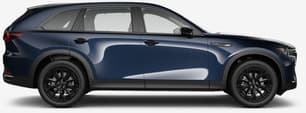
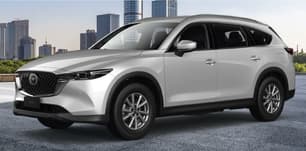
What's the difference?
Mazda calls the new CX-70 its "flagship" five-seat SUV, which also makes it yet another flag-bearer for the brands relentless push up market as part of its 'Mazda Premium' strategy.
It might have a different badge, but it's really a five-seat version of the brand's biggest and most expensive offering, the seven-seat CX-90.
And, for reasons that will become clear in a moment, it's something of a bargain, at least in the context of Mazda's plush large SUV range.
How so, you ask? Read on.
Mazda has a tendency to have a lot of similar looking horses in the stable; blink and you'll miss the (very) subtle differences between the CX-8 and the CX-9 but if you're not super keen on the bulk of the CX-9 and you've outgrown the space of the CX-5... this one's for you.
Especially, if you've been considering its competition - the Hyundai Santa Fe Elite CRDi AWD and Toyota Kluger GXL AWD. Both of which have become known for their features and space.
So, how does it compare? The CX-8 GT SP diesel all-wheel drive seats seven, has a decent boot space (albeit, when the third row isn't in use) and handles like a dream.
Perfect combination? Maybe. I've been driving it for the last week with my family to find out for you.
For mine, the CX-70 is the pick of Mazda's premium SUV range, and if you can survive without a third row of seats, it's significantly cheaper than its CX-90 twin, too.
Note: CarsGuide attended this event as a guest of the manufacturer, with travel, accommodation and meals provided.
So, what did my family think about the Mazda CX-8 GT SP diesel all-wheel drive? I love how it performs on the road - it's super easy to drive and you don't notice how large it is in a car park.
There are some great family-friendly features scattered throughout and I like how practical this is too with the extra seats and top-tether points. The multimedia system isn’t my favourite and I would have preferred to have seen a few extra airbags and a 360-degree view camera, but overall, it’s a good family car and gets an 8.0/10 from me.
My son loved the sun blinds and the cool colour of the seats. He also gives it an 8.0/10.
Yes, the Mazda premium SUV range can look a little same-same, but Mazda insists there are critical differences.
That said, if you can immediately spot the difference between the CX-70 and CX-90 without taking a peek inside, you're doing better than me, given it is the same exact dimensions as Mazda's three-row flagship.
Sure, Mazda talks about things like this design being a “passion pursuer” that serves up "dignified performance” – all of which sounds utterly ridiculous – but the less marketing-speak version is that it looks like a shapely large SUV that ditches the boxy dimensions of a proper 4WD for a more sleek and swooping profile.
Inside, it's a plush and premium-feeling space, with lovely cabin materials, plenty of tech, and plenty of space.
To be honest, I can't really tell the CX-8 and CX-9 apart on the road. They're both large SUVs that sport the classic Mazda bonnet - sharp and long. Up close, the CX-9 has a bulkier shape but otherwise they are remarkably similar.
The CX-8's darkened grille generates some interest with its lattice-work and there are enough shiny chrome accents scattered about the car that it looks pretty.
Yet, the sporty sharpness that Mazda is known for is still hinted at with its shaping and the 19-inch black alloy wheels.
Our model is finished in 'Platinum Quartz Metallic' and it is the highlight for the exterior styling for me. I think because it's such an interesting colour to look at - it varies a lot depending on lighting conditions. Sometimes, it almost has a sheen of pink to it and at others, it looks like pearly sand.
The interior looks polished and refined with its burgundy leather trim and soft-touchpoints. Again, there is a lot of chrome inside to make otherwise dull features, like air vents, pop out.
The CX-70 measures a substantial 5120mm long, 1994mm wide, and 1745mm tall, and it rides on a 3120mm wheelbase.
It will tow 2.5 tonnes no matter which engine you choose, and the expansive boot will swallow between 589 litres and 2015 litres, depending on how you configure the backseat.
All of that space translates to a hugely airy backseat experience, with the second row able to be fixed in a position that either prioritises leg room or boot space.
With the former, you've got tons of space in the second row. I'm 175cm, and my knee and leg room was ample, with only the intrusive tunnel that runs down the middle-centre of the cabin eating into leg room for the middle passenger.
There are also air vents and temp controls, twin USB charge ports, seat heating in the window seats and swathes of very nice materials.
The boot is massive, too. I can't even reach the back of the rear seats when I lean into it, and Mazda says it will swallow smaller surfboard or SUPs without needing to resort to roof racks.
Under-floor storage adds a bit more security for precious items, too.
The CX-8 is a very practical family hauler because there's ample room in all three rows. Yes, even adults will be able to squeeze into that third row without too many complaints!
All rows enjoy well-cushioned seats and up front they are electrically adjustable, but unfortunately, only the driver's side has lumbar support.
The middle row can slide forward manually or by using the electric button found on the side of the seats... but doing it yourself is way faster.
They do slide far enough forward that you won't embarrass yourself too much when you have to clamber into the third row. Where the seats have a 50/50 split-fold and manual adjustments (accessed via the boot).
In the first two rows there are lots of individual storage options but the front enjoys the most. The middle console is deep enough to be useful and I like the dual opening lid. Each row gets a couple of cupholders and drink bottle holders, too.
The charging options are great, with each row getting two USB-C ports and the front getting a wireless charging pad and 12-volt socket.
All of the controls and dials feel within easy reach and the 10.25-inch touchscreen multimedia system graphics are clear.
You can use it as a touchscreen or opt for the rotary dial but switching between the two was awkward for me. Especially, since the touchscreen function is disabled when you are using the wireless Apple CarPlay. This also has wired Android Auto, for those users.
The amenities are practical throughout with a dark headliner, three-zone climate control and heated outboard seats and retractable sun-blinds in the middle row.
Good news for families because there are five top-tether points across the back rows and ISOFIX child seat mounts on the outboard seats in middle row, in case you need them.
You can fit a 0-4 rearward facing child seat and it shouldn’t impact on front passenger comfort.
My six-year old found it super easy to get in and out of this car because of the 205mm ground clearance and wide door apertures. He enjoyed the high seating position, too, but was disappointed he couldn’t see out of the sunroof!
The boot space is a bit cramped with all three rows are in use at 209L but folding the third row opens up a more respectable 775L - perfect for the average family and its stuff!
The loading space is level, with the temporary spare tyre and clever storage compartments housed underneath. There is a retractable cargo blind and net, luggage anchor points and a 12-volt port, too.
And, as always, I love a powered tailgate, which this has!
We'll drill down on this a little more in the practicality section, but it's important to note here that the CX-70 is the same size as the CX-90 – both are 5120mm long, 1994mm wide and 1745mm high — which means the only real difference between the two models is the third row of seats in the CX-90.
And, as it turns out, that's a very expensive pair of chairs. The CX-70 starts with the GT trim at $75,970 before on-road costs for the petrol or $77,970 for the diesel, and then climbs to the Azami trim, which is $82,970 or $84,970.
The CX-90, though, is $82,577 or $85,785 for the GT, or $91,461 or $93,030 for the Azami.
That makes the CX-90's third row at least a $6600 option, but as much as an $8000 upgrade. Mazda has made moves to address this, with a drive-away "plate clearance" that closes that gap, but we suspect those offers will become permanent fixtures to make the jump from 70 to 90 less ferocious.
Anyway, Mazda has thrown just about everything they've got at the CX-70. The GT kicks off with plenty of high-end gear, including 21-inch black alloy wheels, adaptive LED headlights, a panoramic sunroof and a handsfree powered tailgate.
Inside, there are twin 12.3-inch screens with Apple CarPlay and Android Auto, a 12-speaker Bose stereo, leather seats that are heated front and rear, three-zone climate control and a heated steering wheel.
The Azami then adds things like ambient lighting, black Nappa leather seats, which are now ventilated in the front, footwell lighting, body-coloured wheel arches and lower cladding and body-coloured door handles.
The GT SP diesel AWD is one of the premium models, sitting third from the top and will cost you $65,560, before on road costs.
However, its price tag positions it as the most expensive compared to its rivals. With the closest rival being the Kluger at $65,310 and the most affordable being the Santa Fe at $60,000.
You do get a stylish-looking package with lots of features for your cash, like heated front seats, heated rear outboard seats, a tilt and slide sunroof, and premium leather interior trim.
There's some great tech scattered throughout, too, like the 10.25-inch touchscreen multimedia system, wireless charging pad, USB-A ports in the third row, Bose Premium sound system with 10 speakers, wireless Apple CarPlay and wired Android Auto.