What's the difference?
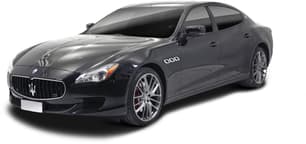
Maserati's Quattroporte is part of a dying breed. A decade or so ago, the European manufacturers took a huge amount of pride in their range-topping big luxury sedans, cars you can either drive or be driven in, bristling with the latest technology.
In 2015, all we hear about are the range-topping SUVs from those makers, with cars like the S-Class and 7 Series fading slowly into irrelevance.
While by no means low-tech, the Maserati Quattroporte takes the high style route, focussing on a luxurious interior with that handmade feel.
Do you like swimming against the tide? Do you like to zig when everyone else is zagging? Are you unafraid of making the unpopular choice?
Well, if you align with the above, I have just the car for you.
The Volvo ES90 pushes against most current trends. The luxury sedan used to be the measure of a brand, but not anymore. These days the luxury market is defined by SUVs and sedans have been reduced to an afterthought for many.
But if you’re willing to think outside the SUV-shaped box, there is a lot to like about Volvo’s new luxury offering. Whether it’s a true sedan or not is open to debate, but what it isn’t is an SUV and for those willing to live that counter-culture lifestyle this may be right for you.
Beauty is way more than skin-deep in the Quattroporte and while the 330 doesn't have the punch of the S, it's hardly that much slower. Maserati reasons you will want to spend the $25,000 saved on options, concentrating on the Italian craftsmanship rather than the outright performance available in the V8 or the efficiency of the less aurally attractive diesel.
As with any car of this type, you've got to want one in the first place, but for a big, beautiful sedan, there's nothing as good looking this side of an Aston Rapide. The Quattroporte 330 does nothing to dim the allure of Modena's big mover and, if you're that way inclined, nobody on the outside will ever know.
More stylish than ever before, as quiet and refined as you'd expect from a luxury car and yet the stand out feature might once again be safety. Despite seemingly every new car being loaded to the gills with safety features, Volvo has managed to demonstrate industry best-practice and leads the way again.
I would encourage engineers from every other car brand to drive the ES90 to learn how to better integrate the modern suite of active safety features like forward collision warning and lane departure warning.
But beyond that, is the ES90 a car worthy of consideration? Well, pretty much everything it does the EX90 does too, so if you prefer an SUV that’s definitely worth consideration. But if you don’t want an SUV, if you prefer a sedan or just love to be different, the ES90 is a very attractive proposition in more ways than one.
Long, flowing lines mark out the Maserati as something quite different to its German, British and Japanese competition. This Quattroporte has increased in every dimension but the lines cover its size beautifully.
Big wheels, long wheelbase, low ride but it still looks like a sedan rather than pretending to be a coupe.
The elegance of the lines is complemented by a distinct lack of bling – there's little in the way of chrome work or shouty details. There's plenty satin finishes available and the beautiful paint, while available in pretty much any colour you like, is best kept to a restrained, deep hue. Or silver.
The cabin will doubtless age well. Classic shapes house a fairly conventional but hugely comfortable cabin. The front seats have heaps of adjustment and are large but supportive. Naturally, the leather is soft and supple.
The central screen isn't the dominant feature, like a 50-inch LCD screen in a small living room while buttons are kept to a minimum.
The rear seat is sensationally comfortable, with hectares of available space and a seat comfortable for either lounging or working.
Discussing Volvo design will draw different opinions depending on your age. As a millennial, I grew up at a time when Volvos were, to quote a famous movie line from the 1990s, ‘boxy, but good’.
But over the past two decades Volvo has smoothed off those boxy edges and become one of the most style-conscious car companies in the world. It has embraced its now-unique place as a Scandinavian carmaker and uses softer edges and more Nordic design themes (such as light coloured interior woods) to ensure the ES90 is simply a good-looking car.
What it isn’t, at least not technically-speaking, is a sedan. That’s because it has a liftback rear-end design, rather than a traditional ‘three-box’ sedan with a conventional boot. That shouldn’t be a deal-breaker for anyone and it means it’s a far more practical design.
It also sits taller than a conventional ‘sedan’, which is an increasingly common trait for modern European sedans as they try to woo would-be SUV buyers. It’s not a lot, you certainly wouldn’t call it a tall or high-riding car, but it is noticeable.
Ends up as an ‘in-between’ design, neither one thing or the other. The closest thing it reminds me of is the short-lived BMW 5-Series GT, which is damning with faint praise, but it speaks to the challenge of making something that simply isn’t an SUV appealing to the modern SUV-obsessed market.
The very stylish cabin features that previously mentioned light coloured wood (at least in our test car) and that unique Scandinavian look. It’s the closest you’ll get to sitting in a Swedish lounge room on wheels.
The current Quattroporte has been with us now for a couple of years in diesel and petrol turbocharged V6s and turbo V8 forms.
The 330BHP uses the same, Ferrari-built V6 but detuned to 'just' 330 bhp. The price has been detuned too, dropping $25,000 from the V6 S's entry price to kick off at $210,000.
Maserati 330bhp benefits from an overall specification improvement across the range, landing in your garage with a ten-speaker stereo with USB and Bluetooth, power everything, dual-zone climate control, keyless entry and start, front and rear parking sensors with reversing camera, cruise control, sat-nav, auto headlights and wipers, double glazed windows and an interior covered in leather and wood.
Later in the year, your Quattroporte will be available with a new silk trim from Zegna
Only very occasionally does it become clear that Maserati is part of the Fiat Group and that moment comes when you use the 7.0-inch central screen in the dash.
eight-speed ZF automatic transmission
The software is based on the group's UConnect and it isn't great. It's not bad, but it feels its age (however, it's much better than the system on the Gran Turismo), needing a lot more work or a quick surrender to Apple's CarPlay or Android Auto.
Once you work your way through the weird menus, it's fine to use and is miles ahead of the not-much-cheaper Lexus LS unit which is almost unusable.
Sound from the ten speaker stereo is crystal clear and the phone performance is also very good.
The ES90 range consists of two models at the time of publication both powered by a single, rear-mounted electric motor, with the twin-motor option available on the EX90 SUV currently not offered in Australia (emphasis on the word ‘currently’).
The range begins with the Pure from $88,880, before on-road costs, and is completed by the current range-topping Ultra variant, which we're testing, priced from $107,990, plus on-roads.
That means it’s cheaper than its direct rivals in the luxury electric sedan market. Audi’s e-tron GT starts at more than $200,000, the BMW i5 line-up is priced from $155,900 and the Mercedes-Benz EQE range begins at $134,900. So, even with this more expensive Ultra variant, Volvo has a clear head-start on the competition.
And Volvo hasn't managed that by skimping on standard equipment. The ES90 comes loaded with adaptive air suspension, 22-inch alloy wheels, a comprehensive safety package (as you’d expect from Volvo) as well as an electrochromic panoramic roof, a smart key you can add to your phone and 'Nordico' upholstery - Volvo’s sustainable synthetic leather.
There’s also a 25-speaker Bowers & Wilkins sound system, but more on that later…
Like the S, the 330bhp is powered by Maserati's twin turbo 3.0 litre V6, made with more than a dash of Ferrari involvement. As the name suggests, it produces 243kW and a chunky 500Nm. With just under two tonnes to shift, the ubiquitous eight-speed ZF automatic transmission whisks the Quattroporte 100km/h in 5.6 seconds, only half a second down on the 301kW V6 S.
Maserati claims 9.1L/100km on the combined cycle (with the help of stop-start), which seems reasonable given our figure of 10.8L/100km, which we got a with a mix of city and highway running as well as a very enthusiastic blast through some secret back roads.
As the name suggests, the ES90 Single Motor is powered by a single, rear-mounted electric motor that drives the rear wheels via a single-speed transmission. The motor makes a healthy 245kW and 480Nm, so the 0-100km/h sprint time is 6.6 seconds - sprightly for such a big car.
As alluded to earlier, there is a Twin Motor, all-wheel drive ES90 variant available in overseas markets, with 500kW, but Volvo Australia is yet to confirm when, or even if that will arrive here.
Just a few hundred metres behind the wheel is all it will take to convince you the Maserati belongs in the same class as the competition. It's incredibly quiet – courtesy of the acoustic double glazing – and all occupants benefit from supreme comfort.
While the 330 is 58kW down on the full fat V6, you won't really miss them. There's a fat torque curve, with all 500Nm available from 1750 to 5000rpm, meaning easy progress for the 5.2 metre sedan.
The Quattroporte has two sport buttons to choose from – one looks after the drivetrain and exhaust valving while the second stiffens up the Skyhook suspension.
With the first sport button pressed, you get a more lively throttle, sharper shifts and a glorious noise from the exhausts, although they are a long way from your ears.
It's still a fast car, with strong acceleration from standstill and in the gears, the power as linear as you like with no real turbo lag and a most un-turbo noise to go with the performance.
The only dynamic problem is the electric steering – it seems to get confused between your inputs and feedback from the road, the tyres feeling like they're 'nibbling' an uneven surface, tweaking the wheel in your hands.
The assistance is a little spotty, too, unexpectedly changing weight. It's just a bit weird. In normal driving, you'll never notice it.
As you’d expect from a luxury, electric car the ES90 is a quiet and refined vehicle to drive. Being a Volvo, the company has used its experience where it matters, and there is excellent insulation from the outside world. Unlike some EVs that lose the engine and hope that just makes things quieter, the ES90 gives you a genuine feeling of insulation from the exterior hustle and bustle.
Performance is adequate from the single motor but it’s by no means a sports sedan with only 250kW/480Nm and such a big vehicle. But it has the instant response that is an EV trademark so it has all the performance this type of car and the drivers it will attract would likely need. If buyers start banging on the door for more power, Volvo can oblige, but for now it does the job you expect of a luxury four-door.
While it has the sedan silhouette, the taller body and raised ride height on the air suspension are noticeable. You will find yourself looking up at SUV drivers, but not all of them. It’s roughly the same seat height as you’ll find in a modern small SUV, so a slight elevation rather than a big boost.
The ride is what you expect from this type of car. You can adjust the suspension and steering between ‘soft’ and ‘firm’ settings, but even with the latter selected there is a lot of compliance and the ride remains comfortable.
The steering is fine most of the time, but when you have to do parking maneuvers you certainly notice the ES90's steer-by-wire technology. The steering literally feels like an old computer game steering wheel set-up, with very little resistance as the wheel lightly spins from lock-to-lock. It’s not a bad feeling, but it is a bit odd and takes some getting used to.
The ultimate take-away from the driving experience is just how relaxed it is - quiet and effortless are the two words that probably best sum it up.
Six airbags, ABS, stability and traction controls, brake assist, blind spot monitoring and rear cross traffic alert.
There is no ANCAP or EuroNCAP safety rating for the Quattroporte.
This is obviously the area that Volvo is famous for, but with seemingly every other brand forced to raise their own safety features over the years, does the Swedish brand still do anything special on this front?
Absolutely.
Put simply the Volvo suite of active safety systems is better developed and better integrated. Every rival car to the ES90 will have a similar list of features, including adaptive cruise control, forward collision warning, lane departure assist, road sign information and more. But Volvo has made it work so well that unlike rival models, you never even think of turning them off, they don’t beep and bong ad nauseum, they only work if you need them in an emergency - which should be the standard.
One thing to note is the ‘bump’ on the roof (you may see in the images) to house a Lidar system. However, Volvo split with its supplier and has decided to abandon this technology for the ES90. That means the 2026 model year examples will not have the roof bump, but still come loaded with five radars, seven cameras and 12 ultrasonic sensors for the excellent coverage of the surrounding environment.
The only thing that stops the ES90 being worthy of a 10/10 safety score is the lane keeping assist could do with some fine-tuning, as it has a tendency to move in the lane slightly too much.
There is no current ANCAP score for the ES90, but the EX90 SUV does, and given the organisation's previous sharing of scores between different models based on the same core underpinnings, there is no reason to believe the ‘sedan’ wouldn’t be just as safe.