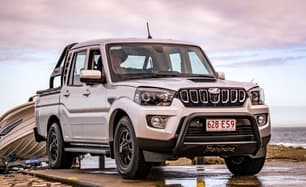
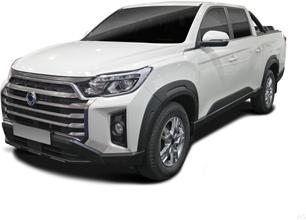
What's the difference?
The current generation Mahindra PikUp has been with us since 2007, which is a long time given major players in this market tend to introduce a new generation every decade, or close to it.
However, with Mahindra reportedly developing an all-new ute, based on the underpinnings of its latest Scorpio SUV, the budget-priced PikUp is destined for retirement within a few years.
Better late than never, the latest MY23 version of the S11 dual-cab has for the first time been equipped with an automatic, which is sure to increase buyer appeal in a market in which self-shifting transmissions rule.
We recently revisited this Indian-built dual cab to see how it measures up for tradies in such a competitive market.
The SsangYong Musso XLV Ultimate is one of, if not the, most affordable part-time 4x4 ute on the market at the moment a recent facelift sees some improvements to its design, features and ride comfort.
I'm in the top-grade model with my family of three to see how those tweaks translate to real-world family life and how it competes against rivals like the GWM Ute Cannon and the LDV T60.
Its sub-$40K pricing undercuts the cheapest Ford Ranger or Toyota HiLux 4x4 equivalents by $10-15K and it’s backed by a decent warranty and 60-strong dealer network (mostly regional). It’s also largely absent from the federal government’s vehicle-recall listings, which suggests solid build quality.
However, it’s also short on safety, has relatively high servicing costs and numerous design quirks. Fact is, such low pricing comes with compromises, so, if you can learn to live with those, this sturdy and willing auto-equipped workhorse could represent good value for those shopping on a budget.
The SsangYong Musso XLV Ultimate is an affordable workhorse that has good comfort, features and drives well. It suited my little family and our gear just fine this week with its space. If you need the practicality of a ute and are on a budget, you get a lot for your money here.
The PikUp has a 3040mm wheelbase and 5175mm length, 1820mm width and 1915mm height.
So, compared to a Ford Ranger XL equivalent, it’s 230mm shorter in wheelbase, 195mm shorter overall and 98mm narrower, so it’s relatively compact for a dual cab ute.
Built on a traditional ladder-frame chassis, its twin-wishbone front suspension uses torsion bars instead of the more common coil springs, while under the tail is a leaf-spring live rear axle. Brakes are front discs and rear drums.
With 210mm of ground clearance, its steep 34-degree approach angle is excellent but its 15-degree departure angle is less than half that figure, so it's prone to tail-dragging in the rough stuff.
And its bafflingly large 13.4-metre turning circle (kerb-to-kerb) demands numerous three-point turns.
The interior appears to have a good standard of finish and provides a visually-pleasing mix of black and grey surfaces with satin chrome highlights throughout. Driver controls are easy to see and operate and the front bucket seats are comfortable.
The rear bench seat is quite firm with good lumbar support, but it’s a squeeze for three adults given its relatively narrow width.
Even so, there’s adequate kneeroom and heaps of headroom even for tall adults, which is no doubt appreciated by hat-wearing farmers and tradies.
The Musso looks the part of a 4x4 dual cab ute. It’s big even without the XLV pack at 5095mm in length. And with it, that jumps up to 5395mm. Enough to well and truly fill out a car space.
To put it in perspective, it's longer than the Kia Carnival, so I'd check to see if it will fit in your garage!
The finish isn’t the best, with wide spaces between door jams and the tray (I can fit my hand in that one) and a painted foam-like joinery in the tailgate which is already showing a lot of wear and tear for a brand-new workhorse. Stuff like this could make it look worn quickly.
Once you move into the cabin, it becomes obvious where a lot of the facelift has been focused.
The black leather upholstery, headliner and accents all make it feel premium in the cabin.
The dashboard has been redesigned to be more horizontally-themed and to sit lower than the previous dash. It showcases the new upgraded tech screens, large integrated air vents and digital climate control panel.
The cabin looks way more expensive than the price tag might suggest and it's most welcome.
With its 2115kg kerb weight and 3150kg GVM, the S11 PikUp offers a 1035kg payload rating so it’s a genuine one-tonner.
It’s also rated to tow up to 2500kg of braked trailer but given Mahindra doesn't publish a GCM rating (or how much it can legally carry and tow at the same time) we don’t know if it can retain its maximum payload while towing that weight.
Strangely, the load tub does not have any internal load-anchorage points. The only option for securing ropes or straps are external hooks, which are located along both upper sides of the tub and across the tailgate.
However, these would be ineffective in securing loads that are lower than the tub sides.
Front cabin storage is limited, as there are only narrow bins and no bottle holders in the front doors and you won’t find any cup/bottle holders or storage for small items in the dash, either. However, there is a single glove box and an overhead glasses holder.
The centre console has an open storage tray at the front and single cup and bottle holders in the centre, which are fine for one occupant but not two.
In contrast to the front doors, there are no bins in the base of each rear door, but they do get a large-bottle holder and what looks like a phone holder at mid-height.
There are also pockets on each front seat backrest, but the fold-down centre armrest does not have any cup/bottle holders.
The rear bench seat’s base cushion is fixed, so it can’t swing up and be stored vertically (like many dual cabs) if more internal cargo space is required.
However, it does at least provide some open storage space underneath for soft items like jackets etc.
The cabin of the XLV Ultimate is big on space and all occupants enjoy fantastic head- and legroom.
Individual storage is good for a ute with the front enjoying two cupholders, a good-sized middle console and glove box plus a drink bottle holder in each door.
Rear occupants get map pockets, a fold-down armrest with two cupholders and storage bins in each door.
Amenities on the whole are good with the heated and ventilated front seats that feature lumbar support. But the upgrade to electric control for the fronts and heat function for the rear outboard positions clinch the luxury factor Both rows are well-cushioned and comfortable for long journeys.
Charging options are limited to the front with two USB-C ports, which is an upgrade from the old USB-A ports, and two 12-volt sockets.
But one of them is an old-school cigarette lighter which I haven’t seen in years! Now that was a teachable moment when I was a kid.
It's a shame there are no charging options in the rear as it could be inconvenient if you travel a lot and your kidlets have devices.
Fitting a child seat in the rear row is a little awkward due to the backrest folding down in one piece and it misses out on any clever hacks like some other utes have, like the zippered accessed points to the top-tether anchor points found on the HiLux and D-Max or the 60/40 split-fold on the Cannon.
Because of this, you'll want to fit your child seats at the same time and probably want it to be a 'set and forget' scenario.
On to the upgraded technology – the touchscreen of the multimedia system is responsive but the info is limited to the radio and a small settings menu.
Think of it as more of a mirror-screening device for the wired Apple CarPlay and Android Auto. It’s easy to connect to the CarPlay and the graphics are nice and bright.
The instrument cluster is semi-customisable but it’s here you can access/customise more information like the safety features, which I appreciate.
Our test vehicle has that XLV Pack fitted which adds 300mm to the tray length and boosts the overall capacity by 251L.
The max payload is 880kg, which should be sufficient for a lot of weekend pursuits.
You get a full-sized spare wheel and with our optioned tonneau accessory, you don’t have to worry about your gear getting wet, either.
The tailgate is large and feels very light to operate, thanks to the assist function but this ute lacks any sort of step to access the tray, which won’t be an issue for you giants out there but for me it was a bit of comedy to climb in to the back to retrieve stuff.
Our S11 PikUp test vehicle is available only with a 2.2-litre four-cylinder turbo-diesel engine and new Aisin-sourced six-speed automatic, for a list price of $38,500, drive-away.
Our example is also equipped with a Mahindra genuine accessory winch-compatible steel bull-bar which adds $3500 (fitted).
The S11 comes standard with 16-inch alloy wheels and 245/75 R16 tyres with a matching spare.
There’s also LED daytime running lights and dusk-sensing halogen headlights with static bending (which automatically illuminates inside kerbs when cornering at night), front fog lights, rain-sensing wipers, side-steps, rear sports bar, load tub-liner, automatic rear diff-lock, reversing camera and more.
There’s fabric-trimmed seating for up to five occupants, with the front bucket seats equipped with unusual but welcome fold-down inboard armrests.
There’s also a USB port, two 12-volt outlets, centre console air-vents for rear passengers and a multimedia system controlled by a 7.0-inch touchscreen with multiple connectivity options, including links for Apple and Android devices.
Mahindra also offers a genuine accessories range, from towbars, nudge bars and bullbars to engine snorkels, wheel options and lots more.
The facelift sees the Musso gain a mid-spec variant in the form of the Adventure which creates a line-up of three grades overall.
Our test vehicle is the flagship Ultimate, which is priced from $45,000, drive-away, making it one of the most affordable 4x4 dual-cab utes on the market at the moment.
In comparison, the GWM Ute Cannon Vanta is the closest competitor at $46,490, before on-road costs, with the LDV T60 Max Luxe coming in at $47,884, before on-roads.
The Ultimate grade gets some great premium features, like heated and ventilated front seats, a heated leather steering wheel, as well as, updated technology with the 12.3-inch touchscreen multimedia screen (up from the previous 8.0-inch system), and the new 12.3-inch instrument cluster, up from the previous 10.25-inch unit. The climate controls have been integrated into a new touchscreen panel, which is easy to use.
Other standard features include an assisted tailgate function, full-size spare wheel,18-inch alloy wheels, LED DRLs and fog lights, HID headlights, a 360-degree camera system and wired Apple CarPlay and Android Auto.
Off-roading enthusiasts will be pleased with the part-time 4x4 drivetrain that includes low- and high- range and the auto-locking rear differential feature.
For its price point, the Ultimate is well-specified but our test vehicle has a couple of option packs and a few accessories that boost the overall costs.
The test vehicle features the 'Luxury Pack' for $3000, which adds dual-zone air-conditioning, a sunroof, leather upholstery, electric front seats and heated rear outboard seats.
It’s also fitted with the 'XLV Pack' for $1500 which adds 300mm to the tray length and an extra 20Nm of torque.
But we’re not done. With the red metallic paintwork and accessories like a tow bar, rubber mat set, tonneau cover and electronic brake controller our test vehicle actually slides in at $53,598.
Which is still great given the market but not as jaw-dropping as the first price might suggest because most of those added extras would be needs rather than wants for some buyers. Especially the extra torque and tow bar if you plan on using the 3.5-tonne braked towing capacity.
The latest version of the S11’s 'mHAWK' 2.2-litre four-cylinder turbo-diesel meets tough Euro 6b emissions standards using AdBlue.
Armed with an intercooler and common-rail fuel injection, it produces a modest 103kW at 3750rpm. Its 320Nm, available across a 1300rpm-wide torque band between 1500-2800rpm, highlights good flexibility particularly under load.
It’s coupled with an equally refined Aisin-sourced six-speed torque converter automatic transmission, driving the rear wheels and offering the choice of sequential manual-shifting.
There’s also a Borg Warner part-time dual-range 4x4 transfer case and an Eaton automatic rear diff-lock.
The upgrade hasn’t seen any changes to the Musso's powertrain and it is still powered by a 2.2-litre, four-cylinder turbo-diesel engine with a maximum power output of 133kW and 420Nm of torque (400Nm without the XLV Pack).
It’s got plenty of grunt and despite having only a six-speed auto transmission, the gear changes are mostly smooth.
Adventure enthusiasts should be happy because the Musso is a proper part-time 4x4 with low- and high-range, which is easy as pie to change over to when the need arises.
Mahindra claims an official combined average of 9.3L/100km. At the conclusion of our 265km test, which was conducted without a load and in mostly city and suburban driving, our ‘real world’ figure based on fuel bowser and trip meter readings came in at 9.4 which is lineball.
So, it should deliver an excellent driving range of around 850km from its 80-litre tank.
Despite its size, the Musso's official combined cycle fuel economy figure is only 9.0L/100km.
My real-world average came in at 10.2L/100km after a good mix of open-road and urban driving. Not too surprising, but that's without any loads. Expect it to be thirstier if you plan on towing.
Based on the combined fuel figure and 75L fuel tank, you should be able to get a driving range in excess of 800km.
The fold-down inboard armrest combined with the door’s armrest allows the driver to evenly rest both elbows, which reduces strain on shoulders and arms particularly during long highway hauls.
This set-up could work even better if the wheel had reach adjustment in addition to its adjustable height.
There’s no rake adjustment in the seat’s base cushion, either, but fortunately there’s a big left footrest to help the driver to maintain a comfortable posture.
The driving position is high relative to the bonnet and the tops of the doors, which is ideal for vehicle placement when off-road driving as it provides commanding views over the front and out the sides.
Unladen ride quality is quite firm, as you’d expect of a 4x4 designed to carry one tonne of payload, but is supple enough to provided acceptable comfort.
The steering weight is linear with easy turning effort; handling and braking response is satisfactory and engine and tyre noise are pleasantly low.
Our only major gripe is the huge turning circle, which is nudging that of a full-size American pick-up. The need to often do three-point turns, in situations that you really shouldn’t have to in a vehicle of this size, is annoying (and in some situations embarrassing).
Although its 2.2-litre diesel has modest outputs, it provides decent performance in city and suburban driving with its smooth-shifting auto.
It’s also a low-stressed highway cruiser, requiring less than 2000rpm to maintain 110km/h which is comfortably within its peak torque band.
We didn’t get to do our usual GVM test due to a hiccup with our weight supplies, but we have previously tested a cab-chassis PikUp with just under one tonne of payload (990kg) which it hauled with an all-round competence that belied its relatively small engine output.
The Musso has won me over with how it drives. The update has seen the suspension retuned and it’s well-cushioned without feeling spongy.
The ride comfort is very good but you occasionally get some shudders through the frame when gear changes happen on a steep hill. The cabin sounds refined with how quiet it is, even at higher speeds and you’ll enjoy that on longer trips.
Hitting the open-road isn’t an issue with power being delivered smoothly when you accelerate. Despite being a tall car, the Musso handles cornering much better than I thought it would without heaps of roll.
You don’t feel any of the weight of the car when you steer, though, and that’s a bit too light for my liking. But it gives the Musso more of a car-like feel rather than a ute/truck feel which some people might enjoy.
Massive windows mean the Musso has crazy-good visibility for a ute and I feel confident about checking the blind-spot because of it. That's great for such a big vehicle.
Despite being almost 5.5m long, the Musso isn't too difficult to park because of the 360-degree view camera system, and front and rear parking sensors, a must have on large cars like this. The camera system is a smidge low quality for the image, though.
ANCAP only awarded it three out of five stars - and that was back in 2012. There are dual front airbags for driver and passenger, electronic stability control and ABS plus a reversing camera and LED daytime running lights.
There are also ISOFIX child seat anchorages and top tethers on the two outer rear seating positions.
On the top-grade model, you get most of the important safety features you expect to see on new cars but only at this level. The lower grades miss out on some big-ticket items and it annoys me when you have to pay extra for safety.
Standard features include biggies like rear cross-traffic alert, blind-spot monitoring, as well as AEB with forward collision warning and lane-change collision warning.
Other features include lane departure alert, safe exit assist, driver attention warning, tyre pressure monitoring, hill descent control, hill start assist, a 360-degree camera system, plus front and rear parking sensors.
It features six airbags, which is good for this class, but is currently unrated with ANCAP while its rivals all sport a maximum five-star rating.
There are ISOFIX child seat mounts on the outboard rear seats and three top-tethers but you can’t legally fit a child-seat in the middle seat as it only features a lap belt. Not having the sash does lower the safety aspect for any middle rowers and I’d think of the middle seat as an emergency spot for an adult only.
Warranty is five years/150,000km. 12 months roadside assist is renewable with each scheduled service at Mahindra dealers.
Service intervals are 12 months/15,000km whichever occurs first.
Capped-price servicing for the first four years or 55,000km totals $2296, or a pricey average of $574 per service.
The on-going costs are great on the Musso, with it coming with a seven-year/unlimited km warranty, which is above average for this class.
It also comes with a seven year/105,000km servicing program where services average $375, which is competitive for the class.
Servicing intervals are average at every 12 months or 15,000km, whichever occurs first.