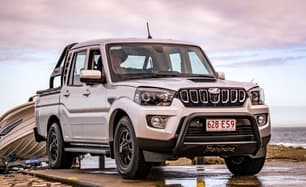
What's the difference?
The current generation Mahindra PikUp has been with us since 2007, which is a long time given major players in this market tend to introduce a new generation every decade, or close to it.
However, with Mahindra reportedly developing an all-new ute, based on the underpinnings of its latest Scorpio SUV, the budget-priced PikUp is destined for retirement within a few years.
Better late than never, the latest MY23 version of the S11 dual-cab has for the first time been equipped with an automatic, which is sure to increase buyer appeal in a market in which self-shifting transmissions rule.
We recently revisited this Indian-built dual cab to see how it measures up for tradies in such a competitive market.
In the realm of family friendly mid-size SUVs, few names have the same reputation as Mitsubishi’s Outlander.
While this new one looks almost identical to the previous version, it’s hiding some serious, Australian-flavoured changes under the skin.
But in a segment now full of not only upgraded mainstream rivals, but also new cut-price alternatives from China, does such a modest upgrade to the Outlander do enough to deserve your consideration in such a crowded market?
We went to its Australian launch to find out.
Its sub-$40K pricing undercuts the cheapest Ford Ranger or Toyota HiLux 4x4 equivalents by $10-15K and it’s backed by a decent warranty and 60-strong dealer network (mostly regional). It’s also largely absent from the federal government’s vehicle-recall listings, which suggests solid build quality.
However, it’s also short on safety, has relatively high servicing costs and numerous design quirks. Fact is, such low pricing comes with compromises, so, if you can learn to live with those, this sturdy and willing auto-equipped workhorse could represent good value for those shopping on a budget.
Mitsubishi has leaned into its strengths with this Outlander update, spending its money in subtle areas to upgrade what was already a widely appealing mid-size SUV.
The local tuning has made a notable difference to the refinement and comfort of this version, while subtle updates to the software and interior trim help to refine things even further.
If you’ve had an Outlander before, you’ll love this one, although it doesn’t help the brand to challenge new players on the value front. This leaves you with the decision of whether to pick a brand with the reputation and network of Mitsubishi, or roll the dice on a far more affordable new player.
For what it’s worth, it’s genuinely tough to pick a sweet spot here. I think the best picks are at either end of the spectrum, with the ES being outstanding value, and the Exceed being particularly plush.
Note: CarsGuide attended this event as a guest of the manufacturer, with travel, accommodation and meals provided.
The PikUp has a 3040mm wheelbase and 5175mm length, 1820mm width and 1915mm height.
So, compared to a Ford Ranger XL equivalent, it’s 230mm shorter in wheelbase, 195mm shorter overall and 98mm narrower, so it’s relatively compact for a dual cab ute.
Built on a traditional ladder-frame chassis, its twin-wishbone front suspension uses torsion bars instead of the more common coil springs, while under the tail is a leaf-spring live rear axle. Brakes are front discs and rear drums.
With 210mm of ground clearance, its steep 34-degree approach angle is excellent but its 15-degree departure angle is less than half that figure, so it's prone to tail-dragging in the rough stuff.
And its bafflingly large 13.4-metre turning circle (kerb-to-kerb) demands numerous three-point turns.
The interior appears to have a good standard of finish and provides a visually-pleasing mix of black and grey surfaces with satin chrome highlights throughout. Driver controls are easy to see and operate and the front bucket seats are comfortable.
The rear bench seat is quite firm with good lumbar support, but it’s a squeeze for three adults given its relatively narrow width.
Even so, there’s adequate kneeroom and heaps of headroom even for tall adults, which is no doubt appreciated by hat-wearing farmers and tradies.
Blink and you’ll miss the changes. Actually, squint and you still might miss them. Aside from the eye-catching new 20-inch wheels on the Exceed and Exceed tourer grades and the new ‘Moonstone Grey’ paint colour, it’s hard to tell the new Outlander apart from its predecessor.
Look closer and there’s new lower garnish designs front and rear, a tweaked grille and a smoked appearance for the rear tail-light clusters.
It’s very subtle stuff, but Mitsubishi has chosen to spend its time and money on upgrades on unseen areas.
For example, the bonnet is now steel rather than aluminium, which helps with noise insulation (and also has the side-effect of removing the high-speed ‘fluttering’ effect the aluminium bonnet had on the previous version), there’s additional sound insulation throughout the car, and cladding in the transmission tunnel to make the cabin a quieter place.
Back on the topic of appearance, though, the dash and console has also been tweaked a little. For example, the new screen looks a bit more contemporary, with a much smaller bezel and more attractive software. The console has been rearranged to move the bottle holders to one side of the electronic gear shifter, which makes for a larger centre console.
High-grade leather seat trims also now have alternate patterns, but the range follows the same trims, from cloth on the ES and LS, while the Aspire gets a microsuede and synthetic leather blend, while the Exceed and Exceed Tourer get the ‘high-grade semi-aniline’ leather trim.
With its 2115kg kerb weight and 3150kg GVM, the S11 PikUp offers a 1035kg payload rating so it’s a genuine one-tonner.
It’s also rated to tow up to 2500kg of braked trailer but given Mahindra doesn't publish a GCM rating (or how much it can legally carry and tow at the same time) we don’t know if it can retain its maximum payload while towing that weight.
Strangely, the load tub does not have any internal load-anchorage points. The only option for securing ropes or straps are external hooks, which are located along both upper sides of the tub and across the tailgate.
However, these would be ineffective in securing loads that are lower than the tub sides.
Front cabin storage is limited, as there are only narrow bins and no bottle holders in the front doors and you won’t find any cup/bottle holders or storage for small items in the dash, either. However, there is a single glove box and an overhead glasses holder.
The centre console has an open storage tray at the front and single cup and bottle holders in the centre, which are fine for one occupant but not two.
In contrast to the front doors, there are no bins in the base of each rear door, but they do get a large-bottle holder and what looks like a phone holder at mid-height.
There are also pockets on each front seat backrest, but the fold-down centre armrest does not have any cup/bottle holders.
The rear bench seat’s base cushion is fixed, so it can’t swing up and be stored vertically (like many dual cabs) if more internal cargo space is required.
However, it does at least provide some open storage space underneath for soft items like jackets etc.
The previous Outlander was already known for having a spacious and versatile cabin, and this continues for the new car with a few small tweaks.
The width and satisfying seat positioning continue, and seats in all grades are generous and comfortable, but particularly the leather seats on the Exceed and Exceed Tourer grade we tested.
Adjustability is good in all positions, and the digital instrument cluster has an attractive dual-dial layout and functional display options. While not the best in class, it’s far better than many rivals.
The touchscreen’s new software is meant to be faster, but I found it a bit laggy still, although the integration of Google’s API into the navigation suite is an excellent tweak, making it relevant and useful for much longer.
The tweaks to the centre console make the area more space efficient and useful, but the new cupholders seem strangely shallow, potentially causing large bottles to tip. The tweaked centre console box is nice and large, and the wireless charger is nice and accessible, although its surface is not quite rubbery enough to stop your phone from leaving the charging area in the corners.
The back seat is noticeably stadium – you sit a fair bit higher than in the first row, which eats into headroom in cars equipped with a sunroof for adults. However, width is good, as is the seat comfort.
The rear doors open nice and wide, which should make fitting a child seat easy enough, and the floor is surprisingly flat, too, which makes the middle position more useful.
The third row, which I sampled in an Aspire grade, is both hard to get into and tight once you’re in there. The second row can slide forward on a rail, offering just enough room for me, at 182cm tall, to fit back there, with my knees hard up against the seat in front, and my head nearly touching the roof.
It is for this reason Mitsubishi calls seven-seat versions ‘5+2’. Good for kids, maybe, but not adults for any extended period of time.
The boot is enormous with two rows in use (485 litres in five-seat versions, or 478 litres in seven-seaters), and for this update, the space now has a wider aperture that should make loading objects easier. Space with seven seats up is 163L. Five-seaters get a full-size spare under the floor, while seven-seaters get a space saver.
Braked towing capacity is a middling 1600kg for petrol-powered variants. The brand says not many Outlander buyers are focused on towing as a key capability for the mid-sizer.
Our S11 PikUp test vehicle is available only with a 2.2-litre four-cylinder turbo-diesel engine and new Aisin-sourced six-speed automatic, for a list price of $38,500, drive-away.
Our example is also equipped with a Mahindra genuine accessory winch-compatible steel bull-bar which adds $3500 (fitted).
The S11 comes standard with 16-inch alloy wheels and 245/75 R16 tyres with a matching spare.
There’s also LED daytime running lights and dusk-sensing halogen headlights with static bending (which automatically illuminates inside kerbs when cornering at night), front fog lights, rain-sensing wipers, side-steps, rear sports bar, load tub-liner, automatic rear diff-lock, reversing camera and more.
There’s fabric-trimmed seating for up to five occupants, with the front bucket seats equipped with unusual but welcome fold-down inboard armrests.
There’s also a USB port, two 12-volt outlets, centre console air-vents for rear passengers and a multimedia system controlled by a 7.0-inch touchscreen with multiple connectivity options, including links for Apple and Android devices.
Mahindra also offers a genuine accessories range, from towbars, nudge bars and bullbars to engine snorkels, wheel options and lots more.
Let’s get the bad news out of the way first: prices are up across the whole Outlander range.
The increases are modest, contained to between two to three thousand dollars across this mid-size SUV’s sprawling eight-variant range.
It sounds like an overwhelming number of versions but the Outlander is split across five grades in front- or all-wheel drive, with either five or seven seats.
Check out our pricing table below for the detailed prices before on-road costs:
Traditional rivals in the 5+2 mid-size SUV category include this model's platform-mate Nissan X-Trail (from $38,025 - $59,265) and the Honda CR-V ($41,900 - $59,900), with the Hyundai Santa Fe ($53,000 - $72,500) and Kia Sorento ($50,880 - $84,660) being a price-bracket above.
The biggest issue is the Outlander is facing increased competition from models like Chery’s Tiggo 7 (as a five-seater), which can be had for as low as $29,990 drive-away! Even the most expensive version of the Tiggo 8 (seven-seater) in plug-in hybrid form costs the same as a mid-grade Outlander, at $49,990 (d/a).
Options like this put the choice back in your hands. You can choose a brand with the heritage and support network of Mitsubishi, or you can go with the value of a new player yet to put those runs on the board.
Although it has an almost identical visage to the previous car, there are some major upgrades hidden below the metal. Sure, there’s a tweaked equipment list, but importantly, there’s a completely revised ride and handling tune, which was developed by Mitsubishi right here in Australia using local expertise.
It’s a similar program to the successful ones undertaken by Kia and Hyundai in recent years to improve the handling of their cars, and Mitsubishi in Japan was impressed enough with the depth of the changes that most of them have been adopted to the global tune for the car.
On the topic of standard equipment, LED interior lights and the 12.3-inch digital dash have been made standard across the range, there is now seat ventilation to join the seat heating for the front two positions in the top Exceed and Exceed Tourer grades, while the upper mid-spec Aspire grade scores front seat heating and a heated steering wheel.
The 12.3-inch multimedia screen has also been upgraded, featuring a smaller bezel and more processing power for a faster response rate, as well as a tweaked software suite with a new layout. This screen also hosts wireless Apple CarPlay and Android Auto across the range.
In addition, there’s also the introduction of the Mitsubishi Connect phone app, which features a range of safety and security features, as well as the ability to remotely control things like the ignition, climate system, navigation and locking system.
Across the range the audio system has also been upgraded to an eight-speaker Yamaha-developed system, with the top-spec Exceed Tourer grade scoring a 12-speaker Yamaha system with up to 1650W of power.
The interior now uses higher-quality materials, according to the brand, with extended upholstery across the range. The top-spec Exceed Tourer also scores a new brown interior colour.
A 360-degree parking camera is now standard across the range, and the safety suite also includes the driver monitoring system and traffic sign recognition system as also used in the Triton.
The plug-in hybrid version, which is what the Outlander is arguably most famous for, is not yet available, but Mitsubishi tells us it will arrive in a few months time, at very least before the end of 2025, and it, too, will carry an Australian-developed ride and handling tune.
The latest version of the S11’s 'mHAWK' 2.2-litre four-cylinder turbo-diesel meets tough Euro 6b emissions standards using AdBlue.
Armed with an intercooler and common-rail fuel injection, it produces a modest 103kW at 3750rpm. Its 320Nm, available across a 1300rpm-wide torque band between 1500-2800rpm, highlights good flexibility particularly under load.
It’s coupled with an equally refined Aisin-sourced six-speed torque converter automatic transmission, driving the rear wheels and offering the choice of sequential manual-shifting.
There’s also a Borg Warner part-time dual-range 4x4 transfer case and an Eaton automatic rear diff-lock.
The petrol-powered Outlander soldiers on with a drab non-turbo, non-hybrid 2.5-litre four-cylinder engine, mated to a continuously variable automatic transmission.
The brand calls this combination “proven” and it’s hard to argue given it hasn’t cropped up with any major reliability issues in the pre-facelift car.
Still, it produces a middling 135kW/244Nm, not as punchy as many turbo options, and nowhere near as efficient as hybrid alternatives.
Those seeking a more powerful fuel-sipping option may want to wait for the PHEV version arriving later this year.
Mahindra claims an official combined average of 9.3L/100km. At the conclusion of our 265km test, which was conducted without a load and in mostly city and suburban driving, our ‘real world’ figure based on fuel bowser and trip meter readings came in at 9.4 which is lineball.
So, it should deliver an excellent driving range of around 850km from its 80-litre tank.
As a result of its relatively old-school sounding powertrain, fuel consumption isn’t at the forefront of the petrol-powered Outlander, with official consumption ranging between 7.5L/100km for the lightest five-seat ES 2WD version, to 8.1L/100km in the heaviest, top-spec Exceed Tourer AWD.
C02 emissions are also on the high side, which the brand will no doubt be off-setting with the new PHEV version which will offer even more emissions-free driving range than before.
One benefit of this long-serving engine, though, is it can be fed entry-level 91RON unleaded, better for the back pocket. The petrol-powered Outlander has a 55-litre fuel tank.
The fold-down inboard armrest combined with the door’s armrest allows the driver to evenly rest both elbows, which reduces strain on shoulders and arms particularly during long highway hauls.
This set-up could work even better if the wheel had reach adjustment in addition to its adjustable height.
There’s no rake adjustment in the seat’s base cushion, either, but fortunately there’s a big left footrest to help the driver to maintain a comfortable posture.
The driving position is high relative to the bonnet and the tops of the doors, which is ideal for vehicle placement when off-road driving as it provides commanding views over the front and out the sides.
Unladen ride quality is quite firm, as you’d expect of a 4x4 designed to carry one tonne of payload, but is supple enough to provided acceptable comfort.
The steering weight is linear with easy turning effort; handling and braking response is satisfactory and engine and tyre noise are pleasantly low.
Our only major gripe is the huge turning circle, which is nudging that of a full-size American pick-up. The need to often do three-point turns, in situations that you really shouldn’t have to in a vehicle of this size, is annoying (and in some situations embarrassing).
Although its 2.2-litre diesel has modest outputs, it provides decent performance in city and suburban driving with its smooth-shifting auto.
It’s also a low-stressed highway cruiser, requiring less than 2000rpm to maintain 110km/h which is comfortably within its peak torque band.
We didn’t get to do our usual GVM test due to a hiccup with our weight supplies, but we have previously tested a cab-chassis PikUp with just under one tonne of payload (990kg) which it hauled with an all-round competence that belied its relatively small engine output.
The Australian team had a significant amount of input on the driving dynamics of this new Outlander, but does it make a big difference behind the wheel?
We were granted the chance to drive the old one alongside the new version to find out, and the changes are significant.
Overall, the character of the car hasn’t been fundamentally altered. This is still a somewhat plush and soft-around-the-edges family SUV, but redeveloped new suspension parts and even very minor, nerdy modifications like the thickness of sway bars have added up to a much more pleasant vehicle to spend an extended amount of time in.
The first thing you’ll notice is the retuned steering. Mitsubishi’s engineers tell us the tweaked feedback was all down to the software in the rack, and it’s a big difference, upping the firmness of the steering at low speeds, keeping the vehicle on track with more confidence while heading straight, and also removing a slight twitchiness with sudden adjustments.
Next is the cabin ambiance. The new Outlander is a relatively quiet place to be thanks to the extra insulation throughout. It combines with the new steering to give the car much more of a sense of heft than before. The engine is reduced to a distant thrum, and the road is damped away for the most part. Mitsubishi says the 20-inch wheels are a particular hit with buyers, which to me is a shame because I’m willing to bet it’s particularly comfy on the lower-grade tyres.
Elsewhere, the Outlander has a softer initial response to bumps thanks to retuned shocks, and the reduced width of the front sway bar makes for less ‘head toss’ for front seat occupants.
Does it make a significant difference? Yes. The new Outlander is all-round better balanced and better suited to our road conditions. It might not have the sophistication of more expensive options, and it still might be a tad off what the also balanced-and-comfortable RAV4 offers, although it will be interesting to get one back to see how it compares to rivals in a like-for-like test.
Just expect a much more comfort-oriented option than some rivals. These changes don’t make the Outlander as fun to drive as a Mazda CX-5 or a Skoda Kodiaq. For example, while the 2.5-litre engine and CVT combo provides a surprisingly urgent initial response, it's a dull, rubbery power application from there on.
ANCAP only awarded it three out of five stars - and that was back in 2012. There are dual front airbags for driver and passenger, electronic stability control and ABS plus a reversing camera and LED daytime running lights.
There are also ISOFIX child seat anchorages and top tethers on the two outer rear seating positions.
The Outlander has a robust array of active safety kit, with all the key gear like autonomous emergency braking, lane support, blind-spot monitoring and rear cross-traffic alert available across the range. Traffic sign recognition and driver attention monitoring is now available from the new Triton, however it is also worth noting some relatively minor items are only available on higher grades.
The ES and LS grades miss out on adaptive high beams, traffic jam assist and steering assist (although they maintain lane departure warning and lane-keep assist).
Mitsubishi is hoping the updated Outlander will qualify for a continued five-star ANCAP safety rating held by the pre-facelift model.
During our drive we also found the lane-keep and driver attention software (which was much-derided at the launch of the Triton) was reasonably well behaved, with the brand saying it had had significant software tweaks over time to make it less invasive. We’ll need to save our final verdict on this system for when we spend an extended time behind the wheel.
Warranty is five years/150,000km. 12 months roadside assist is renewable with each scheduled service at Mahindra dealers.
Service intervals are 12 months/15,000km whichever occurs first.
Capped-price servicing for the first four years or 55,000km totals $2296, or a pricey average of $574 per service.
Mitsubishi continues to offer its near-industry-leading 10-year/200,000km warranty, conditional on the car being serviced at a Mitsubishi dealer. Otherwise, it reverts to a five-year/100,000km promise.
The 10 years of warranty is joined by 10 years of capped-price servicing required at 12 month or 15,000km intervals.
Prices are tame, varying between $320 and $680 per visit, for a total yearly average of $434. It’s not the cheapest yearly average out there, but most brands also don’t have capped price servicing extended this far, so it seems like a good deal regardless.