What's the difference?
Remember when Lexus design was about as adventurous as a warm cup of tea and a good lie down?
The Japanese luxury brand (and Toyota’s more expensive little brother) wasn’t exactly famed for taking risks on boundary-pushing looks. And that's not even me being mean - its own executives say they favoured conservatism over all else when working on an a new model. And thus everything looked like it was designed by a 75-year-old Japanese man, largely because it had been.
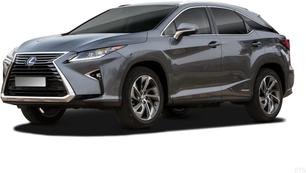
But gazing upon the angry, jutting jawline of the Lexus RX, those play-it-safe days suddenly feel a long time ago. If this RX isn’t the most striking (for better or for worse) SUV in its premium field, it’s got to be pretty darn close.
The cheapest and most youth-oriented model in the RX family is the 200T, making use of a 2.0-litre turbocharged petrol engine to propel the big SUV. And the one you see in these pictures is the F-Sport model, which scores a bespoke bodykit, unique alloys and other styling stuff to make it look even more aggressive on the road.
Having received its last major update in 2015 (but with a mid-life tweak just around the corner) this RX is starting to get on a little bit. So we spent a week in the 200T to see if it's still able to mix it with the best in the segment.
Following the money comes pretty naturally to carmakers. It’s what happens when the product planning department smells a new direction on the breeze and then handballs that to the design and engineering folks who turn a perceived market trend into a showroom reality. And when everybody gets it right, you have a new default product. And everybody else has to keep up. Some even have to catch up.
We’ve seen it plenty of times before, too. Think about those early 1980s days when the default small car went from a sedan to the five-door hatchback. Didn’t that catch on? You might also remember more recently when a family car had to be a four-wheel drive. And what about the dual-cab ute revolution of the last 15 years?
The other strident market segment right now is the SUV, of course. And within that, most recently has been the march to electrification, starting with conventional hybrid technology and now progressing to the new must-have, a plug-in hybrid platform.
The fact is, if you’re a Chinese carmaker intending to sell on a world stage, you can’t ignore the plug-in SUV in any of its various sizes and marketing segments. There’s a good basis for this, too. Plug-in hybrids just make good sense. They offer the urban running-cost advantages of any hybrid, the option of zero tailpipe emissions, all-electric running over a normal commuting distance and – crucial for a big country like this one – they’ll keep motoring along for as long as the owner puts petrol in them.
Okay, so they can be heavy with all that tech on board, and there’s no denying that two power sources (petrol and electric) make for a more complex machine, but the advantages outweigh the downsides for many buyers.
The other graph you can plot with great certainty is that new tech will get cheaper as the industry moves forward. Which is exactly where BYD finds itself right now by being able to offer a plug-in hybrid variant of its Sealion 5 mid-sized SUV at a price that will have much of the opposition running scared. But how scared should the others be?
Big, practical and comfortable, the Lexus RX 200T F-Sport deserves its place in the premium SUV pantheon. And don't let the little engine fool you, the turbocharged four-cylinder unit serves up plenty of poke to get the RX moving. But if it's fancy new technology that really excites you, prepare for mild disappointment, with the RX's in-cabin tech feeling a little underwhelming.
Cars that don’t always appeal to enthusiast buyers are often seen by manufacturers as a way of not bothering with the dynamics. Good enough is, apparently, good enough. Thankfully, BYD hasn’t taken that path here and the local suspension tweaks have turned what could have been a me-too product into a bit of a dynamic class leader. And even if buyers can’t verbalise the benefits of that, they will still be subliminally enjoying them with every kilometre.
The other stand-out feature is the price-tag which represents an awful lot of car for the money. And, in such a price-sensitive market as this one, that will get the BYD over the line for a lot of families. That it also offers a vastly better driving experience simply makes the value equation – and the purchasing proposition – even stronger.
Angry, aggressive and very un-Lexus, with a jaw that looks like Ivan Drago somehow transformed into an SUV - that pretty much sums up the RX.
Lexus is already on record as saying its designers had mistakenly tried to make their cars appeal to everyone in the past, and so they ended up boring and tame as a result.
Now they're happy if one person in 10 really loves them. Exactly where you sit on that scale is up to you.
Up front, that 'Spindle Grille' (shaped a little like the Predator’s mouth) serves up plenty of road presence, while the sharply angled fog-light housings and deeply domed bonnet give it a more powerful stance than perhaps is justified by its 2.0-litre engine.
Side on, the big and shining alloys, deep curve above the base of the doors and flared, squared-off wheel guards add plenty of personality to what could have (and in the past, would have) otherwise been a long and featureless stretch of metal.
Step inside and the cabin is premium-feeling, if a little busy, with the doors and dash covered in a combination of soft-touch materials and padded leather. The brushed aluminium-look central tunnel that separates the front seats is super wide, as it houses the the cupholders, drive-mode selector and the strange mousepad that controls the entertainment system, but feels nice under the touch and becomes a kind of focal point in the cabin.
The interior of the Sealion 5 feels pretty well-made and there are soft-touch surfaces on most of the touch-points. The steering wheel, too, is thick and chunky and nice to hang on to. But there’s a lot going on in terms of different colours, textures and surfaces, and it can all look a bit busy, despite the high-tech boardroom overall flavour. It’s also worth mentioning the trim material is synthetic but does a great job of looking and feeling like real leather.
Externally, there’s not a lot to grab the eye. Sure, it’s not an unpleasant looking vehicle, but neither does it stand out from the mid-size SUV pack. At least BYD decided against those cheap-looking plastic tack-ons on each wheel-arch.
Australia’s laser focus on small and city-sized SUVs has been so intense that’s it’s easy to forget the joys of our bigger cars. Stretch out in the 4890mm long and 1895mm wide Lexus NX and it all comes flooding back.
There’s plenty of space for up-front riders (even with the football pitch-sized centre console), as well as two cupholders and extendable pockets in each of the front doors. The cubby that splits the front seats is ridiculously deep, too, and is home to two USB connections, a power outlet and and aux-in point.
Step into the back seat and you’re greeted by plenty of space in each of the window seats, although the central stack that houses the air vents and another power outlet does jut out into the legroom of the middle-seat passenger. There are two bonus cupholders hidden in a pulldown divider that drops from the middle seat, and two ISOFIX attachment points, one in each window seat in the back.
Rear seats in place, the RX serves up 453 litres of luggage space, although you can stretch that to 924 litres by folding the backseats flat.
Here’s the other big shock relative to the price-tag of the Sealion 5: This is not a small car. Based on the price, you might have been thinking the vehicle would be a compact SUV. And you’d have been wrong. This is a proper mid-sized SUV with room for five and luggage and an overall length of 4.7 metres and change. And to put that into some kind of perspective, that’s just 30mm shorter than the Sealion 6 which costs about $9000 more at its starting point.
The wheelbase is long, too, and the 2712mm between the axles helps make the interior even more spacious. That means there’s lots of stretching room in the front, but also that a grown adult can comfortably sit in the back seat behind another grown adult at the wheel and still have enough room in every direction. The window sills are commendably low in the rear seat, too, ensuring even littlies can see out.
The biggest problem in the back is that the seat cushion is a bit flat, but, like the front chairs, it’s still pretty plush.
With all five seats in place, the Sealion 5 boasts 463 litres of luggage space and the cargo area is well done with storage pockets at each side, a light and an under-floor tray designed to transport charging cables and a tyre repair kit. Yep, that’s right, there’s no spare tyre of any sort here. No surprise, really.
Fold the rear seat down and you’re suddenly looking at 1410 litres of cargo space and your SUV is now a panel van.
As well as the dual-zone climate control, the Sealion 5 also offers a single USB -C and a USB-A charging port in the front and rear compartments.
The Sealion 5 also offers a V2L (Vehicle to Load) function, meaning it can power camping or on-site work equipment and even act as your home’s battery.
You’ll part with $86,551 for the Lexus RX 200T F-Sport - about $12k more than the non F-Sport model. And that’s not chump change. But your money does buy you 20-inch alloy wheels, proximity unlocking, LED head and tail-lights, roof rails, a powered boot and a huge powered sunroof.
In the cabin, you can expect leather seats, dual-zone air-con and push-button start, while technology is handled by a nav-equipped 12.3-inch screen that partners with a 15-speaker Mark Levinson stereo that's standard on this F-Sport-stamped model (the cheaper version makes do with a smaller screen and fewer speakers).
The plug-in hybrid in question is the BYD Sealion 5. It has a claimed EV-only range of better than 100km, relatively quick charging, a decent sized battery, adequate performance, enough interior space for a family, good safety and lots of equipment. Oh, and it costs just $33,990, before on-road costs, in its entry-level Essential form. Incoming!
Equipment-wise, that sub-34K sticker gets you a 10.1-inch central info-screen, an 8.8-inch driver display, digital radio, a six-speaker stereo, wireless connectivity for Android Auto and Apple CarPlay and dual-zone climate control.
Throw another four grand on the table and you move up to the Premium version which adds plenty of kit for the $37,990 ask. That includes a panoramic sunroof, automatic tailgate, roof rails, heated and electrically folding mirrors, one-touch power windows, a six-way powered drivers seat and four-way powered co-pilot’s chair, a heated and ventilated driver’s seat and wireless charging.
The step up from Essential to Premium also includes a battery upgrade, and we’ll cover that off in the Under the Bonnet section below.
There was a time not so long ago when the thought of fitting a four-cylinder, 2.0-litre engine to a near two-tonne SUV would be truly torturous.
But turbocharging has become so clever that the smallest engine in the RX range never feels underpowered. It'll serve up 175kW at 5600rpm and 350Nm at a low 1650rpm - enough to push the big Lexus from 0-100km/h in just 9.2 seconds. That power is fed through the a six-speed automatic and sent to the front wheels.
Both variants of the Sealion 5 have the same driveline – mostly. They each use a 1.5-litre petrol engine teamed with a single electric motor, both driving the front wheels. Unlike the bigger Sealions, there’s no all-wheel drive version. Power peaks at 156kW and torque at 300Nm.
Why a non-turbocharged engine? BYD tells us the non-turbo engine helps keep cost out of the vehicle and, since the engine really only runs to power the electric motor and charge the batteries, it does so at a relatively constant engine speed, negating the need for a wide spread of petrol power.
The only major difference is that the Essential version has a 12.9kWh battery-pack, while the Premium gets a bigger, 18.3kWh pack for longer range, but precisely the same output and, therefore, performance.
A single-speed transmission is part of the BYD driveline package, also made possible by the fact that the vast majority of the driving of wheels is done by the electric motor.
Lexus claims a 8.1 litres per 100km on the claimed/combined cycle (though we returned a much less happy number - one that started with an 11...).
Emissions are pegged at 189g/km of CO2 on the combined cycle, and the big Lexus' 72-litre fuel tank requires 95RON fuel.
The Premium’s bigger battery claims to up the official NEDC range from the Essential’s 71km to 100km. BYD reckons with the 52-litre fuel tank brimmed and the car operating at its claimed 1.2 litres per 100km efficiency, the range of either version is just on 1000km. In the real world, that’s likely to be closer to 800km (especially with some highway running thrown in) but it’s still one heck of a solution to range anxiety.
There’s no DC charging function for the Sealion 5, so forget about commercial fast chargers. But on a 3.3kW AC power outlet, the maker claims the Essential can reach full charge in under four hours, while the Premium’s bigger battery will take under six hours to fully charge. A Type 1 charge cable is included.
Your love for the RX will likely depend on your priority list. Do you want the latest gadgets, a seamless multimedia interface and the kind of cool technology you can show off to your passengers?
Well, um, perhaps best keep looking, then. The in-cabin tech here feels a little off the pace now, and that cursed mouse-style controller still frustrates the bejeezus out of me.
But if a smooth, easy and quiet drive sits atop your list, then the RX 200T will grab you in all the right places. Probably most impressive, it doesn't feel overly large and cumbersome, and is equally at home in the cramped inner city as it is eating up kays on the freeway.
The gearbox is silky-smooth seamless, switching between cogs without you even noticing, and the cabin is commendably quiet - especially when you're coasting though the ‘burbs - locking the worst of the outside word out of the cabin. The ride has clearly been engineered to iron out small, sharp road imperfections, but you can bounce around a bit in the cabin over speed bumps.
There was a time not so long ago when the thought of fitting a four-cylinder, 2.0-litre engine to a near two-tonne SUV would be truly torturous.
You can spice things up a little by selecting Sport or Sport + via the central dial and, while there’s no noticeable change in exhaust, the accelerator gets noticeably more sensitive and the gearing more aggressive; more wiling to hold a lower gear for longer, squeezing the most out of that little engine.
It can feel a little heavy when you first brake into a corner, but beyond that the steering is smooth, predictable, and without a lot of dead-air play. It’s not a sports car by any measure, but it doesn't feel like you’re constantly dragging a big, heavy SUV around, either.
But be warned, it’s not the most engaging of drives. This is not a car you'd ever wake up excited to run out to. It’s comfortable, capable and engaging enough, sure, but it never really stirs your emotions.
You don’t have to drive very far to realise that the local input into the Sealion 5’s suspension and steering have been worth the effort. BYD Australia has a local engineering team on call these days, and it shows here.
Actually, the steering is not the highlight; it has some weight but not a whole lot of feel, or, indeed, feedback for the driver. The ride and handling combination is what stars. Obviously well-damped, the suspension allows for a ride that is both complaint and quiet, without causing the car to wallow around like some jacked-up designs can with their higher centre of gravity.
In fact, the BYD is athletic to the point where keener drivers will find it an entertaining drive; hardly something that can be said for the majority of medium SUVs.
Performance is strong without being overwhelming and even though the Sealion 5 has that signature electric-drive feeling of effortlessness, the accelerator pedal has been calibrated to avoid the neck-snapping surge of grunt off the line. As such, it emerges with a fairly flat acceleration curve, and no hint that the petrol motor is cutting in or out.
Until, that is, you bury the throttle all the way at which point the petrol engine takes a few second to join in. And when it does, it’s pretty vocal – shrill, almost – as it catches up with the rest of the car and starts directly driving the wheels. To be fair, though, this is not going to be a common occurrence in everyday life thanks to the flexibility of the petrol-electric system for 99 per cent of circumstances.
On the move, the cabin is perhaps most notable for its soft, plush seats that are a nice change from the church pews of some manufacturers. And although the driving position is about right, taller drivers might prefer a steering column that extends out another few millimetres.
The driver display screen is another source of annoyance. It’s pretty small and contains lots and lots of information, to the point where the typeface is too small to be read on the run by anybody who relies on reading glasses.
There's no shortage of cushioning safety in the RX, with 10 airbags as standard. They join a parking camera, front and rear parking sensors and rear cross-traffic alert.
Lane-departure warning and assist, blind-spot monitoring, active cruise and AEB join the list, too. All of which were enough for the Lexus RX to nab the maximum five-star crash rating when tested in Europe - a score that has since been adopted by ANCAP in Australia.
Passive safety in the Sealion 5 starts with no fewer than seven airbags including full-length side-curtain bags.
There’s also a front-centre airbag, something we’d like to see in more cars, particularly at this price-point. Child restraint points in the rear seat are the ISOFIX type.
The BYD gets pretty much the full suite of driver aids, including autonomous emergency braking, blind-spot monitoring, rear-cross traffic alert with active assistance, stability control, active cruise-control, traffic-sign recognition, front and rear collision warning and tyre pressure monitoring.
The Sealion 5 also incorporates a driver-attention monitor which seems better calibrated than some earlier efforts from some of the Chinese carmakers. Also improved in calibration terms is the lane-keeping assistance which is still too violent for our tastes, but more subtle than some of the competition’s systems. But while the savagery of this system has been toned down, it appears to have been at the expense of sensitivity and, time and time again, the cameras missed road markings that were faded or dirty.
The major safety benefit in paying more for the Premium variant is the addition of front parking sensors and a 360-degree camera instead of the Essential’s simple reversing camera.
The Sealion 5 has not been ANCAP tested as yet, although BYD says this is largely down to ANCAP’s scheduling rather than any hesitance on BYD’s part.
Expect a four year/100,000km warranty, with a trip to the service centre required every 12 months or 15,000km. And when the car does have to go back for a service, Lexus has received much praise from owners for offering a choice between a loan car, or a pick-up and delivery service from your home or office.
Like other BYDs, the Sealion 5 comes with a six-year/150,000km warranty. Some of the competition have unlimited kilometre warranties, but to be honest, 150,000km in six years is going to be beyond the need and aspirations of most owners.
The EV battery is covered by an eight-year/160,000km warranty, and let’s not forget, BYD was a battery manufacturer before it started making whole cars. Certainly, the company is very bullish about the quality and safety of its 'Blade' battery technology, claiming it easily passes the technically-daunting 'nail-puncture' test.
BYD plans to have capped-price servicing for the Sealion 5, but no pricing announcements have been made yet.
Servicing also falls into line with other BYD models, so that means 12 months or 20,000km intervals.