What's the difference?
When you look at a Lexus LX, you see a distinct resemblance to a Toyota LandCruiser. That’s understandable given that, fundamentally, the Lexus LX is a comprehensively gussied-up Toyota LandCruiser.
Built to put the luxury brand into the large SUV game, and taking advantage of Toyota's huge product portfolio, it's clear that this is not for chucking down the side of a mountain (although it can absolutely do that if asked, as long as you're on good terms with your local paint shop).
Lexus is - or more accurately, LX buyers are - very clear about how folks use the LX: it’s a city car. So it's got all the sophisticated city looks, with skirts and bling and big shiny alloy wheels. Whether there's a point to all that is irrelevant - there are clearly people, like you, who want a posh LandCruiser.
Let’s make one thing clear from the very beginning - this new Mercedes-AMG GLC63 S E Performance is technically superior to the model it replaces. Whether it’s actually better or not, is the real question at the heart of the matter.
Why? Because, like the C63 sedan stablemate, AMG has opted to replace the previous model’s 4.0-litre twin-turbo V8 engine with a new 2.0-litre four-cylinder hybrid powertrain. It was a move brought about in part because of increasingly stricter emissions standards in Europe, but also ties-in with the German firm’s success in modern Formula One racing.
While the new hybrid system offers more power, more torque and better fuel economy, as the lukewarm response to the C63 has demonstrated, the hard reality for AMG is that its buyers associate it with V8 and even V12 engines. That emotional pull is hard to replace with logic, even if the new model offers technical superiority.
But how does the new powertrain suit the GLC63 - is it just technically better or is it holistically improved?
The Lexus is awkwardly big and not very fleet of foot when you're negotiating the commute to work, school or the shops. It slurps fuel at a rate we're not used to seeing these days and it's not the easiest to park, even with all of its cameras and beepers.
The LX is far more at home out on the highway, where it is incredibly comfortable and quiet. One imagines the diesel entry-level model would do it all, but with less consumption. If you must have a V8, the LX 570 without the S might be even more comfortable without the sports dampers.
Either way, it's a lot of car for the suburbs.
Like I said right from the start, this new, hybrid version of the AMG GLC63 is technically superior to the model it replaces in every meaningful way. It is faster, more powerful and more fuel efficient and therefore a better performance SUV than the model it replaces.
Is it a better model than the one it replaces? Ultimately that will come down to how much stock you put into the soundtrack and your feelings on an AMG not powered by a V8 engine.
Because if you can see past that, then the AMG GLC63 is an absolutely fantastic performance SUV. Not only does the new powertrain make it faster in a straight line, but the chassis is very well-balanced, making for an engaging driving experience.
For those who can look past the smaller engine they will be rewarded with an incredibly fast and rewarding-to-drive member of the AMG family.
Note: CarsGuide attended this event as a guest of the manufacturer, with travel, accommodation and meals provided.
The LX came in for a facelift in 2021, perhaps to differentiate it from its Toyota sibling and, according to the press release, “ its level of urban sophistication.” That kind of tells you where this car is going to spend all of its time, doesn’t it?
There’s the new spindle grille that dominates the nose, with some clever detailing to make it look a bit more sporty and dramatic. Around the car there are modified bumpers, skirts, new wheel designs, all that kind of thing. It does look sportier, but there’s no way to hide the visual bulk of such a big unit.
The interior is largely unchanged and the ruggedness is softened somewhat by semi-anline leather trim and alloy sports pedals. It’s terribly conventional and very usable, but there’s none of the excitement or innovation you'll find in other, more recent Lexus cabins.
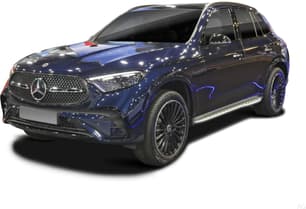
The GLC63 is unmistakably an AMG from the moment you first lay eyes on it. That’s thanks to the AMG-specific elements, starting with the grille with vertical strikes and the AMG crest on the bonnet; which is now a signature item for the performance sub-brand.
The GLC63 is also fitted with the Night Package II design kit; this adds a darkened grille and black chrome badging to further enhance its visual appeal.
The AMG-specific alloy wheels and more aggressive stance do mean the GLC63 stands out from the rest of the GLC range, helping it look fast even when it’s standing still.
Hellooo?! I think there’s an echo in here. This is one giant car, with eight seats available for the keen or foolhardy to squeeze themselves into. If you’ve got all eight deployed, the boot space starts at a reasonable 349 litres. Kick out the three in the back row and flip them up to the sides of the boot and you have 710 litres, although that figure is slightly down on what it could be as the seats don’t stow neatly away under the floor.
Getting the third-row passengers out is a bit of a chore, because the middle row needs a hefty shove to move, while folding the third row jump seats is a power-assisted affair. The middle-seat passenger in the third row is hugely unlikely to be comfortable no matter their size, but the headroom is good anywhere you choose to sit, and the second row has heaps of legroom.
Scattered throughout are cupholders - I counted seven - and you get bottle holders in the doors. All three rows should be reasonably comfortable, with vents supplying climate-controlled air to each and everyone, and the middle row has its own set of controls.
Inside the GLC63 is clearly a derivative of the rest of the range, with its C-Class-inspired design and layout, but there’s enough AMG-specific elements to ensure it looks and feels special. This starts with the AMG steering wheel, which comes not only with a thick rim wrapped in Alcantara, but also some AMG special dials to adjust the various performance settings for the powertrain, suspension and transmission.
Then there are the AMG-specific seats, which look good and offer good support for the driver and front seat passenger. The rear seats offer decent space for what is a mid-size SUV, with room enough for two adults or teenagers or three smaller kids.
Those in the back aren’t particularly well looked after though, with only rear air-con vents and small door pockets but no USB charging ports or other small item storage.
The boot is 590 litres, down from 620L in the rest of the range, thanks to the addition of the rear-mounted electric motor. There’s also no room for the temporary spare the rest of the GLC range gets and instead you have to make do with a puncture repair kit.
When you’re knocking on the door of $170,000, “good value” is relative. You’ll be pleased to hear, however, that the LX 570 S is properly loaded. You get 21-inch wheels, air suspension, comprehensive multi-terrain modes should you feel the need to get out amongst it, terrain cameras (with under-car view), variable steering, auto LED headlights, auto wipers, powered tailgate, reversing sensors, reversing camera, clearance sensors, sat nav, head-up display, power front seats, four-zone climate control, heated front seats, wireless phone charging, around-view cameras, sunroof, heated steering wheel, and heated outboard seats in the middle row.
The 12.3-inch screen is big but it’s the old Lexus system, controlled by the weird mixture of touchpad and four-way rocker switch. It’s never been a satisfactory control method and the system itself is a little cumbersome, lacking Apple CarPlay and Android Auto.
The kids in the back should be sorted, though, with an 11.6-inch HDMI-input screen on the back of each front seat, and a set of supplied headphones so that, once the kids are plugged in, you can enjoy the 19-speaker Mark Levinson stereo in peace.
The power and torque figures aren’t the only numbers that have risen sharply, with the GLC63 clearly impacted by a double whammy of inflation and the usual new-car price rise.
The GLC63 now starts at more than $191,814 for the SUV and $198,415 for the Coupe, which represents a nearly $30k increase over the old V8-powered model, which was priced at $164,600 just two years ago. Even for luxury car buyers that’s a big jump, especially when you’re trying to convince people of the merits of the four-cylinder powertrain.
That also means it's more expensive than all of its key competitors, including the BMW X3 M Competition, Maserati’s Grecale and the outgoing, petrol-powered Porsche Macan GTS.
To help explain some of this price increase Mercedes-Benz Australia has opted for a high level of standard specification for local cars. Standard equipment includes 21-inch alloys, AMG composite braking, a panoramic sliding sunroof, a unique AMG steering wheel, power-adjustable sports seats in Nappa leather, a head-up display, dual-zone climate control, wireless smartphone charging and a Burmester 3D Sound system.
Also included is the AMG Track Pace suite, for those who want to unleash their GLC on the racetrack.
There’s also a limited run, AMG Edition 1 Package available too, for an additional $12,900. On the outside you get Manufaktur graphite grey magno paint, foiling with colour gradation and large AMG logo on the sides, an AMG Aerodynamics Package, unique alloy wheels with Edition 1 and AMG branding, yellow brake calipers and an AMG fuel filler cap in silver chrome with AMG lettering.
Inside there’s AMG Performance seats, AMG Nappa leather in black with yellow contrasting stitching, AMG illuminated door sills, carbon-fibre AMG trim highlights, yellow seat belts and a unique AMG Performance steering wheel wrapped in carbon-fibre and microfibre.
The 5.7-litre petrol V8 is classic Toyota/Lexus, unstressed and unhurried, with 270Kw and 530Nm. All of this is harnessed to an eight-speed automatic and an extremely capable off-road setup that almost nobody who buys this car will ever use.
The LX 570 S will tow up to 3500kg braked and 750kg braked.
This is what lies at the heart of the AMG GLC63’s success or failure. As I mentioned at the beginning, the previous generation’s 4.0-litre twin-turbo V8 has been replaced by an F1-inspired plug-in hybrid powertrain.
But don’t think that means AMG is suddenly focused on efficiency over performance. When AMG says the powertrain is inspired by the brand’s success in Formula 1 racing, what it means is the battery and electric motor provides a significant performance boost to support the internal combustion engine, not just save fuel.
To that end the combination of the turbocharged 2.0-litre four-cylinder petrol engine and the rear-mounted electric motor produces an impressive 500kW and 1020Nm. That’s a massive jump over the 375kW/700Nm made by the outgoing V8.
The official combined cycle figure of 14.4L/100km is fairly sobering but the real world is even more so - my time with the LX 570 S yielded an indicated 18.5L/100km, which was not unexpected given I spent a lot of time in urban and suburban driving. I don’t think that figure will come as a surprise to any owner of a 2600kg-plus petrol V8-powered four-wheel drive.
The LX 570 S has twin petrol tanks (93 and 45 litres) for a whopping 138-litre capacity to swallow 95 RON fuel, which, on my figures should deliver 745km between fills.
Mercedes makes no secret that the battery is designed for performance, not saving fuel. It only has a 14km EV range but can recharge quickly on the move to provide a power boost when needed.
But despite all that, the GLC63 is actually significantly more fuel efficient than the old V8, using a claimed 7.3L/100km, which is a massive 4.9L/100km improvement over the old model. Although, on our day-long test drive we didn’t manage to come close to that claimed figure and instead saw returns around 11L/100km, albeit after a lot of spirited open-road driving.
First, some key figures - the LX 570 S is 5.08 metres long, 1.98 metres wide and 1.87 metres tall, depending on the height you’ve set the air suspension. It is Quite Large. Yes, cars like the Mazda CX-9 are as long and the Hyundai Palisade is nearly as tall, but given the LX’s humble origins, it just feels really, really big, and it looks it, too.
That feeling is not helped by oddly heavy and slow steering. The latter quality is a result of its off-roading abilities, but you can’t help but wonder if the variable-ratio steering couldn’t be made a bit quicker for town use. The S in the 570 S also adds sportier dampers front and rear, which do the ride quality few favours. Smooth roads are fine, of course, but concrete roads induce a weird porpoising movement that some air-suspended Land Rovers get, and it’s not particularly pleasant, although if you don’t use one of those roads, you won’t notice.
It's obviously a tricky machine to park and get around tight inner-city back streets. Our narrow suburban street posed a challenge when turning in and out of our narrow driveway with cars parked either side. And I did wonder about the strength of our driveway, given the heft of the LX.
I'm not going to pretend I enjoyed driving the LX, but it’s not bad to drive. You’re always aware of the sheer size and weight of the thing, though, as well as the conspicuous consumption of the very smooth and very agreeable V8. The engine does its best to shift the huge weight and the transmission is beautifully calibrated.
Once you’re on a motorway, progress is quite regal, too, so trips away in the LX will be supremely comfortable, even if you hit the busted-up dirt roads I accidentally ended up on.
Anyone who still believes in the adage ‘there’s no replacement for displacement’ hasn’t driven a modern turbocharged and hybridised engine. The GLC63 is a demonstration of the metaphorical and literal power of modern technology, combining an extremely efficient and potent internal combustion engine with an electric motor to make enormous real-world performance.
To be blunt, the GLC63 feels like a rocketship out of corners, launching with a ferocity and relentlessness the old V8 simply can’t match. It shouldn’t come as a surprise, a mid-size SUV with 1020Nm was always going to have plenty of performance, but even so it’s a shock to the system every time you give the GLC63 full throttle. Officially AMG claims it takes just 3.5 seconds to run 0-100km/h and has an electronically limited top speed of 275km/h - mighty impressive figures for a five-seat mid-size SUV.
To help get all that torque to the road, AMG deploys torque distribution technology that allows for it to be split an even 50/50 front/rear all the way to 100 per cent to the rear tyres.
Other technologies deployed to enhance its handling include AMG Ride Control suspension with adaptive damping and rear-axle steering. There’s also eight AMG Dynamic Select driving modes and four AMG Dynamics settings (Basic, Advanced, Pro and Master), so it’s a complex vehicle that is designed for the enthusiast.
While it’s easy to drive around town, once you get out on the open road you can really get a sense of the GLC63’s performance potential. Beyond just its powertrain the suspension offers good body control and the rear-axle steering helps it feel agile and responsive.
It’s not perfect though. At times the complexity of the system does lead to some hesitation when you put your foot down. It certainly lacks the linear power delivery of the old V8 and makes for a slightly trickier driving experience at times.
As for the sound, which is one of the biggest elements missing from the V8, Mercedes has added AMG Real Performance Sound, which features a pressure sensor in the exhaust that picks up on the engine note and plays it through the speaker system. It certainly helps make for a louder, more noticeable engine noise, but it still sounds more like an A45 than the previous GLC63 and for many would-be buyers, that’s a major turn-off.
The LX has 10 airbags, ABS, stability and traction control, forward AEB (with pedestrian detection), auto high-beam, lane-departure warning, blind-spot monitoring, rear cross traffic alert and trailer-sway control.
The LX does not have an ANCAP safety rating. Its LandCruiser twin was last tested in 2011, so that’s not exactly relevant, given the huge rule changes and improvements in safety equipment since then.
The GLC63 comes standard with a comprehensive suite of safety features including 'Distronic' (Mercedes’ name for adaptive cruise control), 'Active Lane Keeping Assist', 'Blind Spot Assist', 'Traffic Light Assist' and 'Adaptive Highbeam Assist'. It also includes Mercedes’ 'Pre-Safe' accident anticipation system - which pre-tensions the seat belts and will even play a white noise to protect your ears if it senses a crash is imminent.
A parking system that includes a 360-degree camera and active parking assist is also included.
The GLC range was awarded a five-star ANCAP rating in 2022, which pre-dates the latest testing protocols, so doesn’t provide a like-to-like comparison for vehicles tested after that date.
Lexus offers what I think is a unique four-year/100,000km warranty along with four years' roadside assist.
Capped-price servicing weighs in at $495 per service, almost $3000 over six services, and you'll be back at the dealer every six months or 10,000km before leaving with a loan car. Or the dealer will come and fetch the car from you and then return it freshly cleaned. Nice.
LX owners also get access to Lexus Encore Platinum . This generous program includes Lexus on Demand (you can book another Lexus - such as an LS or an RC F if you’re feeling racy - four times per year at some airports or dealers) and eight valet parking vouchers for some Westfields and Chadstone in Melbourne, all booked through the Encore app. There’s also a bunch of benefits inherited from the standard Encore program.
The GLC63 is covered by Mercedes Australia’s usual five-year/unlimited kilometres warranty.
As for maintenance, Mercedes offers service plans, spanning three to five years. Three years will cost you $5025, $6455 for four years and five years is priced from $7180. Servicing intervals are 12 months or 20,000km, whichever comes first.