What's the difference?
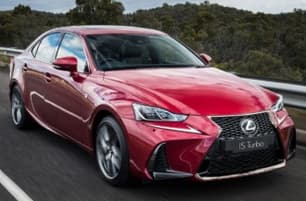
Peter Anderson road tests and reviews the new Lexus IS200t F Sport with specs, fuel consumption and verdict.
Long ago, the Lexus IS overtook the LS as the most recognisable Lexus on the road. With strong, angular styling, sharp pricing and spec against the Germans, and a 2.0-litre straight six engine, it seems like Lexus sold a million of them and only one of them has broken down irretrievably and is now being used to prop up the Harbour Bridge, such was its solid build quality.
Hell, Lexus was even able to hide for a while that it was a rebadged Japanese Toyota Altezza, partly because Toyota didn't do funky rear-wheel drive sedans outside of Japan. The IS took the brand into many more homes than the ES or GS could ever hope to because it looked like it was a Lexus.
We're now three generations and one facelift into the IS and the big selling IS250 is no more, replaced some time ago by a 2.0-litre turbo four and renamed IS200t. You can now get an F Sport version, too, just like you can buy an Audi with S Line or a BMW with M Sport.
That turbo engine hopefully addresses one of the problems with the entry-level IS sedan - it was always a little on the slow side...
The sixth-generation of Subaru’s Forester has landed and while the new hybrid versions constitute the biggest news of this batch, the petrol-only variants should not be ignored.
The five-seat mid-size SUV has a 2.5-litre four-cylinder 'boxer' engine, Subaru’s well-regarded 'symmetrical all-wheel drive' system and some new changes inside and out.
So, does the top-spec Touring offer the best value-for-money in the petrol Forester line-up?
Read on.
The Lexus range comes with a four year/100,000km warranty with roadside assist for the duration. Servicing is every 15,000km or twelve months, whichever comes first.
Sadly, there's no fixed or capped-price servicing regime, not even a pre-pay option like the stingy Germans. Lexus will only commit to indicative pricing, although the first service at 15,000km is priced keenly - it's free.
When you buy a Lexus, they don't like to let go of you. My father-in-law's original IS 200 is still fetched by the dealership - should he so desire - for its annual service. If he chooses to darken the dealership door himself, he'll drive out in a loan car. Nobody has ever stalked him at the dealership demanding he consider a new one.
The IS200t seems the pick of the IS bunch, despite pricing on par with a couple of the IS350s. It's a worthy alternative to the usual suspects, with its own look, feel and approach to luxury motoring. In fact, it's far more a luxury car than sports sedan, but manages to do both well. In the end, a BMW will edge it for handling and overall chassis grace, the Merc has that badge and the Audi is all-wheel drive and bang-up-to-date.
But none of them can touch the Lexus for after-sales service nor are any of them quite as well put together as the Japanese-built IS. It may not be as fast or as fun, but it's very, very good.
The MY26 Subaru Forester packs plenty of punch in terms of standard features, a roomy and functional interior and overall driveability. Sure, it’s not the most exciting vehicle to drive on- or off-road but to get stuck on that is to miss the point entirely. This is a decent all-rounder with a solid background and an AWD system that long ago set the gold standard for vehicles of this type.
In a tough mid-size SUV market segment aimed more at those intent on driving through car parks rather than adventuring through national parks, the Forester offers greater versatility than most and should not be ignored.
The current IS is by far the most distinctive of the three generations. With a couple of exceptions, it is a terrific looking car. It looks long and low slung, like the best sporting sedans, with an almost Maserati-like approach to its proportions. The loud and proud Lexus spindle grille - the object of such derision when it first arrived - looks utterly fantastic and draws attention away from the odd, squished headlights.
it is one of most comfortable cars you can buy, for both front and (short) rear seat passengers.
Inside is less impressive, with a weird stacked dash and integrated screen. The materials are top notch, however and while the designers have tried to do something interesting with the dash design, there are better ideas out there they might want to consider next time around.
This Forester is 4655mm long (with a 2670mm wheelbase), 1830mm wide and 1730mm high.
The new generation retains more than enough of the previous Forester – blocky profile included – to remain clearly recognisable.
Traditionalists may chafe at the slicker, more citified appearance of this Forester over previous generations but the overall package is inoffensive enough to not elicit any howls of outrage from passers-by on the street.
The Forester’s interior maintains a similar cabin look and feel as before but with a 11.6-inch portrait-oriented multimedia touchscreen dominating up front, a mix of physical and on-screen buttons, as well as soft-touch surfaces and durable plastics.
The IS's cabin is probably the weakest point of the car, with limited storage for your bits and bobs. Front and rear seat passengers do get cupholders for a total of four, but the rear doors don't have bottle holders, limiting you to the two upfront.
On hot days like Sydney's 2017 summer, those cooled seats are heaven-sent.
The centre console bin is small and is the only place for your phone apart from the cupholders, which isn't an ideal spot, let's face it. The boot is a German-matching 480 litres and you can split fold the seats for more room.
Having said that, it is one of most comfortable cars you can buy, for both front and (short) rear seat passengers. The front seats are especially good and on hot days like Sydney's 2017 summer, those cooled seats are heaven-sent.
The Forester is quite roomy for a mid-size SUV and this is the top-spec variant so there’s leather everywhere.
The interior layout is neat and tidy and lands firmly on the correct side of being practical and familiar, with all controls easy to locate and operate.
The touchscreen offers mostly simple intuitive functionality with infrequent need to cycle through numerous menus and sub-menus to access what you want.
The aforementioned mix of physical and on-screen buttons, as well as soft-touch surfaces and durable plastic are welcome here because, you know... real life.
The front seats offer ample support and the driver is able to dial-in their preferred position via power controls on the eight-way power-adjustable seat (with dual memory). The front passenger has an eight-way power-adjustable seat. Both seats are heated and ventilated.
The 60/40 split folding second-row seats aren’t too shabby either, in terms of comfort and amenities, with a fold-down arm-rest with cupholders and directional air vents etc.
Cargo volume is 496 litres (with rear seat in use) and 1174 litres (with the rear seat down, 1667 litres to ceiling.
The tailgate is powered and hands-free with a kick sensor (apparently). But I never tried that, instead opting for the tailgate-mounted button to open and close it.
The IS range kicks off with the 200t Luxury at $59,340, closely followed by the hybrid 300h, the V6-powered 350 ($65,390) and then the $73,540 200t F Sport. Pricing then heads up into the mid-$80,000s for the IS350 Sports Luxury.
The 200t F Sport's almost $74,000 price tag fetches you a car with 18-inch alloys, dual-zone climate control, reversing camera, front and rear parking sensors, a hefty safety package, electronic dampers, auto LED headlights, auto wipers, electric heated and cooled front seats, digital instruments, sat nav, keyless entry and start, leather (some real, some not) interior, variable ratio steering rack and power everything.
The 10-speaker stereo is Mark Levinson branded and is controlled by Lexus' own connectivity and sat nav suite. The sound is fantastic, the control system less so. Commands come from a few shortcut buttons (good) and weird mouse-type arrangement on the centre console that is largely infuriating. The less said about the on-screen graphics, the better - they're low-res and on occasions, amateurish. You can connect via USB or Bluetooth but the app integration is limited. You also get an at-first unfathomable DAB+ radio.
Once on boost, the engine is smooth with a lovely flat torque curve.
Options are limited to $1500 for premium paint, which makes up eight out of ten colours.
Out of interest, $74,000 gets you a reasonably well equipped BMW 330i M Sport or Luxury Line and a few hundred dollars more will get you into a hybrid 330e M Sport. Audi will cheerfully sell you a loaded-up A4 quattro 2.0 TFSI and Mercedes might be tempted to sell you a C350e. Infiniti will probably throw themselves at you with a V6 twin-turbo Q50 Red Sport rocketship, or at the very least a V6 Hybrid Premium.
The Forester AWD Touring (petrol) is priced at $50,990 MLP while its hybrid sibling is $55,990.
Standard features include an 11.6-inch multimedia touchscreen (with wireless Android Auto and Apple CarPlay), 18-inch alloy wheels, auto LED headlights, dual-zone climate, heated front seats and electric folding rear seats as well as a wireless phone charger.
Top-grade additions include a sunroof, low-profile roof rails, a digital driver display, leather-accented seats, a leather auto-shifter, ventilated front seats and a 10-speaker Harman Kardon audio system.
It also has power-adjustable front seats, sat-nav, auto-dipping and folding door mirrors and a hands-free tailgate.
Exterior paint choices include 'Crystal White Pearl', 'Ice Silver Metallic', 'Magnetite Grey Metallic', 'Crystal Black Silica', 'Crimson Red Pearl', 'Brilliant Bronze Metallic', 'Daybreak Blue Pearl', 'Sapphire Blue Pearl', 'Cashmere Gold Opal', 'Autumn Green Metallic' and 'River Rock Pearl'.
The 200t denotes a 2.0-litre turbocharged four-cylinder under that long bonnet, delivering 180kW and 350Nm to the rear wheels via an eight-speed automatic transmission. This translates to seven seconds dead to 100km/h for the 1680kg sedan, which isn't hanging around.
The Forester has the line-up’s 2.5-litre four-cylinder naturally aspirated boxer engine (producing 136kW at 5800rpm and 247Nm at 3700rpm) matched to a constantly variable transmission (CVT), which some people detest, and some people couldn’t give a rat’s whether it’s there or not.
Also onboard is Subaru’s all-wheel drive system, driving modes (including 'Normal', 'Deep snow/Mud', and 'Snow/Dirt') and 'X-Mode' “that constantly monitors the traction available to each wheel and centralises the control of key components including the engine, transmission, drivetrain and brakes to help manage slippery conditions”, according to Subaru.
Try as we might - and we did - we couldn't get at all close to the claimed combined fuel figure of 7.5L/100km. We didn't even hit the standard plus 30%, but we did get 12.2L/100km. That's a fairly solid miss.
Official fuel consumption on the combined (urban/extra-urban) cycle for the Forester is 7.9L/100km and it uses 91RON 'standard' unleaded petrol at a minimum.
On this test, I recorded 8.1L/100km. But fuel consumption was as low as a dash-indicated 1.7L/100km while driving the Forester with adaptive cruise control engaged.
The Forester has a 63-litre fuel tank, so, going by our on-test fuel-use figures you could reasonably expect a driving range of almost 780km from a full tank. However, as with any vehicle, once you’ve loaded the Forester with any real-world burdens (e.g kids, dogs, camping gear, etc) you’ll soon see the fuel consumption increase.
After having the good fortune to step out of the IS350 and into the 200t, it was immediately apparent that the 200 is the better car. For a start, it feels so much more nimble. Sure, it doesn't have the seamless urge of that silky V6, but the 2.0 turbo does a fine impression of a bigger engine. Once on boost, the engine is smooth with a lovely flat torque curve. If you're off boost, though, you're in a bit of trouble - the eight-speed is reluctant to downshift and needed prodding from the steering wheel mounted paddles on occasion.
As with just about every Lexus, the ride is impeccable and refinement virtually unmatched in the class.
From a driving point of view, the fundamentals are better - less weight over the front wheels meaning the steering feels better, it turns in better and it moves more fluidly, which is impressive because the 350 isn't a slouch. Even the dashboard is better. The 350 has a traditional two clock arrangement where the 200t has a single dial in the middle that is digitally remastered. Press a button and it slides to the side to provide extra info on your choice of the available data. It leaves a fair amount of black space but it's easier to read and doesn't suffer as badly from reflections.
As with just about every Lexus, the ride is impeccable and refinement virtually unmatched in the class. There's something about the way a Lexus knocks the edge of all but the biggest bumps, sails over speed bumps and handles imperfections that is hard to beat and hard to find unless you're spending really big bucks. The adaptive damping never feels like it's doing anything which is exactly the point - even when switching to Sport+, there's an ease to the ride without it feeling loose.
You'll barely know the engine is there, and the way the transmission slurs around the gears means non-stop serenity.
The Forester feels comfortable and composed on sealed surfaces and offers some degree of dynamism to the driving experience – so in line with previous generations.
It feels more refined, sharper to steer and more responsive than before. There’s ample visibility to the front but a substantial B pillar obscures the driver’s vision back over their right shoulder.
The Boxer engine and CVT work well together, power and torque outputs are more than adequate in this package, and that much-maligned transmission is not intrusive if the Forester is driven with care and common sense.
However, acceleration from a full stop is sluggish.
The suspension set-up – MacPherson struts up front and double wishbones at the rear – yields a firm but not jarring sense of ride and handling.
The 1662kg Forester proved nimble to manoeuvre around the Big Smoke, the suburbs and in the bush (more about that soon) with a neat 10.8m turning circle.
All-wheel drive vehicles are capable of tackling off-road adventures in their own right but, for safety’s sake, AWD drivers should avoid anything beyond well-maintained dirt tracks in dry weather. AWD cars are designed for use on bitumen roads with some dirt or light-duty off-road use.
And so it was with our test of this Forester. On-test off-road terrain equalled firm-packed sand and gravel/dirt bush tracks in dry weather, although we did drive through one shin-deep mudhole with no trouble.
The Forester has a listed 220mm of ground clearance, the suspension held up well over a brief stint on mild corrugations and Subaru AWD proved more than up to the task when things became a little trickier, providing improved grip and traction in slippery conditions that demanded to be driven at very low speeds.
If push comes to shove, it’s capable of more than light off-roading, but the Forester’s ground clearance and off-road angles ultimately limit its off-road capabilities.
The Forester’s 'all season' tyres – Falken Ziex Z001A A/S (225/55 R18 98V) – are fine for light to moderate off-roading but anything more difficult than that and you’ll need to get a set of more aggressive all-terrain tyres. It does have a full-sized spare onboard.
It has maximum towing capacities of 750kg (unbraked trailer), 1800kg (braked) and a maximum towball download of 180kg. GVM is 2223kg; GCM is 4023kg.
Some niggles: The driver awareness system is annoyingly over-reactive.
Standard safety kit includes eight airbags (including knee bags for front seat occupants), ABS, stability and traction controls, blind spot sensor, lane departure warning, rear cross traffic alert, brake assist and driver attention detection.
The IS scored the maximum available five ANCAP stars when it was re-tested in October 2016.
The Forester has the maximum five-star ANCAP safety rating from testing in 2024.
It has nine airbags (dual front, dual front side, dual curtain, driver’s knee, far side and front passenger seat cushion), adaptive cruise control, emergency lane-keep and centring (with departure warnings), pre-collision braking, auto emergency steering, a 360-degree view monitor system, and a driver monitoring system which includes a ‘safe stop’ feature that – if the vehicle detects that the driver is non-responsive – will bring the vehicle to a gradual, you guessed it, safe stop.
The Lexus range comes with a four year/100,000km warranty with roadside assist for the duration. Servicing is every 15,000km or twelve months, whichever comes first.
Sadly, there's no fixed or capped-price servicing regime, not even a pre-pay option like the stingy Germans. Lexus will only commit to indicative pricing, although the first service at 15,000km is priced keenly - it's free.
When you buy a Lexus, they don't like to let go of you. My father-in-law's original IS 200 is still fetched by the dealership - should he so desire - for its annual service. If he chooses to darken the dealership door himself, he'll drive out in a loan car. Nobody has ever stalked him at the dealership demanding he consider a new one.
The MY26 Subaru range is covered by a five-year/unlimited kilometre warranty, five-year/75,000km capped price servicing, and 12 months roadside assistance.
A service is required every 12 months or 15,000km, whichever occurs soonest. After your free “1 Month Health Check and Chat”, cost per service is $347.95 (at the 15,000km/12 month mark), $520.45 (30,000km or 24 months), $393.10 (45,000km or 36 months), $679.30 (60,000km or 48 months) and $358.20 (75,000km or 60 months). Average over the five years is $459.80.
Subaru Australia has more than 140 dealerships across the country with a decent spread over metro and regional areas. Foresters may be serviced at those dealers or by approved mechanics.