What's the difference?
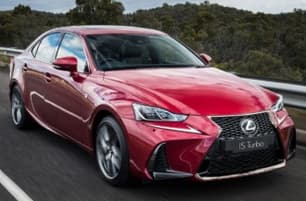
Peter Anderson road tests and reviews the new Lexus IS200t F Sport with specs, fuel consumption and verdict.
Long ago, the Lexus IS overtook the LS as the most recognisable Lexus on the road. With strong, angular styling, sharp pricing and spec against the Germans, and a 2.0-litre straight six engine, it seems like Lexus sold a million of them and only one of them has broken down irretrievably and is now being used to prop up the Harbour Bridge, such was its solid build quality.
Hell, Lexus was even able to hide for a while that it was a rebadged Japanese Toyota Altezza, partly because Toyota didn't do funky rear-wheel drive sedans outside of Japan. The IS took the brand into many more homes than the ES or GS could ever hope to because it looked like it was a Lexus.
We're now three generations and one facelift into the IS and the big selling IS250 is no more, replaced some time ago by a 2.0-litre turbo four and renamed IS200t. You can now get an F Sport version, too, just like you can buy an Audi with S Line or a BMW with M Sport.
That turbo engine hopefully addresses one of the problems with the entry-level IS sedan - it was always a little on the slow side...
One question frequently discussed in the skunkworks of the CarsGuide office is: What exactly does Lexus stand for?
When the brand debuted its original export-market IS sedan in 1999 the messaging was more or less clear: Toyota’s premium sub-brand was here to be a Japanese BMW.
The brand even employed Nobuaki Katayama – chief engineer on the iconic Corolla AE86 program – to again take the reins of its small rear-wheel drive sedan program.
As the years went on though, Lexus changed. Fundamentally geared toward the US market, the second-generation (wild IS F aside) became a bit more sedate and softer around the edges, while the third generation strayed even further from the sedan’s performance-inspired roots, leaning into a plush interior, hybrid drive, and even CVT transmissions.
This brings us to today’s Lexus IS. Essentially a heavy facelift of the third generation (which arrived back in 2013), the brand has “reimagined” its core sedan with a tweaked design and updated technology for 2021.
Is it enough to keep it relevant against its ever-present European rivals and the newly arrived threat from Hyundai’s Genesis G70? I took a signature IS300h hybrid for a week to find out.
The Lexus range comes with a four year/100,000km warranty with roadside assist for the duration. Servicing is every 15,000km or twelve months, whichever comes first.
Sadly, there's no fixed or capped-price servicing regime, not even a pre-pay option like the stingy Germans. Lexus will only commit to indicative pricing, although the first service at 15,000km is priced keenly - it's free.
When you buy a Lexus, they don't like to let go of you. My father-in-law's original IS 200 is still fetched by the dealership - should he so desire - for its annual service. If he chooses to darken the dealership door himself, he'll drive out in a loan car. Nobody has ever stalked him at the dealership demanding he consider a new one.
The IS200t seems the pick of the IS bunch, despite pricing on par with a couple of the IS350s. It's a worthy alternative to the usual suspects, with its own look, feel and approach to luxury motoring. In fact, it's far more a luxury car than sports sedan, but manages to do both well. In the end, a BMW will edge it for handling and overall chassis grace, the Merc has that badge and the Audi is all-wheel drive and bang-up-to-date.
But none of them can touch the Lexus for after-sales service nor are any of them quite as well put together as the Japanese-built IS. It may not be as fast or as fun, but it's very, very good.
Smooth, cosy, quiet, the IS looks and feels better than ever, but without a doubt this hybrid version is a car best suited to cruising the dense metropolis of Chiba at midnight more than it is carving up a bunch of S-bends in the Australian countryside on the weekend.
While that might still limit its appeal for fans of German sports luxury sedans and place it further from the original ISβs ambitions, it does offer an intriguing efficiency and luxury focused alternative, without the compromises brought by rivals with more sporting intent. In a way then, the IS 300h perhaps inadvertently best embodies what Lexus is as a brand.